TR
TR EN
EN

What Are the Differences Between Fuel Injection and Carburetor Systems?
Gasoline engines have used different methods to deliver fuel to the combustion chamber throughout automotive history. Two of the most important technologies are carburetor systems and fuel injection systems.
Carburetors were used for decades and powered countless vehicles before electronic fuel injection became widespread. Fuel injection eventually replaced carburetors in most modern vehicles because it provides much more precise control over fuel delivery, emissions, cold starting, and engine operation.
However, the difference is not simply that one system is “mechanical” and the other is “electronic.” There are several types of fuel injection, including mechanical continuous injection, throttle-body injection, multi-point injection, sequential injection, and direct injection.
How Does a Carburetor System Work?
A carburetor creates the air-fuel mixture before the mixture enters the engine's cylinders.
As the engine draws air through the carburetor, the air passes through a narrowed section called a venturi. The increased air velocity in this area creates a pressure difference that draws gasoline from the fuel circuit into the incoming air.
The resulting air-fuel mixture then travels through the intake manifold and enters the cylinders.
A simplified process is:
Airflow → Venturi effect → Fuel drawn into airflow → Air-fuel mixture → Engine
A typical carburetor can contain a float chamber, jets, venturi passages, throttle plates, idle circuits, accelerator pumps, and a choke or enrichment mechanism.
The exact design varies considerably between carburetors.
How Does a Fuel Injection System Work?
A fuel injection system delivers gasoline through one or more injectors.
In modern electronically controlled systems, the ECU uses information from various sensors to determine how much fuel the engine requires.
Depending on the system, the ECU may consider:
-
Engine speed
-
Engine coolant temperature
-
Air mass or manifold pressure
-
Throttle position
-
Oxygen sensor feedback
-
Intake air temperature
-
Engine load
-
Crankshaft position
-
Camshaft position
The ECU then controls the injectors to deliver the required amount of fuel.
A simplified process is:
Sensors → ECU → Fuel calculation → Injector control → Engine
This allows fuel delivery to change rapidly according to the engine's operating conditions.
The Fundamental Difference in Fuel Control
The most important difference between the two technologies is how the amount of fuel is determined.
A carburetor relies primarily on mechanical airflow and pressure differences to meter fuel.
An electronic fuel injection system uses electronically controlled injectors and an ECU to determine how much fuel is delivered.
This gives electronic injection considerably greater control over the air-fuel mixture under different operating conditions.
However, not every fuel injection system works electronically. Bosch K-Jetronic, for example, is a mechanical continuous fuel injection system. It uses mechanical airflow measurement and hydraulic fuel metering rather than modern electronic injector pulse control.
Fuel Consumption
Fuel injection generally provides better fuel economy than a comparable carburetor system because fuel delivery can be controlled more precisely.
A carburetor must use mechanical circuits and calibration to accommodate different engine conditions. It can work very well when properly designed and adjusted, but it has less ability to continuously adapt.
Electronic injection can adjust fuel delivery according to conditions such as:
-
Engine load
-
Engine speed
-
Coolant temperature
-
Airflow
-
Throttle position
-
Exhaust oxygen content
Fuel can also be reduced or cut under certain conditions, such as some forms of deceleration fuel cut-off.
This does not mean that every fuel-injected vehicle automatically consumes less fuel than every carbureted vehicle. Engine design, vehicle weight, gearing, driving style, and overall condition also have a major effect.
Cold Starting
Cold starting is another major difference.
Gasoline does not vaporize as easily when the engine is cold. A richer mixture may therefore be required during cold operation.
Carbureted vehicles commonly use a choke or another enrichment mechanism to increase the amount of fuel in the mixture during cold starting.
The driver of an older vehicle may have to operate the choke manually, although many carburetors use automatic choke mechanisms.
Fuel-injected engines can instead use coolant-temperature and intake-air information to determine how much additional fuel is required.
The ECU can progressively reduce enrichment as the engine warms up.
This makes cold starting much more consistent and eliminates the need for manual choke operation in modern systems.
Engine Performance
A properly tuned carburetor can provide excellent performance, particularly on older or performance-oriented engines.
However, fuel injection generally provides better control when engine operating conditions change rapidly.
During acceleration, for example, an electronic injection system can modify fuel delivery almost immediately according to sensor information and programmed control strategies.
Fuel injection also makes it easier to maintain an appropriate mixture across a wide range of:
-
Engine speeds
-
Loads
-
Temperatures
-
Altitudes
-
Driving conditions
This contributes to more consistent engine behavior.
Throttle Response
Carburetor throttle response depends on the design of the carburetor and its mechanical circuits.
When the throttle is opened rapidly, the airflow changes before the fuel system can respond in exactly the same way. Carburetors therefore often use an accelerator pump to provide additional fuel during sudden throttle opening.
Fuel injection can control additional fuel electronically and respond to rapid changes in throttle position and engine load.
Modern systems can therefore provide very precise transient fuel control.
Nevertheless, throttle response still depends on the engine, calibration, throttle design, intake system, and overall condition. Fuel injection alone does not guarantee better performance.
Idle Control
Carbureted engines typically control idle through a dedicated idle circuit and mechanical adjustments.
The idle speed may be affected by:
-
Mixture adjustment
-
Idle-speed screw
-
Vacuum leaks
-
Choke operation
-
Carburetor contamination
-
Mechanical wear
-
Ignition timing
Fuel-injected engines use different strategies.
Older fuel-injected vehicles may use an idle air control valve, while many modern vehicles use an electronically controlled throttle body to regulate idle speed.
The ECU can continuously adjust the system to compensate for changes in engine load, such as switching on the air conditioning or electrical accessories.
Emissions
Emissions control was one of the major reasons fuel injection became increasingly important.
A carburetor can be calibrated to provide an appropriate mixture, but maintaining precise control across every operating condition is difficult.
Electronic fuel injection can continuously modify fuel delivery according to sensor information.
When combined with a catalytic converter and oxygen-sensor feedback, the system can maintain the air-fuel mixture within the range required for effective emissions control during appropriate operating conditions.
Modern vehicles may also use:
-
EGR
-
EVAP systems
-
Catalytic converters
-
Oxygen sensors
-
Exhaust gas temperature sensors
-
Diesel particulate filters on diesel engines
-
Gasoline particulate filters on some gasoline direct-injection engines
-
Other emissions-control technologies
Therefore, modern emissions performance comes from the entire engine and emissions-control system, not simply from the presence of fuel injection.
Operation at High Altitude
Air density decreases as altitude increases.
This can affect carbureted engines because the carburetor's fuel metering is fundamentally related to pressure differences and airflow.
Older carbureted vehicles may therefore run differently at high altitude and may require adjustments depending on the carburetor design.
Electronic fuel injection can compensate more effectively for changes in air density because the ECU receives information from sensors such as a MAP sensor or MAF sensor.
This allows the system to adjust fuel delivery to changing operating conditions.
The exact level of compensation depends on the particular engine-management system.
Maintenance and Adjustment
Carburetors are mechanically complex but conceptually straightforward.
Typical maintenance can include:
-
Cleaning the carburetor
-
Checking jets
-
Checking the float and float level
-
Inspecting the choke
-
Adjusting idle speed
-
Adjusting mixture where applicable
-
Inspecting vacuum connections
-
Checking accelerator-pump operation
Fuel injection systems require a different approach.
Possible maintenance and diagnostic checks include:
-
Fuel pressure
-
Fuel pump operation
-
Injector condition
-
Sensor operation
-
Wiring and connectors
-
ECU operation
-
Throttle body condition
-
Intake leaks
-
Fuel trims
-
Oxygen sensor operation
Modern injection systems generally require less routine adjustment because the ECU continuously manages many parameters.
Diagnosis of Carburetor Problems
Carburetor diagnosis is primarily mechanical.
If an engine is difficult to start, the technician may check:
Is there fuel? → Is fuel reaching the carburetor? → Is the float system working? → Is the mixture correct? → Is there sufficient airflow? → Is the ignition system working?
Vacuum leaks are also important.
A leak in the intake system can introduce unmetered air and create a lean mixture.
Smoke testing or other appropriate methods can be useful for finding intake leaks. Spraying flammable chemicals around a running engine is not a recommended general diagnostic method because of the fire risk.
Diagnosis of Fuel Injection Problems
Fuel injection diagnosis combines mechanical, electrical, and electronic testing.
A technician may inspect:
-
Fuel pressure
-
Fuel volume
-
Injector operation
-
Injector electrical signals
-
Sensor readings
-
Fuel trims
-
Throttle position
-
Airflow or manifold pressure
-
Oxygen sensor data
-
ECU power and grounds
-
Wiring and connectors
-
Communication between control modules
Modern vehicles also provide OBD diagnostic information.
However, an OBD trouble code does not automatically prove that the named sensor or component has failed.
For example, a sensor-related code may be caused by the sensor itself, wiring, a connector, an electrical supply problem, an air leak, fuel-system problems, or another condition affecting the sensor's readings.
Proper diagnosis should identify the cause rather than simply replacing the component named by the code.
Fuel Distribution Between Cylinders
Another important difference is how fuel reaches individual cylinders.
A carburetor usually creates the mixture centrally, after which the mixture travels through the intake manifold.
The distribution of the mixture can therefore be affected by intake-manifold design and airflow characteristics.
Fuel injection can place the injectors much closer to the individual cylinders.
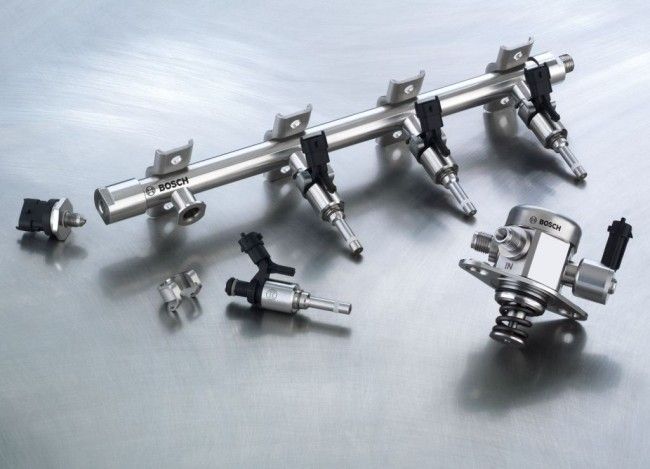
In multi-point fuel injection (MPI), each cylinder generally has its own injector located near its intake port.
This allows more precise fuel distribution between cylinders.
In direct injection, the fuel is injected directly into the combustion chamber. These systems operate at much higher fuel pressures and provide additional control over how fuel is introduced into the cylinder.
Types of Fuel Injection
Fuel injection is not a single technology.
Single-point or throttle-body injection (TBI) uses one or more injectors near the throttle body. It was used as a transitional technology between carburetors and more advanced multi-point systems.
Multi-point fuel injection (MPI) normally uses an injector for each cylinder near the intake port.
Sequential fuel injection controls injector operation according to engine position and operating conditions, allowing more precise fuel delivery.
Mechanical continuous injection, such as K-Jetronic, uses mechanical and hydraulic principles rather than modern electronic injector pulse control.
Gasoline direct injection (GDI) sprays gasoline directly into the combustion chamber and generally uses a high-pressure fuel system.
Each type has different advantages, limitations, and diagnostic requirements.
Mechanical Injection as a Transition Technology
Mechanical injection systems such as Bosch K-Jetronic occupy an interesting position in automotive history.
They are not carburetors, even though they rely heavily on mechanical components.
K-Jetronic continuously supplies fuel through mechanical injectors and uses a mechanically operated airflow sensor and fuel distributor.
Later systems such as KE-Jetronic introduced more electronic control.
This development eventually led toward the highly sophisticated electronic engine-management systems used today.
The evolution can be broadly represented as:
Carburetor → Mechanical fuel injection → Electronic fuel injection → Multi-point/sequential injection → Direct injection
The exact development path varied between manufacturers and engine families.
Advantages of Carburetor Systems
Carburetors have several characteristics that made them successful for many decades.
Simple electronic requirements
A basic carburetor can operate without an ECU or complex electronic control system.
Mechanical operation
Many adjustments can be understood and performed mechanically.
Classic vehicle compatibility
For historically correct restoration, retaining the original carburetor may be important.
Easy basic operation
A mechanically experienced technician can often understand the basic fuel and airflow circuits without electronic diagnostic equipment.
Disadvantages of Carburetor Systems
Despite their long history, carburetors have several limitations compared with modern injection systems.
-
Less precise fuel metering.
-
More sensitivity to temperature and altitude.
-
More difficult cold starting on some applications.
-
Greater dependence on mechanical adjustment.
-
Less sophisticated emissions control.
-
Potentially higher fuel consumption.
-
Mechanical wear can alter calibration.
-
Fuel distribution between cylinders may be less precise.
-
Vacuum and carburetor problems can significantly affect engine operation.
Advantages of Fuel Injection
Fuel injection became dominant because it offers much greater control over engine operation.
Major advantages include:
-
Precise fuel metering.
-
Improved cold starting.
-
Better control of air-fuel ratio.
-
More consistent operation under changing conditions.
-
Better emissions control.
-
Potentially improved fuel economy.
-
Excellent compatibility with turbocharged engines.
-
Better cylinder-to-cylinder fuel control in multi-point systems.
-
Advanced diagnostic capabilities in electronically controlled systems.
Modern fuel injection is also essential for many technologies that would be extremely difficult to implement effectively with a conventional carburetor.
Disadvantages of Fuel Injection
Fuel injection is not necessarily simpler.
Modern systems may contain numerous sensors, actuators, electrical circuits, control modules, and high-pressure components.
A fault may involve:
-
Injector
-
Fuel pump
-
Fuel-pressure regulator
-
Sensor
-
Wiring
-
Connector
-
Throttle body
-
ECU
-
CAN communication
-
Intake system
-
Mechanical engine condition
This makes diagnosis more dependent on appropriate equipment and technical knowledge.
High-pressure gasoline direct-injection systems require additional safety precautions because fuel pressure can be extremely high.
Which System Is Better?
For a modern vehicle used every day, fuel injection is generally the superior technology.
It provides better control of fuel delivery, easier cold starting, better emissions management, and better adaptation to changing operating conditions.
However, this does not mean carburetors are useless or inherently poor.
A properly maintained and correctly adjusted carburetor can work extremely well. It remains particularly relevant to classic vehicles, historic restorations, and enthusiasts who want to preserve the original character of an older engine.
The appropriate system therefore depends on the vehicle and its intended use.
Can a Carbureted Engine Be Converted to Fuel Injection?
In some engines, a carburetor-to-fuel-injection conversion is technically possible.
However, it is much more involved than simply installing injectors.
Depending on the engine, the conversion may require:
-
Fuel injectors
-
Fuel rail
-
High-pressure fuel pump
-
Fuel-pressure control
-
ECU
-
Engine sensors
-
Wiring harness
-
Throttle body
-
Intake-system modifications
-
Crankshaft or camshaft position sensing
-
Appropriate ignition control
-
Return or returnless fuel-system components
The fuel tank and fuel lines may also need to be modified to provide the pressure and flow required by the injection system.
The cost and complexity depend heavily on the engine and the type of injection system selected.
Carburetor vs. Fuel Injection in Older Cars
When working on a classic car, replacing a carburetor with modern fuel injection is not always automatically the best choice.
A conversion can improve starting, fuel control, drivability, and potentially fuel economy. However, it can also reduce originality and introduce additional electronic components.
For a historically accurate restoration, keeping the original carburetor may be preferable.
For a vehicle intended for frequent driving, a well-designed fuel-injection conversion may provide practical advantages.
The decision should therefore consider reliability, originality, cost, performance goals, parts availability, and the intended use of the vehicle.
Why Did Fuel Injection Replace Carburetors?
The transition from carburetors to fuel injection was driven by several factors rather than a single technological advantage.
As emission regulations became stricter, manufacturers needed more precise control over combustion.
At the same time, customers expected:
-
Better fuel economy
-
Easier starting
-
Improved drivability
-
More consistent performance
-
Better operation in different climates and altitudes
Electronic engine management made it possible to combine fuel control with ignition timing, emissions systems, turbocharger control, variable valve timing, and many other functions.
This level of integration would be extremely difficult to achieve with a traditional carburetor.
The Difference in Modern Automotive Technology
The difference between carburetors and fuel injection represents one of the most important transitions in gasoline-engine technology.
The carburetor relies mainly on mechanical airflow and pressure differences to create the air-fuel mixture.
Fuel injection allows fuel to be delivered much more precisely, with modern electronic systems using sensor information and ECU calculations to control the quantity and timing of fuel delivery.
Mechanical injection systems such as K-Jetronic played an important role in the transition, while modern multi-point and direct-injection systems have taken fuel control considerably further.
For today's vehicles, electronic fuel injection is the standard because it provides the level of precision required for modern performance, fuel economy, emissions, and drivability requirements. Carburetors, meanwhile, remain an important part of automotive history and continue to have a place in classic and enthusiast vehicles.