TR
TR EN
EN

What Is a MAP Sensor? How Does It Work? What Are the Symptoms of MAP Sensor Failure?
The MAP sensor is one of the key sensors used by an engine control unit to understand the engine's air load. MAP stands for Manifold Absolute Pressure, meaning the sensor measures the absolute pressure inside the intake manifold.
Although the MAP sensor is a relatively small component, the information it provides can influence fuel injection, ignition timing, turbocharger control, EGR operation, idle control and overall engine performance.
When the MAP sensor reports an incorrect pressure value, the ECU may calculate the engine load incorrectly. This can result in poor fuel mixture control, hesitation, rough running, excessive fuel consumption, reduced power or difficulty starting.
A MAP sensor problem does not always mean that the sensor itself is defective. Vacuum leaks, damaged hoses, wiring problems, connector corrosion, intake contamination and electrical reference-voltage problems can create very similar symptoms.
Understanding what the MAP sensor measures and how the ECU interprets its signal is therefore important when diagnosing an engine performance problem.
What Does MAP Mean?
MAP stands for Manifold Absolute Pressure.
The word "absolute" is important.
A MAP sensor does not simply measure vacuum in the traditional sense. It measures the pressure inside the intake manifold relative to an absolute vacuum reference.
At atmospheric pressure, the intake manifold pressure is relatively high.
When the throttle closes while the engine is running, the pistons continue drawing against the restricted intake path. Manifold pressure then drops substantially below atmospheric pressure.
When the throttle opens and the engine receives more air, manifold pressure generally rises toward atmospheric pressure on a naturally aspirated engine.
On a turbocharged or supercharged engine, manifold pressure can rise above atmospheric pressure because the intake air is being pressurized.
Where Is the MAP Sensor Located?
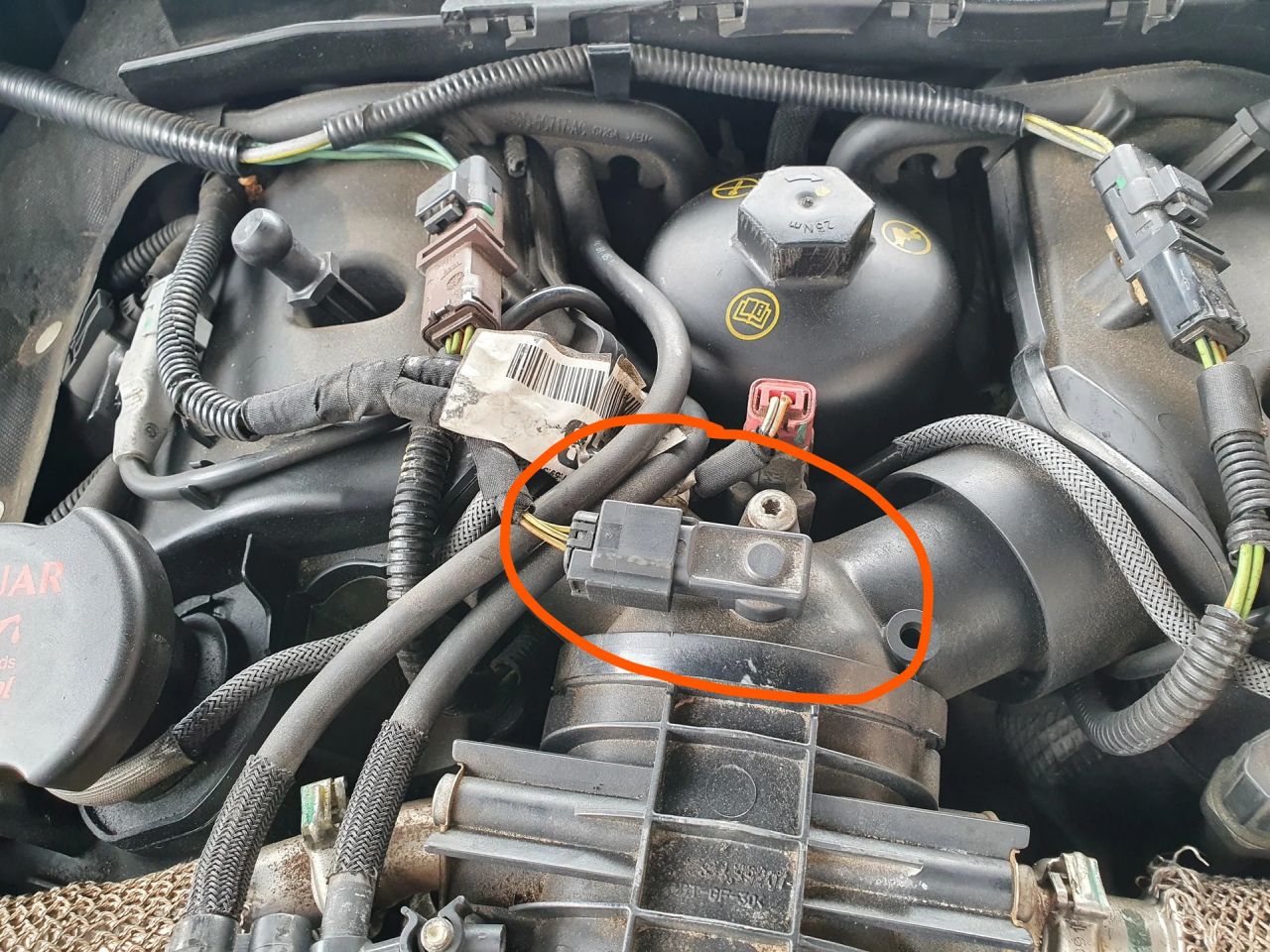
The MAP sensor is usually installed directly on the intake manifold or connected to it through a short pressure passage or hose.
Its exact location varies according to engine design.
Some engines have the sensor mounted directly on the intake manifold.
Others use a remote sensor connected through a vacuum or pressure hose.
Turbocharged engines may have multiple pressure sensors in different parts of the intake and charge-air system, so it is important not to confuse the MAP sensor with another pressure sensor.
What Does a MAP Sensor Measure?
The primary measurement is intake manifold absolute pressure.
The ECU can use this information to estimate how much air is entering the engine and therefore determine engine load.
MAP data can be combined with information from other sensors, such as:
-
Engine speed
-
Throttle position
-
Intake air temperature
-
Oxygen or air-fuel ratio sensors
-
Coolant temperature
-
Mass airflow
-
Barometric pressure
The ECU uses these signals together rather than relying on the MAP sensor alone.
How Does a MAP Sensor Work?
Most automotive MAP sensors use a pressure-sensitive semiconductor element.
Inside the sensor is a sensing element whose electrical characteristics change as pressure changes.
The sensor receives an electrical supply from the ECU, usually including a reference voltage and ground.
As manifold pressure changes, the sensor produces a corresponding output voltage or signal.
The ECU reads this signal and converts it into a pressure value.
In simplified form:
Manifold pressure changes → sensing element responds → electrical signal changes → ECU interprets pressure → engine control parameters are adjusted
The exact signal characteristics depend on the sensor and vehicle manufacturer.
What Is the Relationship Between MAP Sensor Voltage and Engine Load?
In many conventional analog MAP sensors, the output voltage generally increases as manifold absolute pressure increases.
For example, during a high-vacuum idle condition, the sensor output may be relatively low.
When the throttle is opened and manifold pressure increases, the output voltage generally rises.
However, the exact voltage range is sensor-specific.
It is therefore incorrect to assume that one particular voltage always represents a specific pressure on every vehicle.
The manufacturer's specifications should be used when performing electrical diagnosis.
What Happens to MAP Pressure at Idle?
On a naturally aspirated gasoline engine, manifold pressure at a stable warm idle is normally substantially below atmospheric pressure because the closed or nearly closed throttle restricts airflow.
The engine continues pumping air, creating intake vacuum.
A healthy engine therefore produces a relatively stable MAP reading at idle.
If the MAP reading is unusually high at idle, possible causes can include:
-
Vacuum leak
-
Incorrect valve timing
-
Low engine compression
-
Throttle-related problems
-
Exhaust restriction
-
Incorrect sensor signal
-
Engine mechanical problems
The exact diagnosis depends on the actual pressure value and engine conditions.
What Happens to MAP Pressure During Acceleration?
When the driver opens the throttle, the restriction in the intake system decreases.
Manifold pressure rises.
On a naturally aspirated engine, it approaches atmospheric pressure as the throttle opens fully under load.
On a turbocharged engine, the pressure can rise above atmospheric pressure when boost is produced.
This change is one reason MAP data is useful for determining engine load.
MAP Sensor in Naturally Aspirated Engines
Naturally aspirated engines do not use a turbocharger or supercharger to force air into the engine.
The MAP sensor therefore measures the pressure generated by the engine's pumping action and throttle position.
At idle, manifold pressure is relatively low.
During acceleration, it rises.
During engine braking with the throttle closed, manifold pressure can drop significantly.
These pressure changes provide the ECU with valuable information about engine operating conditions.
MAP Sensor in Turbocharged Engines
MAP sensors are particularly important in turbocharged engines.
The ECU needs to know how much pressure is present in the intake manifold in order to manage engine load and boost control.
Depending on the engine design, the system may use a MAP sensor capable of measuring pressure above atmospheric pressure.
A turbocharged engine can therefore have MAP readings that are higher than atmospheric pressure under boost.
The ECU can compare MAP information with other parameters to determine whether the engine is producing the expected boost.
What Is the Difference Between MAP and MAF Sensors?
MAP and MAF sensors are often confused because both can be used to determine engine airflow and load.
They perform different measurements.
A MAP sensor measures pressure inside the intake manifold.
A MAF sensor measures the mass of air flowing through the intake system.
Some engines use a MAF sensor.
Some use a MAP-based strategy.
Others use both.
The ECU can use MAP information together with engine speed, intake temperature and other parameters to estimate the amount of air entering the cylinders.
Can a Car Run With a Faulty MAP Sensor?
Yes, in many cases.
If the ECU detects that the MAP signal is implausible or outside its expected range, it may substitute a calculated or default value.
The engine may continue running, but performance can be affected.
Depending on the vehicle, the ECU may enter a fallback strategy.
Possible consequences include:
-
Reduced engine power
-
Poor throttle response
-
Increased fuel consumption
-
Rough idle
-
Difficult starting
-
Incorrect ignition timing
-
Increased emissions
-
Check Engine Light
The exact behavior depends on the vehicle and the nature of the sensor failure.
What Are the Symptoms of a Faulty MAP Sensor?
A MAP sensor problem can produce a wide range of symptoms.
The most common include:
-
Check Engine Light
-
Rough idle
-
Engine hesitation
-
Poor acceleration
-
Reduced power
-
Difficult starting
-
Engine stalling
-
Increased fuel consumption
-
Rich or lean running
-
Surging
-
Unstable engine speed
-
Poor throttle response
-
Misfires
-
Increased emissions
Not every vehicle will show all of these symptoms.
Check Engine Light
One of the most common signs is the Check Engine Light.
The ECU continuously checks whether sensor signals are plausible compared with other engine parameters.
If the MAP signal is too high, too low, implausible or inconsistent with engine operating conditions, the ECU may store a diagnostic trouble code.
Possible MAP-related diagnostic codes can include:
P0105 – MAP/Barometric Pressure Circuit Malfunction
P0106 – MAP/Barometric Pressure Circuit Range/Performance
P0107 – MAP/Barometric Pressure Circuit Low Input
P0108 – MAP/Barometric Pressure Circuit High Input
P0109 – MAP/Barometric Pressure Circuit Intermittent
The exact interpretation can vary slightly depending on the manufacturer and diagnostic system.
A code in this range does not automatically prove that the MAP sensor itself must be replaced.
Rough Idle Caused by a MAP Sensor Problem
The ECU uses manifold pressure as an important indication of engine load.
If the reported pressure is incorrect, fuel and ignition calculations can be affected.
The engine may therefore idle unevenly.
However, rough idle has many possible causes, including:
-
Vacuum leaks
-
Dirty throttle body
-
Ignition problems
-
Injector problems
-
EGR issues
-
Incorrect fuel pressure
-
Compression problems
-
Crankshaft or camshaft sensor problems
The MAP sensor should therefore be tested rather than replaced based only on a rough-idle symptom.
Poor Acceleration and Hesitation
A faulty MAP signal can cause the ECU to misunderstand how much load the engine is experiencing.
When the driver requests acceleration, the ECU may not calculate the required fuel and ignition strategy correctly.
The result can be hesitation, sluggish acceleration or inconsistent power delivery.
On turbocharged engines, incorrect MAP information can also affect boost management.
Increased Fuel Consumption
If the ECU interprets the MAP signal incorrectly, it may command an inappropriate fuel mixture.
Depending on the failure mode, the engine may operate too rich or too lean.
A rich mixture can increase fuel consumption and emissions.
However, increased fuel consumption should never be attributed to the MAP sensor without checking other possible causes.
Faulty oxygen sensors, leaking injectors, incorrect fuel pressure, thermostat problems and ignition faults can create similar symptoms.
Difficult Starting
The MAP sensor can also influence fuel calculation during engine starting.
If the sensor reports an implausible pressure value, the ECU may calculate an inappropriate amount of fuel.
The engine may then crank for longer before starting or may start and immediately run poorly.
A MAP sensor fault is one possible cause, but it should be diagnosed alongside fuel pressure, ignition and engine-speed signals.
Engine Stalling
A severe or intermittent MAP signal problem can contribute to stalling.
If the ECU suddenly receives an implausible pressure signal, the calculated engine load can change abruptly.
This can disturb fuel and ignition control.
If the engine stalls intermittently, however, the MAP sensor should not be the first component replaced without testing.
Crankshaft position sensor failures, fuel delivery problems and electrical supply interruptions can also cause sudden stalling.
Engine Surging
Engine surging means that engine speed or power repeatedly rises and falls without the driver's intended input.
A MAP sensor can contribute to this condition if its signal fluctuates incorrectly.
However, surging may also result from vacuum leaks, throttle-body problems, EGR operation, fuel-pressure instability or ignition faults.
The sensor signal should be monitored to determine whether it is actually changing incorrectly.
MAP Sensor Signal That Jumps or Fluctuates
A healthy MAP signal should respond logically to changes in engine operating conditions.
Sudden unexplained changes can indicate:
-
Internal sensor failure
-
Electrical interference
-
Loose connector
-
Damaged wiring
-
Poor ground
-
Pressure hose problem
-
Intake manifold pressure instability
An oscilloscope or suitable scan tool can be useful for detecting intermittent signal problems.
Can a Vacuum Leak Cause a MAP Sensor Code?
Yes.
A vacuum leak changes the actual pressure inside the intake system.
The MAP sensor may then report a value that is correct for the pressure it is measuring, but the ECU may consider the overall engine behavior implausible.
For example, an intake leak can alter manifold pressure and fuel trim values simultaneously.
This is an important diagnostic distinction:
A MAP-related fault code does not necessarily mean the MAP sensor is defective.
The sensor may simply be reporting a real pressure condition caused by another problem.
Can a Dirty MAP Sensor Cause Problems?
Yes.
Because the MAP sensor may be exposed to intake manifold vapors, oil mist and combustion-related contamination, its sensing port can become dirty over time.
Deposits can interfere with pressure measurement.
This is particularly possible on engines with significant crankcase ventilation vapors or EGR contamination.
However, cleaning a MAP sensor should be approached carefully.
Not every sensor is designed to tolerate aggressive solvents.
The manufacturer's service procedure should be followed.
Can Oil Damage a MAP Sensor?
Oil contamination can affect the sensing port or pressure passage.
A small amount of oil vapor in an intake system can be normal on many engines because of crankcase ventilation.
Excessive oil contamination, however, can indicate another issue, such as excessive blow-by, turbocharger problems or crankcase ventilation problems.
If the MAP sensor repeatedly becomes heavily contaminated, simply cleaning or replacing it may not address the root cause.
MAP Sensor Wiring Problems
The MAP sensor depends on a stable electrical supply and reliable signal and ground circuits.
A wiring problem can therefore create symptoms that look exactly like a failed sensor.
Possible wiring faults include:
-
Broken conductor
-
Short circuit
-
Open circuit
-
Corroded connector
-
Loose terminal
-
Damaged insulation
-
Poor ground
-
Reference-voltage problem
Movement and engine vibration can make intermittent wiring faults particularly difficult to diagnose.
How Do You Test a MAP Sensor?
A proper MAP sensor diagnosis normally begins with a scan tool.
Look at the MAP reading with the ignition on and the engine off.
Under these conditions, manifold pressure should be close to the local atmospheric pressure because the engine is not creating vacuum.
This provides a useful reference point.
After starting the engine, the MAP value should change significantly as manifold pressure changes.
The technician can then compare the scan-tool reading with expected engine behavior.
Testing the MAP Sensor With a Multimeter
A multimeter can be used to check the electrical side of many MAP sensors.
Depending on the design, the technician may check:
-
Reference voltage
-
Ground quality
-
Signal voltage
-
Continuity
-
Voltage changes under changing pressure
The sensor should be tested according to the manufacturer's wiring diagram and specifications.
A generic voltage value should not be treated as a universal standard for every MAP sensor.
Testing the MAP Sensor With a Vacuum Pump
A hand-operated vacuum pump can be useful when the sensor design allows a controlled pressure change to be applied.
As pressure changes, the sensor output should change in a predictable manner.
A sensor that produces no response, an erratic signal or a signal outside the manufacturer's specifications may be defective.
Care must be taken not to apply pressure or vacuum beyond the sensor's specified operating range.
Using a Scan Tool to Diagnose a MAP Sensor
A scan tool is often the most useful starting point.
Observe the MAP value under several conditions:
Ignition on, engine off
The reading should generally correspond closely to atmospheric pressure.
Warm idle
A naturally aspirated engine should show substantially lower manifold pressure than atmospheric pressure.
Throttle opening
The MAP value should respond as manifold pressure changes.
Acceleration under load
A naturally aspirated engine should approach atmospheric pressure as load increases.
A turbocharged engine should show increasing pressure as boost develops.
The important factor is not just one number, but whether the signal changes logically with engine conditions.
What Happens If You Disconnect the MAP Sensor?
On some vehicles, disconnecting the MAP sensor will cause the ECU to detect a fault and substitute a default or calculated value.
The engine may continue running, but performance can change and a diagnostic trouble code will normally be stored.
Disconnecting a sensor is therefore not a reliable way to determine whether it is defective.
Proper testing provides much better information.
Should You Clean or Replace a MAP Sensor?
If contamination is confirmed and the sensor manufacturer's procedure permits cleaning, careful cleaning may restore proper operation.
However, internal electronic failure cannot be repaired by cleaning.
A sensor with an internally damaged sensing element, incorrect electrical output or permanent signal fault generally needs to be replaced.
The intake system should also be checked for the reason contamination occurred.
Can a MAP Sensor Be Repaired?
In most cases, the internal sensing element is not practically repairable.
The sensor is normally replaced as a complete unit.
Electrical wiring, connectors and hoses, however, may be repairable.
This distinction is important because replacing the sensor will not solve a broken wire, poor ground or leaking pressure hose.
Does Replacing the MAP Sensor Require ECU Programming?
Usually, a basic MAP sensor replacement does not require programming in the same way that some control modules do.
However, the exact procedure depends on the vehicle.
Some vehicles may require fault-code clearing, relearning procedures or verification of sensor values after installation.
The vehicle manufacturer's service procedure should be followed.
Can a MAP Sensor Cause Misfires?
It can contribute to misfire conditions if the incorrect pressure signal causes the ECU to calculate an inappropriate air-fuel mixture or ignition strategy.
But a misfire should not automatically be blamed on the MAP sensor.
Spark plugs, ignition coils, injectors, fuel pressure, compression, valve timing and vacuum leaks are all potential causes.
A MAP-related fault should be confirmed with data and testing.
MAP Sensor and Turbocharger Problems
On turbocharged engines, MAP data can be especially valuable.
If the sensor reports less pressure than expected under boost, possible causes may include:
-
Boost leak
-
Wastegate problem
-
Turbocharger control problem
-
Intake restriction
-
Faulty MAP sensor
-
Wiring fault
-
Incorrect boost control
-
Exhaust-related problems
Again, the sensor may be correctly reporting low pressure caused by a mechanical problem.
The diagnostic process must distinguish between a bad sensor signal and a real pressure problem.
Why Is MAP Sensor Diagnosis Sometimes Misleading?
The MAP sensor is a measurement device.
If the intake manifold pressure is genuinely abnormal, the sensor may be doing its job perfectly.
For example, an engine with a large vacuum leak may have an abnormal manifold pressure. The MAP sensor will correctly detect that pressure.
Replacing the sensor would not fix the vacuum leak.
This is one of the most important principles when diagnosing MAP-related faults:
A sensor code identifies a problem in the measurement system, not necessarily a failed sensor.
Common Causes of MAP Sensor Failure
The most common causes can include:
-
Internal sensor failure
-
Contamination
-
Oil deposits
-
Water intrusion
-
Damaged pressure port
-
Vacuum or pressure hose damage
-
Connector corrosion
-
Broken wiring
-
Poor ground
-
Reference-voltage problem
-
Short circuit
-
Open circuit
-
Intake manifold leaks
-
Engine mechanical problems
-
Turbocharger or boost-system problems
The actual cause must be established through testing.
Can a Bad MAP Sensor Increase Emissions?
Yes.
Because MAP information can contribute to fuel and ignition calculations, incorrect pressure information can result in an inappropriate combustion mixture.
This can increase emissions and may cause the vehicle to fail an emissions inspection depending on the severity and local requirements.
A MAP problem can therefore affect more than just engine performance.
What Should You Check Before Replacing a MAP Sensor?
Before installing a new sensor, check:
-
Diagnostic trouble codes
-
Live MAP data
-
Atmospheric pressure comparison
-
Sensor reference voltage
-
Sensor ground
-
Signal voltage
-
Connector condition
-
Wiring continuity
-
Intake manifold condition
-
Vacuum or pressure hoses
-
Intake leaks
-
Throttle operation
-
Related engine sensors
This prevents unnecessary parts replacement.
Final Thoughts
The MAP sensor is a small but important part of modern engine management.
It measures manifold absolute pressure and provides the ECU with information that helps determine engine load and control fuel, ignition and, on many engines, other functions.
A failed MAP sensor can cause rough idle, hesitation, poor acceleration, increased fuel consumption, difficult starting, stalling, surging and a Check Engine Light.
But these symptoms can also be produced by vacuum leaks, wiring problems, intake contamination, fuel-system faults and mechanical engine problems.
For this reason, a MAP-related diagnostic code should never be interpreted as automatic proof that the sensor itself needs to be replaced.
The most reliable approach is to compare MAP readings with atmospheric pressure, engine operating conditions and other sensor data while checking the electrical circuit and intake system.
A correct diagnosis identifies whether the problem is actually the MAP sensor, its wiring, the pressure path, or the engine condition that the sensor is measuring.
That distinction can save unnecessary parts replacement and lead to a much more effective repair.