TR
TR EN
EN

What Is a Dual Mass Flywheel?
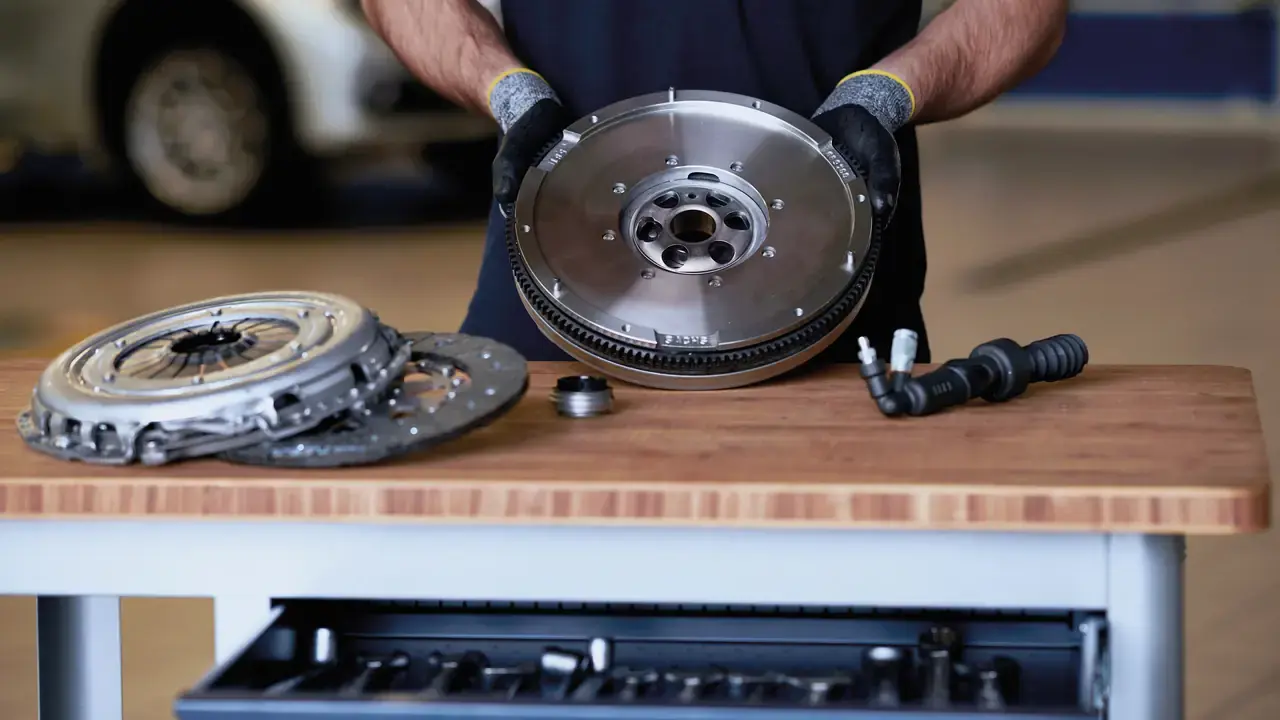
A dual mass flywheel (DMF) is a component used between the engine and clutch to control torsional vibrations and irregular torque pulses produced by the engine. Unlike a conventional single-piece flywheel, a dual mass flywheel consists of two separate rotating masses connected by a damping mechanism.
Its purpose is not simply to transfer engine power to the transmission. It also helps make the power transfer smoother, quieter, and more comfortable while reducing the amount of vibration reaching the transmission.
DMFs are particularly common in modern diesel vehicles, but they are also used in many gasoline engines that produce high torque.
Why Does a Dual Mass Flywheel Exist?
A four-stroke internal combustion engine does not produce perfectly smooth rotational force.
During combustion, the piston is pushed downward with considerable force. Between combustion events, however, the crankshaft continues rotating using the energy stored in the rotating assembly and flywheel.
This creates fluctuations in crankshaft speed and torque.
These fluctuations are called torsional vibrations.
If they are transmitted directly to the transmission, they can cause:
-
Gear rattle
-
Drivetrain vibration
-
Noise at low engine speeds
-
Harsh engagement
-
Increased transmission wear
-
Uncomfortable driving characteristics
The dual mass flywheel is designed to absorb much of this torsional vibration before it reaches the transmission.
How Does a Dual Mass Flywheel Work?
A conventional flywheel is essentially one rigid rotating mass attached to the crankshaft.
A dual mass flywheel is different because it contains two main masses.
The primary mass is connected to the engine crankshaft.
The secondary mass is connected toward the clutch and transmission.
Between these two masses is a damping mechanism, usually consisting of specially designed springs and friction-related components.
As the engine produces torque pulses, the primary mass moves slightly relative to the secondary mass. The internal springs absorb and control this movement.
In simple terms, the system works somewhat like a mechanical filter.
Instead of allowing every fluctuation from the crankshaft to pass directly into the transmission, the dual mass flywheel absorbs and smooths these fluctuations.
The Power Path Through the System
The basic power path is:
Engine → Crankshaft → Dual Mass Flywheel → Clutch → Transmission → Differential → Wheels
The DMF therefore sits directly between the engine and clutch.
Because it is located at this point in the drivetrain, it has an important role in controlling the torsional behavior of the entire powertrain.
What Is Inside a Dual Mass Flywheel?
The exact construction varies between manufacturers and applications, but a typical DMF may contain:
-
Primary flywheel mass
-
Secondary flywheel mass
-
Damping springs
-
Spring seats
-
Bearings
-
Friction elements
-
Internal guides
-
Clutch friction surface
-
Grease or damping material
The internal spring system is especially important.
These springs are designed to absorb changes in rotational speed and torque between the engine and transmission.
As the vehicle accumulates mileage, the springs, bearings, friction surfaces, and other internal components can wear.
This is one of the main reasons why a worn DMF can produce unusual noises and vibrations.
Is a Dual Mass Flywheel the Same as a Clutch?
No.
The dual mass flywheel and clutch work together, but they perform different jobs.
The clutch is responsible for connecting and disconnecting engine power from the transmission. Its main components include the clutch disc, pressure plate, and release mechanism.
The dual mass flywheel primarily controls torsional vibrations and torque fluctuations.
When a clutch is replaced, the DMF should therefore be inspected rather than automatically assumed to be good or bad.
What Are the Symptoms of a Failing Dual Mass Flywheel?
A worn DMF can produce several different symptoms.
One of the most noticeable is vibration at idle.
The vehicle may feel rough while stationary, particularly at low engine speeds. In some cases, the vibration becomes more noticeable when the clutch pedal is released.
Another common symptom is a metallic rattling or knocking sound.
This may be heard when:
-
Starting the engine
-
Switching the engine off
-
Idling at low RPM
-
Accelerating from low RPM
-
Changing engine load
-
Engaging or disengaging the clutch
The exact sound depends on the type and severity of the internal wear.
A damaged DMF may also cause:
-
Shuddering during take-off
-
Low-RPM vibration
-
Clutch pedal vibration
-
Harsh engagement
-
Drivetrain noise
-
Excessive movement inside the flywheel
-
Metallic noise when the engine is started or stopped
However, none of these symptoms alone proves that the dual mass flywheel has failed.
Engine mounts, clutch components, transmission bearings, and even uneven engine operation can create similar symptoms.
Why Does a Worn DMF Make Noise?
Inside the flywheel, the two masses are supposed to move relative to each other within a controlled range.
The damping springs and other internal components absorb the rotational fluctuations.
As these components wear, the amount of free movement can increase.
The internal damping may also become less effective.
When the engine produces torque pulses, the two masses can then move more abruptly than intended.
This can create rattling, knocking, or clunking noises.
The noise may be especially noticeable at idle because engine torque pulses are more apparent at low RPM.
What Causes Dual Mass Flywheel Failure?
There is no single mileage at which every DMF fails.
Its service life depends heavily on the vehicle, engine torque, driving conditions, and driving style.
Common contributing factors include:
Normal wear
The internal springs, bearings, friction surfaces, and other components gradually wear with use.
High engine torque
Modern diesel engines can produce substantial torque at relatively low RPM. This places considerable torsional stress on the drivetrain.
Aggressive starts
Repeated hard launches can increase the mechanical load on the DMF and clutch.
Driving at very low RPM under heavy load
This is particularly important.
Forcing a high-torque engine to accelerate from very low RPM in a high gear can produce strong torsional vibration.
Downshifting instead of heavily loading the engine at very low RPM can reduce this stress.
Clutch problems
A damaged or improperly operating clutch can increase shock loading through the drivetrain.
Engine misfire or irregular combustion
An engine that does not produce smooth combustion can transmit abnormal torque pulses into the flywheel.
Increased engine torque after tuning
Performance tuning or ECU calibration that substantially increases engine torque can increase the load on the DMF.
This does not mean every tuned vehicle will damage its flywheel, but the additional torque should be considered when evaluating drivetrain capacity.
Can Engine Misfires Damage the Dual Mass Flywheel?
They can contribute to increased stress.
A properly running engine produces a predictable pattern of combustion pulses.
If one or more cylinders begin producing irregular combustion, the crankshaft can experience abnormal changes in acceleration and deceleration.
The DMF attempts to absorb these fluctuations.
A vehicle with a serious or persistent misfire should therefore not be driven for long periods simply because the engine still runs.
When diagnosing a suspected DMF problem, engine operation should also be checked. Otherwise, an engine problem can be incorrectly blamed on the flywheel.
How Is a Dual Mass Flywheel Diagnosed?
Diagnosis should begin with the symptoms rather than immediately removing the transmission.
First, determine when the noise or vibration occurs.
For example:
-
Does it occur only at idle?
-
Does it change when the clutch pedal is pressed?
-
Is it worse during engine start-up?
-
Is it worse when shutting the engine off?
-
Does it appear during take-off?
-
Does it change with engine load?
-
Does it become stronger at low RPM?
The answers can help narrow down the source.
A technician may also use a mechanical stethoscope or other diagnostic methods to determine where the noise is coming from.
If the symptoms strongly indicate a DMF problem, the transmission may need to be removed for a proper inspection.
What Should Be Checked After Removing the Transmission?
Once the flywheel is accessible, the technician can inspect it for:
-
Excessive rotational movement
-
Excessive radial movement
-
Abnormal axial movement
-
Damaged springs
-
Cracks
-
Heat damage
-
Friction marks
-
Grease leakage
-
Bearing damage
-
Abnormal wear
One important point is that some movement between the two masses is normal.
A DMF is designed to allow controlled movement.
Therefore, saying "the flywheel has movement, so it is bad" is not a technically reliable diagnosis.
The measured movement must be compared with the manufacturer's specifications and inspection procedure.
Does a Dual Mass Flywheel Have a Fixed Lifespan?
No.
Some vehicles may require DMF replacement relatively early, while others can cover very high mileage before replacement becomes necessary.
Driving conditions make a significant difference.
Frequent city driving, heavy traffic, repeated clutch engagement, towing, aggressive acceleration, and low-RPM high-load driving can increase stress.
On the other hand, smooth driving and correct engine operation can reduce unnecessary drivetrain shock.
For this reason, it is better to evaluate the actual condition of the DMF rather than replacing it simply because the vehicle has reached a particular mileage.
What Happens If You Continue Driving With a Bad DMF?
The consequences depend on the severity of the damage.
A mildly worn DMF may initially produce only noise or vibration.
As the internal components deteriorate, however, the movement between the two masses can become excessive.
This can lead to:
-
Increasing vibration
-
Severe rattling
-
Harsh clutch engagement
-
Drivetrain shock
-
Increased clutch wear
-
Transmission-related stress
-
Possible internal flywheel damage
A severely damaged flywheel should not be ignored.
If there is strong metallic knocking, severe vibration, unusual movement, or rapidly worsening symptoms, the vehicle should be inspected promptly.
Should the Clutch Be Replaced With the DMF?
It depends on the condition of the clutch.
Because the transmission normally has to be removed to replace the DMF, the clutch assembly becomes accessible at the same time.
If the clutch disc, pressure plate, or release mechanism is significantly worn, replacing the worn components during the same repair can prevent another transmission removal later.
However, this does not mean every clutch automatically needs replacement whenever a DMF is replaced.
The condition of the complete clutch system should be evaluated.
Can a Dual Mass Flywheel Be Converted to a Single Mass Flywheel?
Some vehicles have conversion kits that replace the dual mass flywheel with a conventional single mass flywheel.
However, this changes the torsional characteristics of the drivetrain.
The DMF was installed to absorb specific engine torque fluctuations.
Removing that damping effect can result in:
-
More drivetrain vibration
-
Gear rattle
-
Increased low-RPM noise
-
Different clutch engagement characteristics
-
Greater torsional loading on the transmission
A single-mass conversion may be appropriate for certain applications, but it should not be treated as a universal upgrade.
Compatibility with the specific engine, transmission, clutch system, and intended use must be considered.
How Can You Extend Dual Mass Flywheel Life?
Several driving habits can reduce unnecessary stress on the system.
Avoid repeatedly launching the vehicle aggressively.
Do not hold the vehicle on an incline by slipping the clutch.
Avoid driving in a high gear at extremely low RPM while demanding strong acceleration.
If the engine is heavily loaded at low RPM, select a lower gear.
Engine problems such as misfires should also be repaired promptly because irregular combustion can increase torsional vibration.
For vehicles that have been tuned for additional torque, the effect of the increased torque on the clutch and flywheel should also be considered.
A DMF Problem Should Not Be Diagnosed by Noise Alone
One of the most important points when diagnosing a dual mass flywheel is that noise is only one piece of evidence.
A similar rattling or vibration can originate from the clutch, transmission, engine mounts, accessory drive, or the engine itself.
For that reason, a proper diagnosis should consider the complete drivetrain.
The technician should determine when the symptom occurs, how it changes with engine speed and load, and whether clutch operation changes the symptom.
Only after these observations should the flywheel itself be condemned.
A dual mass flywheel is essentially a vibration-control device built into the drivetrain. Its two rotating masses and internal damping system allow modern engines to deliver high torque without transmitting every combustion pulse directly into the transmission.
When it wears, the resulting symptoms can range from minor vibration to serious mechanical noise. Correct diagnosis is therefore important, because replacing a DMF is a labor-intensive repair and similar symptoms can be caused by other components.
The key is not simply to ask whether the flywheel has some movement or makes a noise, but whether its measured condition and behavior are outside the manufacturer's specified limits.