TR
TR EN
EN

What Is a Throttle Return Spring? Symptoms of a Faulty Throttle Spring
The throttle body controls how much air enters the engine. On traditional mechanically operated throttle systems, the throttle plate is connected to the accelerator pedal through a cable or mechanical linkage.
One small but important component in this mechanism is the throttle return spring.
The throttle return spring helps return the throttle plate toward its closed position when the driver releases the accelerator pedal. Although it is a simple mechanical component, a weak, broken, stretched, or incorrectly installed spring can cause throttle operation problems and, in certain situations, create a safety concern.
However, modern vehicles require an important distinction.
Many newer cars use an electronic throttle control system, also known as drive-by-wire. In these systems, there may not be a conventional accelerator cable or a simple externally visible return spring performing the same function as on an older mechanical throttle.
Understanding which throttle system the vehicle uses is therefore the first step in diagnosing a suspected throttle spring problem.
What Is a Throttle Return Spring?
A throttle return spring is a spring mechanism designed to return the throttle toward its resting or closed position when accelerator input is reduced.
In a traditional cable-operated throttle system, pressing the accelerator rotates the throttle linkage and opens the throttle plate.
When the accelerator pedal is released, the return spring helps rotate the throttle mechanism back toward its normal position.
The spring therefore contributes to:
-
Returning the throttle plate toward the closed position
-
Maintaining tension in the throttle linkage
-
Providing predictable accelerator response
-
Helping prevent the throttle from remaining open
-
Supporting stable idle operation
The exact spring arrangement depends on the throttle body and vehicle design.
Some systems use a single return spring, while others use multiple springs or redundant return mechanisms for safety.
Where Is the Throttle Return Spring Located?
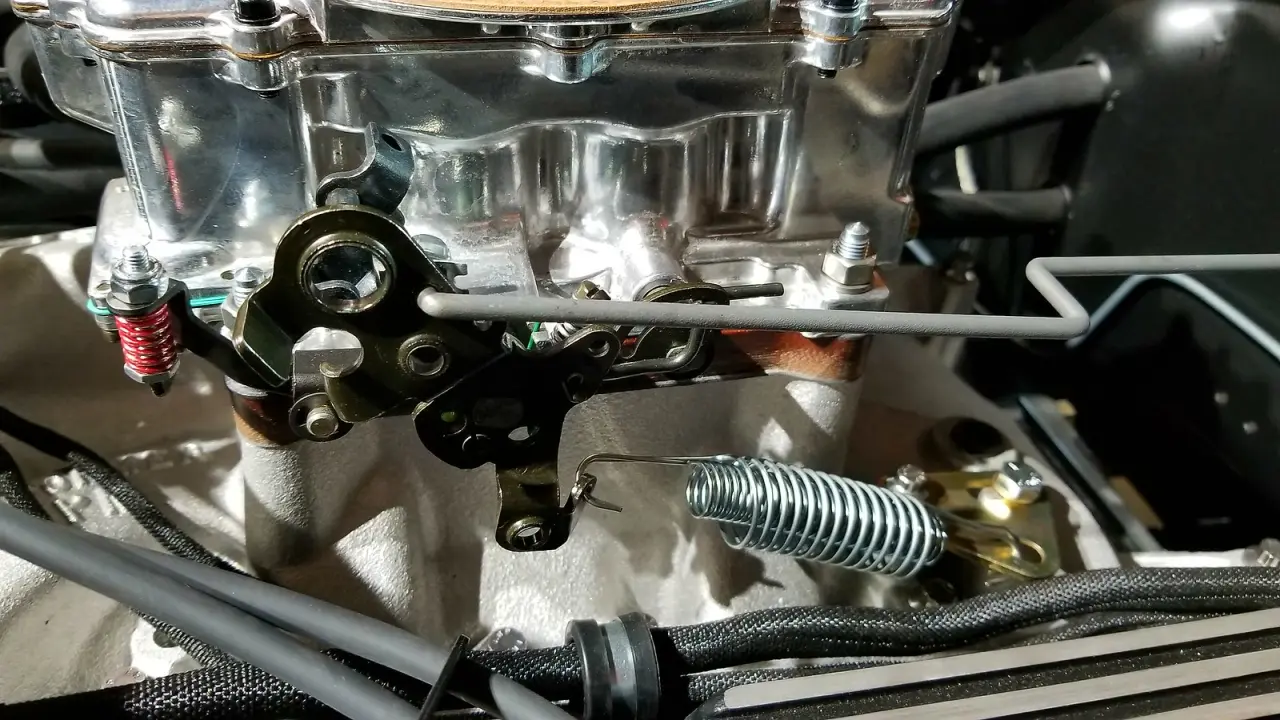
On a conventional mechanical throttle body, the return spring is usually located around the throttle shaft or throttle linkage.
The accelerator cable connects to the throttle mechanism.
When the driver presses the accelerator, the cable moves the linkage and opens the throttle plate.
The return spring is positioned so that it creates a restoring force when the throttle is opened.
When the pedal is released, the spring helps return the mechanism.
The exact location can vary significantly between engines, so the spring should not be confused with other springs attached to the throttle body or accelerator linkage.
How Does a Throttle Return Spring Work?
The operating principle is relatively simple.
When the throttle is opened, the spring is either stretched, compressed, or rotated depending on its design.
This stores mechanical energy.
When the accelerator is released, the stored energy produces a force in the opposite direction and helps move the throttle mechanism back toward its resting position.
This can be compared to a door closer.
The driver provides the force to open the throttle, while the spring provides the force that helps return it.
The spring itself does not determine how much fuel the engine receives. Its primary purpose is mechanical return of the throttle mechanism.
What Happens If the Throttle Return Spring Breaks?
A broken spring can produce different symptoms depending on the design of the throttle system.
On a simple mechanical throttle, the throttle may become slow to return or may fail to return completely.
Possible symptoms include:
-
Accelerator pedal does not return normally
-
Throttle remains partially open
-
Engine speed stays high after releasing the accelerator
-
Delayed return to idle
-
Accelerator pedal feels unusual
-
Throttle linkage feels loose
-
Engine may remain at elevated RPM
-
In severe cases, the throttle can become difficult to control
The severity depends on whether the vehicle has additional return mechanisms.
Modern safety-oriented throttle systems are generally designed with redundancy, so failure of one spring or mechanism does not necessarily mean that the throttle will remain fully open.
Symptoms of a Weak Throttle Return Spring
A spring does not necessarily have to break completely to create a problem.
A spring that has lost tension may still move the throttle, but not with the same force as intended.
Possible symptoms include:
Slow throttle return
After releasing the accelerator pedal, engine speed may take longer than normal to fall.
High or hanging idle
If the throttle plate does not return completely to its intended closed position, the engine may receive more air than expected.
This can result in an elevated or unstable idle.
However, a high idle should never automatically be blamed on the throttle return spring.
Vacuum leaks, throttle body contamination, idle control problems, sensor faults, and electronic throttle issues can produce similar symptoms.
Accelerator pedal feels different
The pedal may feel unusually light or may not return with its normal resistance.
A change in pedal feel can indicate a problem with the spring, cable, linkage, or accelerator pedal mechanism.
Throttle linkage does not snap back
With the engine off, a technician can sometimes inspect the throttle linkage and observe whether it returns smoothly to its resting position.
It should not stick, bind, or move irregularly.
Can a Broken Throttle Spring Cause Unintended Acceleration?
A mechanical throttle return problem can potentially contribute to unintended throttle opening or delayed throttle closure.
However, it is important not to assume that every unintended acceleration event is caused by a broken return spring.
Possible causes include:
-
Throttle body mechanical binding
-
Accelerator cable problems
-
Floor mat interference
-
Accelerator pedal problems
-
Electronic throttle faults
-
Incorrectly installed components
-
Wiring or sensor faults
-
Foreign objects around the throttle mechanism
If the accelerator does not return normally, the vehicle should be inspected rather than repeatedly driven to determine whether the problem gets worse.
Can a Throttle Return Spring Cause a Check Engine Light?
A simple mechanical return spring does not normally generate a diagnostic trouble code by itself.
The Engine Control Module does not usually monitor the physical spring directly.
However, if the throttle does not reach the expected position, the throttle position sensor may report a value that does not correspond to the commanded or expected position.
On an electronically controlled system, the ECU may detect disagreement between throttle position signals or between accelerator pedal input and throttle position.
This can result in a Check Engine Light and diagnostic trouble codes.
Therefore, a throttle-related fault code does not automatically mean that the return spring itself is defective.
Mechanical Throttle vs. Electronic Throttle
This distinction is extremely important when diagnosing throttle problems.
Mechanical throttle system
Older and some simpler vehicles may use:
-
Accelerator cable
-
Mechanical throttle linkage
-
Throttle return spring
-
Throttle plate
-
Throttle position sensor
The driver's foot directly influences throttle position through the mechanical system.
Electronic throttle system
Modern vehicles commonly use:
-
Accelerator pedal position sensors
-
Electronic throttle actuator
-
Throttle position sensors
-
ECU/ECM
-
Electric motor
-
Internal return mechanisms
There is no traditional throttle cable connecting the accelerator pedal directly to the throttle plate.
The driver presses the accelerator pedal, sensors detect the pedal position, and the ECU commands the throttle actuator.
This means a problem that appears to be a "throttle spring problem" on an older vehicle may actually be an electronic throttle actuator, sensor, wiring, or control issue on a modern vehicle.
Does an Electronic Throttle Body Have a Return Spring?
Many electronic throttle bodies contain internal return mechanisms, but the design is manufacturer-specific.
An electronic throttle body commonly uses an electric motor to move the throttle plate and incorporates mechanical provisions to return or position the throttle under certain fault conditions.
Some systems use one or more internal springs.
However, the internal construction should not be assumed to be identical between different manufacturers.
A spring visible on one throttle body may not exist in the same form on another.
This is why replacing or modifying an internal throttle spring without manufacturer-specific information is not recommended.
Symptoms That Can Be Mistaken for a Throttle Spring Failure
Several other problems can create almost identical symptoms.
Dirty throttle body
Carbon and oil deposits can accumulate around the throttle plate and bore.
Heavy deposits can interfere with smooth throttle movement, particularly around the closed position.
Sticking throttle plate
A mechanically restricted throttle plate may not return smoothly.
The cause could be contamination, mechanical damage, a worn shaft, or another problem.
Damaged accelerator cable
On cable-operated systems, a frayed, kinked, contaminated, or incorrectly routed cable can create resistance.
The driver may feel that the accelerator pedal is sticking or returning slowly.
Accelerator pedal mechanism
The return mechanism may be located partly or entirely at the accelerator pedal assembly.
A problem there can feel similar to a throttle spring problem.
Throttle position sensor
A defective throttle position sensor can cause inconsistent throttle-related behavior and warning lights.
However, a sensor fault does not physically prevent the throttle plate from moving.
Electronic throttle actuator
On drive-by-wire vehicles, a problem with the throttle motor or actuator can cause reduced power, abnormal throttle response, or a limp-home mode.
How Do You Diagnose a Throttle Return Spring?
Diagnosis should begin with the simplest mechanical checks.
First, make sure the engine is switched off.
Then inspect the throttle mechanism where it is accessible.
Look for:
-
Broken spring
-
Missing spring
-
Bent linkage
-
Loose components
-
Corrosion
-
Foreign objects
-
Damaged accelerator cable
-
Signs of binding
-
Abnormal movement
The throttle mechanism should move smoothly and return consistently.
Do not force the throttle mechanism if it appears damaged.
Checking the Accelerator Cable
On a cable-operated system, the accelerator cable should also be inspected.
Check whether the cable:
-
Moves smoothly
-
Has excessive slack
-
Is damaged
-
Is frayed
-
Is incorrectly routed
-
Contacts hot components
-
Binds during movement
A cable that sticks can produce symptoms very similar to a weak return spring.
If the cable is damaged, lubrication may not be an appropriate permanent solution. Replacement may be necessary depending on its condition and design.
Checking Throttle Plate Movement
With the engine off and following the vehicle manufacturer's safety procedure, the throttle mechanism can be inspected for smooth movement.
A mechanically operated throttle should move without abnormal resistance.
It should return smoothly when released.
If the throttle plate feels rough, catches at a particular point, or fails to return consistently, the problem may not be the spring.
The throttle shaft, bearings, linkage, cable, or throttle body itself may be involved.
Can You Replace a Throttle Return Spring Yourself?
On a simple mechanical throttle system, spring replacement may be relatively straightforward.
However, the correct spring is important.
Do not install a random spring simply because it has a similar size.
The spring's:
-
Length
-
Diameter
-
Tension
-
Attachment points
-
Spring rate
-
Operating range
all affect throttle operation.
A spring that is too weak may fail to return the throttle properly.
A spring that is too strong may make the accelerator pedal unnecessarily heavy and place additional stress on the cable and throttle mechanism.
Why You Should Not Stretch the Old Spring
A common temporary repair is to stretch a weak spring to increase its tension.
This is not a reliable repair.
The spring may not maintain the desired characteristics, and the resulting force may be unpredictable.
The correct replacement part should be used whenever possible.
Can a Throttle Spring Cause Poor Fuel Economy?
A throttle return spring does not normally cause a significant increase in fuel consumption by itself.
However, if the throttle remains slightly open when it should be closed, engine speed may remain higher than normal.
Depending on the severity of the problem, this can affect fuel consumption and drivability.
Nevertheless, poor fuel economy has many possible causes, including:
-
Incorrect tire pressure
-
Faulty oxygen sensors
-
Injector problems
-
Air leaks
-
Ignition problems
-
Thermostat problems
-
Engine temperature issues
-
Brake drag
-
Incorrect fuel mixture
The spring should therefore not be blamed without confirming the mechanical problem.
Can a Throttle Return Spring Cause High RPM?
It can contribute to high RPM on a mechanical throttle system if the throttle plate does not return fully.
For example, if the spring is broken or the linkage is binding, the throttle may remain partially open.
The engine will then receive more air than it would at a fully closed throttle position.
However, high idle speed can also be caused by vacuum leaks, electronic throttle control faults, idle air control problems on applicable engines, incorrect throttle adaptation, or sensor-related issues.
Diagnosis is essential.
What Should You Do If the Accelerator Does Not Return?
Treat this as a potentially serious safety problem.
If the accelerator pedal does not return normally while driving:
-
Stay calm.
-
Keep the vehicle under control.
-
Apply the brakes firmly as necessary.
-
Shift to neutral if appropriate for the vehicle and situation.
-
Move to a safe location.
-
Switch off the engine when it is safe and appropriate.
-
Do not continue driving until the cause has been identified.
The exact emergency procedure can depend on the vehicle's transmission and manufacturer instructions.
The key point is that a sticking accelerator should never be ignored.
How Can Throttle Spring Problems Be Prevented?
The spring itself generally requires little routine maintenance.
However, the entire throttle mechanism should be kept in good condition.
Useful preventive measures include:
-
Inspecting the throttle linkage during service
-
Keeping the throttle body clean when required
-
Checking the accelerator cable on cable-operated systems
-
Repairing damaged or corroded components
-
Avoiding modifications that alter throttle linkage geometry
-
Using the correct replacement parts
-
Addressing abnormal accelerator pedal behavior immediately
For electronic throttle systems, maintenance should focus on the throttle body, wiring, connectors, sensors, actuator, and ECU-controlled system rather than assuming there is a conventional external return spring.
When Should a Throttle Return Spring Be Replaced?
A throttle return spring should generally be replaced if it is:
-
Broken
-
Cracked
-
Severely corroded
-
Stretched beyond specification
-
Missing
-
Deformed
-
Too weak to return the throttle properly
It should also be replaced if the manufacturer specifies a new spring as part of a particular repair procedure.
There is normally no universal mileage-based replacement interval for a throttle return spring.
It is a condition-based component.
Final Thoughts
The throttle return spring is a small mechanical component with an important job: helping return the throttle mechanism toward its normal position when accelerator input is released.
On traditional cable-operated throttle systems, a damaged or weakened spring can cause slow throttle return, high or hanging engine speed, unusual accelerator pedal feel, or a throttle that does not close properly.
However, modern vehicles increasingly use electronic throttle control systems. In these vehicles, throttle behavior can involve the accelerator pedal sensors, ECU, electric throttle motor, throttle position sensors, wiring, and internal return mechanisms.
For this reason, a throttle-related symptom should not automatically be diagnosed as a failed throttle spring.
If the accelerator pedal sticks, the throttle does not return normally, or the engine remains at an unexpectedly high RPM, the vehicle should be inspected promptly.
The throttle system is directly related to engine control and vehicle safety, so replacing the correct component and verifying proper operation is much more important than simply installing a stronger spring.