TR
TR EN
EN

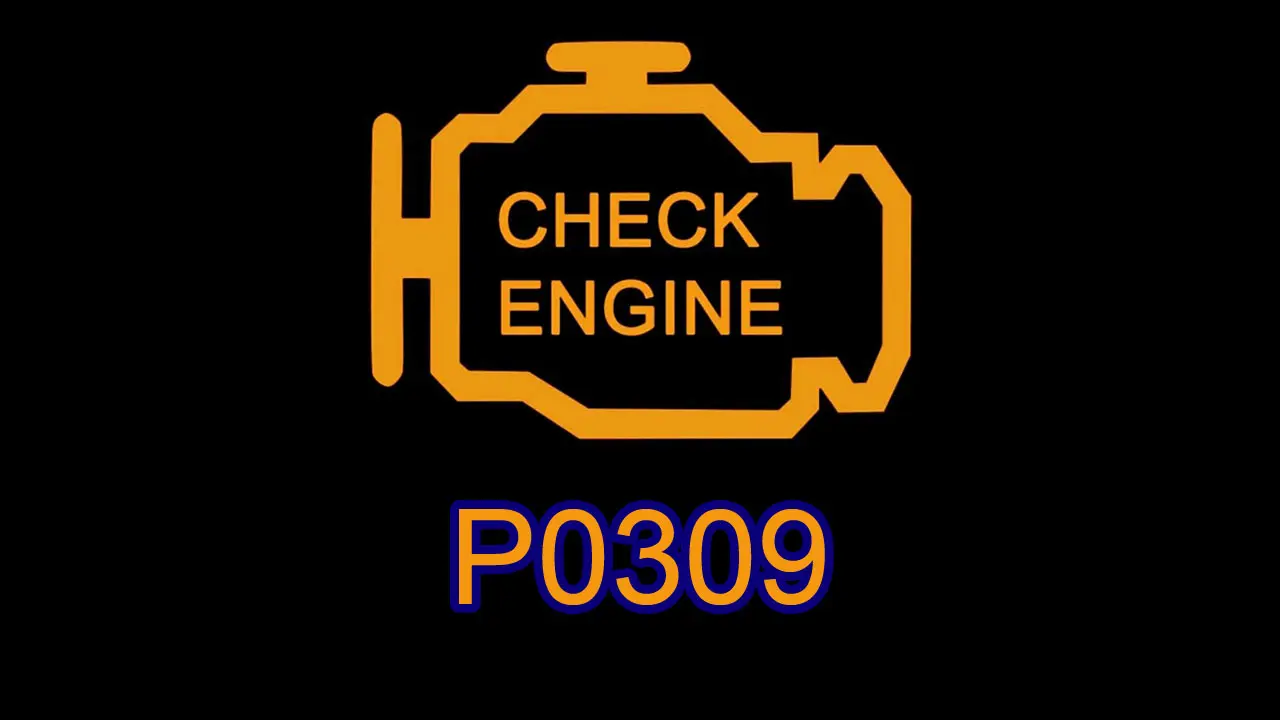
P0309 Cylinder #9 Misfire Detected
The P0309 OBD-II trouble code means that the engine control module (ECM/PCM) has detected a misfire in cylinder #9.
A misfire occurs when cylinder #9 fails to produce the expected combustion during one or more engine cycles. The control module generally detects this by monitoring changes in crankshaft speed. When combustion in one cylinder is weaker than expected, the resulting change in crankshaft acceleration can be recognized by the ECM.
P0309 identifies the affected cylinder, but it does not identify the failed component. The cause could be the spark plug, ignition coil, fuel injector, fuel supply, intake system, compression, valve operation, engine timing, or an electrical problem.
Cylinder numbering is also manufacturer-specific, so the physical location of cylinder #9 should always be confirmed using the vehicle's service information.
What Does P0309 Mean?
The code can be understood as:
-
P – Powertrain
-
03 – Ignition/misfire-related diagnostic category
-
09 – Cylinder #9
This makes P0309 different from a general misfire code such as P0300.
With P0300, the ECM detects random or multiple-cylinder misfires without establishing one specific cylinder as the primary source. With P0309, the control module has identified a misfire pattern associated with cylinder #9.
That makes diagnosis more targeted.
What Happens When Cylinder #9 Misfires?
During normal combustion, the mixture inside the cylinder burns and produces pressure against the piston. This pressure creates torque at the crankshaft.
When cylinder #9 misfires, that combustion event is weak or absent.
The result can include:
-
Reduced engine power
-
Engine vibration
-
Uneven idle
-
Hesitation
-
Poor acceleration
-
Increased fuel consumption
-
Higher exhaust emissions
If the misfire is severe, unburned fuel can enter the exhaust system. This can raise catalytic-converter temperatures and potentially cause expensive damage.
Common Symptoms of P0309
The symptoms depend on how frequently cylinder #9 misfires and under what conditions the problem occurs.
Possible symptoms include:
-
Check Engine Light
-
Rough idle
-
Engine shaking
-
Noticeable vibration
-
Hesitation during acceleration
-
Poor throttle response
-
Reduced engine power
-
Uneven engine operation
-
Engine stumble
-
Poor acceleration
-
Increased fuel consumption
-
Exhaust popping
-
Unburned fuel smell
-
Hard starting
-
Extended cranking
-
Engine stalling
Some misfires occur only under particular conditions.
For example, the engine might run normally at idle but misfire during:
-
Hard acceleration
-
High RPM
-
Climbing a hill
-
Heavy engine load
-
Cold starts
-
Hot-engine operation
This behavior can provide an important diagnostic clue.
Why Can an Engine Run Normally Despite P0309?
A cylinder does not necessarily misfire continuously.
A weak ignition coil, for example, might produce enough spark at idle but struggle when cylinder pressure rises during acceleration.
Similarly, an injector may occasionally stick, an electrical connection may lose contact due to vibration, or a mechanical problem may become noticeable only when the engine reaches a particular temperature.
Therefore, the absence of obvious symptoms does not mean that P0309 can be ignored.
What Causes P0309?
There are several possible causes, and they should be investigated systematically.
Worn or damaged spark plug
A spark plug serving cylinder #9 may be worn, fouled, cracked, incorrectly gapped, or contaminated with oil or fuel.
A weak spark can prevent the air-fuel mixture from burning properly.
Faulty ignition coil
On engines with individual ignition coils, the coil assigned to cylinder #9 may be defective.
A coil can sometimes work at low engine load but fail when the ignition voltage requirement increases.
Ignition wiring problem
Depending on the engine design, the ignition system may use separate wiring, coil connectors, or other components that can develop:
-
Broken wires
-
Corrosion
-
Loose connections
-
Poor electrical contact
-
Insulation damage
Faulty fuel injector
Cylinder #9 may not be receiving the correct amount of fuel.
The injector could be:
-
Clogged
-
Stuck
-
Electrically defective
-
Internally damaged
-
Suffering from a wiring or control problem
Low fuel pressure
Insufficient fuel pressure can cause a lean condition and misfire.
However, a general fuel-pressure problem often affects more than one cylinder. If P0309 is the only misfire code, the injector or cylinder-specific fuel circuit deserves particular attention.
Vacuum or intake leak
An intake leak near cylinder #9 can introduce unmetered air and disturb the air-fuel mixture.
This can be particularly important on engines where individual intake runners feed individual cylinders.
Low compression
Cylinder #9 may have a mechanical problem that prevents it from producing sufficient compression.
Possible causes include:
-
Burned valve
-
Bent valve
-
Damaged piston
-
Worn piston rings
-
Cylinder-wall wear
-
Head-gasket failure
If ignition and fuel systems test normally, mechanical testing becomes increasingly important.
Valve or engine timing problem
Incorrect camshaft timing can affect combustion.
Potential causes include a timing-chain or timing-belt problem, incorrect mechanical timing, a variable valve timing fault, or another mechanical synchronization issue.
Camshaft or crankshaft signal problem
The ECM relies on accurate crankshaft and camshaft position information to determine when combustion should occur.
A problem with these signals can result in misfires, although such faults frequently produce additional diagnostic codes.
Electrical or wiring problems
A poor ground, damaged harness, loose connector, intermittent connection, or control-circuit problem can cause a cylinder-specific misfire.
How Is P0309 Diagnosed?
A proper diagnosis should begin by confirming that cylinder #9 is actually misfiring.
1. Scan for all stored codes
Do not diagnose P0309 in isolation.
Look for additional codes related to:
-
Ignition coils
-
Injectors
-
Fuel pressure
-
Camshaft position
-
Crankshaft position
-
Air/fuel mixture
-
VVT
-
Other cylinders
Additional codes can significantly change the diagnostic direction.
2. Check freeze-frame data
Freeze-frame information can show the conditions under which P0309 was stored.
Useful information includes:
-
Engine RPM
-
Engine load
-
Coolant temperature
-
Vehicle speed
-
Throttle position
-
Fuel-trim information
If P0309 occurs consistently at high load, components that fail under load deserve particular attention.
3. Check live misfire counters
A capable diagnostic scanner may show individual cylinder misfire counts.
If cylinder #9 repeatedly accumulates misfires while the other cylinders remain relatively stable, the cylinder-specific diagnosis becomes much stronger.
4. Inspect the spark plug
Remove the spark plug serving cylinder #9 and inspect it carefully.
Look for:
-
Worn electrodes
-
Incorrect gap
-
Carbon deposits
-
Oil contamination
-
Fuel fouling
-
Cracks
-
Abnormal deposits
Comparing the plug with another cylinder can be especially useful.
5. Test the ignition coil
If the engine uses interchangeable individual coils, the suspected cylinder #9 coil can sometimes be moved to another cylinder.
After clearing the codes, the engine can be monitored again.
If the misfire moves with the coil, the coil becomes a strong suspect.
If the misfire remains on cylinder #9, the investigation should continue.
This method should only be used when the vehicle's ignition design allows coil interchange.
6. Check the injector
The cylinder #9 injector should be checked for both electrical and mechanical operation.
Depending on the vehicle, testing may include:
-
Injector activation
-
Resistance checks where specified
-
Current-pattern testing
-
Injector balance testing
-
Flow comparison
-
Wiring and connector inspection
An injector can have an electrically normal circuit while still suffering from a mechanical flow problem.
7. Check fuel pressure
Fuel pressure should be measured and compared with the manufacturer's specifications.
Avoid applying a generic fuel-pressure value to every vehicle because fuel-system designs differ significantly.
8. Check for intake leaks
A smoke test can help locate vacuum or intake leaks.
If the leak is close to cylinder #9, it may explain why that particular cylinder is misfiring.
9. Perform a compression test
If the ignition and fuel systems appear normal, compression should be checked.
Cylinder #9 should be compared with the other cylinders.
The important question is not simply whether a generic pressure number is reached, but whether cylinder #9 shows a significant difference from the rest of the engine.
10. Perform a leak-down test
If compression is low, a leak-down test can help determine where the pressure is escaping.
Air escaping through the intake may indicate an intake-valve problem.
Air escaping through the exhaust can point toward an exhaust-valve problem.
Air entering the crankcase can indicate piston-ring or cylinder problems.
Can a Bad Spark Plug Cause P0309?
Yes.
A damaged or worn spark plug is one of the possible causes of P0309.
However, the code itself does not prove that the spark plug is defective.
If replacing or testing the spark plug does not eliminate the misfire, the ignition coil, injector, intake system, compression, and timing should be investigated.
Can a Bad Ignition Coil Cause P0309?
Yes.
A defective ignition coil can produce a cylinder-specific misfire.
The failure can also be load-dependent. A coil that appears to work normally at idle may fail when the engine is accelerating and cylinder pressure is higher.
This is why simply checking whether the engine starts is not enough to confirm that an ignition coil is healthy.
Can a Fuel Injector Cause P0309?
Yes.
If the cylinder #9 injector is clogged, stuck, or otherwise unable to deliver the correct amount of fuel, combustion can become weak or disappear.
Injector wiring should also be checked because an injector that is mechanically healthy cannot operate correctly if its electrical control circuit is faulty.
Can Low Compression Cause P0309?
Yes.
If cylinder #9 has insufficient compression, replacing the spark plug or ignition coil will not solve the underlying problem.
Mechanical causes such as valve damage, piston problems, worn rings, or head-gasket issues should then be considered.
A compression test followed by a leak-down test can help separate these possibilities.
P0309 vs P0300
P0309 indicates a misfire associated with cylinder #9.
P0300 indicates random or multiple-cylinder misfires.
If both codes are present, cylinder #9 may be one of the cylinders contributing to a larger engine misfire problem.
P0309 vs P0308 and P0310
These codes identify different cylinders:
-
P0308 – Cylinder #8 misfire
-
P0309 – Cylinder #9 misfire
-
P0310 – Cylinder #10 misfire
The physical position of these cylinders depends on the engine configuration and manufacturer.
Do not assume that cylinder #9 is physically next to cylinder #8 or #10 without confirming the manufacturer's cylinder numbering.
What If P0309 Appears With Other Cylinder Misfire Codes?
This situation is particularly important.
If the vehicle reports P0309 together with several other cylinder-specific misfire codes, the problem may not be limited to cylinder #9.
Possible broader causes include:
-
Low fuel pressure
-
Air/fuel mixture problems
-
Ignition power supply
-
Engine timing
-
Camshaft/crankshaft synchronization
-
Low battery voltage
-
Vacuum leaks
-
Fuel contamination
-
VVT problems
For example, replacing the cylinder #9 ignition coil would not solve a fuel-pressure problem affecting the entire engine.
What Should Be Replaced for P0309?
There is no specific part that should automatically be replaced when P0309 is stored.
A good diagnostic process should establish whether the problem follows an ignition component, remains with cylinder #9, or is caused by a broader engine condition.
A practical approach is:
Confirm the misfire → inspect ignition → test whether the ignition fault follows the component → check injector and fuel supply → check intake air → test compression → investigate timing and mechanical condition.
This approach is much more reliable than replacing multiple components based solely on the fault code.
Can You Drive With P0309?
A vehicle with P0309 should not be driven aggressively until the cause is identified.
If the Check Engine Light is steady and the engine is running relatively smoothly, a short, gentle trip to a repair facility may be possible.
However, if the Check Engine Light is flashing, the engine is shaking heavily, there is significant power loss, the engine is stalling, or there is a strong raw-fuel smell, continued driving can damage the catalytic converter.
A cylinder-specific misfire can also become more severe over time, so even an apparently minor P0309 should be properly diagnosed rather than simply cleared from the ECU.
The Most Important Diagnostic Point
P0309 tells you where the ECM has detected the misfire, not why it happened.
Cylinder #9 should therefore be treated as the starting point of the investigation.
The fault may be as simple as a worn spark plug or defective ignition coil, but it can also originate from an injector, wiring problem, intake leak, fuel-pressure issue, low compression, valve problem, or engine timing fault.
The most effective diagnosis is to determine whether the misfire follows an ignition or fuel component, remains fixed on cylinder #9, or is accompanied by evidence of a mechanical or system-wide problem.