TR
TR EN
EN

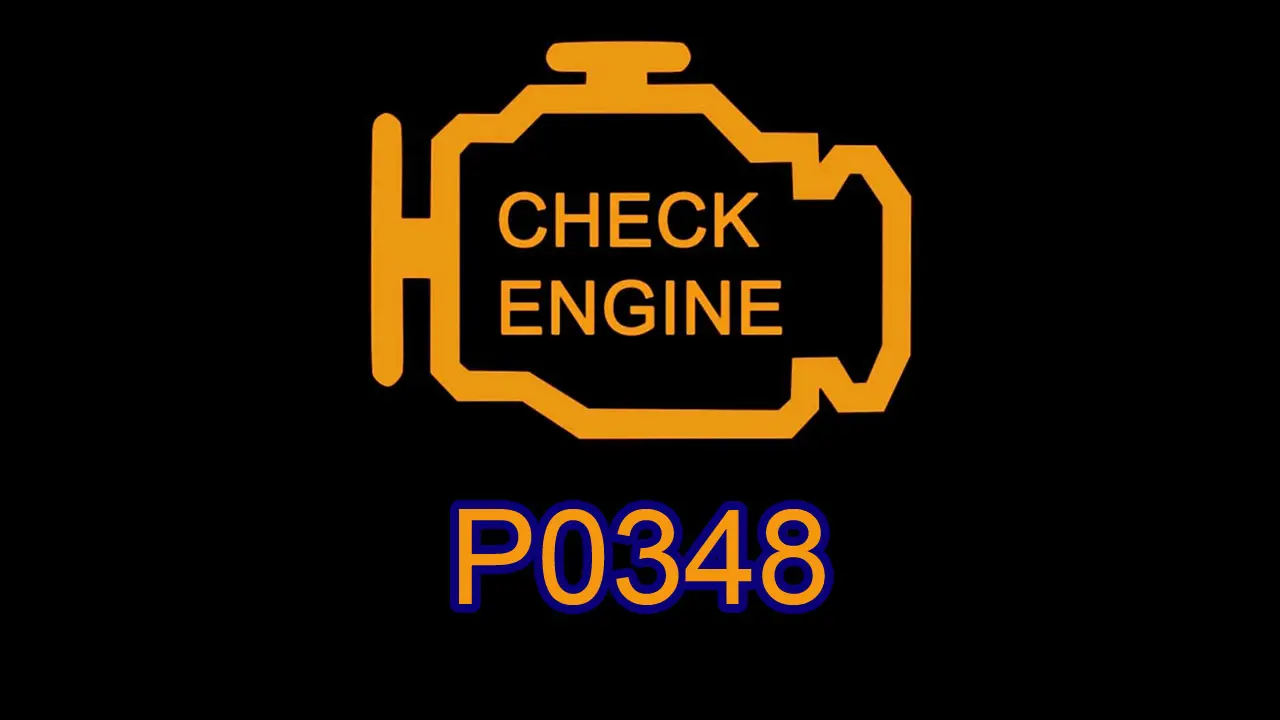
P0348 Camshaft Position Sensor "A" Circuit High Input (Bank 2)
P0348 is an OBD-II diagnostic trouble code indicating that the engine control module (ECM/PCM) has detected an abnormally high electrical signal from the Camshaft Position Sensor “A” circuit on Bank 2.
The most important word in this code is “High.” It refers to the electrical signal or voltage seen by the ECM. It does not mean that the camshaft is turning too fast, engine RPM is too high, or the camshaft timing is necessarily advanced.
Likewise, P0348 does not automatically mean that the camshaft position sensor itself has failed.
The fault can be in the sensor, wiring, connector, power supply, signal circuit, sensor ground, trigger target, or, in less common cases, the ECM.
What do “Sensor A” and “Bank 2” mean?
Sensor A is a manufacturer-dependent designation.
On many engines with separate intake and exhaust camshafts, Sensor A may correspond to the intake camshaft, but this is not universal. Some manufacturers use different naming strategies.
Bank 2 generally refers to the cylinder bank that does not contain cylinder number 1 on a multi-bank engine.
This means P0348 should not be interpreted as a universal “Bank 2 intake camshaft sensor” code without checking the specific vehicle's service information.
On a four-cylinder inline engine, for example, there is normally no Bank 2 at all. P0348 is therefore primarily relevant to engines with multiple cylinder banks or systems that use manufacturer-specific sensor designations.
What does “Circuit High Input” mean?
The camshaft position sensor provides the ECM with information about the position and rotation of the camshaft.
Depending on the engine, the sensor may be a Hall-effect sensor or a variable-reluctance (VR) sensor.
A Hall-effect sensor commonly receives a power supply and ground and produces a digital signal. A VR sensor generates its own alternating electrical signal as the target passes the sensor.
Because these systems work differently, there is no universal voltage or resistance value that can be applied to every camshaft sensor.
With P0348, the ECM is seeing an electrical signal that is higher than the expected range for the particular sensor circuit.
This can happen because the signal is actually being driven too high, because the circuit has been shorted to a higher voltage, or because the sensor is producing an abnormal signal.
What can cause P0348?
Several faults can produce a circuit-high condition.
Common possibilities include:
-
Faulty camshaft position sensor A
-
Signal wire shorted to battery voltage
-
Damaged wiring
-
Corroded connector
-
Loose connector terminal
-
Poor terminal contact
-
Incorrect sensor installation
-
Incorrect replacement sensor
-
Sensor power-supply problem
-
Sensor ground problem
-
Excessive resistance in the circuit
-
Damaged connector pins
-
Electrical interference
-
Damaged camshaft reluctor or trigger target
-
Incorrect sensor air gap where applicable
-
Engine timing problem
-
VVT system problem
-
ECM fault
A signal wire shorted to battery voltage is particularly important because it can directly produce an abnormally high signal.
What symptoms can P0348 cause?
The camshaft position signal is important for engine synchronization and fuel-injection/ignition control.
Depending on the vehicle, P0348 can cause:
-
Check Engine Light
-
Difficult starting
-
Long cranking
-
Intermittent no-start
-
Rough idle
-
Engine hesitation
-
Poor acceleration
-
Misfire
-
Reduced engine performance
-
Engine stalling
-
Increased fuel consumption
-
Poor throttle response
-
VVT-related symptoms
Some vehicles may continue to operate almost normally because the ECM can use the crankshaft position signal and other information as a fallback.
In such cases, the driver may notice only the Check Engine Light.
Why can the engine still run with a camshaft sensor fault?
The camshaft position sensor provides synchronization information, but the engine may have other position references available.
The crankshaft position sensor is usually the primary reference for engine speed and position, while camshaft information helps the ECM determine the phase of the engine cycle.
If the camshaft signal becomes unreliable, some systems can temporarily operate using alternative strategies.
However, this does not mean the vehicle should be ignored. Starting performance, fuel injection timing, ignition timing, VVT control, emissions, and drivability can all be affected depending on the system.
How should P0348 be diagnosed?
The first step is to scan the vehicle for all stored and pending codes.
Do not diagnose P0348 in isolation.
Other camshaft, crankshaft, VVT, synchronization, or voltage codes can significantly change the diagnostic direction.
Freeze-frame data is also useful. Engine RPM, coolant temperature, system voltage, engine load, and other parameters may reveal whether the fault occurred during starting, idle, acceleration, or a particular temperature range.
The technician should then confirm exactly what Camshaft Position Sensor A on Bank 2 means for that engine.
Inspect the sensor and connector
A physical inspection should be performed before replacing the sensor.
Look for:
-
Damaged sensor housing
-
Oil contamination
-
Water intrusion
-
Corrosion
-
Loose connector
-
Bent terminals
-
Pushed-back pins
-
Broken wires
-
Chafed wiring insulation
-
Harness contact with hot engine components
-
Previous wiring repairs
The wiring should also be inspected along its entire accessible route.
A signal wire that has rubbed against another powered wire can create a circuit-high condition without the sensor itself being defective.
Check the sensor power and ground
If the vehicle uses a powered Hall-effect camshaft sensor, the technician should verify the sensor's supply voltage and ground.
A poor ground can alter the sensor's signal behavior.
Likewise, an incorrect supply voltage can cause the sensor to produce an abnormal output.
Ground testing should ideally include voltage-drop testing under operating conditions, rather than relying solely on an ohmmeter.
A ground may appear electrically continuous when measured with the ignition off but become unreliable when the circuit is operating.
Check the signal wire for a short to voltage
Because P0348 specifically indicates a high input, the signal circuit should be checked for an unintended connection to a higher voltage source.
The technician should determine:
-
Whether the signal wire is shorted to battery voltage
-
Whether it is shorted to another powered circuit
-
Whether there is excessive resistance
-
Whether the connector has internal contamination
-
Whether the sensor output itself is abnormally high
This distinction is important.
If the signal is already too high at the sensor, the sensor or its immediate electrical environment becomes more suspicious.
If the signal is normal at the sensor but becomes high at the ECM, the wiring between the sensor and ECM deserves close attention.
Use an oscilloscope when necessary
An oscilloscope can be extremely valuable when diagnosing P0348.
Instead of simply seeing that a voltage is “high,” the technician can observe the actual camshaft sensor waveform.
This can reveal:
-
Abnormally high signal level
-
Missing pulses
-
Distorted waveform
-
Electrical noise
-
Incorrect pulse shape
-
Intermittent signal changes
-
Incorrect synchronization
The waveform should be compared with known-good specifications or another appropriate reference for that engine.
This is especially useful when a basic multimeter does not provide enough information.
Could the timing chain cause P0348?
A mechanical timing problem can affect the relationship between the camshaft and crankshaft.
A stretched timing chain, incorrect timing installation, damaged camshaft target, or VVT problem can cause camshaft synchronization problems.
However, P0348 by itself does not prove that the timing chain is defective.
A mechanical timing problem is more strongly suspected when P0348 appears together with:
-
Cam/crank correlation codes
-
VVT performance codes
-
Multiple camshaft position codes
-
Starting problems
-
Abnormal camshaft timing data
-
Evidence of incorrect synchronization on an oscilloscope
If the electrical signal itself is being held high because of a wiring short, replacing the timing chain would not solve the problem.
Could VVT cause P0348?
The Variable Valve Timing system can change camshaft position relative to the crankshaft.
A VVT problem can therefore affect camshaft-related signals and synchronization.
However, a mechanical VVT problem does not normally explain a straightforward electrical circuit-high condition by itself.
If P0348 is accompanied by VVT codes or camshaft actual-versus-commanded position errors, VVT should be investigated.
The electrical circuit should still be tested first when the diagnostic description specifically identifies a high input.
Could low engine oil cause P0348?
Low or incorrect engine oil can cause VVT systems to operate incorrectly on engines that use oil-pressure-controlled camshaft timing.
That can create camshaft timing and correlation problems.
But low oil level does not normally create a direct electrical “circuit high” condition.
Therefore, oil level and oil pressure may be worth checking when VVT symptoms are present, but they should not automatically be used to explain P0348.
Can a weak battery cause P0348?
A weak battery can cause unusual sensor behavior during engine cranking if system voltage becomes unstable.
However, low battery voltage is not the direct meaning of P0348.
If the vehicle has several unrelated low-voltage or communication codes, the battery, alternator, and main grounds should be tested.
If P0348 is isolated, attention should remain on the Bank 2 Sensor A circuit.
Could the ECM be faulty?
An ECM fault is possible but relatively uncommon.
The ECM is responsible for interpreting the camshaft position signal. If the input circuitry inside the module is damaged, it may interpret or measure the signal incorrectly.
Before condemning the ECM, the technician should prove that:
-
Sensor power is correct
-
Sensor ground is correct
-
Signal wiring is intact
-
Signal wire is not shorted to voltage
-
Connector terminals are good
-
Sensor output is correct
-
Trigger target is correct
If the sensor and wiring produce a correct signal but the ECM consistently interprets it incorrectly, the ECM becomes a more reasonable suspect.
What should be replaced?
There is no universal component that should be replaced simply because P0348 is stored.
If testing proves the camshaft position sensor is producing an incorrect signal, the sensor should be replaced.
If the signal wire is shorted to voltage, the wiring should be repaired.
If the connector has damaged or corroded terminals, the connector or terminals should be repaired.
If the trigger target is damaged, the mechanical cause must be corrected.
If the camshaft timing is incorrect, the timing or VVT system should be repaired.
An ECM should only be considered after the sensor and complete circuit have been proven good.
P0348 does not automatically mean “bad camshaft sensor”
This is the most important diagnostic distinction.
P0348 tells you that the ECM is seeing an abnormally high electrical input from the Camshaft Position Sensor A circuit on Bank 2.
It does not tell you exactly which component has failed.
The diagnostic path should therefore follow the signal:
Camshaft sensor → connector → power/ground → signal wire → trigger target → ECM
The objective is to determine where the signal becomes abnormal.
P0348 vs. P0347
These two codes describe opposite electrical conditions involving the same general sensor designation:
-
P0347 – Camshaft Position Sensor “A” Circuit Low Input, Bank 2
-
P0348 – Camshaft Position Sensor “A” Circuit High Input, Bank 2
P0347 indicates that the ECM sees the signal lower than expected.
P0348 indicates that the ECM sees the signal higher than expected.
Neither code automatically proves that the sensor itself has failed.
P0348 vs. P0346
The distinction between these codes is also important:
P0346 indicates a range/performance problem with Camshaft Position Sensor A on Bank 2.
P0348 indicates a high electrical input from that circuit.
A range/performance problem can involve timing, waveform quality, synchronization, or plausibility, whereas a circuit-high code points more directly toward an electrical signal-level problem.
Final diagnostic conclusion
P0348 – Camshaft Position Sensor “A” Circuit High Input (Bank 2) means that the ECM has detected an excessively high electrical signal from the specified camshaft position sensor circuit.
The most likely areas to investigate are the sensor, signal wiring, connector, power supply, ground, and possible short to voltage.
Mechanical timing and VVT should not be ignored when other evidence points in that direction, but P0348 alone does not prove a timing-chain or VVT failure.
The best diagnosis is therefore not simply “replace the camshaft sensor.” The correct approach is to identify Sensor A and Bank 2 for the specific engine, measure the electrical circuit, inspect the waveform when necessary, and determine exactly where the signal becomes abnormal before replacing any component.