TR
TR EN
EN

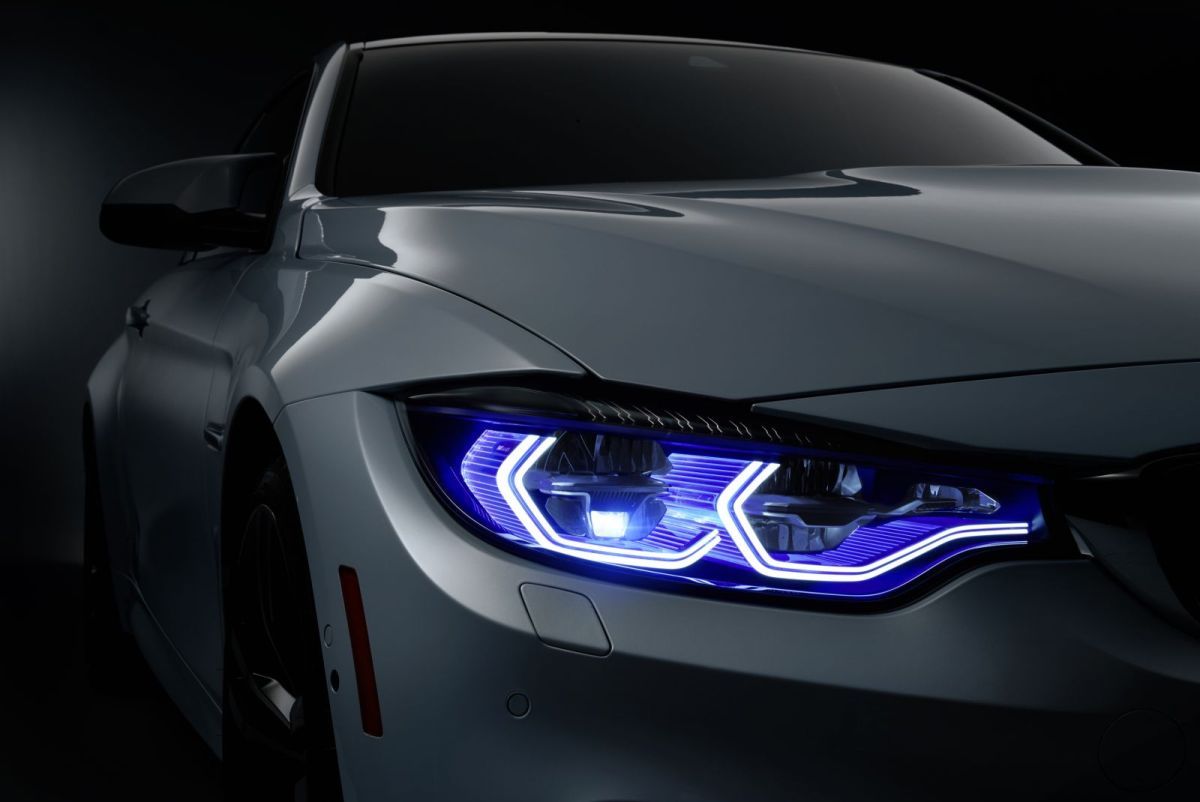
What Is an Adaptive Headlight and How Does It Work?
An adaptive headlight system is an advanced vehicle lighting technology that automatically changes the direction, intensity, or distribution of the headlight beam according to driving conditions and the surrounding environment.
With conventional headlights, the direction and distribution of the light beam are largely fixed. Adaptive headlights can use information such as steering angle, vehicle speed, road direction, road slope, and surrounding vehicles to adjust the lighting pattern.
The main purpose of the system is to improve visibility during night driving while reducing glare for other road users.
Adaptive lighting technology ranges from mechanically moving headlights to camera-controlled high-beam systems and advanced Matrix LED headlights that can control individual sections of the light beam.
How Does an Adaptive Headlight Work?
An adaptive headlight system is not made up of a single component. Depending on the vehicle, it can include sensors, cameras, electronic control modules, and mechanically or electronically controlled lighting components.
The system generally works as follows:
-
The vehicle collects information from various sensors.
-
A front-facing camera monitors the road and surrounding vehicles.
-
Vehicle speed and steering angle are evaluated.
-
The lighting control unit determines the appropriate lighting pattern.
-
The direction or distribution of the headlight beam is adjusted.
-
If necessary, specific sections of the high beam are switched off or reduced.
This allows the system to provide the driver with the best possible visibility under changing road conditions.
Main Components of an Adaptive Headlight System
The exact configuration varies between vehicles, but an advanced adaptive lighting system may include:
-
Headlight assembly
-
LED, xenon, or other light sources
-
Headlight control module
-
Electric adjustment motors
-
Steering angle sensor
-
Vehicle speed information
-
Ride-height or leveling sensors
-
Front-facing camera
-
Rain and light sensor
-
Vehicle network communication
-
Electronic control units
Not every vehicle uses all of these components.
How Does Adaptive Cornering Lighting Work?
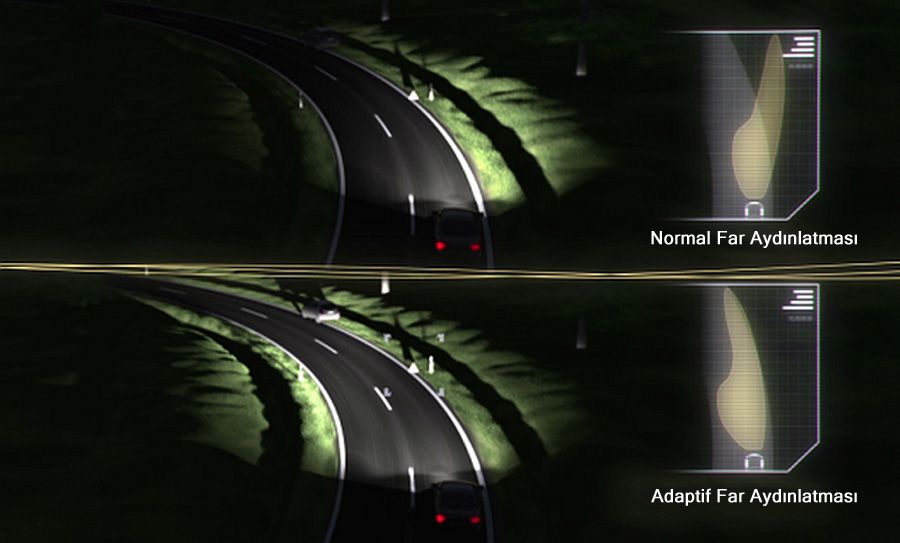
One of the best-known features of adaptive headlights is cornering illumination.
With fixed headlights, the beam generally continues pointing in the same direction as the vehicle body. When the vehicle enters a bend, part of the road ahead may therefore remain poorly illuminated.
Adaptive cornering headlights can use steering angle and vehicle movement information to direct the light beam toward the inside of the corner.
For example, when the vehicle turns right, the system can increase illumination toward the right-hand side of the road.
This can be particularly useful on:
-
Dark corners
-
Mountain roads
-
Rural roads
-
Poorly illuminated roads
Why Is Steering Angle Important?
The steering angle sensor provides important information to the adaptive lighting system.
When the driver turns the steering wheel, the system can determine the intended direction of travel.
However, the system does not normally rely on steering angle alone. Vehicle speed and other vehicle dynamics information can also be considered.
A sharp turn at low speed and a small steering input at high speed do not necessarily require the same lighting response.
Modern systems therefore combine information from several sources.
Adaptive Headlights and Vehicle Speed
Some adaptive headlight systems change their lighting characteristics according to vehicle speed.
At lower speeds, the system may provide a wider beam to illuminate a larger area close to the vehicle.
At higher speeds, the system may prioritize longer-range illumination.
This allows the lighting pattern to adapt to different situations such as:
-
City driving
-
Rural roads
-
Curved roads
-
Highways
The exact lighting strategy depends on the vehicle manufacturer and headlight system.
Are Adaptive Headlights the Same as Automatic High Beams?
No.
Automatic high-beam systems and adaptive headlights are related technologies, but they are not the same thing.
Automatic high beams use a camera or other sensors to determine when the high beam should be switched on or off.
For example, when an approaching vehicle is detected, the system can turn off the high beam. Once the vehicle has passed, the high beam can be activated again.
An adaptive system can go further by changing the direction or distribution of the light beam and, in more advanced systems, selectively controlling individual areas of the beam.
Therefore, a vehicle with automatic high beams does not necessarily have a fully adaptive headlight system.
What Is a Matrix LED Adaptive Headlight?
Matrix LED headlights are one of the more advanced forms of adaptive lighting technology.
Instead of using one continuous light source, the headlight contains multiple individually controlled LED segments.

A front-facing camera can detect vehicles ahead or approaching from the opposite direction. The lighting control system can then adjust individual LED segments according to their position.
For example, if an approaching vehicle is detected, the LEDs illuminating the area around that vehicle can be dimmed or switched off while the remaining sections continue providing high-beam illumination.
This allows the driver to maintain a wide and long field of visibility while reducing glare for other drivers.
How Does Matrix LED Work?
The basic operating principle is:
-
The camera scans the road ahead.
-
Approaching and preceding vehicles are detected.
-
Their position is determined.
-
The headlight control unit calculates the required lighting pattern.
-
Individual LED segments are dimmed or switched off where necessary.
-
The remaining segments continue operating.
This process can happen very quickly.
As a result, the headlight does not simply produce one fixed beam. Instead, it continuously creates a lighting pattern adapted to the traffic environment.
What Is the Difference Between Adaptive Headlights and Xenon Headlights?
Xenon refers primarily to a type of light source, while adaptive lighting refers to how the light is controlled.
Therefore, xenon and adaptive headlights are not competing technologies.
A vehicle can have:
-
Fixed xenon headlights
-
Adaptive xenon headlights
-
Fixed LED headlights
-
Adaptive LED headlights
-
Matrix LED headlights
The important distinction is not only the type of light source but also whether and how the beam can be controlled.
Are Adaptive Headlights the Same as Automatic Headlight Leveling?
No.
Automatic headlight leveling and adaptive lighting have different functions.
Automatic headlight leveling helps maintain the correct vertical headlight position when the vehicle load or body position changes.
For example, when heavy luggage or passengers are added to the rear of the vehicle, the rear suspension may sit lower. This can cause the headlights to point too high.
The leveling system adjusts the headlight position to compensate for this change.
Adaptive lighting is a broader concept that can include cornering illumination, beam distribution changes, and traffic-responsive lighting.
A vehicle can have both automatic leveling and adaptive headlights.
What Information Does an Adaptive Headlight Use?
Depending on the sophistication of the system, it may use information such as:
-
Steering angle
-
Vehicle speed
-
Yaw rate
-
Vehicle acceleration
-
Suspension height
-
Vehicle load
-
Front camera images
-
Approaching vehicles
-
Vehicles traveling ahead
-
Road direction
-
Road gradient
-
Ambient light
The electronic control system processes this information and determines how the headlights should operate.
Symptoms of Adaptive Headlight Failure
An adaptive headlight system can produce several different symptoms when a fault occurs.
Possible symptoms include:
-
Headlight does not move when cornering
-
Headlight remains fixed in one direction
-
Incorrect headlight leveling
-
Left and right headlights positioned at different heights
-
Matrix LED segments not operating
-
Automatic high beam not activating
-
Headlight warning appearing on the dashboard
-
Adaptive lighting system being disabled
-
Headlights remaining in a basic operating mode
Depending on the vehicle, the entire adaptive system may be disabled, or only certain functions may be deactivated.
Common Causes of Adaptive Headlight Problems
Adaptive headlight systems can develop faults for both electrical and mechanical reasons.
Common causes include:
-
Headlight adjustment motor failure
-
Ride-height sensor failure
-
Steering angle sensor problems
-
Camera calibration problems
-
Headlight control module failure
-
Damaged wiring
-
Loose or corroded connectors
-
Water or moisture entering the headlight
-
LED module failure
-
Software problems
-
Low battery voltage
-
Missing coding or calibration after headlight replacement
Camera or headlight replacement can be particularly important because some systems require calibration and coding after components are replaced.
How Are Adaptive Headlight Problems Diagnosed?
Replacing the entire headlight is not always the correct solution.
The vehicle should first be scanned using an appropriate diagnostic system.
Depending on the vehicle, technicians may check:
-
Headlight control module
-
Body control module
-
Camera system
-
Ride-height sensors
-
Steering angle information
-
Headlight adjustment motors
-
LED modules
-
Communication networks
-
Stored diagnostic trouble codes
The conditions under which the fault occurs are also important.
For example, a ride-height sensor fault and a headlight adjustment motor fault can produce similar symptoms, but the required repairs are completely different.
Why Is Adaptive Headlight Calibration Important?
Correct calibration of cameras and sensors is essential for advanced adaptive lighting systems.
If the front camera is replaced, the windshield is replaced, or work is performed around the front of the vehicle, camera calibration may be required on some vehicles.
Similarly, work involving headlights, suspension components, or ride-height sensors may require the headlight leveling system to be recalibrated.
A system with incorrect calibration may misidentify the position of other vehicles or direct the light beam incorrectly.
Advantages of Adaptive Headlights
The main advantage of adaptive headlights is their ability to optimize nighttime visibility according to driving conditions.
Potential benefits include:
-
Better visibility through corners
-
Wider road illumination
-
More effective high-beam use
-
Reduced glare for approaching drivers
-
Different lighting patterns at different speeds
-
Improved nighttime driving visibility
-
Less need for the driver to manually control high beams
Advanced Matrix LED systems can provide particularly precise control over the light beam compared with conventional headlights.
Disadvantages of Adaptive Headlights
Adaptive lighting systems also have some disadvantages.
The biggest disadvantage is increased complexity.
A modern adaptive headlight may contain motors, electronic modules, sensors, cameras, and multiple LED components in addition to the light source itself.
As a result:
-
Diagnosis can be more complicated.
-
Replacement parts can be expensive.
-
Complete headlight replacement can be costly.
-
Camera calibration may be required.
-
Coding or software procedures may be necessary.
-
Moisture can cause electronic problems.
-
Individual component failures can disable certain functions.
On advanced Matrix LED systems, even a problem with a specific LED module or control component can affect part of the lighting system.
Can Adaptive Headlights Be Installed Later?
In some vehicles, adaptive headlights can technically be retrofitted.
However, replacing only the headlight assembly is often not enough.
Depending on the vehicle, the retrofit may require:
-
Adaptive headlight assemblies
-
Headlight control modules
-
Additional wiring
-
Front camera
-
Ride-height sensors
-
Control units
-
Software configuration
-
Coding
-
Calibration
The vehicle's electronic and mechanical architecture must therefore be compatible with the system.
Installing a headlight that looks adaptive does not necessarily mean that the vehicle actually has a functioning adaptive lighting system.
Adaptive Headlights vs Fog Lights
Adaptive headlights and fog lights serve different purposes.
Fog lights are generally designed to illuminate the area relatively close to the vehicle and can help improve visibility in certain low-visibility conditions.
Adaptive headlights change the direction or distribution of the main lighting system according to driving conditions.
Some vehicles use a separate cornering light or even a fog-light function to illuminate the inside of a turn. However, this does not necessarily mean that the vehicle has a true adaptive headlight system.
Do Adaptive Headlights Improve Safety?
A properly functioning adaptive headlight system can improve nighttime visibility and driving comfort.
Better illumination through corners and on poorly lit roads can help the driver identify road edges, obstacles, curves, and other vehicles earlier.
However, correct operation is essential.
Incorrect headlight height, poor camera calibration, damaged sensors, or a malfunctioning adaptive system can prevent the system from providing its intended performance.
Final Thoughts
Adaptive headlights are advanced vehicle lighting systems designed to improve nighttime visibility by adjusting the direction or distribution of the light according to driving conditions.
Depending on the technology, the system may use steering angle, vehicle speed, suspension sensors, cameras, and other vehicle information to control the headlights.
Basic adaptive systems can turn the headlights toward a corner, while advanced Matrix LED systems can divide the light beam into multiple independently controlled sections and automatically adjust illumination around other vehicles.
Adaptive lighting therefore does not simply mean producing more light. Its main advantage is putting the available light in the right place at the right time while minimizing unnecessary glare.