TR
TR EN
EN

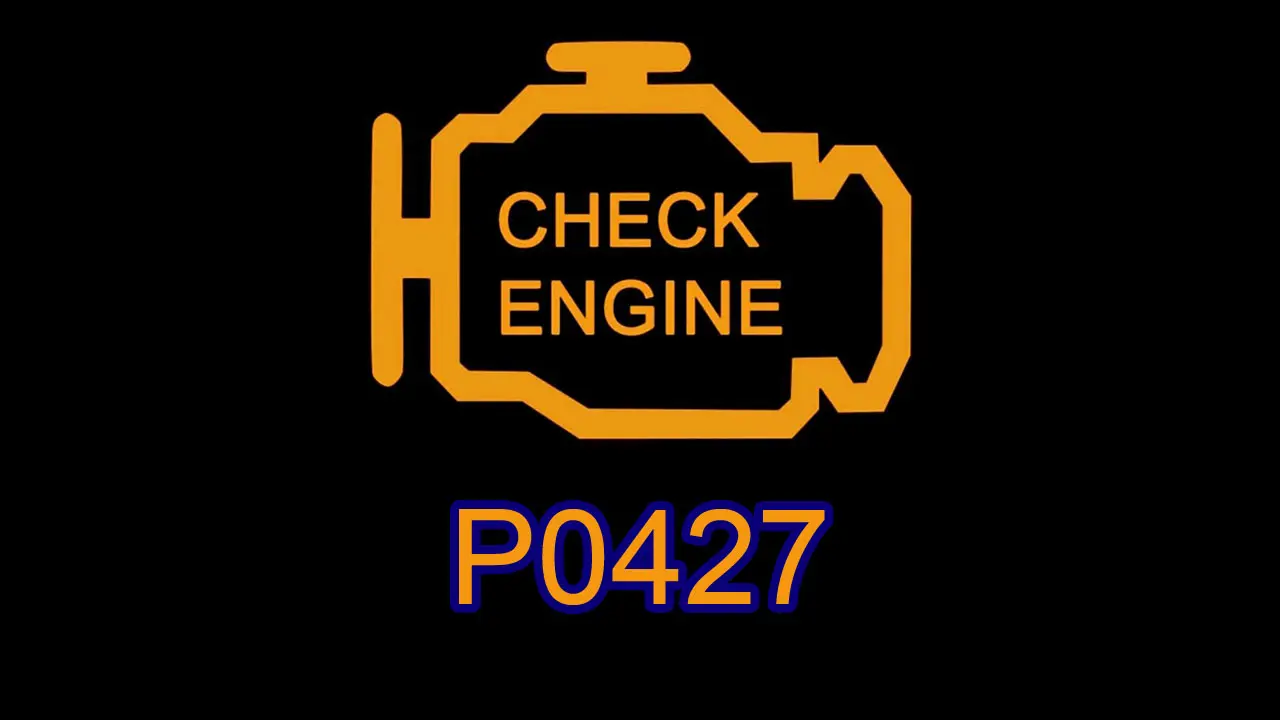
P0427 Catalyst Temperature Sensor Circuit Low (Bank 1 Sensor 1)
The P0427 trouble code means the engine control module (ECM/PCM) has detected a low electrical signal from the catalyst temperature sensor circuit for Bank 1 Sensor 1.
This code is primarily an electrical circuit fault. It does not automatically mean that the catalytic converter itself is damaged, clogged, or no longer working.
The sensor is used to provide the engine computer with information about exhaust or catalyst temperature. Depending on the vehicle, this information can be used to monitor catalyst operation, protect components from excessive heat, control fuel and emissions strategies, and evaluate whether the catalytic converter is reaching the expected temperature.
The exact sensor design varies considerably between manufacturers. Some vehicles use a dedicated catalyst temperature sensor, while others use an exhaust gas temperature sensor positioned before or near the catalytic converter.
What Does “Bank 1 Sensor 1” Mean?
The terminology is important when diagnosing P0427.
Bank 1 refers to the engine bank containing cylinder number 1.
On an inline four-cylinder or inline six-cylinder engine, there is normally only one cylinder bank, so the system is considered Bank 1.
On a V6, V8, or another multi-bank engine, there are two cylinder banks. Bank 1 is the side containing cylinder #1.
Sensor 1 generally refers to the sensor positioned upstream of the catalytic converter, although the exact sensor arrangement can vary by manufacturer and engine design.
Therefore, P0427 is not simply saying “the catalytic converter is cold.” It is specifically reporting that the ECM sees a low electrical signal or low sensor output in the Bank 1 Sensor 1 catalyst-temperature sensing circuit.
What Does “Circuit Low” Mean?
This is one of the most important parts of understanding P0427.
The word “Low” refers primarily to the electrical signal being lower than the ECM expects.
It does not necessarily mean that the catalytic converter itself has a low physical temperature.
For example, depending on the sensor design, a low signal can be caused by:
-
A short to ground
-
A damaged signal wire
-
A sensor with an internal electrical fault
-
A problem with the sensor's power or reference circuit
-
A poor connector connection
-
Corrosion inside the connector
-
An incorrect sensor
-
A wiring repair performed incorrectly
-
A sensor ground problem
-
A control-module fault
The actual electrical interpretation depends on whether the vehicle uses a thermistor-type temperature sensor, thermocouple, amplified sensor, or another manufacturer-specific design.
This is why measuring a sensor with a generic resistance value found online is not always a reliable diagnosis.
How the Catalyst Temperature Sensor Works
The catalytic converter needs to reach a sufficiently high operating temperature before it can efficiently convert harmful exhaust gases.
During a cold start, the catalyst is relatively cool. The engine management system therefore has to consider how quickly the exhaust system and catalyst are warming.
A temperature sensor can provide the ECM with information about the temperature of the exhaust or catalyst area.
Depending on the vehicle, the ECM may use this information to:
-
Monitor catalyst warm-up
-
Evaluate catalyst operating conditions
-
Protect the catalyst from excessive temperature
-
Adjust fuel or ignition strategies
-
Support emissions monitoring
-
Detect abnormal exhaust temperatures
-
Assist other emission-control diagnostics
The sensor itself does not normally control the catalytic converter. It measures temperature and reports information to the control system.
Common Causes of P0427
There are several possible causes, and the correct diagnosis depends heavily on the vehicle's wiring and sensor configuration.
Faulty catalyst temperature sensor
The sensor itself may have an internal electrical failure. Internal damage can cause the output to remain abnormally low or fall outside the expected operating range.
Shorted signal wire
A signal wire touching ground or another circuit can pull the sensor signal down.
This is a particularly important possibility when the code appeared suddenly after wiring work, exhaust work, or repairs around the engine.
Damaged wiring
The wiring around the exhaust system is exposed to considerable heat. Insulation can become brittle, melt, crack, or contact hot exhaust components.
A wire may look acceptable from above while being damaged closer to the exhaust manifold or catalytic converter.
Poor electrical connection
A loose terminal, corroded connector, pushed-back terminal, water intrusion, or damaged connector lock can produce an incorrect sensor signal.
Sensor ground problem
If the sensor depends on a dedicated ground or sensor return circuit, excessive resistance or an open ground can interfere with its signal.
Power or reference problem
Some temperature-sensing systems require a specific supply or reference circuit. A missing or abnormal supply can produce a low or implausible signal.
Incorrect sensor installation
Installing the wrong sensor, an incompatible aftermarket sensor, or a sensor with a different electrical characteristic can cause the ECM to interpret the signal incorrectly.
Exhaust system damage
Although P0427 is fundamentally a sensor-circuit code, physical damage around the sensor mounting point or exhaust system can affect sensor operation.
Control-module problem
An ECM/PCM fault is possible, but it should normally be considered only after the sensor, wiring, connectors, power, ground, and related components have been properly tested.
Symptoms of P0427
P0427 can produce very different symptoms depending on how the vehicle uses the catalyst temperature signal.
Common symptoms include:
-
Check Engine Light
-
Emissions warning
-
Failed emissions inspection
-
Increased emissions
-
Abnormal catalyst monitoring
-
Reduced fuel economy
-
Slight hesitation
-
Reduced engine performance in some vehicles
-
Additional catalyst or exhaust-related fault codes
However, some vehicles may drive almost normally with P0427.
The ECM may still be able to operate the engine using substitute values or information from other sensors. In that situation, the driver may notice nothing except the illuminated Check Engine Light.
Can P0427 Cause the Catalytic Converter to Fail?
P0427 does not automatically mean the catalytic converter has failed.
The code identifies a problem with the catalyst temperature sensor circuit.
That distinction is important.
A faulty sensor may simply prevent the ECM from accurately determining catalyst temperature. Replacing an expensive catalytic converter without testing the sensor circuit could therefore solve nothing.
At the same time, an actual exhaust or catalyst problem should not be ignored. A severely restricted catalytic converter, abnormal combustion, misfire, or excessively rich mixture can create unusual exhaust temperatures and may generate additional codes.
The correct approach is to diagnose the complete system rather than replacing the converter based on P0427 alone.
P0427 and the Catalytic Converter Are Not the Same Fault
There is an important difference between temperature-sensor codes and catalyst-efficiency codes.
P0427 concerns the electrical signal from the catalyst temperature sensing system.
A code such as P0420 – Catalyst System Efficiency Below Threshold (Bank 1) concerns the ECM's evaluation of catalytic converter efficiency.
A vehicle can therefore have:
-
A good catalytic converter with a faulty temperature sensor
-
A good sensor with an actual catalyst problem
-
Both a sensor problem and a catalyst problem
-
A wiring problem that makes a good sensor appear faulty
This distinction can prevent unnecessary catalyst replacement.
Diagnosing P0427 Correctly
A professional diagnosis should begin with the complete vehicle configuration rather than immediately replacing the sensor.
1. Scan all stored codes
Check for additional DTCs before focusing exclusively on P0427.
Codes related to:
-
Misfires
-
Fuel mixture
-
Oxygen sensors
-
Exhaust temperature
-
Catalyst efficiency
-
Engine coolant temperature
-
Wiring or power supply
may provide important clues.
If several codes appeared simultaneously, they may share a common electrical or engine-related cause.
2. Check the freeze-frame data
Freeze-frame information can show what the ECM was seeing when P0427 was recorded.
Look at:
-
Engine RPM
-
Engine load
-
Coolant temperature
-
Vehicle speed
-
Fuel trims
-
Sensor temperature values
-
Operating conditions
This can help determine whether the problem occurred during a cold start, warm operation, acceleration, or steady cruising.
3. Identify the exact sensor
Do not assume that every vehicle uses the same catalyst-temperature sensor arrangement.
Use the manufacturer's wiring diagram and component information to determine:
-
Sensor location
-
Connector pinout
-
Sensor type
-
Power supply
-
Ground or sensor return
-
Signal circuit
-
Expected operating characteristics
4. Inspect the wiring near the exhaust
This is one of the most valuable physical checks.
Look carefully for:
-
Melted insulation
-
Burn marks
-
Chafing
-
Broken wires
-
Wires touching the exhaust
-
Poor previous repairs
-
Corroded terminals
-
Loose connectors
-
Water contamination
Pay particular attention to areas close to the catalytic converter and exhaust manifold.
5. Check the electrical circuit
Test the sensor circuit according to the manufacturer's specifications.
Depending on the system, this may include checking:
-
Supply voltage
-
Reference voltage
-
Sensor ground
-
Signal voltage
-
Continuity
-
Short to ground
-
Short to voltage
-
Voltage drop
-
Sensor response
Do not assume a universal voltage or resistance specification. Different temperature sensors can have very different electrical characteristics.
6. Compare scan-tool temperature data
If the scan tool displays catalyst or exhaust temperature, observe the value under different operating conditions.
A temperature value that remains fixed, is implausible compared with engine conditions, or changes incorrectly can help distinguish a sensor problem from a wiring problem.
7. Test the sensor itself
If the wiring, power, ground, and connector are correct, test the sensor according to the manufacturer's procedure.
A sensor that does not respond correctly to temperature changes may need replacement.
The correct test procedure depends on the sensor technology used by the vehicle.
8. Check for exhaust and engine problems
If the electrical circuit tests correctly, investigate the broader system.
Misfires, incorrect fuel mixture, ignition problems, fuel-injection faults, exhaust restrictions, and other engine-management problems can affect catalyst temperature and may generate additional DTCs.
Why a Simple Continuity Test May Not Be Enough
A wire can pass a basic continuity test and still fail when the engine is running.
For example, a damaged wire may have enough contact to show continuity with a multimeter but develop excessive resistance when exposed to:
-
Engine vibration
-
Heat
-
Harness movement
-
Moisture
-
Current flow
For this reason, professional diagnosis may require voltage-drop testing, circuit loading, live-data monitoring, and physical movement of the harness while observing the sensor signal.
This is especially useful when P0427 appears intermittently.
Could the Catalytic Converter Itself Cause P0427?
It is possible for an exhaust or catalyst problem to influence temperature readings, but that does not make the catalytic converter the first component to replace.
If the ECM specifically reports a low sensor-circuit signal, the electrical circuit should be checked first.
A catalytic converter should generally be considered after the sensor and its circuit have been verified and after other engine-management problems have been ruled out.
P0427 vs P0425
These two codes are closely related but describe different problems.
P0425 – Catalyst Temperature Sensor Circuit Malfunction (Bank 1 Sensor 1)
This is a general malfunction of the catalyst temperature sensor circuit.
P0427 – Catalyst Temperature Sensor Circuit Low (Bank 1 Sensor 1)
This indicates that the ECM has specifically identified a low signal condition.
Therefore, P0427 provides more directional information than the general P0425 circuit-malfunction code.
P0427 vs P0426
P0426 – Catalyst Temperature Sensor Range/Performance (Bank 1 Sensor 1)
This means the sensor signal is outside the expected range or does not behave as the ECM expects.
P0427 specifically points toward a low electrical signal.
A range/performance fault does not necessarily mean the signal is simply low.
P0427 vs P0428
P0428 – Catalyst Temperature Sensor Circuit High (Bank 1 Sensor 1)
P0428 is essentially the opposite electrical direction from P0427.
-
P0427: signal too low
-
P0428: signal too high
The physical causes can overlap, but the electrical failure mode is different.
For example, a short to ground may contribute to a low-signal condition, while a short to voltage or an open circuit can produce a high-signal condition on certain sensor designs.
The exact result still depends on the manufacturer's circuit architecture.
Can You Drive With P0427?
If the engine is running normally and there are no severe symptoms, the vehicle may remain driveable with P0427 for a limited period.
However, the fault should not simply be ignored.
A faulty catalyst-temperature signal can interfere with emissions monitoring and may prevent the vehicle from correctly detecting other exhaust-system problems.
Driving should be treated more urgently if P0427 is accompanied by:
-
Flashing Check Engine Light
-
Severe misfire
-
Major loss of power
-
Excessive exhaust heat
-
Strong fuel smell
-
Abnormal exhaust noise
-
Engine overheating
-
Severe hesitation or stalling
A flashing Check Engine Light, in particular, can indicate a serious misfire capable of damaging the catalytic converter.
Repairing P0427
The correct repair depends on the actual cause.
Possible repairs include:
-
Replacing the catalyst temperature sensor
-
Repairing damaged wiring
-
Repairing or replacing a connector
-
Restoring a sensor ground
-
Repairing a power or reference circuit
-
Correcting a short to ground
-
Correcting a short to voltage
-
Replacing damaged exhaust-side wiring
-
Correcting an incorrect sensor installation
-
Repairing an underlying engine or exhaust problem
-
Addressing a control-module fault when properly diagnosed
Simply clearing P0427 with a scan tool does not repair the problem. If the underlying fault remains, the ECM will generally detect it again when the appropriate monitoring conditions occur.
Final Diagnosis
P0427 – Catalyst Temperature Sensor Circuit Low (Bank 1 Sensor 1) is primarily a low electrical signal fault involving the catalyst temperature sensing circuit.
The most important diagnostic distinction is that “low” describes the electrical signal, not necessarily the actual temperature of the catalytic converter.
A faulty sensor is one possibility, but wiring damage, a short to ground, connector problems, power or ground faults, an incorrect sensor, and other circuit issues can produce exactly the same DTC.
The most reliable diagnosis is therefore to identify the vehicle's exact sensor configuration, inspect the exhaust-side wiring, verify power and ground, monitor live sensor data, test the signal circuit under the correct conditions, and only then determine whether the sensor or another component needs to be replaced.