TR
TR EN
EN

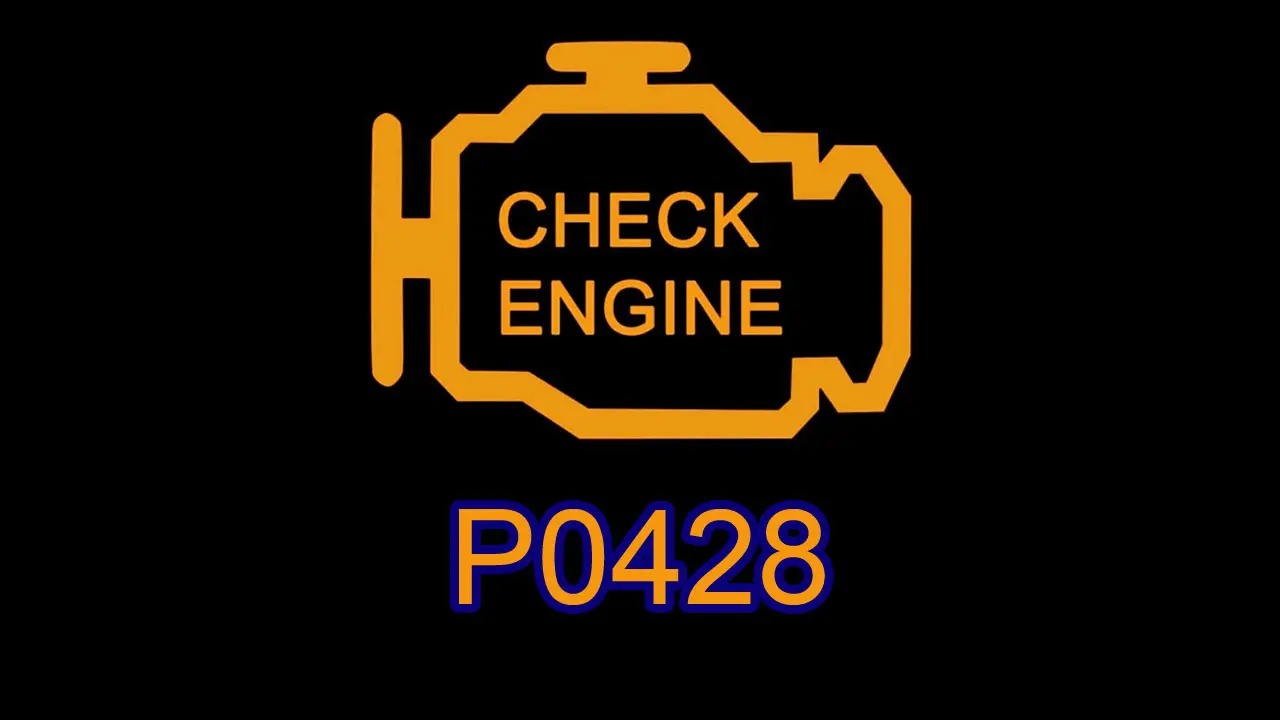
P0428 Catalyst Temperature Sensor Circuit High (Bank 1 Sensor 1)
P0428 means the engine control module (ECM/PCM) has detected an abnormally high electrical signal in the catalyst temperature sensor circuit for Bank 1, Sensor 1.
The most important word in this code is “Circuit High.”
It does not automatically mean that the catalytic converter is overheating.
The ECM is primarily reporting that the electrical signal coming from the designated catalyst temperature sensor is higher than the value it expects.
Depending on the vehicle, that high signal can be caused by the sensor itself, an open circuit, a short to voltage, a wiring problem, a connector problem, or another fault in the sensor circuit.
Only after the electrical side has been proven correct should you start asking whether the catalyst is actually running too hot.
What Does Bank 1, Sensor 1 Mean?
Bank 1 is the cylinder bank containing cylinder number 1.
On a V6, V8 or another multi-bank engine, there are two cylinder banks. Bank 1 contains cylinder #1, while Bank 2 is the opposite bank.
Sensor 1 generally refers to the sensor located toward the upstream side of the exhaust system, but the exact meaning and physical location can vary by manufacturer.
This is particularly important with catalyst temperature sensors because manufacturers do not all use identical exhaust layouts.
The sensor may be installed:
-
In or near the catalytic converter
-
Immediately upstream of the catalyst
-
In the exhaust pipe close to the catalyst
-
As part of a catalyst temperature monitoring assembly
Therefore, the exact physical location should always be confirmed using the vehicle's service information.
What Does a Catalyst Temperature Sensor Do?
A catalyst temperature sensor provides the ECM with information about exhaust or catalyst temperature.
The ECM can use this information for several purposes depending on the vehicle, including:
-
Catalyst temperature monitoring
-
Catalyst protection
-
Emissions control
-
Fuel and ignition strategy
-
Catalyst warm-up monitoring
-
Exhaust temperature management
-
DPF regeneration strategies on some applications
The sensor allows the ECM to determine whether exhaust temperatures are within an acceptable range.
This information can become particularly important because catalytic converters can be damaged by excessive heat.
However, the sensor itself is an electrical device, and the ECM can only determine temperature from the signal it receives.
If that signal is wrong, the ECM can believe the catalyst is at an abnormal temperature even when the actual temperature is normal.
What Does “Circuit High” Actually Mean?
This is where P0428 is often misunderstood.
A high circuit signal means the ECM is detecting a voltage or electrical value higher than the expected range for that sensor circuit.
It does not necessarily mean:
“The catalyst temperature is too high.”
For example, if the engine has been sitting overnight and the catalyst is cold, the scan tool should normally show a temperature that is reasonably consistent with the surrounding conditions, depending on the sensor technology.
If the scan tool instead reports an extremely high temperature immediately after ignition is switched on, before the engine has warmed up, that is a strong clue that the problem may be electrical.
The actual electrical interpretation depends on the sensor design.
Catalyst Temperature Sensors Are Not All the Same
One of the biggest mistakes in diagnosing P0428 is assuming that every catalyst temperature sensor uses the same electrical characteristics.
Different manufacturers can use different sensor technologies.
A temperature sensor may behave as a thermistor, thermocouple or another temperature-sensing device.
For a thermistor-based system, the relationship between temperature and resistance is determined by the sensor design.
That means there is no universal resistance value or universal voltage that can be used to diagnose every P0428 vehicle.
The manufacturer's specifications should be used.
This is particularly important before condemning a sensor based on a resistance measurement.
Common Causes of P0428
Several problems can produce a high catalyst temperature sensor circuit signal.
Failed catalyst temperature sensor
The sensor may internally fail and produce an abnormally high signal.
Open circuit
Depending on the sensor and circuit design, a broken wire or disconnected sensor can cause the ECM input to rise to an abnormally high value because of the module's internal pull-up or signal-processing strategy.
This is why an “open circuit” can sometimes result in a “high input” code.
Signal wire shorted to voltage
If the sensor signal wire contacts a battery-voltage source or another higher-voltage circuit, the ECM can detect a high input.
Damaged wiring
The exhaust system operates at high temperatures, so wiring routed near the catalyst is exposed to considerable thermal stress.
The insulation can become brittle, melt or rub against surrounding components.
Corroded or damaged connector
Water, road salt, heat and vibration can damage exhaust sensor connectors.
A connector can also develop poor terminal tension, causing an intermittent or abnormal signal.
Reference or ground problem
Some temperature-sensor systems rely on a specific reference or ground arrangement.
A poor ground or abnormal reference can change the sensor signal and produce an incorrect temperature reading.
Incorrect sensor
Installing the wrong sensor or a sensor with different electrical characteristics can result in an implausible temperature signal.
ECM/PCM fault
This is much less common, but a damaged input circuit inside the ECM can produce an incorrect reading.
It should normally be considered only after the sensor and wiring have been properly tested.
Can P0428 Mean the Catalyst Is Actually Too Hot?
It can, but the code itself does not prove it.
An engine can genuinely produce excessive exhaust temperatures under certain conditions.
Possible causes include:
-
Severe misfire
-
Excessively rich air-fuel mixture
-
Incorrect ignition timing
-
Fuel-injection problems
-
Air-fuel control problems
-
Exhaust restriction
-
Engine-management faults
A misfire is particularly important.
When combustion does not occur correctly inside the cylinder, unburned fuel can enter the exhaust. That fuel may burn inside the catalytic converter and generate extremely high temperatures.
Repeated overheating can permanently damage the catalyst.
Therefore, if P0428 appears together with misfire or fuel-mixture codes, those faults should be investigated before assuming the temperature sensor itself is defective.
What Symptoms Can P0428 Cause?
P0428 can sometimes occur with almost no noticeable drivability problem.
The driver may simply see:
-
Check Engine Light
-
Emissions warning
-
Failed emissions test
-
Reduced catalyst-monitor readiness
Depending on the vehicle and the underlying cause, additional symptoms can include:
-
Poor fuel economy
-
Rough running
-
Hesitation
-
Reduced engine power
-
Misfire
-
Excessive exhaust heat
-
Fuel odor
-
Catalyst damage
If the sensor is giving an artificially high temperature reading, the engine may still run normally.
The ECM may nevertheless change its emissions strategy or disable certain functions because it cannot trust the temperature information.
How P0428 Should Be Diagnosed
The best diagnosis starts with determining whether the problem is electrical or genuinely thermal.
Start with a complete scan
Do not look only at P0428.
Check the ECM and other modules for related faults involving:
-
Oxygen sensors
-
Air-fuel sensors
-
Misfires
-
Fuel mixture
-
Engine temperature
-
Exhaust pressure
-
Catalyst efficiency
-
Other temperature sensors
A group of related codes can provide a much clearer direction than P0428 alone.
Check the freeze-frame data
Look at the conditions under which the ECM stored the code.
Pay attention to:
-
Engine coolant temperature
-
Engine RPM
-
Engine load
-
Vehicle speed
-
Catalyst temperature
-
Fuel trims
-
Oxygen/air-fuel sensor data
If the catalyst temperature signal was already implausibly high when the engine was cold, the electrical circuit becomes a much stronger suspect.
Check the Temperature Reading With a Cold Engine
This is one of the most useful initial tests.
Allow the engine to cool completely.
Then compare the catalyst temperature reported by the scan tool with the surrounding temperature and other relevant temperature sensors.
The values do not have to be identical, but a completely unrealistic reading is significant.
For example, if the vehicle has been sitting overnight and the catalyst temperature sensor reports an extremely high temperature before the engine starts, the catalyst obviously has not reached that temperature through normal operation.
That points toward a sensor or electrical problem.
This simple observation can prevent unnecessary catalyst replacement.
Inspect the Wiring Around the Catalyst
The catalyst is one of the hottest components under the vehicle, so the wiring deserves particular attention.
Look for:
-
Melted insulation
-
Burn marks
-
Brittle wiring
-
Wires touching the exhaust
-
Chafing
-
Broken conductors inside the insulation
-
Corrosion
-
Loose connectors
-
Damaged terminals
-
Incorrect previous repairs
A wire can look acceptable from the outside while having internal damage.
Moving the harness carefully while monitoring the sensor signal can sometimes reveal an intermittent fault.
Test the Sensor Circuit
Once the physical inspection is complete, test the circuit according to the manufacturer's wiring diagram.
Depending on the design, this may involve checking:
-
Sensor supply/reference
-
Sensor ground
-
Signal circuit
-
Continuity
-
Resistance
-
Voltage
-
Short to battery voltage
-
Short to ground
-
Voltage drop
-
Connector terminal condition
Do not assume that the sensor has a conventional 5-volt reference simply because it is a temperature sensor.
The circuit architecture must be identified first.
Check the Sensor Itself
If the wiring and connector are correct, the sensor should be tested according to the manufacturer's specifications.
For a resistance-based sensor, compare measured resistance with the manufacturer's temperature/resistance chart.
For other sensor technologies, a different diagnostic procedure may be required.
A sensor that produces an abnormal value at a known temperature can be considered defective if the rest of the circuit is correct.
Use Live Data Instead of Relying Only on the Stored Code
P0428 is especially suitable for live-data diagnosis.
Monitor the catalyst temperature signal while:
-
The engine is cold
-
The engine warms up
-
The vehicle idles
-
Engine RPM changes
-
The vehicle is driven under load
The temperature should respond in a physically believable manner for that particular sensor and exhaust system.
A reading that remains fixed at an extreme value, suddenly jumps without a corresponding change in operating conditions, or behaves differently from what the manufacturer's data indicates deserves further investigation.
Can a Bad Oxygen Sensor Cause P0428?
Not normally in the direct sense.
P0428 specifically concerns the catalyst temperature sensor circuit, while oxygen sensors measure oxygen concentration in the exhaust.
However, oxygen-sensor or air-fuel problems can indirectly cause excessive exhaust temperatures.
For example, an incorrect mixture can increase catalyst temperature and potentially create a genuine thermal problem.
Therefore, oxygen-sensor codes should not be ignored when they appear together with P0428, but an oxygen sensor should not be replaced simply because P0428 is present.
Can a Bad Catalytic Converter Cause P0428?
A damaged catalyst can be associated with abnormal exhaust temperatures, but P0428 is primarily a temperature-sensor circuit high code.
A physically damaged or restricted catalyst should therefore not be assumed to be the cause.
If the catalyst is suspected, first establish whether the temperature reported by the sensor is accurate.
If the sensor reports an extreme temperature and independent testing confirms that the exhaust really is excessively hot, then the engine and catalyst system should be investigated.
If the sensor reports an extreme temperature but the actual exhaust temperature is normal, the problem is much more likely to be in the sensor or its circuit.
P0428 vs P0425
These codes are related but not identical.
P0425 – Catalyst Temperature Sensor Circuit Malfunction (Bank 1 Sensor 1)
This is a broader catalyst-temperature sensor circuit malfunction.
P0428 – Catalyst Temperature Sensor Circuit High (Bank 1 Sensor 1)
This specifically indicates a high electrical input condition.
So P0428 provides more directional information than the general P0425 circuit-malfunction code.
P0428 vs P0426
P0426 – Catalyst Temperature Sensor Circuit Range/Performance (Bank 1 Sensor 1)
This indicates that the sensor signal is present but its value or behavior is outside the expected range or performance characteristics.
P0428 – Catalyst Temperature Sensor Circuit High
This indicates that the electrical input itself is higher than expected.
A range/performance code does not necessarily mean the voltage is simply “too high.” The ECM may be detecting an implausible response or relationship between temperature, engine operation and sensor behavior.
P0428 vs P0427
P0427 – Catalyst Temperature Sensor Circuit Low (Bank 1 Sensor 1)
This is the opposite electrical direction from P0428.
P0427 indicates a low input condition, while P0428 indicates a high input condition.
Neither code should automatically be interpreted as “the catalyst is too cold” or “the catalyst is too hot.”
They describe the electrical signal detected by the ECM.
Should the Catalyst Be Replaced?
Usually, not based on P0428 alone.
The catalytic converter should not be replaced simply because the code contains the word “catalyst.”
The diagnostic sequence should first establish:
Is the temperature reading real?
If not, diagnose the sensor and circuit.
Is the sensor circuit correct but the actual temperature abnormal?
Then investigate the engine and exhaust system.
Is the catalyst physically restricted or damaged?
If so, determine why it failed before installing another catalyst.
This approach prevents an expensive catalyst replacement when the actual problem is a damaged sensor wire or failed temperature sensor.
What Is the Correct Repair?
The repair depends on the confirmed cause.
A faulty sensor requires sensor replacement.
A damaged wire requires proper wiring repair.
A corroded connector requires connector or terminal repair.
A shorted signal circuit requires locating and correcting the source of the short.
An abnormal reference or ground requires repairing the relevant circuit.
If genuine excessive exhaust temperature is confirmed, the underlying engine or fuel/ignition problem must be repaired.
If the catalyst has subsequently been damaged, catalyst replacement may then be necessary.
The important point is that P0428 identifies an electrical high condition in the catalyst temperature sensor circuit; it does not tell you which component to replace.
Can You Drive With P0428?
That depends on what is causing the code.
If the vehicle runs normally and the code is caused by an electrical sensor fault, there may be no immediate drivability problem.
However, the fault should still be diagnosed because the ECM may no longer have reliable catalyst temperature information.
If the engine is actually producing excessive exhaust temperature, continuing to drive can cause serious catalyst or exhaust-system damage.
A flashing Check Engine Light, severe misfire, major loss of power, strong fuel smell, or unusually high exhaust temperature should be treated as a more urgent problem.
Final Diagnostic Perspective
P0428 means the ECM has detected a high electrical signal in the catalyst temperature sensor circuit for Bank 1, Sensor 1.
It does not automatically mean the catalytic converter is overheating, and it certainly does not automatically mean the catalytic converter needs to be replaced.
The most useful diagnostic path is:
Check all codes → examine freeze-frame data → check the cold-engine temperature reading → inspect the sensor and heat-damaged wiring → verify the circuit according to the wiring diagram → test the sensor → evaluate live-data behavior → determine whether the temperature is genuinely abnormal → investigate engine/exhaust causes if necessary.
The key distinction is between a genuinely high catalyst temperature and a sensor circuit that falsely tells the ECM the temperature is high.
That distinction is what makes P0428 a sensor-circuit diagnosis first, rather than a catalytic-converter replacement code.