TR
TR EN
EN

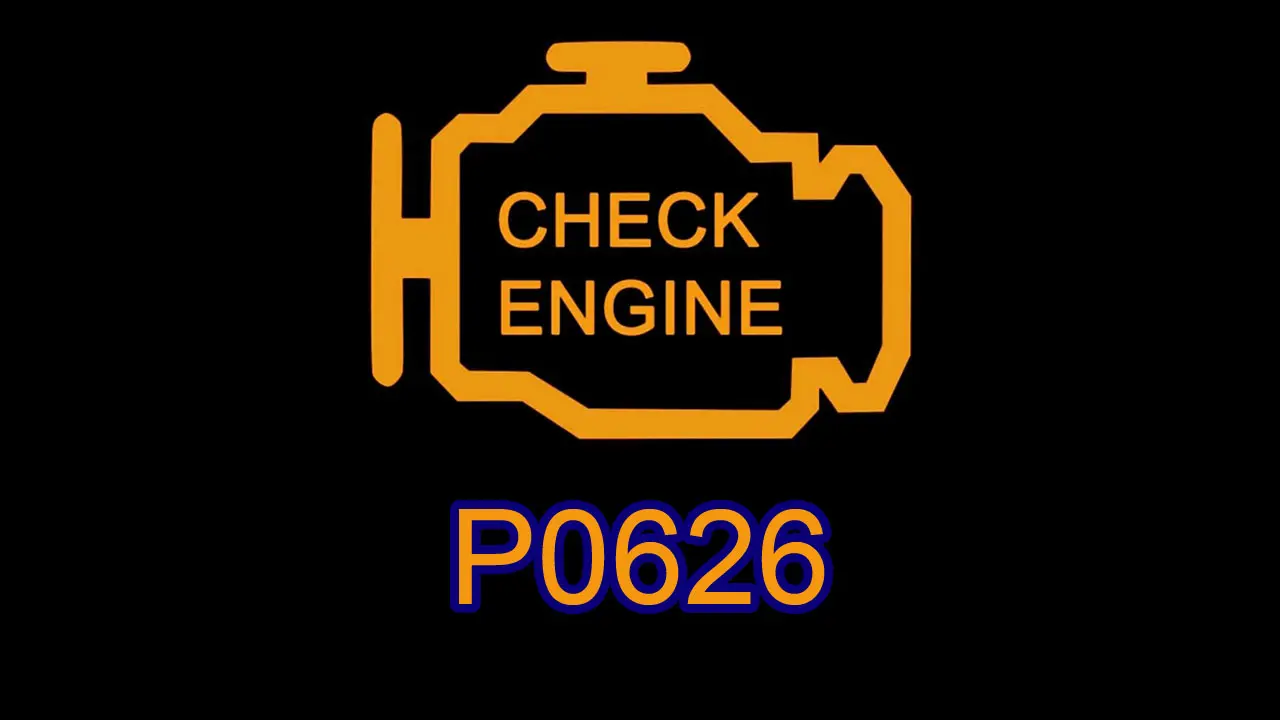
P0626 Generator Field/F Terminal Circuit High
The P0626 – Generator Field/F Terminal Circuit High diagnostic trouble code (DTC) indicates that the ECM/PCM has detected an abnormally high electrical signal in the generator field or F-terminal circuit.
In simple terms:
The engine computer is detecting higher-than-expected voltage or an abnormal electrical condition in the alternator's field-control circuit.
This code is related to the vehicle's charging system and alternator control, rather than directly indicating a battery failure.
The problem may involve:
-
Alternator
-
Generator field circuit
-
F-terminal
-
Voltage regulator
-
Alternator control wiring
-
Electrical connectors
-
ECM/PCM
-
Battery
-
Charging system wiring
What Is the Generator Field/F Terminal?
The generator field circuit controls the alternator's magnetic field and therefore influences how much electrical power the alternator produces.
The F terminal is commonly associated with the alternator's field or field-monitoring circuit, although the exact circuit design varies between manufacturers.
A simplified system can be represented as:
ECM/PCM ↔ Alternator/Voltage Regulator → Field Circuit → Alternator Output
The ECM may monitor the alternator's operation through this circuit.
If the voltage or signal on the F-terminal circuit becomes higher than the expected range, P0626 can be stored.
What Does P0626 Mean?
P0626 specifically indicates a high condition.
This is different from:
P0625 – Generator Field/F Terminal Circuit Low
P0626 means the monitored circuit is seeing a signal that is higher than the value expected by the control module.
This does not necessarily mean that the alternator is producing excessively high battery voltage. The problem can exist specifically within the field-control or monitoring circuit.
What Causes P0626?
Common possible causes include:
-
Faulty alternator
-
Faulty voltage regulator
-
Internal alternator regulator failure
-
Short to voltage in the field circuit
-
Damaged field-control wiring
-
Incorrect wiring repair
-
Corroded connector
-
Loose electrical terminal
-
ECM/PCM control circuit problem
-
Incorrect alternator installation
-
Charging-system voltage problem
-
Poor electrical connection
On some vehicles, the voltage regulator is integrated into the alternator, while on others the charging system is controlled differently.
Can a Bad Alternator Cause P0626?
Yes.
A defective alternator or internal voltage regulator is one of the important possibilities.
The alternator may have an internal fault that causes the field circuit to behave incorrectly.
Possible internal problems include:
-
Voltage regulator failure
-
Field circuit failure
-
Internal short circuit
-
Brush or slip-ring problems
-
Internal wiring damage
However, the alternator should not automatically be replaced simply because P0626 is present.
Can a Bad Voltage Regulator Cause P0626?
Yes.
The voltage regulator controls alternator field current to maintain appropriate charging voltage.
If the regulator fails, the field circuit can behave abnormally.
Depending on the failure, the vehicle may experience:
-
Overcharging
-
Undercharging
-
Unstable charging voltage
-
Battery warning light
-
P0626
Can P0626 Cause Overcharging?
It can, but P0626 does not automatically mean the vehicle is overcharging.
The code describes a high electrical condition in the generator field/F-terminal circuit.
If the regulator or alternator has failed in a way that causes excessive field current, charging voltage may also become too high.
Therefore, actual battery voltage should be measured.
Can P0626 Occur Without Overcharging?
Yes.
This is an important distinction.
The ECM can detect a high signal specifically in the field-control circuit even when the alternator's output voltage remains within an acceptable range.
For this reason:
P0626 ≠ automatically overcharging
The actual charging voltage and the field circuit both need to be evaluated.
Can a Short to Voltage Cause P0626?
Yes.
A field-control wire that is unintentionally connected to a voltage source can cause the monitored signal to become too high.
For example:
Damaged insulation → Field wire contacts battery/voltage supply → Circuit voltage rises → ECM detects high signal → P0626
This makes wiring inspection particularly important.
Can Damaged Wiring Cause P0626?
Yes.
The wiring between the alternator and the control module can become damaged through:
-
Heat
-
Vibration
-
Oil contamination
-
Corrosion
-
Previous repairs
-
Chafing
-
Incorrect routing
Inspect the harness near the alternator carefully because engine-bay temperatures can be high.
Can a Bad Connector Cause P0626?
Yes, potentially.
A loose, corroded or damaged connector can produce an abnormal field signal.
Inspect:
-
Alternator connector
-
F-terminal connection
-
ECM/PCM connector
-
Wiring terminals
-
Ground connections
Look for:
-
Corrosion
-
Bent pins
-
Loose terminals
-
Water intrusion
-
Burned contacts
Can a Bad Ground Cause P0626?
Potentially.
The charging system depends on reliable electrical grounds.
Poor grounding can create abnormal voltage measurements and unstable alternator operation.
Check:
-
Battery negative connection
-
Engine ground strap
-
Chassis ground
-
Alternator ground path
-
ECM/PCM ground
A voltage-drop test under load is more informative than a simple continuity test.
Can a Bad Battery Cause P0626?
Usually, a weak battery is not the direct cause of P0626.
However, a severely damaged battery can create abnormal charging-system conditions.
The battery should therefore be tested, particularly if there are additional charging-system symptoms.
Can a Bad Alternator Belt Cause P0626?
Usually not directly.
A slipping or damaged serpentine belt can cause poor alternator output, but P0626 specifically concerns the generator field/F-terminal circuit.
Nevertheless, if charging performance is abnormal, inspect:
-
Serpentine belt
-
Belt tensioner
-
Alternator pulley
-
Alternator
Can the ECM/PCM Cause P0626?
Yes, but it is not the first component that should be replaced.
If the alternator, regulator, wiring and electrical connections are confirmed to be correct, an internal ECM/PCM driver or monitoring circuit could potentially be responsible.
Before condemning the ECM/PCM, verify:
Power → Ground → Wiring → Alternator → Regulator → Field signal
Symptoms of P0626
Possible symptoms include:
-
Check Engine Light
-
Battery/charging warning light
-
Charging-system warning
-
Battery not charging correctly
-
Overcharging
-
Undercharging
-
Fluctuating electrical voltage
-
Headlights becoming unusually bright or dim
-
Electrical accessories behaving abnormally
-
Battery repeatedly going flat
-
Engine stalling in severe charging-system failures
Some vehicles may store P0626 without obvious symptoms.
Can P0626 Cause a Dead Battery?
Yes, indirectly.
If the alternator does not charge the battery correctly, the battery can gradually discharge.
For example:
Alternator control fault → Insufficient charging → Battery voltage decreases → Vehicle eventually cannot start
Therefore, a vehicle with P0626 and a battery that repeatedly goes flat should have the charging system tested immediately.
Can P0626 Cause a No-Start Condition?
Potentially, but usually indirectly.
P0626 itself does not necessarily prevent the engine from starting.
However:
Charging system failure → Battery becomes discharged → Starter cannot crank engine properly → No-start
This can happen if the vehicle continues to be driven with a serious alternator problem.
Can P0626 Cause Engine Stalling?
Yes, indirectly.
Modern vehicles depend heavily on stable electrical voltage.
If the alternator stops charging and battery voltage falls far enough, control modules and ignition/fuel systems may eventually stop functioning correctly.
The engine can then stall.
Can P0626 Cause Limp Mode?
Potentially.
Some vehicles can enter a protective strategy when a charging-system control problem is detected.
However, limp mode is not a universal response to P0626.
The behavior depends on the manufacturer and vehicle architecture.
Is P0626 a Serious Code?
Yes, it can be.
A generator field/control problem can eventually result in:
-
Battery discharge
-
Charging-system failure
-
Electrical-system instability
-
Engine stalling
-
No-start condition
If the battery warning light is illuminated or charging voltage is abnormal, the vehicle should be diagnosed promptly.
Can You Drive With P0626?
It depends on the actual charging-system condition.
If the alternator is charging normally and the vehicle has no warning signs, a short trip to a repair facility may be possible.
However, if you notice:
-
Battery warning light
-
Voltage fluctuations
-
Dimming lights
-
Electrical failures
-
Engine stalling
continued driving is risky because the battery may discharge and the engine can eventually stop.
How Is P0626 Diagnosed?
A systematic charging-system diagnosis is recommended.
1. Scan all modules
Check for additional:
-
Charging-system codes
-
Voltage codes
-
Communication codes
2. Check battery condition
A weak or damaged battery can complicate diagnosis.
3. Measure charging voltage
Check charging voltage with the engine running.
Do this under different operating conditions when appropriate.
4. Inspect the serpentine belt
Verify proper belt condition and tension.
5. Inspect alternator wiring
Check the field/F-terminal wiring and connectors.
6. Check the F-terminal signal
Compare the measured signal with the manufacturer's specifications.
7. Inspect the voltage regulator
If the regulator is integrated into the alternator, regulator testing may require alternator-level diagnosis.
8. Perform voltage-drop tests
Check positive and ground paths under load.
9. Check for a short to voltage
If the field signal is excessively high, inspect the harness for unintended voltage contact.
10. Check ECM/PCM control
If the alternator and wiring are confirmed to be good, investigate the control module.
How Do You Test the Charging System?
A basic charging-system test should include:
Engine OFF → Battery voltage
Engine RUNNING → Charging voltage
Electrical load applied → Charging-system response
The exact acceptable voltage depends on the vehicle.
Modern smart-charging systems can intentionally vary alternator voltage, so a fixed assumption such as "the alternator must always produce exactly 14.4 V" is not appropriate for every vehicle.
Why Is a Scan Tool Useful for P0626?
Modern charging systems can be electronically controlled.
A capable diagnostic tool may show:
-
Generator command
-
Generator load
-
Field duty cycle
-
Charging voltage
-
Battery state
-
Alternator status
-
Requested generator output
Comparing commanded and actual values can help determine whether the problem is in the alternator or the control circuit.
Can P0626 Be Caused by a Smart Alternator?
Yes.
Many modern vehicles use electronically controlled or "smart" alternators.
The alternator's output can be adjusted according to:
-
Battery condition
-
Engine load
-
Electrical demand
-
Operating conditions
-
Fuel-economy strategy
The communication/control circuit must therefore be diagnosed according to the manufacturer's design.
What If P0626 Appears With P0625?
These codes are closely related.
P0625 – Generator Field/F Terminal Circuit Low
indicates a low electrical condition.
P0626 – Generator Field/F Terminal Circuit High
indicates a high electrical condition.
If both appear at different times, investigate an intermittent problem such as:
-
Damaged wiring
-
Loose connector
-
Failing regulator
-
Alternator internal fault
-
Unstable power supply
What If P0626 Appears With Battery Voltage Codes?
If P0626 appears together with multiple voltage-related DTCs, inspect the charging system before replacing individual control modules.
Check:
Battery → Alternator → Regulator → Grounds → Main power cables → Field circuit
What If P0626 Appears With U-Codes?
Multiple communication codes can indicate a broader electrical or network problem.
Check:
-
Battery voltage
-
Charging voltage
-
ECM/PCM power
-
Grounds
-
CAN network
-
Alternator communication/control wiring
An unstable charging system can cause multiple modules to generate apparently unrelated codes.
Can P0626 Be Fixed Without Replacing the Alternator?
Yes.
Possible repairs include:
-
Repairing the field-control wire
-
Repairing a short to voltage
-
Repairing a connector
-
Replacing a damaged terminal
-
Repairing a ground connection
-
Correcting charging-system wiring
-
Repairing or replacing an external voltage regulator, where applicable
The alternator should only be replaced when testing confirms that it is defective.
Can P0626 Be Cleared With an OBD Scanner?
The code can generally be cleared after the problem has been repaired.
However, clearing P0626 does not repair the charging system.
If the field circuit remains abnormal, the code will return.
The correct process is:
Diagnose → Repair → Clear → Test → Rescan
Does P0626 Mean the Alternator Is Bad?
No.
The alternator is an important suspect, but P0626 is a generator field/F-terminal circuit high code.
The actual problem could be:
Alternator → Voltage regulator → Field circuit → Wiring → Connector → Power/ground → ECM/PCM
Testing should identify the failed part before replacement.
Common Diagnostic Mistakes
Replacing the alternator immediately
The problem may be a wiring fault.
Assuming P0626 always means overcharging
The field signal can be high even when charging voltage appears normal.
Checking only battery voltage
The field-control circuit itself must be evaluated.
Ignoring the alternator connector
A loose or corroded terminal can create intermittent faults.
Ignoring smart-charging systems
Modern alternators do not always operate at a fixed voltage.
Replacing the ECM/PCM too quickly
Control-module failure should be considered only after the external charging circuit has been verified.
How Is P0626 Repaired?
The appropriate repair depends on the confirmed cause.
Possible repairs include:
-
Repairing damaged field wiring
-
Repairing a short to voltage
-
Replacing damaged connectors
-
Repairing poor electrical grounds
-
Replacing a faulty voltage regulator
-
Repairing or replacing the alternator
-
Correcting charging-system wiring
-
Repairing the ECM/PCM control circuit when confirmed faulty
How Do You Clear P0626?
After the repair:
Scan all modules → Check battery → Test charging voltage → Inspect belt → Check alternator wiring → Test F-terminal circuit → Test regulator → Check power and ground → Repair fault → Clear DTC → Start engine → Verify charging system → Road test → Rescan
If P0626 does not return and the charging system operates correctly, the repair is likely successful.
Final Thoughts on P0626
P0626 – Generator Field/F Terminal Circuit High indicates that the ECM/PCM has detected an abnormally high electrical signal in the alternator's field/F-terminal circuit.
The most important areas to investigate are:
Alternator → Voltage regulator → F-terminal → Wiring → Connectors → Grounds → Charging system → ECM/PCM
The most important point is that P0626 does not automatically mean the alternator must be replaced.
A proper diagnosis should determine whether the high signal originates from the alternator/regulator itself, a shorted or incorrectly wired circuit, a connector problem, an electrical supply/ground issue, or the ECM/PCM control circuit.
If P0626 is accompanied by a battery warning light, abnormal charging voltage, dimming or excessively bright lights, repeated battery discharge, or engine stalling, the charging system should be inspected as soon as possible.