TR
TR EN
EN

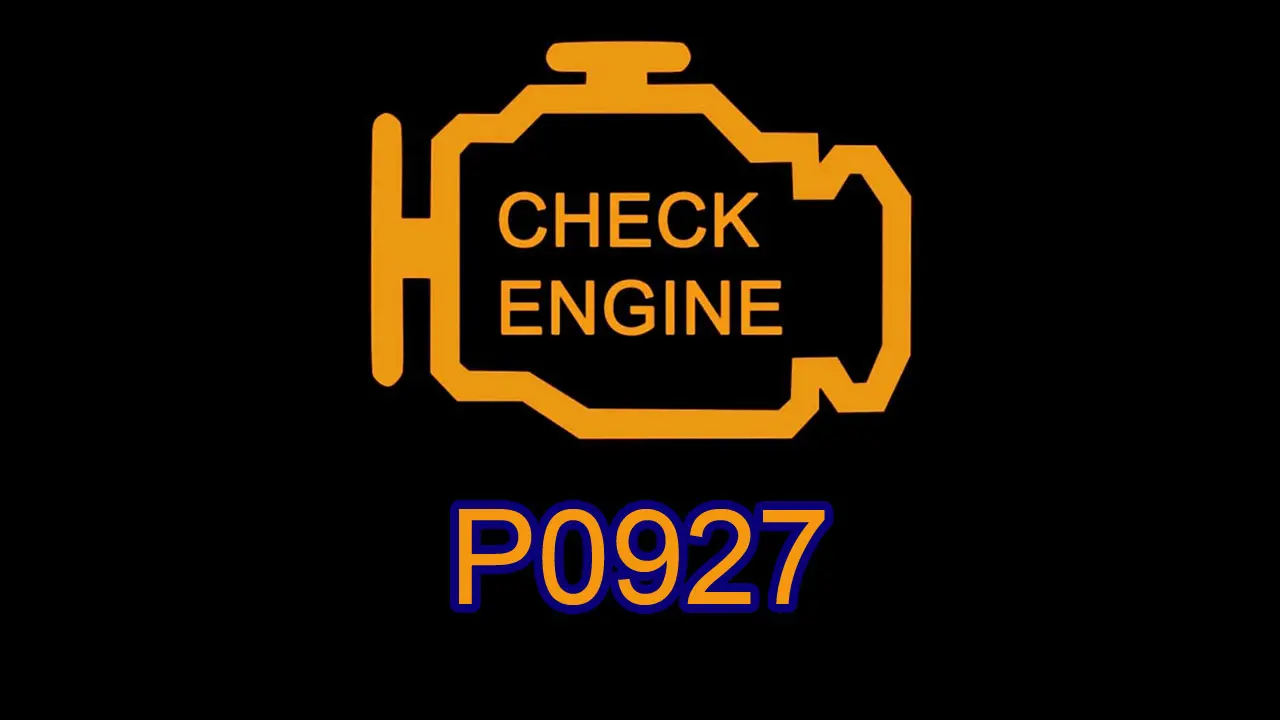
P0927 Gear Shift Reverse Actuator Circuit High
The P0927 – Gear Shift Reverse Actuator Circuit High diagnostic trouble code (DTC) indicates that the vehicle's transmission control system has detected an abnormally high electrical signal or voltage in the reverse gear shift actuator control circuit.
The reverse gear actuator is responsible for helping the transmission engage Reverse (R) when commanded by the driver. Depending on the vehicle, this actuator may be an electrically controlled solenoid, motor, or an electronically controlled mechanism integrated into the transmission or gear-selection assembly.
When P0927 is stored, the transmission control module (TCM), powertrain control module (PCM), or another related control unit has detected that the electrical signal in the reverse actuator circuit is higher than the expected range.
This is primarily an electrical control circuit fault. It does not automatically mean that the transmission has suffered an internal mechanical failure.
What Does P0927 Mean?
P0927 can be understood as follows:
-
P – Powertrain-related diagnostic code
-
09 – Transmission-related system
-
27 – Specific fault identification
-
Gear Shift Reverse Actuator – The actuator responsible for reverse gear selection
-
Circuit High – The control module has detected excessive voltage or an unexpectedly high electrical condition in the circuit
In simple terms:
The transmission control system is seeing a higher-than-expected electrical signal in the reverse gear actuator circuit.
The exact voltage threshold and circuit strategy vary between manufacturers.
What Is the Gear Shift Reverse Actuator?
Modern automatic, automated manual, dual-clutch, and some electronically controlled manual transmissions can use electrical actuators to control gear selection.
The actuator receives commands from the transmission control system and moves or controls the mechanism required to select the desired gear.
When the driver selects Reverse:
Driver selects R → Control module receives the command → Reverse actuator is commanded → Transmission selects Reverse → Reverse gear is engaged
If the actuator circuit has an electrical problem, the transmission may not be able to execute the requested command correctly.
Symptoms of P0927
The symptoms can vary depending on the transmission design and the severity of the electrical fault.
Common symptoms include:
Reverse gear does not engage
The vehicle may move forward normally but fail to move backward.
Delayed reverse engagement
Reverse may engage several seconds after the selector is moved to R.
Intermittent reverse operation
Reverse may work sometimes and fail at other times.
Transmission warning light
A transmission or drivetrain warning may appear on the instrument panel.
Check Engine Light
The malfunction indicator lamp may illuminate when the fault is detected.
Transmission remains in another gear
The transmission may enter a protective or fail-safe strategy.
Harsh gear selection
The vehicle may engage a gear abruptly when attempting to select Reverse.
Gear selector does not behave normally
On electronically controlled gear selectors, the displayed gear may not correspond correctly to the requested position.
Reduced transmission performance
The vehicle may enter limp mode to prevent further transmission damage.
Is P0927 a Serious Problem?
P0927 can be serious, particularly if Reverse is unavailable.
The code can sometimes be caused by a relatively simple electrical issue such as a damaged connector or wiring problem.
However, if the reverse actuator cannot operate correctly, the transmission may be unable to select Reverse.
A vehicle without Reverse can create a practical and safety problem, especially when parking, maneuvering, or moving the vehicle in confined areas.
The vehicle should therefore be diagnosed promptly rather than repeatedly clearing the code.
Most Common Causes of P0927
Several conditions can produce a high signal in the reverse actuator circuit.
Short to battery voltage
One of the most important possibilities is a control wire that has unintentionally contacted a battery-voltage source.
This can cause the control module to detect voltage that is higher than expected.
Damaged wiring
The harness can become:
-
Chafed
-
Pinched
-
Melted
-
Cut
-
Corroded
-
Internally broken
-
Contaminated with transmission fluid
A damaged wire can produce abnormal voltage readings even when the external insulation appears intact.
Shorted actuator circuit
The actuator control circuit may be shorted to another power circuit.
This can raise the voltage on the control line above the expected value.
Faulty reverse gear actuator
The actuator itself can develop an internal electrical fault.
Depending on the design, this could involve an internal winding, motor, position sensor, or electronic control circuit.
Corroded connector
Moisture or transmission-fluid contamination can damage electrical terminals.
Corrosion can alter the expected electrical characteristics of the circuit.
Loose connector terminal
A terminal that does not make proper contact can produce abnormal circuit behavior.
Faulty transmission control module
The TCM can potentially develop an internal driver or circuit fault.
However, a control module should not be replaced before the external circuit has been properly tested.
Poor ground connection
A weak ground can cause abnormal voltage readings and actuator operation.
Internal transmission selector problem
In some transmissions, the electrical actuator operates a mechanical mechanism inside the transmission.
Mechanical damage or binding can therefore cause actuator-control problems.
Where Is the Reverse Gear Actuator Located?
The exact location depends heavily on the transmission design.
In some vehicles, the reverse actuator is integrated into the transmission's mechatronic unit.
In others, it may be part of:
-
The shift actuator assembly
-
Gear selector mechanism
-
Transmission valve body
-
Mechatronic assembly
-
External transmission actuator system
Some automated manual and dual-clutch transmissions use multiple electric motors or actuators to control different gear-selection functions.
Because of this variation, the vehicle-specific service manual and wiring diagram should be used to identify the correct actuator.
How Is P0927 Diagnosed?
A proper diagnosis should focus on determining why the circuit voltage is too high.
Replacing the actuator immediately is not necessarily the correct approach.
1. Scan the vehicle
A professional diagnostic scanner should first be used to retrieve all stored and pending codes.
The technician should record:
-
P0927
-
Related transmission codes
-
Freeze-frame data
-
Transmission temperature
-
Gear selection information
-
System voltage
-
Other actuator-related faults
Additional codes can help identify whether the problem is isolated to the reverse actuator or part of a larger electrical problem.
2. Check whether Reverse actually works
The technician should determine whether the vehicle can engage Reverse.
If Reverse works normally despite the stored code, the fault may be intermittent.
If Reverse does not engage at all, the actuator and its circuit should be investigated carefully.
3. Inspect the transmission wiring
The wiring harness should be inspected for physical damage.
Pay particular attention to areas where the harness:
-
Runs close to the transmission
-
Passes near exhaust components
-
Is exposed to vibration
-
Runs around brackets
-
Has previously been repaired
Heat and vibration can damage transmission wiring over time.
4. Inspect the actuator connector
The connector should be checked for:
-
Corrosion
-
Water
-
Transmission-fluid contamination
-
Bent pins
-
Damaged terminals
-
Loose terminal tension
-
Broken locking mechanisms
A poor connection can create unexpected electrical readings.
5. Check system voltage
Battery and charging-system voltage should be checked.
Abnormally high system voltage can affect multiple electronic systems.
However, normal battery voltage does not rule out a localized short-to-power problem.
6. Check the actuator circuit for excessive voltage
The technician should compare the actual circuit voltage with the manufacturer's specified values.
The control circuit should be tested under the correct operating conditions.
A control line that remains at battery voltage when it should be switched differently may indicate a short to power or a control-driver problem.
7. Check for a short to power
A short between the actuator control wire and a battery-positive circuit can produce a high-circuit condition.
This is one of the important tests when diagnosing P0927.
8. Test the actuator
The reverse actuator should be tested according to manufacturer specifications.
Depending on its design, testing may include:
-
Resistance measurement
-
Power supply testing
-
Ground testing
-
Commanded activation
-
Position feedback
-
Current draw
-
Mechanical movement
Do not apply direct battery power to an electronic actuator unless the manufacturer specifically states that this test is permitted.
9. Check the control module output
If the wiring and actuator are functioning correctly, the TCM's control output should be evaluated.
The control module should be capable of producing the expected signal under the correct conditions.
How to Test P0927 With a Multimeter
A multimeter can help identify an electrical problem, but the exact test procedure depends on the vehicle.
A general diagnostic approach is:
Turn the ignition off and identify the correct circuit using the wiring diagram.
Disconnect the appropriate connector when required by the manufacturer's procedure.
Check the wiring for unwanted voltage.
If a control wire has battery voltage when it should not, a short to power may exist.
Check continuity.
The wiring should have the specified continuity between the relevant components.
Check for short circuits.
The actuator control wire should be checked for unintended continuity with battery-positive circuits or other wiring.
Check power and ground.
Verify that the actuator receives the correct supply and ground.
Check voltage under operating conditions.
A circuit may look normal when the vehicle is stationary but behave incorrectly when the actuator is commanded.
This is why dynamic testing and voltage-drop testing can be more useful than resistance measurements alone.
Can a Bad Battery Cause P0927?
A weak battery can cause many transmission-related electronic faults, especially during starting.
However, a weak battery is not the most typical cause of a specific high-circuit code such as P0927.
If the vehicle has recently experienced:
-
Battery failure
-
Jump starting
-
Alternator problems
-
Electrical system repairs
-
Multiple unrelated electronic codes
then system voltage should be checked.
If the charging voltage is excessively high, an alternator or voltage-regulation problem could affect the transmission control system.
Can an Alternator Cause P0927?
Yes, although this is not necessarily the most common cause.
If the alternator or voltage regulator allows system voltage to become excessively high, electronic control modules can detect abnormal electrical conditions.
If P0927 appears together with several other voltage-related codes, the charging system should be tested.
If only P0927 is present, however, the reverse actuator circuit itself should receive particular attention.
Can a Bad Reverse Actuator Cause P0927?
Yes.
If the internal electronics or electrical characteristics of the reverse actuator are outside the expected range, the TCM may detect an abnormal circuit condition.
However, the actuator should be tested before replacement.
A damaged wire or short to power can produce almost identical symptoms.
Can Low Transmission Fluid Cause P0927?
Low transmission fluid can cause shifting problems, delayed engagement, and other transmission symptoms.
However, low fluid is not normally the direct explanation for a circuit-high electrical fault.
If the transmission has fluid-related symptoms as well as P0927, the fluid level, condition, leaks, and transmission operation should still be checked.
The presence of P0927 does not mean that adding transmission fluid will solve the problem.
Can P0927 Cause Loss of Reverse?
Yes.
If the reverse actuator cannot operate correctly, the transmission may fail to engage Reverse.
This is one of the most important symptoms to watch for.
The vehicle might still drive forward normally because the circuits and mechanisms responsible for forward gears can continue to operate.
Therefore:
Forward gears working normally does not mean the transmission is completely free of faults.
Can P0927 Damage the Transmission?
The code itself does not necessarily mean that internal transmission damage has occurred.
However, continued operation with a transmission that is malfunctioning can potentially create additional problems.
For example, repeated attempts to force Reverse when the transmission cannot engage it correctly may place unnecessary stress on the transmission system.
If the transmission enters limp mode, Reverse disappears, or gear engagement becomes harsh, professional diagnosis is recommended.
Common Diagnostic Mistakes
A common mistake is replacing the reverse actuator immediately.
The actual fault may be located in the wiring between the actuator and control module.
Another mistake is assuming that "Circuit High" means the actuator itself is producing too much voltage.
In many cases, the control circuit is receiving or carrying an unexpectedly high voltage because of a wiring or driver problem.
Other common mistakes include:
Replacing the TCM too early
Control modules are expensive and should only be replaced after the external circuit has been verified.
Ignoring the wiring harness
Transmission wiring is exposed to heat, vibration, moisture, and contamination.
Checking only resistance
Resistance testing alone may not reveal a problem that appears only when the circuit is energized.
Ignoring other DTCs
Additional transmission or voltage-related codes can provide important diagnostic clues.
Assuming the transmission needs rebuilding
P0927 is fundamentally an electrical circuit code. Internal transmission repair should not be assumed without evidence.
How Is P0927 Repaired?
The correct repair depends on the underlying cause.
Possible repairs include:
-
Repairing damaged wiring
-
Replacing a damaged wire
-
Repairing or replacing an electrical connector
-
Removing corrosion from appropriate terminals
-
Repairing a short to battery voltage
-
Repairing a poor ground
-
Replacing the reverse gear actuator
-
Repairing the shift actuator assembly
-
Correcting an excessive charging-voltage problem
-
Repairing the transmission mechatronic unit
-
Updating or replacing a TCM when confirmed necessary
The most important principle is:
Repair the cause, not just the code.
Can You Drive With P0927?
If the vehicle still drives normally, it may be possible to move it, but continued driving is not recommended without determining the cause.
The biggest concern is the potential loss of Reverse or unexpected transmission behavior.
If Reverse has already stopped working, the vehicle can become difficult to maneuver and may not be safe or practical to drive normally.
If the transmission enters limp mode, produces severe noises, shifts violently, or refuses to engage gears, the vehicle should be inspected before continued operation.
How to Reset P0927
After the underlying problem has been repaired, P0927 can be cleared with a suitable diagnostic scan tool.
A proper repair procedure is:
Diagnose → Repair → Clear DTC → Test drive → Rescan
If the code returns immediately, the underlying circuit problem has probably not been resolved.
Disconnecting the battery is not considered a proper repair method. It may temporarily remove the stored code while leaving the electrical problem unchanged.
Does P0927 Mean the Transmission Needs Replacement?
No.
P0927 does not automatically mean that the transmission needs to be replaced.
The code specifically identifies an electrical problem involving the reverse gear actuator circuit.
Before considering major transmission work, the following should be checked:
-
Battery and charging voltage
-
Fuses
-
Wiring
-
Connectors
-
Grounds
-
Reverse actuator
-
Actuator power supply
-
Control signal
-
TCM operation
-
Mechanical operation of the selector mechanism
Only after these areas have been properly tested should internal transmission problems be considered.
P0927 vs. Other Transmission Codes
P0927 belongs to a group of transmission-related diagnostic codes involving gear selection and actuator circuits.
It should not be confused with codes for:
-
Reverse gear performance
-
Shift actuator position
-
Shift solenoid faults
-
Gear-selection range problems
-
Transmission pressure problems
-
Internal transmission ratios
The exact code description and diagnostic procedure can vary between manufacturers.
For this reason, the generic OBD-II definition should be used as a starting point, while the manufacturer's wiring diagrams, service information, and diagnostic procedures should be used for the final diagnosis.
Final Thoughts on P0927
P0927 – Gear Shift Reverse Actuator Circuit High indicates that the transmission control system has detected an unexpectedly high electrical condition in the circuit controlling the reverse gear actuator.
The most likely causes include a short to battery voltage, damaged wiring, a faulty connector, poor grounding, an electrical failure inside the reverse actuator, excessive system voltage, or a problem with the transmission control module.
The code does not automatically indicate internal transmission failure.
If Reverse is unavailable, the problem should be diagnosed promptly. A systematic inspection of the wiring, connectors, power supply, ground, actuator and control-module signals can often identify the real cause without unnecessarily replacing major transmission components.