TR
TR EN
EN

Spare Tires: What Every Driver Should Know
A spare tire is one of those parts of a vehicle that most drivers rarely think about—until a tire goes flat in the middle of nowhere.
Modern vehicles increasingly come without a traditional spare tire. To save weight and free up trunk space, manufacturers may use compact temporary spares, tire repair kits, sealant and compressor systems, or no spare at all.
Knowing which emergency solution your vehicle has can save you from being stranded. Just as importantly, a spare tire should not be treated as maintenance-free equipment simply because it spends most of its life hidden in the trunk.
Why Are Spare Tires Disappearing?
There is a simple reason why the traditional full-size spare tire has become less common: space and weight.
Modern vehicles are packed with equipment, larger batteries, electronic components, hybrid systems, larger exhaust systems, and increasingly complex trunk designs. A full-size wheel and tire can take up a significant amount of cargo space and add considerable weight.
Manufacturers therefore use several alternatives:
-
Compact temporary spare tires
-
Full-size temporary spares
-
Full-size matching spare tires
-
Tire mobility kits
-
Folding spare tires
-
Run-flat tires on certain models
The correct solution depends entirely on the vehicle.
Compact Spare Tires
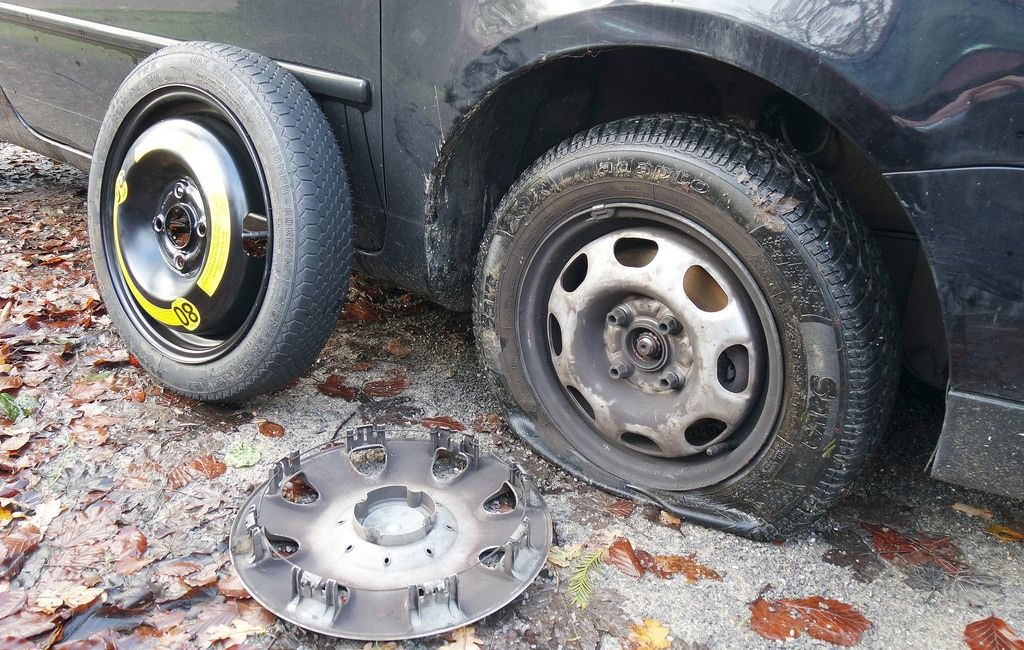
The compact spare, often called a “donut,” is probably the best-known type of temporary spare.
It is much narrower than a normal road tire and is usually stored under the trunk floor. Its smaller dimensions make it easier to package inside the vehicle.
The advantage is obvious: it takes up much less space.
The disadvantage is that it does not provide the same handling characteristics as a normal tire.
A compact spare is designed to get you out of trouble, not to become your new everyday tire.
How Fast Can You Drive on a Temporary Spare?
This is one of the most important things to check before you ever need the spare.
Many temporary spare tires have an 80 km/h (50 mph) maximum speed rating. However, you should never assume that 80 km/h applies to every spare tire.
The maximum speed is normally marked on the tire and specified in the vehicle owner's manual.
Once installed, the safest approach is to drive conservatively and head directly to a tire repair facility.
Avoid treating a temporary spare as if it were a normal tire simply because the car feels stable at higher speeds.
How Far Can You Drive on a Spare Tire?
There is no single universal mileage limit for every temporary spare.
Some manufacturers specify a maximum distance, while others simply instruct the driver to replace the damaged tire as soon as possible.
A temporary spare should therefore be considered a short-term emergency solution.
The longer you drive on it, the longer the vehicle is operating with a tire that may have a different diameter, width, tread pattern, load capacity, and handling characteristic.
If the original tire can be repaired safely, repair it. If it cannot, replace it with the correct tire as soon as possible.
How a Spare Tire Can Change Vehicle Handling
Installing a temporary spare changes more than just the appearance of the wheel.
Because the spare may be significantly narrower than the other tires, the vehicle can behave differently when braking, accelerating, cornering, or driving on wet roads.
You may notice:
-
Reduced traction
-
Different steering response
-
Longer braking distances in some conditions
-
Different cornering behavior
-
Increased sensitivity to road surfaces
-
Changes in the operation of electronic driving systems
For this reason, sudden steering inputs, aggressive acceleration, and hard braking should be avoided.
A temporary spare is a good reason to slow down and drive defensively.
ABS, Traction Control and Stability Systems
It is sometimes claimed that a compact spare will automatically disable ABS or traction control. That is not necessarily true.
Modern vehicles use wheel-speed sensors and sophisticated software to monitor wheel rotation. A difference in tire diameter or circumference can influence how these systems interpret wheel-speed information.
Depending on the vehicle, you may see warning lights or changes in system operation.
This is particularly important on vehicles equipped with AWD or 4WD systems. Differences in tire circumference can place additional stress on the drivetrain, depending on the system design.
If your vehicle has all-wheel drive, check the manufacturer's instructions before using a temporary spare. Some AWD systems have very specific requirements regarding tire diameter differences.
Never Ignore the Spare Tire's Air Pressure
One of the biggest mistakes drivers make is checking the spare tire only after a regular tire has gone flat.
By then, it may be too late.
Spare tires can lose air while sitting unused for months or years. This is especially important because temporary spares often require significantly higher inflation pressures than normal tires.
The correct pressure should be taken from the tire itself or the vehicle manufacturer's specifications.
Do not automatically inflate a spare to the same pressure as the four tires on the vehicle.
A small portable compressor and a tire-pressure gauge are also useful additions to an emergency kit.
Full-Size Matching Spare Tires
A full-size matching spare is the closest thing to having a fifth normal tire.
When the spare matches the vehicle's regular tires in size and specifications, it can provide much more conventional handling than a donut-style temporary spare.
However, simply being the same physical size does not automatically mean that it is suitable for normal rotation.
The spare should match the other tires in the characteristics specified by the manufacturer, including dimensions, load capacity, speed rating, and tire type where applicable.
If the manufacturer permits the spare to be included in tire rotation, doing so can prevent the spare from aging unused for years.
Full-Size Non-Matching Spares
Some vehicles use a spare that is physically large but does not exactly match the regular tires.
It may have a different width, diameter, tread pattern, or other specification.
These tires should generally be considered temporary spares unless the vehicle manufacturer specifically states otherwise.
A non-matching spare should not automatically be added to the normal tire rotation.
The owner's manual should always take priority.
Full-Size Temporary Spares
Not every full-size-looking spare is designed for permanent use.
Some temporary tires are close to the normal tire's dimensions but use a lighter construction or different tread design.
They can provide better emergency mobility than a small donut while still being intended only as a temporary solution.
Always check the markings on the tire and the vehicle manufacturer's instructions before treating it as a normal road tire.
Folding Spare Tires
Folding spare tires are designed to solve one major problem: storage space.
They can be stored in a compact form and inflated when needed.
This makes them useful for vehicles where a conventional spare would take up too much room.
The downside is that they require an appropriate inflation device. If the tire is stored deflated, you cannot simply install it and drive away.
A suitable compressor must be available and capable of inflating the tire to the required pressure.
What About Tire Repair Kits?
Some modern vehicles have no spare tire at all.
Instead, they come with a tire mobility kit containing a compressor and sealant.
These systems can be very convenient for certain types of punctures, particularly small tread punctures caused by nails or similar objects.
However, a repair kit is not a universal replacement for a spare tire.
It may not work when:
-
The tire has a large puncture.
-
The sidewall is damaged.
-
The tire has been driven while severely underinflated.
-
The tire has separated from the wheel.
-
The wheel itself is damaged.
-
The puncture is outside the area that the sealant is designed to repair.
In these situations, roadside assistance or a spare tire may be necessary.
Can You Tow a Trailer With a Temporary Spare?
A temporary spare is generally not intended for towing unless the vehicle manufacturer specifically permits it.
Towing places additional load on the vehicle, tires, brakes, and drivetrain. A temporary spare may not have the same load or handling capability as the original tire.
If you are towing a trailer and experience a flat tire, follow the manufacturer's instructions rather than assuming that the temporary spare can safely handle the additional load.
Spare Tire Age Matters
A spare tire can look almost brand-new even after sitting in a vehicle for many years.
That does not mean the rubber is still in perfect condition.
Tires age even when they are not driven. Heat, humidity, ozone, and storage conditions can gradually affect the rubber compounds.
When inspecting an old spare, look for:
-
Cracks
-
Sidewall deterioration
-
Bulges
-
Cuts
-
Deformation
-
Severe aging
-
Damage around the bead
-
Abnormal loss of air pressure
Do not rely solely on tread depth when deciding whether an old spare is safe.
There is no universal rule that every tire must automatically be discarded at exactly the same age. Tire manufacturers and vehicle manufacturers may provide different recommendations, so the production date and the tire's actual condition should both be considered.
Don't Forget the Jack and Lug Wrench
A spare tire is useless if you cannot install it.
Before a long trip, make sure your vehicle has the necessary equipment, including:
-
Jack
-
Lug wrench
-
Locking wheel-nut key, if applicable
-
Spare tire
-
Jack adapter or special tools, if required
-
Tire-pressure gauge
-
Portable compressor when appropriate
-
Warning triangle or reflective warning equipment
-
Owner's manual
This is particularly important with used vehicles. Previous owners sometimes remove emergency equipment and forget to replace it.
Check Your Spare Before a Long Journey
A spare tire inspection takes only a few minutes.
Before a long trip, check its inflation pressure and look at the sidewalls and tread. Make sure the tire is accessible and that the tools needed to remove the wheel are actually present.
If your vehicle uses a tire repair kit instead of a spare, check the compressor and sealant as well. Sealant cartridges can have expiration dates, and a compressor that does not work is of little use during a roadside emergency.
What Should You Do After Installing a Spare?
Once a temporary spare has been installed, don't simply continue your journey as if nothing happened.
Reduce your speed, avoid aggressive driving, and head to a tire shop or another appropriate location.
If the damaged tire can be repaired safely, have it repaired. If it cannot, replace it with a tire that matches the vehicle's required specifications.
And if the vehicle develops unusual vibrations, steering problems, warning lights, or abnormal noises after installing the spare, stop and have the vehicle inspected.
A Spare Tire Is Emergency Equipment, Not an Afterthought
The most important thing about a spare tire is knowing what you actually have before you need it.
A compact donut, a full-size spare, a folding tire, and a tire repair kit all serve different purposes. Their limitations are also different.
Check your spare tire's pressure, age, condition, speed rating, and usage restrictions periodically. Keep the necessary tools in the vehicle and make sure you understand the manufacturer's instructions.
A few minutes of preparation can make the difference between a manageable flat tire and being stranded on the roadside.