TR
TR EN
EN

Diagnosing Battery Problems and Common Battery Failures
The battery is one of the most important components in a vehicle's electrical system. It provides the electrical energy required to operate the starter motor and start the engine. It also supplies power to electrical systems when the engine is not running and helps stabilize the vehicle's electrical system while the engine is operating.
If you turn the ignition key or press the start button and the engine does not crank, a dead battery is one possible cause. However, the battery is not always responsible.
A faulty alternator, parasitic electrical drain, poor battery connection, bad ground, starter motor, starter relay, solenoid, or another electrical problem can produce very similar symptoms.
For this reason, replacing the battery without first diagnosing the problem can result in unnecessary expense.
Why Does a Car Battery Go Dead?
A vehicle battery can become discharged for many different reasons.
Common causes include:
-
Leaving the headlights or parking lights on
-
Leaving an interior light or trunk light on
-
An alternator that is not charging the battery properly
-
Excessive parasitic electrical drain
-
An electrical accessory that remains powered after the vehicle is switched off
-
Leaving the vehicle unused for a long period
-
Frequent short-distance driving
-
Repeatedly switching the ignition on without running the engine
-
Loose or corroded battery terminals
-
Poor engine or chassis ground connections
-
An incorrect battery type or capacity
-
A battery that has reached the end of its service life
-
Extremely hot or cold temperatures
Aftermarket accessories can also cause battery-drain problems. Dashcams, audio systems, GPS trackers, remote-start systems, USB accessories, auxiliary heaters, and other equipment can continue consuming electricity when the vehicle is parked if they are installed incorrectly or fail to enter standby mode.
Short Trips Can Gradually Discharge a Battery
Starting an engine requires a large amount of electrical energy.
During normal driving, the alternator replaces the energy used during starting and supplies power to the vehicle's electrical systems. However, repeated short trips may not provide enough time for the charging system to fully replace the energy consumed during each start.
This is particularly relevant to vehicles used mainly for short urban journeys.
If a vehicle is repeatedly driven only a few kilometers at a time, the battery may remain partially discharged for long periods. Over time, this can reduce battery life and increase the risk of a no-start condition.
What Should You Check When the Car Will Not Start?
The symptoms you observe when attempting to start the vehicle can provide useful clues.
No electrical systems work at all:
The battery may be completely discharged, but a disconnected battery terminal or major electrical connection problem is also possible.
Dashboard lights are very dim and the starter turns slowly:
The battery may be weak. Corroded terminals or a poor ground connection can cause similar symptoms.
You hear a single click but the engine does not crank:
A weak battery is possible, but the starter relay, starter solenoid, starter motor, or electrical connections should also be considered.
The headlights work normally but the starter does not operate:
The battery may still have enough energy to power the lights, while a problem exists in the starting circuit. The starter motor, relay, solenoid, ignition switch, immobilizer, clutch switch, brake switch, or wiring may require inspection.
Therefore, simply turning on the headlights is not a definitive battery test.
How to Measure Battery Voltage
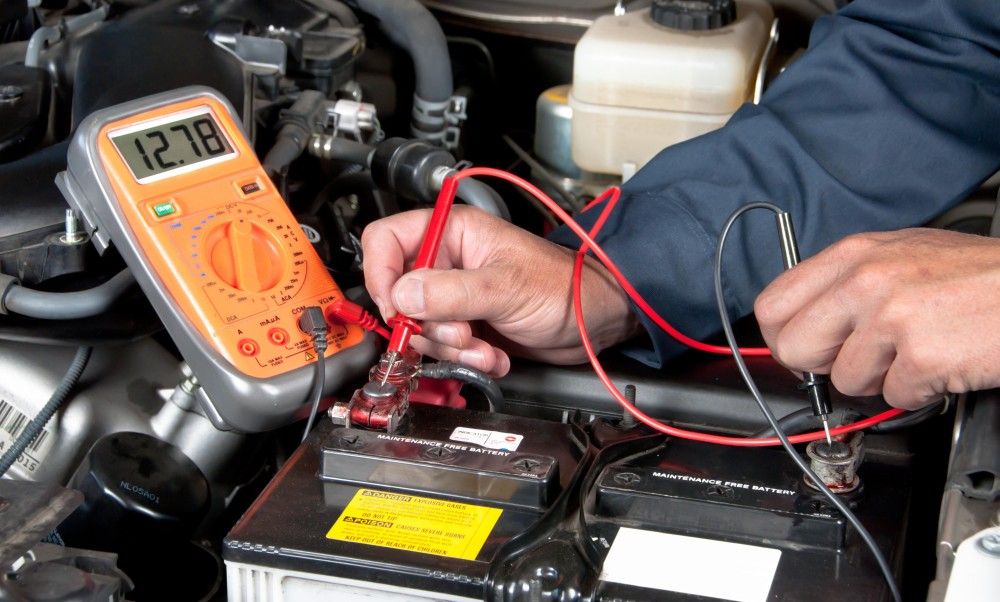
One of the easiest ways to check a 12-volt automotive battery is with a digital multimeter.
Before measuring:
-
Switch off the engine.
-
Turn the ignition off.
-
Turn off the headlights and other electrical accessories.
-
Allow the vehicle to sit for a while if possible.
-
Set the multimeter to DC voltage.
-
Connect the red probe to the positive (+) battery terminal.
-
Connect the black probe to the negative (-) terminal.
-
Read the voltage.
A fully charged conventional 12-volt lead-acid battery that has been allowed to rest will typically show approximately 12.6–12.8 volts.
However, battery voltage alone does not prove that the battery is healthy.
A worn battery can sometimes show a normal voltage with no load but lose a large amount of voltage when the starter motor demands high current.
What Does Battery Voltage Tell You?
As a general reference for a rested conventional lead-acid battery:
12.6–12.8 V: Fully or nearly fully charged
Around 12.4 V: Partially discharged
Around 12.2 V: Approximately half charged
Around 12.0 V: Significantly discharged
11.9 V or lower: Very low state of charge or possible battery problem
These values are approximate. Battery temperature, surface charge, battery condition, chemistry, and measurement conditions can affect the result.
For this reason, a reading of 12.4 volts does not automatically mean that the battery must be replaced.
If the battery is low, it should first be properly recharged and then tested again.
Does a Battery Below 12.4 Volts Need to Be Replaced?
Not necessarily.
A low voltage reading may simply mean that the battery is discharged.
The battery should be fully charged and then allowed to rest before being tested again. If the voltage drops quickly after charging or the battery cannot provide sufficient starting current, the battery may have lost capacity.
A lead-acid battery that remains partially discharged for extended periods can also develop sulfation. Sulfation can reduce the battery's ability to accept and retain a charge.
Therefore, battery replacement should not be based on a single voltage measurement.
Test the Battery During Engine Cranking
A more useful test is to observe the battery while the starter motor is operating.
The starter draws a very large amount of current. A healthy battery should be capable of supplying this current without its voltage collapsing excessively.
An excessive voltage drop during cranking may indicate:
-
A weak battery
-
High internal resistance
-
A damaged battery cell
-
Corroded battery terminals
-
Poor battery cables
-
A bad ground connection
-
A starter motor drawing excessive current
This is why a battery should ideally be evaluated both at rest and under load.
Use an Electronic Battery Tester
A handheld electronic battery tester can provide additional information about battery condition.
Depending on the tester and battery type, it may evaluate:
-
Cold Cranking Amps (CCA)
-
State of charge
-
Internal resistance
-
Starting performance
-
General battery condition
These testers can be particularly useful for batteries that are several years old.
However, electronic battery testers should not be treated as infallible. Their results should be considered together with the battery's age, charging system, physical condition, and actual starting performance.
Check for Parasitic Battery Drain
If the battery repeatedly goes dead overnight or after the vehicle has been parked for several days, a parasitic electrical drain should be investigated.
Modern vehicles continue to consume a small amount of electricity after being switched off. Alarm systems, immobilizers, keyless-entry systems, control modules, memory functions, and other electronics may remain active.
The vehicle's electronic modules may also need several minutes to enter their normal sleep mode.
For this reason, parasitic-current testing should not necessarily begin immediately after switching the engine off.
The vehicle should be allowed to enter its normal sleep state according to the manufacturer's procedure.
What Can Cause Excessive Parasitic Drain?
Possible sources include:
-
Interior lights
-
Trunk lights
-
Glove-box lights
-
Audio systems
-
Alarm systems
-
GPS trackers
-
Dashcams
-
USB adapters
-
Aftermarket sound systems
-
Remote-start systems
-
Auxiliary electrical equipment
-
Faulty electronic control modules
-
A module that fails to enter sleep mode
A normal standby-current specification varies from vehicle to vehicle.
A figure such as 20–30 mA should not be treated as a universal specification for every modern vehicle.
The correct value should be determined from the vehicle manufacturer's service information.
How Is Parasitic Drain Measured?
A suitable ammeter or professional battery-drain tester can be connected in the appropriate part of the battery circuit to measure current consumption while the vehicle is parked.
Care is required when performing this test because opening doors, operating the remote control, switching on lights, or waking up electronic modules can temporarily increase current consumption.
Some modern vehicles can also draw relatively high current for a period after the ignition is switched off.
Once the vehicle has entered its normal sleep mode, the measured current can be compared with the manufacturer's specification.
If the current is too high, individual fuses or circuits can be investigated to identify which system is consuming the electricity.
Is the Alternator Charging the Battery?
If a battery repeatedly becomes discharged, do not immediately install another battery.
The alternator may not be charging the battery correctly.
The charging system should be tested with the engine running.
A conventional charging system may commonly produce approximately 13.8–14.8 volts, but this should only be considered a general reference.
Modern vehicles often use intelligent charging systems that deliberately vary alternator output according to battery state of charge, temperature, electrical load, and other operating conditions.
Therefore, a single voltage reading should not automatically be interpreted as proof of alternator failure.
The manufacturer's charging-system specifications and test procedure should be followed.
Check the Serpentine or Accessory Belt
On many vehicles, the alternator is driven by a serpentine or accessory belt.
A belt that is loose, damaged, slipping, or broken can prevent the alternator from operating correctly.
A broken belt can sometimes cause problems beyond battery charging because, depending on the vehicle design, other components may also be driven by the same belt.
Never put your hands near a moving belt, pulley, or fan while the engine is running.
A visual inspection can identify obvious belt damage, while belt tension and pulley condition may require a professional inspection.
Never Disconnect the Battery While the Engine Is Running
An old diagnostic trick involved starting the engine and then disconnecting a battery terminal to see whether the engine continued running.
This test is not recommended on modern vehicles.
Disconnecting the battery while the engine is running can cause voltage spikes and electrical instability. These can potentially damage sensitive electronic components or charging-system components.
Use a multimeter or appropriate charging-system tester instead.
Check the Battery Terminals
A battery can be perfectly healthy and still fail to start the vehicle if the electrical connections are poor.
Inspect the battery terminals for:
-
Corrosion
-
Loose connections
-
Dirt
-
Oxidation
-
Damaged terminals
-
Damaged battery cables
A poor connection can restrict the high current required by the starter motor.
The negative battery cable and its connections to the engine and vehicle chassis should also be checked.
A poor ground connection can produce symptoms that are very similar to a weak battery.
Battery Compatibility Is Important
Not every 12-volt battery is suitable for every vehicle.
When selecting a replacement battery, consider:
-
Battery capacity (Ah)
-
Cold Cranking Amps (CCA)
-
Battery technology
-
Physical dimensions
-
Terminal position
-
Manufacturer specifications
Vehicles equipped with start-stop systems may require specific battery technologies such as AGM or EFB.
Installing an unsuitable conventional battery into a system designed for AGM or another specific technology can result in poor performance and reduced battery life.
The replacement battery should match the vehicle manufacturer's requirements.
Some Vehicles Require Battery Registration
Many modern vehicles use sophisticated battery-management systems.
Depending on the vehicle, the new battery may need to be registered, coded, or adapted after replacement.
This allows the vehicle's energy-management system to recognize the new battery and adjust charging behavior accordingly.
Failing to perform the required procedure can sometimes lead to incorrect charging strategy, reduced battery life, or charging-related warnings.
The exact procedure depends on the vehicle.
Why Does a Battery Die When a Car Is Not Used?
A parked vehicle still consumes a small amount of electricity.
Alarm systems, immobilizers, remote locking, keyless-entry systems, memory functions, and various control modules can continue drawing power while the engine is off.
If a vehicle remains unused for several weeks or months, the battery can eventually become discharged.
For long-term storage, follow the manufacturer's recommendations. In some situations, a suitable battery maintainer can help keep the battery charged.
Simply disconnecting the battery is not always the best solution for modern vehicles because it can cause loss of electronic settings or require certain systems to be relearned.
Can Frequent Ignition Cycling Drain the Battery?
Repeatedly switching the ignition on without starting the engine consumes electrical energy.
The problem becomes more significant when headlights, climate-control fans, infotainment systems, heated equipment, or other electrical consumers are used while the engine is not running.
However, a healthy battery should not normally become completely dead simply because the ignition was switched on and off a few times.
If the battery repeatedly becomes discharged, look for an underlying problem such as excessive parasitic drain, a charging-system fault, or an aging battery.
How Long Does a Car Battery Last?
There is no universal battery lifespan that applies to every vehicle.
Battery life depends on:
-
Climate
-
Battery technology
-
Driving habits
-
Average trip length
-
Charging-system condition
-
Engine-bay temperature
-
Electrical load
-
Maintenance
-
Number of starting cycles
Conventional lead-acid batteries often last several years under normal conditions, while extreme heat can significantly accelerate battery aging.
AGM and EFB batteries are designed for particular vehicle applications and may offer different service lives depending on how they are used.
Therefore, a five-year-old battery does not automatically have to be replaced, but its condition should be tested more carefully as it ages.
When Should You Replace the Battery?
Battery replacement should be considered when the battery:
-
Consistently struggles to start the engine
-
Loses voltage quickly after charging
-
Fails a proper load or CCA test
-
Has a damaged case
-
Has a damaged terminal
-
Shows severe deterioration
-
Cannot maintain sufficient capacity
-
Repeatedly becomes discharged despite a healthy charging system
Battery age is useful information, but actual battery condition is more important than the number of years alone.
Should You Recharge the Battery or Replace It?
A discharged battery does not automatically need to be replaced.
For example, if the headlights were accidentally left on overnight and the battery is otherwise healthy, recharging it may be all that is necessary.
If the battery has reached the end of its service life or cannot retain sufficient charge after being properly recharged, replacement is the appropriate solution.
A useful diagnostic sequence is:
Recharge the battery → allow it to rest → measure voltage → test it under load → check the charging system → investigate parasitic drain if necessary.
This approach can prevent a healthy battery from being replaced unnecessarily.
Do Not Confuse a Battery Problem With a Starter Problem
A vehicle that will not start does not necessarily have a dead battery.
If the battery passes a proper test but the starter motor does not operate, other components should be investigated.
Possible causes include:
-
Starter motor
-
Starter solenoid
-
Starter relay
-
Wiring
-
Ground connections
-
Ignition switch
-
Clutch switch
-
Brake switch
-
Neutral safety switch
-
Immobilizer system
-
Engine control system
-
Related fuses and control modules
This is particularly important when the dashboard and other electrical systems operate normally but the engine does not crank.
Battery Problems in Cold Weather
Cold weather places additional demands on a battery.
As temperatures fall, the battery's ability to deliver starting current decreases, while the engine may require more effort to crank because engine oil becomes more viscous.
This is why a battery that appears acceptable during warm weather may suddenly struggle during winter.
Before the cold season, it is worth checking the battery's state of charge and starting performance, especially if the battery is already several years old.
Excessive Heat Can Also Damage a Battery
High temperatures can be just as harmful as cold temperatures.
Heat accelerates chemical reactions inside a battery and can increase water loss and internal deterioration in conventional lead-acid batteries.
Vehicles operated in very hot climates may therefore experience shorter battery service lives.
Good battery selection and regular testing become particularly important in hot environments.
A Systematic Battery Diagnosis Saves Money
When a vehicle repeatedly experiences battery problems, replacing the battery over and over is rarely the best approach.
A proper diagnosis should include:
1. Visual inspection
Check the battery case, terminals, cables, and ground connections.
2. Resting voltage test
Determine the approximate state of charge.
3. Cranking test
Observe how the battery behaves under the heavy load of the starter motor.
4. Battery condition test
Use an appropriate load or electronic battery tester.
5. Charging-system test
Check alternator performance according to the manufacturer's specifications.
6. Parasitic-current test
If the battery discharges while parked, determine whether excessive standby current exists.
7. Starting-system inspection
If the battery and charging system are healthy, investigate the starter motor, relay, solenoid, switches, and wiring.
This process is much more reliable than assuming that every no-start condition is caused by the battery.
Simple Habits Can Help Extend Battery Life
A few simple practices can reduce unnecessary battery problems.
Check the battery terminals periodically and keep the connections clean and secure.
Avoid leaving electrical equipment running for extended periods while the engine is off.
If the vehicle is used mainly for very short trips, periodically check the battery's state of charge.
If the vehicle will remain parked for an extended period, use an appropriate battery maintainer when recommended for your vehicle.
When replacing the battery, always use the correct type and specification rather than choosing a battery based solely on physical size.
Diagnose the Cause, Not Just the Dead Battery
A dead battery is often the symptom rather than the complete problem.
The battery may have been discharged because of a light that was left on, but repeated battery failure can indicate an alternator problem, parasitic electrical drain, poor electrical connections, or a battery that can no longer retain its charge.
Likewise, a vehicle that does not crank may have a healthy battery and a faulty starter motor or starting circuit.
The most reliable approach is therefore to test the battery, charging system, electrical connections, parasitic current, and starting system before replacing expensive components.
A few simple measurements with the right equipment can often reveal whether the problem is a weak battery, a charging fault, an electrical drain, or something completely different.