TR
TR EN
EN

What Is a Power Steering Pump? What Are the Symptoms of Power Steering Pump Failure?
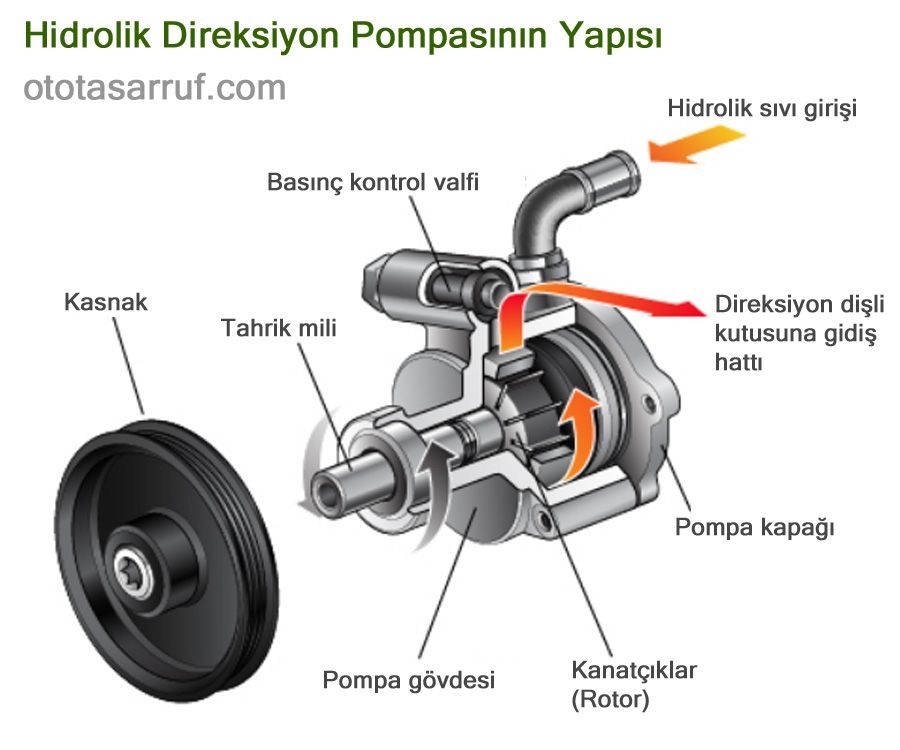
The power steering pump is one of the main components responsible for making the steering wheel easier to turn. In vehicles equipped with a hydraulic power steering system, the pump generates hydraulic pressure and sends pressurized power steering fluid to the steering gear or steering rack.
When the system is working correctly, the driver can turn the steering wheel with relatively little effort, even when the vehicle is stationary or moving slowly.
A failing power steering pump can gradually make the steering heavier and may also produce distinctive noises, fluid leaks, or inconsistent steering assistance.
What Does a Power Steering Pump Do?
The primary job of the power steering pump is to generate hydraulic pressure.
The pump draws power steering fluid from the reservoir and pressurizes it. Depending on the steering direction and the design of the steering system, this pressurized fluid assists the steering rack or steering gear when the driver turns the steering wheel.
The pump therefore does not physically turn the wheels by itself. Instead, it provides hydraulic assistance that reduces the amount of force the driver needs to apply.
How Does a Hydraulic Power Steering Pump Work?
A conventional hydraulic power steering system generally consists of:
-
Power steering pump
-
Power steering fluid reservoir
-
Steering rack or steering gear
-
Hydraulic hoses
-
Steering control valve
-
Drive belt or pulley
-
Steering fluid
The engine drives the pump through a belt, although the exact arrangement varies by vehicle.

When the engine is running, the pump circulates hydraulic fluid through the steering system. When the steering wheel is turned, the steering valve directs hydraulic pressure to the appropriate side of the steering rack.
This pressure assists the driver's steering input.
When the steering wheel is released, the hydraulic system returns toward its neutral position and the assistance decreases.
Where Is the Power Steering Pump Located?
The location varies depending on the vehicle and engine configuration.
On many vehicles with hydraulic power steering, the pump is mounted on the engine and driven by an accessory belt.
It may be located:
-
Near the front or side of the engine
-
Close to the serpentine belt
-
Near the power steering fluid reservoir
-
Connected to the steering rack through hydraulic lines
Some vehicles use a remotely mounted reservoir, so the reservoir may not be directly attached to the pump.
What Are the Symptoms of a Bad Power Steering Pump?
A failing power steering pump can produce several noticeable symptoms.
The most common include:
-
Heavy steering
-
Whining or humming noise
-
Groaning when turning the steering wheel
-
Intermittent power assistance
-
Steering that becomes harder at low speed
-
Power steering fluid leakage
-
Foaming or bubbles in the fluid
-
Fluid contamination
-
Belt noise
-
Steering assistance that changes with engine speed
Not every symptom necessarily means that the pump itself has failed. Other components of the hydraulic steering system can produce very similar symptoms.
Heavy Steering
One of the most important symptoms is increased steering effort.
The steering wheel may suddenly become much harder to turn, particularly when the vehicle is stationary or moving slowly.
A weak or damaged pump may not generate enough hydraulic pressure to provide the required assistance.
However, heavy steering can also be caused by:
-
Low power steering fluid
-
A hydraulic leak
-
Restricted hydraulic hose
-
Faulty steering rack
-
Damaged steering components
-
Incorrect tire pressure
-
Seized steering or suspension components
-
Drive belt problems
Therefore, the pump should not automatically be blamed simply because the steering becomes heavy.
Steering Becomes Harder When Parking
A weak hydraulic pump often becomes most noticeable during parking maneuvers.
Turning the steering wheel while the vehicle is stationary requires considerably more assistance than steering while the vehicle is moving.
If the pump is unable to generate sufficient pressure, the driver may notice that the steering wheel becomes extremely heavy during parking but feels more normal once the vehicle is moving.
This is an important clue when diagnosing hydraulic power steering problems.
Whining or Humming Noise
A whining sound from the power steering system is another common symptom.
The noise may become louder when the steering wheel is turned.
Possible causes include:
-
Low fluid level
-
Air in the hydraulic system
-
Incorrect fluid
-
Contaminated fluid
-
Worn pump bearings
-
Damaged pump vanes
-
Excessive hydraulic pressure
-
Restricted fluid supply
A pump that is forced to operate with insufficient fluid can become noisy and may eventually suffer internal damage.
Groaning or Moaning When Turning
Some failing power steering systems produce a groaning or moaning sound when the steering wheel is turned toward full lock.
A small amount of noise at full steering lock can occur on some hydraulic systems because hydraulic pressure rises sharply.
However, holding the steering wheel against full lock for an extended period is not recommended because it places unnecessary load on the pump and hydraulic system.
If the system makes loud or abnormal noises during ordinary steering, further inspection is necessary.
Intermittent Power Steering Assistance
A power steering pump does not always fail completely at once.
In some cases, the pump may provide adequate assistance under certain conditions but become weak under others.
For example, steering assistance may be:
-
Normal when driving
-
Weak when parking
-
Better at higher engine speed
-
Worse when the engine is hot
-
Intermittent during repeated steering movements
This can occur when the pump is worn internally or when the system has a fluid-flow restriction.
Power Steering Fluid Leakage
A hydraulic steering system depends on maintaining the correct fluid level.
Leaks can occur from:
-
Pump shaft seals
-
Pump housing
-
Hydraulic hoses
-
Hose connections
-
Steering rack seals
-
Reservoir connections
A fluid leak can eventually cause the pump to operate with insufficient fluid.
This creates a dangerous cycle: the original problem may be a relatively small leak, but continued operation with low fluid can damage the pump as well.
Foamy or Bubbling Power Steering Fluid
Foam or bubbles in the reservoir can indicate that air is entering the hydraulic system.
Possible causes include:
-
Low fluid level
-
Loose hose connection
-
Damaged suction hose
-
Reservoir seal problem
-
Incorrect bleeding
-
Hydraulic leak on the pump inlet side
Air in the system can cause whining noises, inconsistent assistance, and abnormal fluid movement.
Simply replacing the pump without finding the source of the air can result in the same problem returning.
Power Steering Pump Failure Due to Low Fluid
Low fluid is one of the most common causes of hydraulic power steering problems.
The pump relies on the fluid not only to generate hydraulic pressure but also for lubrication and cooling.
When the fluid level becomes too low, the pump can draw air instead of fluid.
This can cause:
-
Whining
-
Foaming
-
Reduced steering assistance
-
Pump overheating
-
Internal wear
-
Premature pump failure
If the fluid level is low, the cause should be identified rather than simply topping up the reservoir repeatedly.
Can a Broken Drive Belt Cause Power Steering Failure?
Yes.
On many hydraulic systems, the power steering pump is driven by an accessory belt.
If the belt:
-
Breaks
-
Slips
-
Becomes excessively loose
-
Is contaminated with oil
-
Has damaged ribs
the pump may not rotate correctly.
This can result in loss of power steering assistance.
On some vehicles, the same belt also drives the alternator, air-conditioning compressor, or water pump. Therefore, a broken accessory belt can potentially create several problems simultaneously.
Does Engine RPM Affect Power Steering?
Yes.
A mechanically driven hydraulic pump generally operates according to engine speed.
At low engine speed, the pump produces less flow than at higher engine speed, although the system is designed to provide sufficient assistance during normal operation.
If the pump is worn or inefficient, the difference may become noticeable.
For example, steering assistance may feel weak at idle but improve when the engine is revved.
This can be an important diagnostic clue.
Can a Power Steering Pump Cause Steering Wheel Vibration?
A pump problem is not normally the first thing to suspect when the steering wheel vibrates.
Steering vibration is more commonly associated with:
-
Wheel imbalance
-
Tire problems
-
Bent wheels
-
Worn suspension components
-
Worn steering components
-
Wheel bearing problems
-
Brake disc issues
However, a hydraulic steering problem can sometimes produce abnormal steering feedback or inconsistent assistance.
The symptoms should therefore be evaluated together rather than diagnosing the pump from vibration alone.
Can a Bad Power Steering Pump Cause a Steering Wheel to Shake?
It can contribute to abnormal steering behavior, but steering-wheel shaking is not a typical standalone symptom of pump failure.
If the steering wheel shakes primarily:
-
During braking
-
At a particular road speed
-
Over bumps
-
During acceleration
the underlying problem is more likely to be elsewhere.
The hydraulic steering system should still be checked if the steering effort is simultaneously abnormal.
Power Steering Pump vs. Power Steering Rack
These two components are often confused.
The power steering pump generates hydraulic pressure.
The steering rack converts the driver's steering input into movement of the steering linkage while using hydraulic assistance in a hydraulic system.
A problem with either component can cause heavy steering or fluid leakage.
A leaking steering rack, for example, can produce symptoms that initially appear to be caused by the pump because the fluid level falls and the pump becomes noisy.
How Is a Bad Power Steering Pump Diagnosed?
A proper diagnosis should begin with a basic inspection rather than immediately replacing the pump.
The technician should check:
-
Power steering fluid level
-
Fluid condition
-
Fluid specification
-
Visible leaks
-
Hydraulic hoses
-
Hose connections
-
Drive belt
-
Belt tension
-
Pump pulley
-
Pump noise
-
Steering rack
-
Steering linkage
-
Steering assistance
If necessary, a hydraulic pressure gauge can be connected to the system.
Power Steering Pressure Test
A pressure test is one of the most useful methods for determining whether the pump is capable of generating the required hydraulic pressure.
The technician measures system pressure under specified conditions and compares the results with the vehicle manufacturer's specifications.
A low pressure reading may indicate:
-
Worn pump
-
Internal pump damage
-
Incorrect pump operation
-
Restricted fluid supply
-
Other hydraulic-system problems
A pressure test is much more reliable than replacing the pump simply because it makes noise.
What Does the Power Steering Fluid Look Like?
The correct appearance depends on the type of fluid specified by the manufacturer.
Fluid that appears:
-
Very dark
-
Burnt
-
Contaminated
-
Full of particles
-
Foamy
may indicate a problem.
However, color alone should not be used to determine whether the fluid is suitable or whether the pump has failed.
The vehicle manufacturer's specified fluid should always be used.
Can the Wrong Power Steering Fluid Damage the Pump?
Yes.
Different steering systems can require different hydraulic fluids.
Using an incompatible fluid can affect:
-
Seals
-
Hoses
-
Pump components
-
Steering rack components
-
Hydraulic performance
Some systems use specialized power steering fluid, while others may specify a particular automatic transmission fluid or another hydraulic fluid.
The correct specification should therefore be confirmed before adding fluid.
What Causes Power Steering Pump Failure?
Common causes include:
-
Low fluid level
-
Fluid contamination
-
Incorrect fluid
-
Air entering the system
-
Hydraulic leaks
-
Worn internal components
-
Damaged bearings
-
Damaged shaft seal
-
Excessive belt load
-
Belt misalignment
-
Long-term wear
-
Operating the system with low fluid
Repeatedly turning the steering wheel against full lock can also place excessive load on a hydraulic power steering system.
Can a Power Steering Pump Fail Without Leaking?
Yes.
A pump can develop internal wear or mechanical damage without producing an obvious external fluid leak.
For example, internal components can wear to the point where the pump can no longer generate sufficient hydraulic pressure.
In such a case, the fluid level may remain normal while steering assistance gradually becomes weaker.
Can a Power Steering Pump Make Noise Without Being Bad?
Yes.
A noisy power steering system does not automatically mean that the pump must be replaced.
Low fluid, air, restricted hoses, incorrect fluid, or excessive system pressure can all create noise.
Therefore, the source of the noise should be identified before replacing the pump.
What Happens If You Continue Driving With a Bad Power Steering Pump?
The consequences depend on the vehicle and the severity of the failure.
If hydraulic assistance is lost, the steering may become significantly heavier, particularly at low speeds.
This can make:
-
Parking difficult
-
Emergency steering more demanding
-
Low-speed maneuvering harder
-
Vehicle control less convenient
A failing pump can also generate metal particles or debris that circulate through the hydraulic system and potentially damage other components.
If the system is losing fluid, continued driving can make the problem significantly worse.
Can You Drive With a Failed Power Steering Pump?
A vehicle may remain mechanically steerable after hydraulic assistance is lost, but this does not necessarily mean it is safe to continue driving normally.
The steering effort can become much higher, especially during parking or sudden low-speed maneuvers.
If the steering suddenly becomes heavy, the vehicle should be inspected as soon as possible.
If the steering is difficult to control or the hydraulic system has a major leak, towing the vehicle is the safer option.
Hydraulic Power Steering vs. Electric Power Steering
Not every modern vehicle has a conventional hydraulic power steering pump.
There are three common arrangements:
Hydraulic power steering
Uses an engine-driven hydraulic pump and steering fluid.
Electro-hydraulic power steering
Uses an electrically driven pump to create hydraulic pressure rather than relying directly on an engine-driven belt.
Electric power steering
Uses an electric motor to provide steering assistance and generally does not require hydraulic steering fluid.
This distinction is important because an electric power steering vehicle may not have a conventional power steering pump at all.
How Long Does a Power Steering Pump Last?
There is no universal replacement interval for a power steering pump.
Its service life depends on:
-
Vehicle design
-
Mileage
-
Fluid condition
-
Maintenance
-
Driving conditions
-
Leakage
-
Steering-system condition
-
Operating temperature
A well-maintained pump can last for many years, while operating with contaminated or insufficient fluid can significantly shorten its life.
How Can Power Steering Pump Problems Be Prevented?
Several simple practices can help extend the life of a hydraulic steering system.
-
Check the fluid level periodically.
-
Repair leaks promptly.
-
Use only the specified fluid.
-
Do not ignore unusual whining noises.
-
Inspect the accessory belt.
-
Avoid holding the steering wheel against full lock.
-
Keep hydraulic hoses and connections in good condition.
-
Replace contaminated fluid when required by the manufacturer.
-
Inspect the system if steering assistance becomes inconsistent.
Final Thoughts
The power steering pump is a critical component of a hydraulic steering system because it generates the hydraulic pressure needed to assist steering.
Heavy steering, whining noises, intermittent assistance, fluid leaks, foaming, and steering that becomes particularly difficult at low speed can all indicate a problem with the power steering system.
However, these symptoms do not automatically mean that the pump itself is defective. Low fluid, air in the hydraulic system, a damaged belt, restricted hoses, fluid contamination, or a failing steering rack can produce very similar symptoms.
For this reason, the best approach is to inspect the complete steering system and, when necessary, perform a hydraulic pressure test before replacing the pump. A correct diagnosis can prevent unnecessary parts replacement and help avoid further damage to the steering system.