TR
TR EN
EN

What Is a Car Battery? How Is Car Battery Maintenance Done?
The car battery is one of the most important components of a vehicle's electrical system. It provides the electrical energy required to start the engine and supplies power to various electrical systems when the engine is not running.
The battery also works together with the alternator after the engine starts. While the alternator supplies most of the electrical power during normal operation, the battery stores electrical energy and helps stabilize the vehicle's electrical system.
A weak or poorly maintained battery can cause starting problems, warning lights, electrical malfunctions, and unexpected breakdowns. Regular battery inspection can help prevent these problems.
What Is a Car Battery?
A car battery is a rechargeable electrical energy storage device.
Most conventional vehicles use a 12-volt lead-acid battery, although modern vehicles may use different technologies such as AGM or EFB batteries.
The battery stores energy in chemical form and converts it into electrical energy when the vehicle needs it.
Its most important tasks include:
-
Starting the engine
-
Supplying electrical power when the engine is off
-
Supporting the electrical system during engine cranking
-
Stabilizing system voltage
-
Providing additional current when electrical demand exceeds alternator output
The battery is therefore much more than a device used only for starting the engine.
How Does a Car Battery Work?
A traditional lead-acid battery contains several cells. Each cell produces approximately 2 volts, and six cells connected together provide a nominal voltage of around 12 volts.
Inside the battery are:
-
Positive plates
-
Negative plates
-
Electrolyte
-
Separators
-
Battery case
-
Terminals
A chemical reaction between the plates and electrolyte produces electrical energy.
When the starter motor is activated, the battery supplies a large amount of current for a short period. This allows the starter motor to turn the engine until combustion begins.
Once the engine is running, the alternator recharges the battery and supplies electrical power to the vehicle.
What Is the Difference Between a Battery and an Alternator?
The battery and alternator have different but complementary functions.
The battery stores electrical energy and provides high current for starting.
The alternator generates electrical energy while the engine is running.
A simplified sequence is:
Battery → starts engine → alternator begins generating electricity → electrical systems receive power → battery is recharged.
A battery can therefore be perfectly healthy but become discharged if the alternator is not charging correctly.
Likewise, a properly functioning alternator cannot compensate indefinitely for a battery that has reached the end of its service life.
What Types of Car Batteries Are Available?
Several battery technologies are used in modern vehicles.
Conventional flooded lead-acid batteries
These are traditional automotive batteries and remain widely used.
They contain liquid electrolyte and are generally relatively inexpensive.
Maintenance-free batteries
These batteries are designed to require little or no routine electrolyte maintenance.
However, "maintenance-free" does not mean that the battery should never be inspected.
Terminals, voltage, charging performance, and physical condition should still be checked.
EFB batteries
Enhanced Flooded Battery technology is commonly used in vehicles equipped with basic start-stop systems.
EFB batteries are designed to tolerate more frequent charging and discharging than conventional batteries.
AGM batteries
Absorbent Glass Mat batteries are designed for vehicles with higher electrical demands and many start-stop applications.
They provide good resistance to repeated charge-discharge cycles and can deliver high starting performance.
The correct battery technology is important. A vehicle designed for AGM or EFB should not automatically be fitted with an inferior or incompatible battery type.
What Are the Signs of a Weak Car Battery?
A battery usually provides several warning signs before it completely fails.
Common symptoms include:
Slow engine cranking
The starter motor turns the engine more slowly than usual, particularly during cold starts.
Clicking when starting
A clicking sound without sufficient engine cranking can occur when the battery cannot provide enough current.
However, a starter motor or electrical connection problem can produce similar symptoms.
Difficulty starting
The engine may take longer to start or require multiple attempts.
Dim headlights
Lights may appear weaker when the engine is off or during starting.
Electrical system problems
Various electrical systems may behave abnormally when system voltage becomes too low.
Battery warning light
The battery-shaped warning light does not necessarily mean that the battery itself is defective. It often indicates a charging-system problem, such as an alternator or charging circuit fault.
Why Does a Car Battery Lose Its Charge?
There are many reasons for battery discharge.
Possible causes include:
-
Leaving lights switched on
-
Leaving electrical accessories operating
-
Vehicle remaining unused for a long period
-
Excessive parasitic electrical drain
-
Faulty alternator
-
Faulty voltage regulator
-
Poor electrical connections
-
Extreme temperatures
-
Old or deteriorated battery
-
Repeated short-distance driving
Short trips can be particularly demanding because the starter consumes a significant amount of energy, while the engine may not run long enough for the alternator to fully replace that energy.
How Should a Car Battery Be Maintained?
Battery maintenance is relatively simple, but it should be performed regularly.
The most important checks include:
-
Battery terminals
-
Terminal tightness
-
Corrosion
-
Battery case condition
-
Charging voltage
-
Resting voltage
-
Battery state of charge
-
Battery mounting
-
Signs of leakage or swelling
-
Electrical drain
Even modern maintenance-free batteries benefit from periodic inspection.
How Should Battery Terminals Be Cleaned?
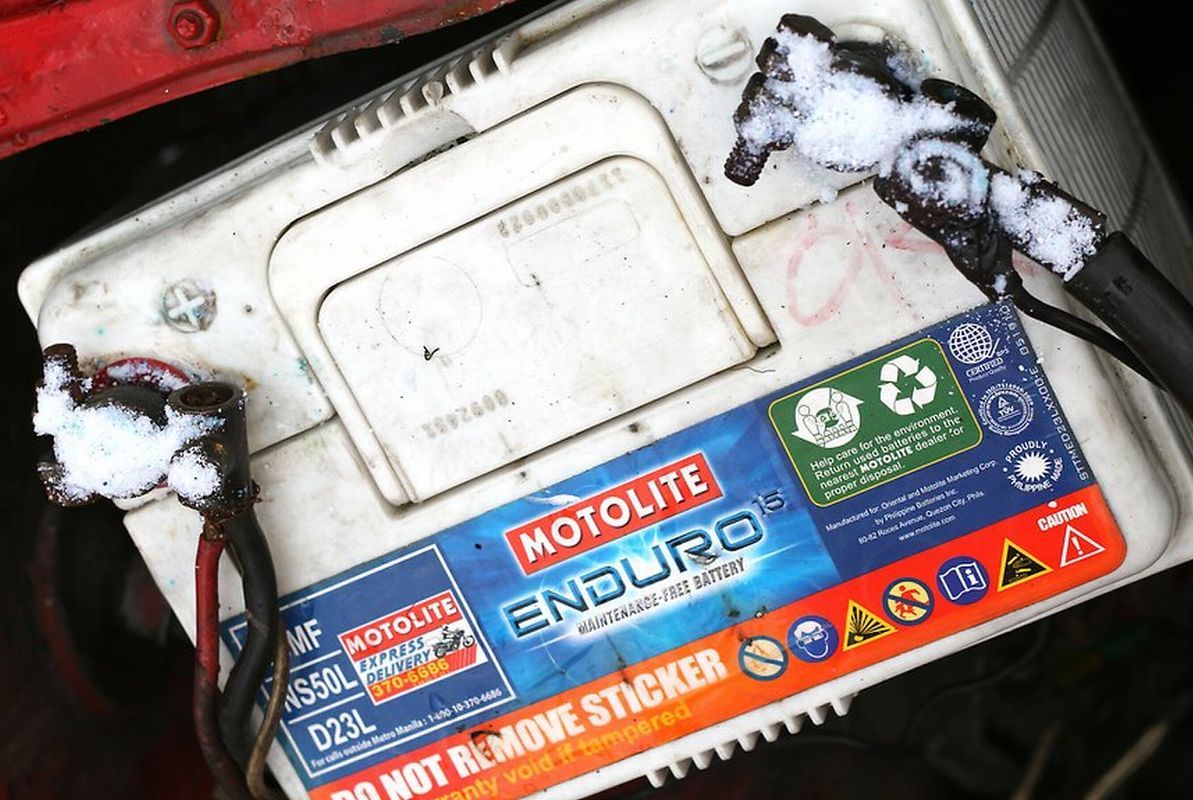
Battery terminals can develop corrosion over time.
Corrosion increases electrical resistance and can interfere with the flow of current between the battery and the vehicle.
Before cleaning the terminals, the vehicle should be switched off and appropriate safety precautions should be taken.
The terminals can be cleaned using a suitable battery-terminal brush or another appropriate cleaning method.
After cleaning, the terminals should be properly tightened.
A clean and secure electrical connection is particularly important because the starter motor can draw a very high current.
Why Do Battery Terminals Corrode?
Corrosion can occur because of chemical reactions around the battery terminals.
Possible contributing factors include:
-
Battery age
-
Electrolyte vapor
-
Moisture
-
Overcharging
-
Poor terminal connection
-
High temperatures
-
Battery damage
Heavy or recurring corrosion should not simply be cleaned repeatedly. The underlying cause should also be investigated.
Should Battery Terminals Be Greased?
A suitable battery-terminal protection product can be used after the electrical connection has been properly established.
The important point is that the protective material should not interfere with the metal-to-metal electrical connection between the terminal and battery post.
The terminal should first be installed and tightened correctly. Protection can then be applied according to the product instructions.
How Can Battery Voltage Be Checked?
Battery voltage can be checked with a digital multimeter.
With the engine switched off and the vehicle allowed to rest, a fully charged conventional 12-volt battery will generally measure around 12.6 volts, although the exact reading can vary depending on battery condition, temperature, and recent charging.
A significantly lower resting voltage may indicate that the battery is partially discharged or deteriorated.
Voltage alone, however, does not provide a complete assessment of battery health.
A battery can show a reasonable resting voltage but still fail to deliver sufficient current when the starter motor is engaged.
What Is a Battery Load Test?
A load test evaluates the battery's ability to maintain voltage while supplying significant current.
This is more informative than simply measuring the battery's resting voltage.
During a proper battery test, the tester evaluates factors such as:
-
Voltage
-
Starting capability
-
Available cranking current
-
Battery state of charge
-
Internal resistance
-
Battery health
Modern electronic battery testers can often estimate the battery's remaining starting capability without applying the same type of heavy load used by older test equipment.
What Is CCA?
CCA stands for Cold Cranking Amps.
It represents the battery's ability to provide starting current under specified cold-temperature testing conditions.
A higher CCA rating generally means the battery is capable of delivering more starting current under those conditions.
However, the correct battery should always be selected according to the vehicle manufacturer's specifications rather than simply choosing the highest CCA rating available.
How Does Cold Weather Affect a Battery?
Cold weather can significantly reduce battery performance.
As temperature decreases, the battery's ability to deliver current decreases. At the same time, the engine requires more effort from the starter because engine oil becomes more viscous.
This combination makes winter particularly demanding for the battery.
A battery that starts an engine easily in warm weather may struggle during a cold morning if its capacity has already deteriorated.
How Does Hot Weather Affect a Battery?
High temperatures can also shorten battery life.
Heat accelerates chemical reactions inside the battery and can increase water loss and internal degradation.
This means that battery failure is not exclusively a winter problem.
In many cases, a battery that appears to fail during winter may actually have been weakened by prolonged exposure to high temperatures during the preceding months.
How Long Does a Car Battery Last?
Battery lifespan varies considerably.
Many automotive batteries last approximately 3 to 5 years, but actual lifespan depends on:
-
Climate
-
Driving habits
-
Vehicle electrical demand
-
Battery technology
-
Charging system condition
-
Number of start-stop cycles
-
Vehicle usage frequency
-
Maintenance
A battery used in a hot climate or subjected to frequent short trips may deteriorate faster.
A battery should therefore be evaluated based on its actual condition rather than replaced solely according to age.
Does Short-Distance Driving Damage the Battery?
Short-distance driving does not directly damage the battery, but it can prevent the battery from receiving enough charging time.
Starting the engine consumes a considerable amount of electrical energy.
If the vehicle is repeatedly driven for only a few minutes, the alternator may not have enough time to restore the energy consumed during starting.
Over time, the battery can remain undercharged, which can accelerate deterioration.
What Is Parasitic Battery Drain?
Parasitic drain occurs when electrical components continue consuming power while the vehicle is switched off.
A small amount of standby consumption is normal because modern vehicles need to maintain functions such as security systems, memory settings, and electronic control modules.
However, excessive current draw can discharge the battery.
Possible causes include:
-
Faulty control modules
-
Interior lights remaining on
-
Trunk or glovebox lights
-
Aftermarket audio systems
-
Dash cameras
-
Alarm systems
-
USB accessories
-
Faulty relays
-
Wiring problems
If a healthy battery repeatedly becomes discharged while the vehicle is parked, excessive parasitic drain should be investigated.
How Should a Car Battery Be Stored?
If a vehicle will remain unused for an extended period, the battery should not simply be ignored.
Depending on the vehicle and battery type, a suitable battery maintainer or charger can help keep the battery at an appropriate state of charge.
The battery should also be protected from extreme temperatures where possible.
Before storing a vehicle for a long period, the electrical requirements of the vehicle should be considered because disconnecting the battery can affect electronic systems, security functions, memory settings, or other vehicle-specific features.
Can a Completely Discharged Battery Be Recharged?
Sometimes a discharged battery can be successfully recharged.
However, the outcome depends on why the battery discharged and how long it remained in a deeply discharged state.
A severely discharged lead-acid battery can suffer permanent damage, particularly if it remains discharged for an extended period.
If the battery repeatedly becomes completely discharged, the cause should be diagnosed rather than repeatedly charging it.
What Is Sulfation?
Sulfation is a common form of lead-acid battery deterioration.
When a lead-acid battery remains undercharged or discharged for extended periods, lead sulfate crystals can form on the battery plates.
Severe sulfation can reduce the battery's ability to accept and hold a charge.
This is one reason why keeping a battery properly charged is important, especially when the vehicle is used infrequently.
Can a Battery Be Maintained Without Removing It From the Vehicle?
In many cases, yes.
Battery voltage and condition can often be checked while the battery remains installed.
Likewise, an appropriate battery charger or maintainer may be connected without removing the battery.
However, some vehicles have specific charging procedures, especially vehicles equipped with battery monitoring systems.
Always follow the vehicle manufacturer's instructions regarding charging and electrical connections.
What Is a Battery Monitoring System?
Many modern vehicles use a battery monitoring sensor, often installed around the battery terminal.
The vehicle's electronic control system can monitor parameters such as:
-
Battery voltage
-
Current flow
-
State of charge
-
Charging behavior
-
Electrical load
This information can be used to manage alternator output and electrical consumption.
On some vehicles, replacing the battery may also require a battery registration or battery adaptation procedure, particularly when changing battery type or capacity.
Why Does a New Battery Sometimes Require Registration?
Modern vehicles may be programmed to understand the characteristics of the installed battery.
If the battery is replaced with another unit, the vehicle may need to be informed about the replacement.
Depending on the vehicle, this process may involve:
-
Battery registration
-
Battery adaptation
-
Battery management reset
-
Battery type configuration
-
Capacity configuration
This is particularly important on vehicles equipped with sophisticated energy-management systems.
How Should a New Car Battery Be Selected?
The replacement battery should match the vehicle's requirements.
Important specifications include:
-
Voltage
-
Battery capacity
-
CCA rating
-
Battery technology
-
Physical dimensions
-
Terminal arrangement
-
Mounting configuration
-
Start-stop compatibility
For example, replacing an AGM battery with a conventional flooded battery simply because it is cheaper may not be appropriate for a vehicle designed around AGM technology.
What Should Be Checked When Replacing a Battery?
Battery replacement should not be limited to removing the old battery and installing the new one.
The charging system should also be checked.
A technician should consider:
-
Alternator output
-
Charging voltage
-
Battery terminals
-
Ground connections
-
Battery mounting
-
Parasitic current
-
Battery monitoring system
-
Battery registration requirements
If the alternator is overcharging or undercharging, a new battery may fail prematurely.
Can a Bad Alternator Damage a Battery?
Yes.
An alternator that does not provide enough charging voltage can leave the battery chronically undercharged.
An alternator or voltage regulator that produces excessive voltage can also damage the battery and other electrical components.
Therefore, when replacing a battery because of repeated discharge, the charging system should be tested as well.
What Should You Do If the Battery Warning Light Comes On?
The battery warning light should not automatically be interpreted as "the battery needs replacing."
It commonly indicates a problem with the vehicle's charging system.
Possible causes include:
-
Alternator failure
-
Drive belt problem
-
Voltage regulator failure
-
Charging-circuit wiring problem
-
Poor battery connection
-
Battery failure
If the warning light remains illuminated while the engine is running, the charging system should be checked as soon as possible.
Safety When Working With a Car Battery
Car batteries should be handled carefully.
A lead-acid battery contains corrosive electrolyte and can produce hydrogen gas under certain conditions.
Important precautions include:
-
Avoid sparks and open flames near the battery.
-
Wear suitable eye protection.
-
Do not short the battery terminals.
-
Do not place metal tools across the terminals.
-
Do not attempt to open a sealed battery.
-
Keep children away from the battery.
-
Follow the manufacturer's charging instructions.
A damaged, swollen, leaking, or severely overheated battery should not be handled casually.
Final Thoughts
The car battery is a fundamental part of the vehicle's electrical and starting system. Although modern batteries require much less maintenance than older designs, they still need periodic inspection.
Checking the battery terminals, monitoring voltage, inspecting for corrosion or physical damage, and testing the charging system can help identify problems before the battery completely fails.
Battery life is affected by climate, driving habits, electrical load, charging-system condition, and vehicle usage. Short trips, long periods of inactivity, extreme temperatures, and excessive parasitic drain can all contribute to premature battery discharge or deterioration.
Most importantly, a battery problem should not always be treated as an isolated battery problem. If a new battery repeatedly becomes discharged, the alternator, wiring, grounds, and parasitic electrical consumption should also be investigated.
Proper battery maintenance is ultimately about more than extending battery life. It helps ensure reliable engine starting and stable operation of the vehicle's electrical systems.