TR
TR EN
EN

What Is a Driveshaft and Universal Joint? What Are the Symptoms of Failure?
The driveshaft and its joints are among the key components of a vehicle’s drivetrain. They transfer the rotational force produced by the engine and transmission to the driven wheels while allowing the suspension and drivetrain to move relative to each other.
Although the exact design varies between front-wheel-drive, rear-wheel-drive, and four-wheel-drive vehicles, driveshafts and joints have the same basic purpose: transmitting torque smoothly while accommodating changes in angle and movement.
What Is a Driveshaft?
A driveshaft is a rotating shaft that transfers engine torque from the transmission or differential to another part of the drivetrain.
In a rear-wheel-drive vehicle, for example, the driveshaft generally carries power from the transmission to the rear differential. The differential then distributes this torque to the rear wheels.
Depending on the vehicle, a driveshaft may consist of:
-
A tubular shaft
-
Universal joints
-
Constant-velocity joints
-
Slip joints
-
Center support bearings
-
Flanges and mounting components
Some vehicles use a single-piece driveshaft, while longer vehicles may use a two-piece design with a center support bearing.

What Is a Joint?
A drivetrain joint is a mechanical connection that allows torque to be transferred even when two connected components are not perfectly aligned.
The term "joint" can refer to several different designs. Common examples include universal joints, constant-velocity joints, and flexible couplings.
The type of joint used depends on the vehicle's drivetrain configuration and the amount of movement required.
What Is a Universal Joint?
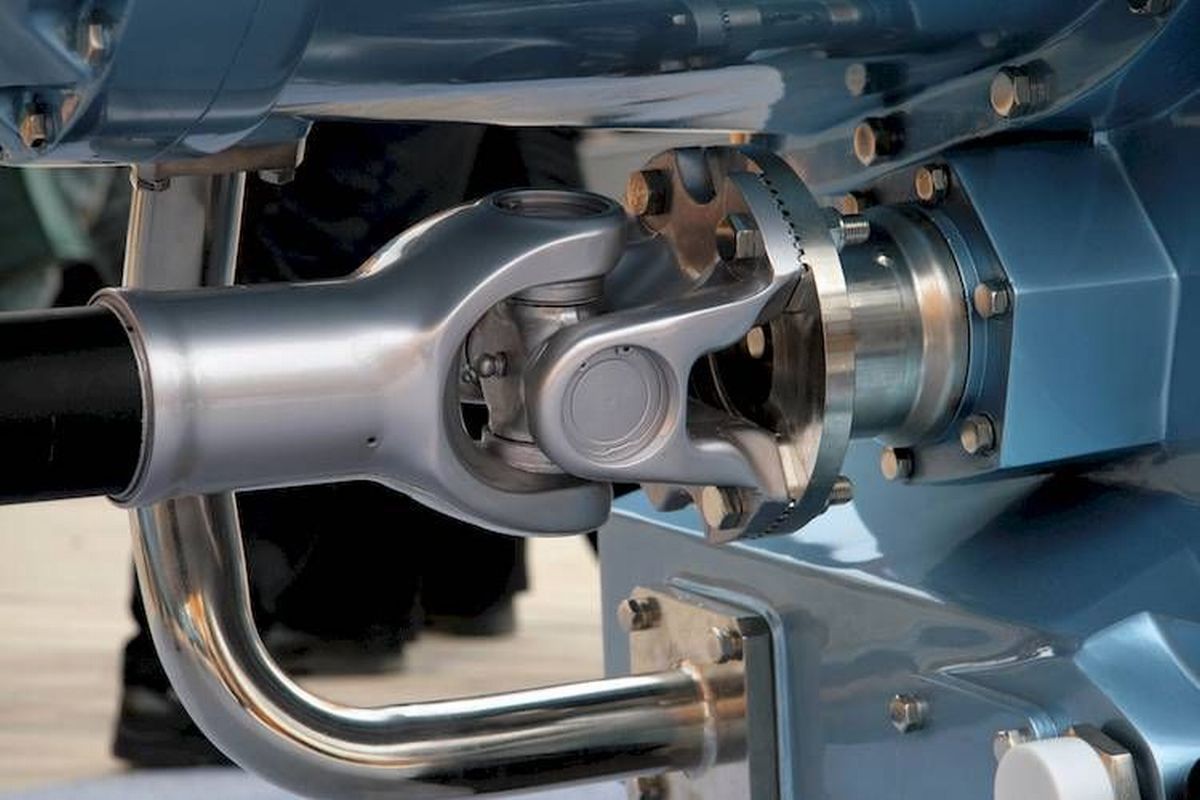
A universal joint, commonly called a U-joint, is a cross-shaped mechanical joint that allows a driveshaft to transmit rotational force while operating at an angle.
It is particularly common in rear-wheel-drive and four-wheel-drive vehicles.
The universal joint allows the driveshaft angle to change as the suspension moves or as the transmission and differential move relative to each other.
A typical universal joint contains:
-
A cross-shaped center
-
Needle bearings
-
Bearing caps
-
Seals
-
Retaining clips or other locking components
The bearings allow the joint to rotate smoothly while the cross-shaped mechanism allows angular movement.
Why Is the Driveshaft Important?
The engine produces torque, but that torque must be transferred through several drivetrain components before reaching the wheels.
A typical rear-wheel-drive power path is:
Engine → Transmission → Driveshaft → Differential → Axle Shafts → Wheels
The driveshaft therefore operates under considerable mechanical stress.
During hard acceleration, towing, hill climbing, or sudden changes in load, the driveshaft and its joints can experience significant torque.
Any looseness, imbalance, deformation, or bearing wear can therefore create noticeable vibration or noise.
What Are the Symptoms of Driveshaft or Joint Failure?
Driveshaft problems often produce symptoms that are easy to feel while driving. However, similar symptoms can also be caused by wheels, tires, wheel bearings, differential components, engine mounts, or transmission mounts.
The most common signs include:
Vibration while driving
One of the most important symptoms is vibration coming from underneath the vehicle.
The vibration may become more noticeable as vehicle speed increases. A driveshaft that is bent, unbalanced, or incorrectly installed can produce a rotational vibration.
If the vibration is strongly related to vehicle speed rather than engine RPM, the driveshaft becomes an important area to inspect.
Clunking when accelerating or decelerating
A worn universal joint can develop excessive play.
When the driver suddenly applies or releases the accelerator, the drivetrain load changes. The resulting movement can produce a noticeable clunk or knocking sound.
This symptom is especially important because excessive joint play can eventually lead to more serious drivetrain problems.
Knocking when shifting between Drive and Reverse
On vehicles with automatic transmissions, a worn driveshaft joint may produce a clunk when shifting between forward and reverse.
This happens because drivetrain torque changes direction and any excessive clearance in the joint or related components becomes more noticeable.
Clicking or metallic noises
A severely worn joint may produce clicking, squeaking, rattling, or metallic sounds.
A dry universal joint can also become noisy because its internal bearings are no longer operating smoothly.
Shuddering during acceleration
Some driveshaft problems cause a shudder or shaking sensation when accelerating.
This can sometimes be confused with:
-
Transmission problems
-
Clutch problems
-
Engine misfires
-
Worn engine mounts
-
Differential problems
-
CV joint problems
The conditions under which the vibration occurs are therefore important for diagnosis.
Excessive movement in the driveshaft
When the vehicle is safely lifted and the drivetrain is inspected, excessive rotational or side-to-side movement may indicate wear.
A driveshaft should not have significant unwanted play at its joints.
Squeaking or grinding
A worn or poorly lubricated joint may produce a squeaking sound, particularly at low speeds or when the drivetrain changes position.
Grinding can indicate more advanced bearing or joint damage.
What Causes Driveshaft Failure?
Driveshafts are mechanically strong components, but they can eventually develop problems.
Common causes include:
Worn universal joints
The bearings inside a universal joint can wear over time. Lack of lubrication, contamination, or high operating loads can accelerate this process.
Driveshaft imbalance
A driveshaft rotates at high speed. Even a relatively small imbalance can create significant vibration.
Missing balance weights, incorrect repairs, corrosion, or component replacement can affect the shaft's balance.
Bent driveshaft
A driveshaft can become bent after an impact, accident, or contact with an obstacle underneath the vehicle.
Even a small deformation can cause substantial vibration at higher speeds.
Worn center support bearing
Two-piece driveshafts often use a center support bearing.
When this bearing or its rubber support deteriorates, vibration, humming, clunking, or movement from underneath the vehicle may occur.
Damaged mounts
Transmission, differential, or driveshaft mounting components can deteriorate and allow excessive drivetrain movement.
This can produce symptoms that appear to originate from the driveshaft itself.
Excessive drivetrain load
Repeated hard acceleration, heavy towing, aggressive driving, or modifications that substantially increase engine torque can increase stress on the driveshaft and joints.
What Happens When a Universal Joint Wears Out?
A universal joint usually does not fail without warning.
In many cases, wear begins as a small amount of play or roughness. The driver may initially notice a slight clunk when accelerating or changing direction.
As wear progresses, the joint can develop significant clearance.
Eventually, the bearing caps, cross, or other components can become severely damaged. In extreme cases, the joint can fail mechanically and the driveshaft may become detached or damaged.
This is why a noticeable clunk or severe vibration should not be ignored.
Driveshaft Vibration vs. Wheel Vibration
It is important to distinguish driveshaft vibration from a wheel or tire problem.
A wheel or tire issue often produces vibration that is strongly related to road speed and may be felt through the steering wheel or body.
Driveshaft vibration can also increase with road speed, but it is often felt more prominently through the vehicle floor, seat, or center of the body.
A bent or imbalanced driveshaft may also produce vibration that becomes particularly noticeable during specific speed ranges.
Professional diagnosis is necessary because the symptoms can overlap.
How Is a Driveshaft Problem Diagnosed?
A proper inspection should begin with a visual examination.
The technician may check:
-
Driveshaft condition
-
Universal joints
-
Joint play
-
Center support bearing
-
Mounting points
-
Flanges
-
Slip joints
-
CV joints where applicable
-
Signs of impact or bending
-
Missing balance weights
-
Corrosion
-
Grease leakage
The vehicle may then be checked for excessive movement in the drivetrain.
A road test can also be useful because the technician can determine whether the vibration or noise occurs during:
-
Acceleration
-
Deceleration
-
Constant-speed driving
-
Gear changes
-
Specific speed ranges
-
Changes in drivetrain load
In more advanced cases, vibration analysis equipment can help identify whether the problem originates from the driveshaft or another rotating component.
Can a Driveshaft Be Repaired?
Not every driveshaft problem requires complete replacement.
Depending on its construction and the extent of the damage, a driveshaft may be repairable.
Possible repairs include:
-
Universal joint replacement
-
Center support bearing replacement
-
Driveshaft balancing
-
Replacement of damaged joints
-
Replacement of worn mounting components
-
Driveshaft straightening by a specialist when appropriate
However, a severely bent, cracked, or structurally damaged driveshaft should generally be replaced rather than repaired improperly.
After certain repairs, proper balancing is particularly important because the shaft operates at high rotational speed.
How Long Does a Driveshaft Last?
There is no universal replacement interval for a driveshaft.
Its service life depends on:
-
Vehicle design
-
Mileage
-
Driving conditions
-
Road quality
-
Towing requirements
-
Maintenance
-
Lubrication
-
Drivetrain torque
-
Previous accidents or impacts
A driveshaft can last for many years without major problems, while its universal joints or support bearings may require attention much earlier.
Therefore, driveshaft components should generally be inspected when symptoms appear rather than replaced automatically at a fixed mileage.
Can You Drive With a Bad Driveshaft or Joint?
Driving with a minor driveshaft problem may initially seem possible, but continuing to use the vehicle can allow the damage to progress.
A worn joint can develop increasing amounts of play, while a damaged or unbalanced shaft can place additional stress on other drivetrain components.
A severe vibration, loud clunking, metallic noise, or obvious driveshaft movement should be treated as a serious warning.
If a universal joint or driveshaft is close to mechanical failure, continued driving can create a safety risk and potentially cause expensive secondary damage.
Driveshaft Problems Should Not Be Confused With CV Joint Problems
Driveshafts and CV joints are related to torque transmission, but they are not the same component.
A CV joint is designed to transmit torque while allowing large changes in operating angle, which is particularly important in front-wheel-drive vehicles where the wheels must both steer and move with the suspension.
A universal joint has a different construction and operating characteristic.
For this reason, a clicking noise while turning sharply may point toward a CV joint, while a clunk or vibration under acceleration may lead the diagnosis toward the driveshaft or its joints.
The exact drivetrain configuration must always be considered.
Final Thoughts
The driveshaft and its joints play a critical role in transferring engine torque through the drivetrain. A healthy driveshaft should rotate smoothly without excessive vibration, looseness, or abnormal noise.
The most important warning signs include vibration, clunking during acceleration or gear changes, shuddering, metallic noises, excessive joint play, and unusual movement underneath the vehicle.
Because these symptoms can also be caused by other drivetrain components, replacing parts based only on the symptom is not always the correct approach. A proper inspection should identify whether the actual problem is the driveshaft, universal joint, center support bearing, CV joint, differential, mounting system, or another component.