TR
TR EN
EN

What Is the EBD System?
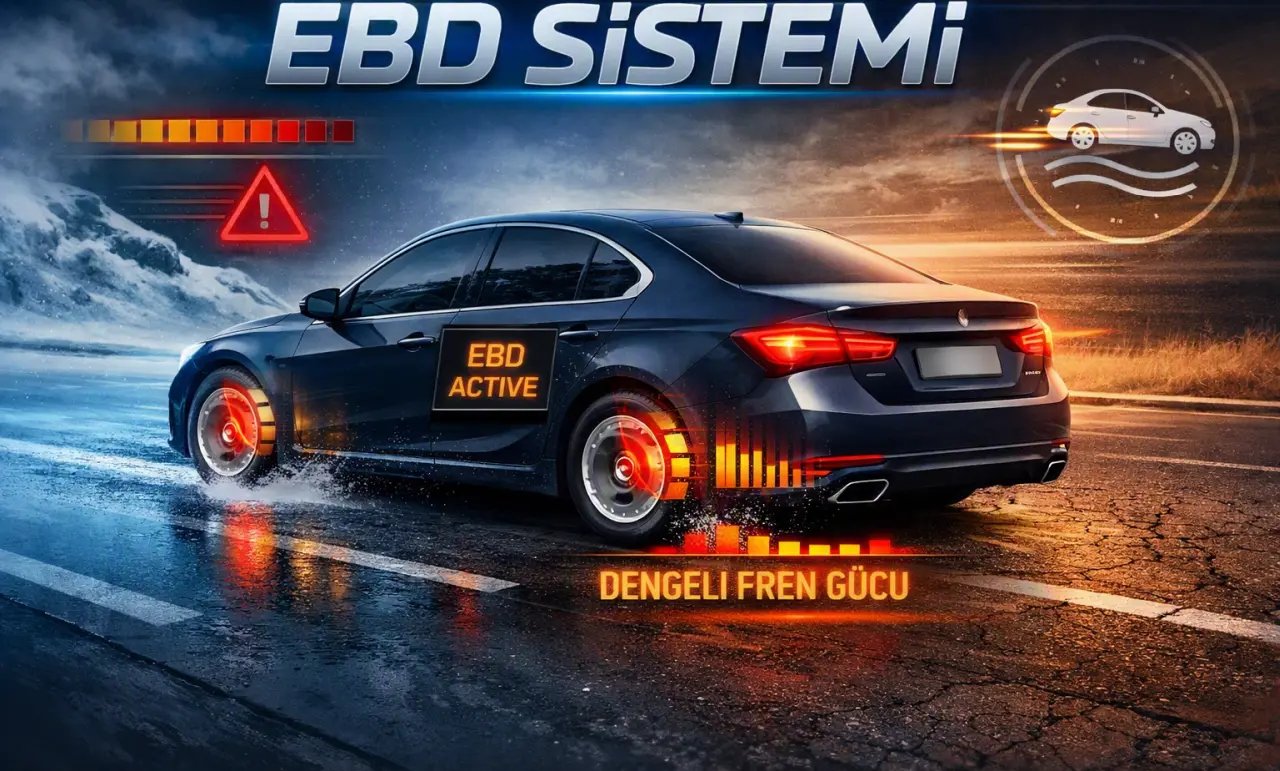
EBD (Electronic Brakeforce Distribution) is an electronic braking system that helps distribute braking force between the vehicle's wheels according to driving conditions.
The system takes into account factors such as wheel speed, vehicle load, braking intensity, and wheel grip to help determine how much braking force should be applied to different wheels.
EBD is normally integrated with the ABS (Anti-lock Braking System). While ABS primarily works to prevent the wheels from locking during hard braking, EBD helps manage how braking force is distributed between the front and rear wheels.
The basic purpose of EBD is to make better use of the available tire grip and help maintain stable braking behavior under different conditions.
Why Is EBD Necessary?
The distribution of weight over a vehicle's wheels changes during braking.
When the driver applies the brakes, the vehicle's weight transfers toward the front axle. As a result, the front wheels carry more vertical load while the rear wheels carry less.
This is particularly noticeable during hard braking.
If the same braking force were applied to all four wheels regardless of conditions, the rear wheels could reach their grip limit earlier because they have less load acting on them.
EBD helps prevent this by dynamically managing the braking force delivered to the wheels.
How Does EBD Work?
EBD uses information from the vehicle's braking and stability-control sensors to determine how braking force should be distributed.
Wheel-speed sensors are particularly important.
During braking, the control system can monitor:
-
Individual wheel speeds
-
Differences between wheel speeds
-
Vehicle deceleration
-
Braking intensity
-
Wheel behavior during braking
If the system detects that the rear wheels are approaching their grip limit, it can reduce or control the hydraulic pressure delivered to the rear brakes.
This helps prevent unnecessary rear-wheel lockup while allowing the available braking force to be used more effectively.
How Does EBD Distribute Braking Force?
The amount of braking force required at each axle is not constant.
During light or moderate braking, the front and rear brakes can operate with a relatively balanced pressure distribution.
During hard braking, however, weight transfer significantly increases the load on the front axle while reducing the load on the rear axle.
The front wheels can therefore handle a greater proportion of the braking force.
EBD adjusts the braking force accordingly.
This is an important point: EBD does not simply increase braking force at the rear wheels. In some situations, its job is actually to limit rear brake pressure to prevent the rear wheels from locking.
How Does EBD Work When the Vehicle Is Heavily Loaded?
Vehicle load can significantly change braking behavior.
Consider a vehicle with an empty trunk compared with the same vehicle carrying heavy luggage and several passengers. The rear axle will carry considerably more weight in the second situation.
Because the rear wheels have more vertical load, their available braking capacity can also change.
EBD helps adapt the braking-force distribution to these changing conditions.
This allows the braking system to operate more appropriately whether the vehicle is lightly loaded or carrying a heavier load.
What Is the Difference Between EBD and ABS?
EBD and ABS work closely together, but they have different primary functions.
ABS is designed to prevent wheel lockup.
When the system detects that a wheel is approaching a locked condition, it rapidly adjusts brake pressure so that the wheel can continue rotating.
EBD is designed to manage brakeforce distribution.
It helps determine how much braking force should be applied to the front and rear wheels under the current conditions.
In simple terms:
EBD → Helps distribute braking force.
ABS → Helps prevent wheel lockup.
In modern vehicles, both functions are commonly integrated into the same ABS hydraulic and electronic control system.
What Is the Difference Between EBD and ESP/ESC?
EBD, ABS, and ESP/ESC are related systems, but they perform different jobs.
EBD primarily deals with brakeforce distribution.
ABS primarily deals with wheel lockup during braking.
ESP/ESC, on the other hand, is designed to help maintain vehicle directional stability.
For example, if a vehicle begins to understeer or oversteer during a corner, the stability-control system can selectively apply braking to individual wheels and, when necessary, request a reduction in engine torque.
Therefore, EBD can be thought of as a brakeforce distribution function, ABS as an anti-lock function, and ESC as a vehicle stability-control function.
Which Sensors Does EBD Use?
The exact system architecture varies between manufacturers and vehicle models.
However, wheel-speed sensors are among the most important sources of information for ABS/EBD operation.
The system monitors the rotational speed of each wheel and compares the signals during braking.
Modern ABS/ESC systems may also have access to information from other sensors, depending on the vehicle. These can include:
-
Steering-angle sensor
-
Yaw-rate sensor
-
Lateral acceleration sensor
-
Brake pedal or brake pressure information
-
Vehicle speed information
Not every vehicle uses all of these sensors directly for EBD. The exact control strategy depends on the vehicle's braking and stability-control architecture.
Does EBD Reduce Braking Distance?
EBD is not designed specifically as a system for reducing braking distance.
However, distributing braking force more appropriately can help the vehicle make better use of available tire grip, particularly under changing load and braking conditions.
Actual stopping distance depends on many factors, including:
-
Tire condition
-
Tire pressure
-
Road surface
-
Wet or dry conditions
-
Vehicle speed
-
Brake pad condition
-
Brake disc condition
-
Brake fluid condition
-
Vehicle load
-
ABS and other electronic systems
Therefore, it would be incorrect to say that EBD always reduces stopping distance by a specific amount.
Its primary purpose is to help optimize brakeforce distribution and maintain stable braking behavior.
What Happens If a Vehicle Does Not Have EBD?
Vehicles without electronic brakeforce distribution must use another method to control the relationship between front and rear braking force.
Older or simpler braking systems may use mechanical or hydraulic devices such as a brake proportioning valve to limit rear brake pressure.
For example, once hydraulic pressure reaches a certain level, the proportioning system can prevent the rear brakes from receiving excessive pressure.
EBD performs a similar general function electronically and can respond dynamically to wheel behavior.
This allows modern braking systems to adapt more effectively to changing operating conditions.
What Are the Symptoms of an EBD Problem?
Because EBD is generally integrated with the ABS/ESC system, an EBD fault may not appear as a warning specifically labeled "EBD."
Possible symptoms include:
-
ABS warning light
-
Brake system warning light
-
ESC/ESP warning light
-
Multiple electronic safety-system warnings
-
Changes in braking behavior
-
Wheel-speed sensor faults
-
Abnormal wheel-speed readings
-
Electronic systems being disabled
-
Vehicle entering a fail-safe mode
Depending on the vehicle, the instrument cluster may display messages such as ABS Fault, ESC Fault, Brake System Fault, or a similar warning.
Can an EBD Fault Disable the Brakes Completely?
Not necessarily.
In many cases, the basic hydraulic braking system can continue to operate even if ABS, EBD, or ESC functions are disabled.
However, the vehicle may no longer have the same electronic braking assistance.
This means the vehicle's braking behavior can be different from normal, particularly during hard braking or on low-grip surfaces.
If the ABS and brake warning lights are illuminated together, the problem should be investigated promptly.
If there is also a soft brake pedal, significant brake-fluid loss, or a noticeable reduction in braking performance, the vehicle should not be driven until the braking system has been inspected.
What Can Cause an EBD Fault?
An EBD-related problem does not necessarily mean that the EBD function itself has failed.
Possible causes include:
Faulty wheel-speed sensor
If an ABS wheel-speed sensor produces an incorrect signal or stops producing a signal, the control unit may no longer be able to accurately determine wheel behavior.
Damaged wiring or connectors
Broken wires, corrosion, loose terminals, or damaged connectors can interrupt sensor signals.
ABS hydraulic unit problems
A fault within the ABS hydraulic modulator or its valves can affect ABS and EBD operation.
Low battery voltage
A weak battery or charging-system problem can cause ABS/ESC control units to generate faults.
Low brake-fluid level
Low brake-fluid level or a hydraulic leak can trigger braking-system warnings.
ABS/ESC control-unit fault
An electronic or software problem within the control module can also disable EBD-related functions.
How Is an EBD Fault Diagnosed?
An EBD problem should not be diagnosed simply by looking at the warning light.
The vehicle should first be scanned with a suitable diagnostic tool, particularly through the ABS/ESC control module.
The technician may then examine:
-
Wheel-speed sensor signals
-
Sensor wiring
-
Sensor connectors
-
ABS hydraulic unit
-
Brake-fluid level
-
Battery voltage
-
Charging voltage
-
CAN communication
-
ABS/ESC live data
-
Individual wheel-speed readings
For example, if a wheel-speed sensor fault code is stored, replacing the sensor immediately may not always solve the problem.
The actual cause could be:
-
Damaged wiring
-
Corroded connector
-
Incorrect sensor installation
-
Damaged wheel bearing
-
Damaged magnetic encoder ring
-
Mechanical damage around the sensor
This is why the circuit and live data should be tested before replacing components.
Can a Bad Wheel Bearing Cause an EBD or ABS Fault?
Yes.
Many modern wheel bearings incorporate a magnetic encoder or tone ring used by the wheel-speed sensor.
If this encoder becomes damaged or contaminated, the wheel-speed sensor may produce an incorrect signal.
The result can be an ABS or EBD-related fault even though the sensor itself is working correctly.
This is an important diagnostic point because replacing the sensor alone would not solve a problem caused by the bearing or encoder.
Can Low Battery Voltage Affect EBD?
Yes.
ABS/ESC control units are sensitive to electrical supply conditions.
A weak battery, poor ground connection, charging-system problem, or voltage drop can cause various electronic modules to report faults.
In some vehicles, several warning lights may appear simultaneously when system voltage falls outside the expected range.
Therefore, battery and charging voltage should be checked before assuming that the ABS or EBD control unit has failed.
Is EBD Related to Tires and Brake Maintenance?
Yes.
Although EBD is an electronic control function, its effectiveness depends on the mechanical braking system and tires.
Incorrect tire pressure, severely worn tires, different tire characteristics, or poor tire condition can change how the vehicle behaves during braking.
The same applies to worn brake pads, damaged brake discs, contaminated brake fluid, and hydraulic problems.
EBD cannot compensate for mechanically defective brakes or severely compromised tires.
Electronic brake control should therefore always be considered together with the condition of the physical braking system.
Does EBD Work on Wet or Slippery Roads?
EBD can help manage brakeforce distribution under changing grip conditions, but it cannot create additional traction.
On a wet, icy, snowy, or contaminated road surface, available tire grip can be dramatically reduced.
ABS can help prevent the wheels from locking, while EBD can help manage brakeforce distribution, but neither system can overcome the physical limits of the tires and road surface.
Driving speed, tire condition, and road conditions remain critical factors.
EBD and Electronic Brake Control
EBD is an important part of the modern vehicle's integrated braking system.
Instead of using a fixed mechanical relationship between front and rear brake pressure, electronic control allows the braking system to react to changing conditions.
The vehicle can be lightly loaded, heavily loaded, braking gently, braking hard, or operating on a surface where wheel grip is different from one side to another.
The electronic braking system continuously evaluates available information and adjusts brake pressure accordingly.
Why Is EBD Important for Vehicle Safety?
During braking, the amount of grip available at each wheel is constantly changing.
Weight transfer, vehicle load, road conditions, tire condition, and braking intensity all influence how much braking force a wheel can handle before reaching its grip limit.
EBD helps the braking system use this available grip more effectively by controlling the distribution of braking force.
It is especially valuable during hard braking and under changing load conditions.
However, EBD does not eliminate the laws of physics. A vehicle traveling too fast on a slippery surface can still lose grip even when ABS, EBD, and ESC are functioning correctly.
EBD, ABS, and ESC Work Together
The modern braking system should not be viewed as a collection of completely independent technologies.
ABS, EBD, and ESC are often integrated into a common control architecture.
EBD helps manage how braking force is distributed.
ABS helps prevent individual wheels from locking during braking.
ESC helps maintain directional stability when the vehicle begins to deviate from the driver's intended path.
Together, these systems can significantly improve braking stability and vehicle control compared with a basic braking system without electronic assistance.
The Most Important Things to Know About EBD
EBD is an electronic brakeforce distribution function that helps determine how braking force should be distributed between the front and rear wheels according to current operating conditions.
It normally works together with ABS and uses wheel-speed information and other available vehicle data to help prevent excessive rear-wheel braking and maintain stable braking behavior.
An EBD warning does not automatically mean that the ABS module or hydraulic unit has failed. Wheel-speed sensors, wiring, connectors, wheel bearings, battery voltage, brake-fluid level, CAN communication, and other components can also cause EBD-related faults.
For this reason, the correct approach is to diagnose the complete braking system rather than simply replacing the component associated with the warning. A properly functioning EBD system, combined with good tires and a healthy mechanical braking system, helps the vehicle make better use of available traction when braking.