TR
TR EN
EN

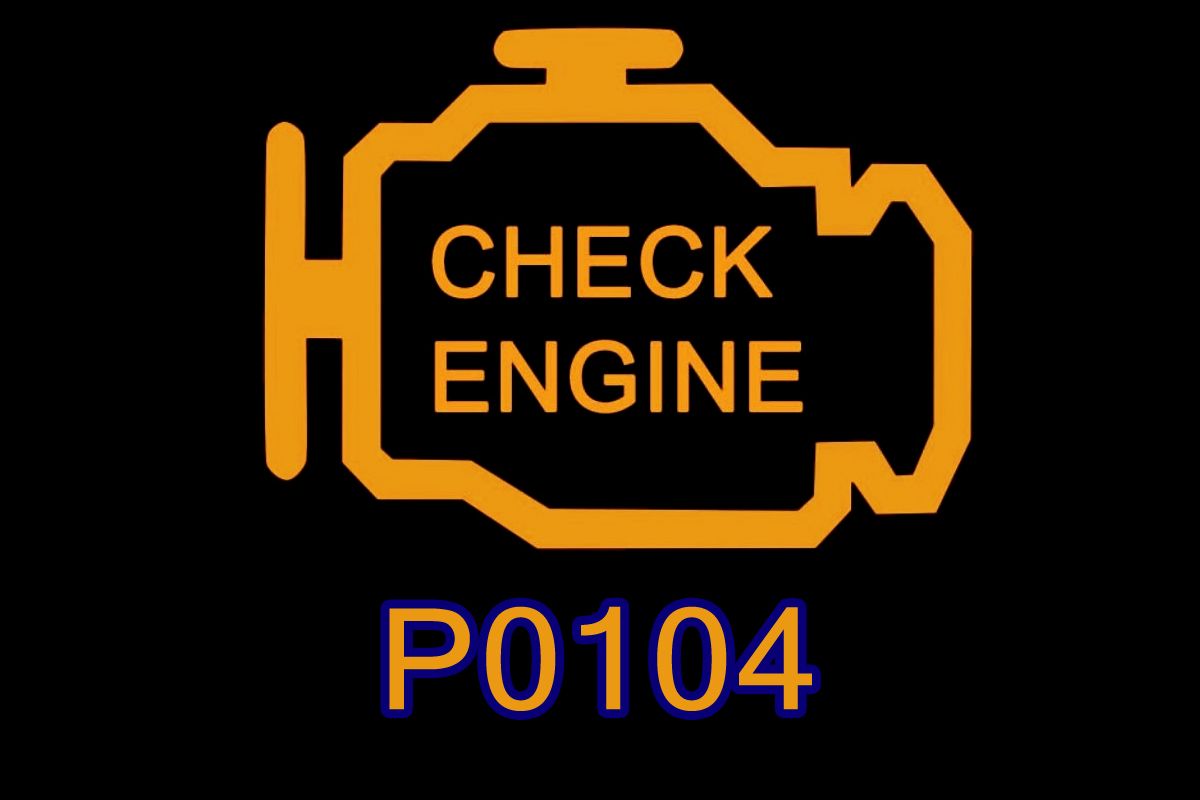
P0104 Mass Air Flow (MAF) Sensor "A" Circuit Intermittent
P0104 is an OBD-II diagnostic trouble code indicating that the engine control module (ECM/PCM) has detected an intermittent or erratic signal from the Mass Air Flow (MAF) Sensor “A” circuit.
The important word in this code is “intermittent.” The ECU is not necessarily seeing a permanently high or permanently low MAF signal. Instead, the airflow signal may suddenly become unstable, drop out, spike, or disagree with the engine's actual operating conditions.
Because the MAF sensor is used to determine how much air is entering the engine, an unreliable signal can affect fuel injection, ignition control, idle quality, emissions and, on some engines, turbocharger management.
What Does the MAF Sensor Do?
The Mass Air Flow sensor measures the amount of air entering the engine.
Most modern MAF sensors use a heated sensing element. As air flows through the intake, it changes the temperature of the sensing element. The electronics inside the sensor convert this change into a signal that the ECU can use to calculate airflow.
The ECU combines MAF information with other data, including:
-
Engine RPM
-
Throttle position
-
Intake air temperature
-
MAP pressure
-
Engine coolant temperature
-
Fuel trims
-
Oxygen sensor information
The result is used to determine the appropriate amount of fuel and to evaluate engine load.
What Does “Sensor A” Mean?
The “A” designation identifies the MAF sensor circuit being monitored by the vehicle's control system.
It does not universally mean “the first MAF sensor” in exactly the same physical arrangement on every vehicle.
Most conventional engines have a single primary MAF sensor, but some vehicle manufacturers use more complex intake and airflow-sensing configurations.
The correct sensor identification should therefore be confirmed using the vehicle's wiring diagram or service information.
Why Is P0104 an Intermittent Code?
An intermittent MAF problem can be difficult to diagnose because the sensor may work perfectly for several minutes and then suddenly produce an abnormal signal.
The fault may appear when:
-
The engine vibrates
-
The harness moves
-
The vehicle accelerates
-
The engine compartment becomes hot
-
The electrical load changes
-
The air filter or intake system creates turbulence
-
Moisture enters the connector
-
The sensor reaches operating temperature
This means a vehicle may run normally when checked at a workshop even though P0104 continues to return during actual driving.
Common Symptoms
Depending on the vehicle and severity of the fault, the driver may notice:
-
Check Engine Light
-
Hesitation during acceleration
-
Poor throttle response
-
Rough idle
-
Engine stalling
-
Reduced engine power
-
Increased fuel consumption
-
Difficult starting
-
Surging or inconsistent acceleration
-
Poor turbocharger response on turbocharged engines
-
Increased emissions
An intermittent signal does not always produce dramatic symptoms. Sometimes the only obvious indication is the Check Engine Light.
What Can Cause P0104?
There are many possible causes, and replacing the MAF sensor immediately is not always the correct solution.
MAF sensor failure
The sensing element or internal electronics can become unreliable.
The sensor may produce a correct signal at one airflow rate but suddenly become erratic at another.
Contaminated sensing element
Dust, oil vapour and other deposits can interfere with the MAF sensing element.
This is particularly relevant when the intake system has been poorly maintained or when an oil-containing aftermarket air filter has been used incorrectly.
Damaged wiring
A partially broken MAF wire can cause an intermittent electrical connection.
The circuit may work normally when the harness is stationary but fail when the engine moves.
Loose connector
A connector that is not fully secured can cause momentary signal interruptions.
Corroded terminals
Corrosion can increase resistance or cause unstable electrical contact.
Poor sensor ground
A weak ground connection can make the MAF signal unstable.
Power-supply problem
The sensor requires an appropriate electrical supply. Voltage instability can affect its operation.
Air intake leak
An air leak after the MAF sensor allows unmetered air to enter the engine.
The MAF sensor may be working correctly while the engine receives more air than the ECU expects.
Intake turbulence
Incorrectly installed intake components, damaged ducting or poor aftermarket modifications can create turbulent airflow around the sensor.
This can make the MAF signal unstable or implausible.
Inspect the Intake System Before Replacing Parts
A MAF sensor does not operate in isolation.
Inspect the intake tract from the air filter housing toward the throttle body.
Look for:
-
Cracked intake hoses
-
Loose clamps
-
Split rubber ducts
-
Disconnected vacuum hoses
-
Damaged airbox components
-
Incorrectly installed filters
-
Leaks downstream of the MAF
-
Aftermarket intake modifications
A small leak may not be obvious at first glance.
Pay Attention to the Connector
The MAF connector deserves careful inspection because P0104 specifically concerns the circuit.
Check for:
-
Bent terminals
-
Loose terminals
-
Corrosion
-
Water intrusion
-
Broken locking mechanism
-
Damaged wires near the connector
-
Poor previous repairs
A connector can look perfectly clean while a terminal inside has lost its proper tension.
Try a Wiring Wiggle Test
Because P0104 describes an intermittent condition, a controlled wiggle test can be useful.
While monitoring MAF live data with a scan tool, gently move the wiring harness and connector.
If the airflow value suddenly drops, spikes or disappears when the harness is moved, there may be a wiring or terminal problem.
The test should be performed carefully. Do not pull aggressively on the harness or connector.
Check MAF Live Data
Live data is one of the most useful diagnostic tools for P0104.
Monitor the MAF reading while the engine is:
-
Idling
-
Revved gently
-
Accelerated quickly
-
Held at a steady RPM
-
Driven under load
The important thing is not one universal MAF number.
MAF readings vary according to:
-
Engine displacement
-
Engine design
-
RPM
-
Throttle position
-
Engine load
-
Intake temperature
-
Altitude
-
Turbocharger operation
Instead, look for smooth and logical changes.
When airflow increases, the MAF reading should generally increase accordingly.
A sudden drop to an implausible value while engine operation remains unchanged is much more suspicious.
Compare MAF With Other Sensors
A MAF value becomes more meaningful when considered alongside other parameters.
Useful data includes:
-
RPM
-
Throttle position
-
MAP
-
Intake air temperature
-
Fuel trims
-
Engine load
-
Oxygen sensor data
For example, if the throttle is opened significantly and engine RPM rises, but the MAF reading suddenly falls to an implausible level, the MAF circuit deserves attention.
On the other hand, if MAF, MAP and throttle data all change consistently, an apparent fluctuation may simply reflect a genuine change in engine airflow.
MAF vs MAP: They Are Not the Same
The MAF sensor measures airflow entering the engine.
The MAP sensor measures pressure in the intake manifold.
They provide different information, but the ECU can use both to evaluate engine load.
If P0104 occurs together with MAP-related codes, comparing the two sensors can be particularly useful.
A major disagreement between MAF, MAP, throttle position and RPM can help identify whether the problem is related to the sensor, wiring or actual engine airflow.
Check Fuel Trims
Fuel trims can provide supporting evidence.
If the MAF sensor incorrectly reports the amount of incoming air, the ECU may inject an inappropriate amount of fuel.
Depending on the direction of the error, fuel trims may move significantly positive or negative.
However, fuel trims alone cannot prove that the MAF sensor is defective.
Vacuum leaks, fuel-pressure problems, injector problems and other engine faults can also produce abnormal fuel-trim values.
A Vacuum Leak Can Look Like a MAF Problem
An air leak downstream of the MAF sensor is particularly important.
Suppose the MAF measures a certain amount of air entering the engine. If additional air enters through a cracked intake hose after the sensor, that extra air was never measured by the MAF.
The ECU can then see a mismatch between expected and actual engine operation.
Inspect:
-
Intake boots
-
PCV hoses
-
Vacuum lines
-
Throttle-body connections
-
Intake manifold connections
-
Brake-booster hose
A smoke test can be useful when an intake leak is suspected.
Do Not Automatically Blame the MAF Sensor for Every Airflow Problem
A dirty or defective MAF sensor is only one possibility.
Other problems can affect the airflow calculation, including:
-
Intake leaks
-
Restricted air filter
-
Throttle-body problems
-
MAP sensor faults
-
EGR problems
-
Turbocharger issues
-
Intercooler leaks
-
Exhaust restrictions
-
Fuel-system problems
-
Engine mechanical problems
A good diagnosis determines whether the MAF signal is actually incorrect before replacing the component.
Turbocharged Engines
On turbocharged engines, airflow can change dramatically with boost pressure.
P0104 may therefore be accompanied by symptoms such as:
-
Poor boost
-
Hesitation
-
Reduced power
-
Inconsistent acceleration
Inspect the entire intake and charge-air system if appropriate:
-
Turbocharger inlet
-
Compressor outlet
-
Intercooler hoses
-
Intake pipes
-
Clamps
-
Boost-control system
A boost leak does not necessarily mean the MAF sensor is defective.
Electrical Testing
If the live-data behavior points toward an electrical problem, use the vehicle-specific wiring diagram to identify:
-
MAF power supply
-
Sensor ground
-
Signal circuit
-
Any additional signal or reference circuits
Check the power and ground under operating conditions.
A circuit that appears normal with the ignition on may develop a voltage drop when the engine is running or when the harness moves.
Why Continuity Testing Isn't Always Enough
A wire can pass a continuity test and still cause P0104.
For example, a conductor may be partially broken inside its insulation.
With the wire stationary, the multimeter may show continuity. When the engine vibrates, the conductor separates enough to interrupt the signal.
For this reason, intermittent MAF faults may require:
-
Voltage-drop testing
-
Load testing
-
Harness movement testing
-
Signal monitoring
-
Oscilloscope testing
An oscilloscope can be especially useful when the MAF signal drops out for only a fraction of a second.
Can Cleaning the MAF Sensor Fix P0104?
If contamination is the cause, cleaning may restore proper operation in some cases.
However, cleaning should only be performed using a cleaning method and product appropriate for the MAF sensor.
The sensing element is delicate.
Do not scrape it, touch it unnecessarily, or use brake cleaner, carburetor cleaner or another aggressive solvent unless the manufacturer specifically approves it.
If the sensor's electronics or sensing element has failed, cleaning will not repair it.
When Should the MAF Sensor Be Replaced?
Replacement is most appropriate when testing indicates that the sensor itself is producing an incorrect or unstable signal.
Before replacing it, verify:
-
Correct power supply
-
Good sensor ground
-
Good connector
-
Intact wiring
-
No significant intake leaks
-
No obvious airflow restriction
-
Plausible MAP/MAF relationship
If the circuit is healthy but the MAF signal remains abnormal, the sensor becomes the primary suspect.
Could the ECU Cause P0104?
It is possible, but relatively uncommon compared with sensor, wiring and connector problems.
The ECU should generally be considered only after the external circuit has been tested properly.
If the MAF sensor produces the correct signal but the signal arriving at the ECU is different, the wiring should be investigated.
If the correct signal reaches the ECU but the ECU interprets it incorrectly, further ECU-side diagnosis may be necessary.
A Practical Diagnostic Sequence
For an intermittent MAF fault, a logical diagnostic sequence is:
Read all DTCs → check freeze-frame data → inspect intake system → inspect MAF connector and wiring → monitor live MAF data → perform a wiring wiggle test → verify power and ground → compare MAF with MAP/throttle/RPM → check for intake leaks → test the MAF sensor itself.
This approach is usually more effective than simply installing a new MAF sensor.
What Happens If P0104 Is Ignored?
A vehicle can sometimes continue operating with P0104 for an extended period, but the engine may not be running with accurate airflow information.
Possible consequences include:
-
Poor fuel economy
-
Increased emissions
-
Poor acceleration
-
Rough running
-
Engine stalling
-
Reduced performance
If the MAF signal intermittently disappears during acceleration, the resulting loss of engine response can also create a driving safety issue.
Final Takeaway
P0104 means the ECU has detected an intermittent problem with the Mass Air Flow Sensor “A” circuit.
The fault can originate from the MAF sensor itself, but wiring, connector terminals, power supply, ground, intake leaks and airflow disturbances can all produce similar symptoms.
Because the problem is intermittent, live-data monitoring is particularly valuable. The most useful question is not simply “Is the MAF reading correct?” but rather:
“Does the MAF signal change smoothly and logically as engine speed, throttle position and load change?”
If it suddenly drops, spikes or disappears without a corresponding change in engine operation, the sensor circuit and its wiring should be investigated carefully.