TR
TR EN
EN

How Can You Tell If a Shock Absorber Is Blown?
Shock absorbers are one of the most important components of a vehicle's suspension system. Their primary job is to control the movement of the springs and keep the tires in contact with the road.
A blown shock absorber does not always mean that the shock absorber is completely broken or leaking heavily. It can also mean that its internal damping performance has deteriorated and it can no longer control suspension movement effectively.
Some failures are easy to identify, such as visible oil leakage. Others appear through changes in vehicle handling, braking, tire wear, or suspension behavior.
What Does a Shock Absorber Do?
The springs support the weight of the vehicle and allow the suspension to move over bumps. However, springs naturally continue oscillating after being compressed or extended.
The shock absorber controls these movements.
A properly functioning shock absorber helps:
-
Keep the tires in contact with the road.
-
Reduce bouncing after bumps.
-
Control body movement.
-
Improve braking stability.
-
Improve cornering behavior.
-
Reduce excessive suspension movement.
-
Improve driving comfort.
When a shock absorber loses its damping ability, the spring continues moving more than it should.
The Most Common Sign: Excessive Bouncing
One of the easiest symptoms to notice is excessive bouncing.
After passing over a bump or uneven road, a vehicle with healthy shock absorbers should settle relatively quickly.
With a severely worn shock absorber, the vehicle may continue bouncing several times.
You may notice:
-
The front or rear of the vehicle repeatedly bouncing.
-
The body continuing to move after passing over a bump.
-
The vehicle feeling unstable on uneven roads.
-
Excessive suspension movement at low speeds.
However, the traditional "push down on the corner of the car and see how many times it bounces" test is only a rough indication. Modern suspension systems and different spring rates can make this test misleading.
Oil Leakage From the Shock Absorber
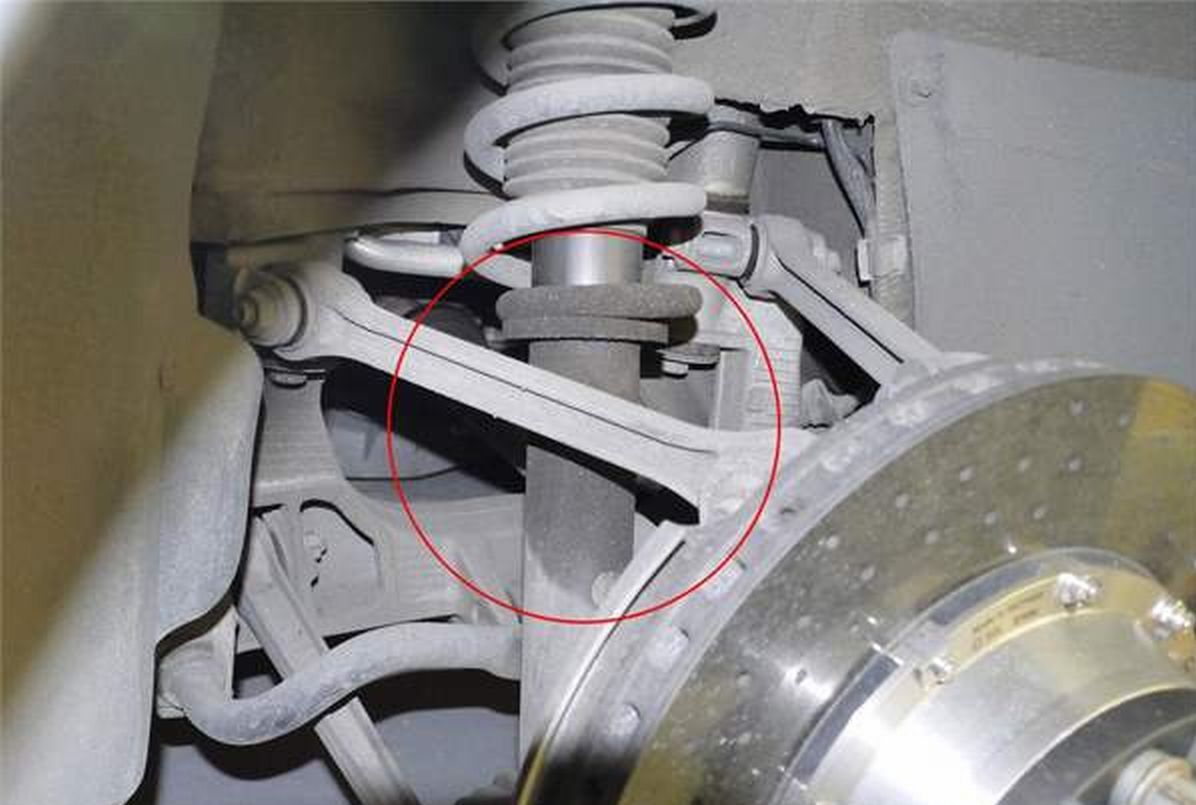
Visible oil leakage is one of the strongest physical signs of shock absorber failure.
A shock absorber contains hydraulic fluid. If the shaft seal or another internal component fails, fluid can escape.
A small amount of surface moisture or a light film does not always mean that the shock absorber has failed. However, a clearly wet shock absorber with fluid running down its body is much more concerning.
Look for:
-
Wetness around the shock absorber body.
-
Oil running down the cylinder.
-
Accumulated dirt stuck to oily areas.
-
Significant fluid loss.
A leaking shock absorber should be inspected rather than judged solely by appearance.
The Vehicle Feels Unstable
A worn shock absorber can make the vehicle feel less stable, especially at higher speeds.
The vehicle may feel as though it moves excessively after:
-
Hitting a bump.
-
Changing lanes.
-
Driving over expansion joints.
-
Entering or exiting a corner.
-
Driving on uneven pavement.
The driver may describe this as the car feeling "floaty" or less controlled than before.
Excessive Body Movement During Braking
Shock absorbers help control suspension movement during braking.
When the front shock absorbers are badly worn, the front of the vehicle may dive more than normal when the brakes are applied.
This can be accompanied by:
-
Excessive front-end movement.
-
Less stable braking.
-
Increased suspension movement after braking.
-
Reduced confidence during emergency braking.
However, excessive brake dive is not proof of a blown shock absorber. Spring condition, suspension geometry, vehicle load, and brake behavior should also be considered.
Excessive Body Roll in Corners
Worn shock absorbers can contribute to excessive body movement while cornering.
The vehicle may feel as though it leans more than it used to, particularly when combined with worn springs or anti-roll-bar components.
Possible sensations include:
-
Excessive body movement.
-
Delayed stabilization after steering input.
-
Reduced cornering confidence.
-
The vehicle feeling unstable over uneven corners.
It is important to distinguish this from an anti-roll bar problem. The anti-roll bar and shock absorbers perform different jobs, although both affect body movement.
The Car Becomes Unstable Over Bumps
A healthy suspension should allow the wheels to follow uneven road surfaces while keeping the body reasonably controlled.
With weak shock absorbers, the wheels may move excessively after a bump.
This can produce:
-
Repeated bouncing.
-
Reduced road holding.
-
Suspension movement after the bump has passed.
-
Increased steering corrections.
-
A less controlled feeling at higher speeds.
The problem becomes particularly noticeable on roads with successive bumps.
Tire Wear Can Reveal a Shock Absorber Problem
Worn shock absorbers can contribute to abnormal tire wear.
When the wheel is not being properly controlled, the tire may repeatedly lose and regain pressure against the road surface.
This can produce a characteristic irregular wear pattern sometimes called cupping or scalloping.
However, irregular tire wear can also be caused by:
-
Incorrect wheel alignment.
-
Wheel imbalance.
-
Worn wheel bearings.
-
Damaged suspension components.
-
Incorrect tire pressure.
-
Worn bushings.
Therefore, replacing the shock absorber without investigating the underlying cause may not solve the tire-wear problem.
Steering Feels Less Precise
A vehicle with worn front shock absorbers can feel less precise when steering.
The driver may notice:
-
Excessive movement after steering input.
-
Delayed response.
-
Increased corrections on uneven roads.
-
Less confidence during lane changes.
-
Unstable behavior over bumps.
This does not necessarily mean the shock absorbers are the only problem. Tie rods, ball joints, control-arm bushings, strut mounts, wheel bearings, and alignment should also be checked.
Knocking or Clunking Noises
A knocking noise does not automatically mean the shock absorber itself is blown.
Suspension assemblies contain several components that can produce similar noises.
For example:
-
Shock absorber mount
-
Strut mount bearing
-
Shock absorber shaft
-
Dust boot
-
Bump stop
-
Anti-roll-bar link
-
Control-arm bushing
-
Ball joint
If a knocking noise appears together with poor damping or visible leakage, the shock absorber becomes a stronger suspect.
Shock Absorber vs Strut
The terms shock absorber and strut are often used interchangeably, but they are not always technically the same.
A conventional shock absorber is primarily a damping component mounted within the suspension system.
A MacPherson strut is a structural suspension component that can incorporate the damper and also contributes to wheel and suspension positioning.
Therefore, when diagnosing a "blown strut," the technician may need to inspect not only the damper itself but also the mount, bearing, spring, boot, and other components.
How Can a Shock Absorber Be Tested?
A proper diagnosis should combine visual inspection, suspension inspection, and, when available, a dedicated suspension test.
The technician can check:
Visual inspection
Look for fluid leakage, damaged components, corrosion, bent parts, or damaged dust boots.
Manual suspension inspection
The vehicle can be inspected for excessive movement and abnormal behavior.
Road test
The vehicle's behavior over bumps, during braking, cornering, and lane changes can provide useful information.
Suspension tester
Some workshops use a suspension test machine that measures wheel and suspension behavior under controlled conditions.
Component inspection
Mounts, springs, bushings, ball joints, anti-roll-bar links, and wheel bearings should also be inspected because they can produce symptoms similar to a bad shock absorber.
Can a Shock Absorber Be Bad Without Leaking?
Yes.
This is an important point.
A shock absorber does not have to leak oil to be worn out.
Its internal damping components can deteriorate while the housing remains dry.
For example, the internal valve system may no longer provide the required resistance, causing the shock absorber to become too soft.
Therefore:
No visible leak does not automatically mean the shock absorber is healthy.
Can a Shock Absorber Leak Without Being Completely Dead?
Yes.
A minor leak does not necessarily mean that the shock absorber has immediately lost all of its damping ability.
However, leakage should not be ignored because continued fluid loss can eventually reduce damping performance.
The condition of the shock absorber should be assessed based on the amount of leakage, its damping performance, and the manufacturer's or technician's inspection criteria.
Front Shock Absorber Failure Symptoms
When a front shock absorber is worn, symptoms can include:
-
Excessive front-end bouncing.
-
Increased body movement.
-
Nose diving during braking.
-
Unstable behavior over bumps.
-
Steering that feels less precise.
-
Abnormal front tire wear.
-
Suspension noises.
-
Visible fluid leakage.
On vehicles using MacPherson struts, a problem in the strut assembly can also produce steering-related symptoms.
Rear Shock Absorber Failure Symptoms
Rear shock absorber problems can be more noticeable when the vehicle is carrying passengers or luggage.
Possible symptoms include:
-
Excessive rear bouncing.
-
Rear-end instability.
-
Increased movement over bumps.
-
Poor control on uneven roads.
-
Abnormal rear tire wear.
-
Excessive body movement.
-
Visible leakage.
If the rear of the vehicle feels as though it continues moving after passing over a bump, the rear dampers should be inspected.
Can Worn Shock Absorbers Affect Braking Distance?
They can affect braking performance and stability.
The shock absorber helps keep the tire properly loaded against the road surface. If damping is severely degraded, the wheel can move excessively over uneven pavement.
This can reduce tire contact consistency and contribute to less stable braking, particularly on rough roads.
However, braking distance is also strongly affected by:
-
Tire condition.
-
Tire pressure.
-
Brake pads.
-
Brake discs.
-
Brake fluid.
-
ABS operation.
-
Road surface.
-
Vehicle load.
Therefore, a longer braking distance should never automatically be blamed on the shock absorbers.
Can Bad Shock Absorbers Damage Tires?
Yes.
A severely worn shock absorber can contribute to irregular tire wear because the wheel is not being controlled properly.
The result can be uneven contact between the tire and road surface.
If abnormal tire wear is present, the suspension should be inspected before installing new tires. Otherwise, the new tires may develop the same wear pattern.
Can Bad Shock Absorbers Cause Vibration?
They can contribute to certain types of vibration or unstable wheel movement, but they are not the most common cause of every steering-wheel vibration.
For example, vibration at a specific road speed is more commonly associated with:
-
Wheel imbalance.
-
Bent wheel.
-
Tire deformation.
-
Tire damage.
-
Wheel bearing problems.
-
Suspension component wear.
A shock absorber problem should be considered when vibration occurs together with excessive suspension movement, bouncing, or poor road holding.
How Long Do Shock Absorbers Last?
There is no universal replacement interval that applies to every vehicle.
Their service life depends on:
-
Road quality.
-
Vehicle weight.
-
Driving style.
-
Vehicle load.
-
Climate.
-
Mileage.
-
Potholes and impacts.
-
Suspension design.
-
Shock absorber quality.
A vehicle driven mostly on smooth highways may have a very different shock absorber lifespan from a vehicle frequently driven on rough roads.
Instead of relying only on mileage, the actual condition of the suspension should be inspected.
Should Shock Absorbers Be Replaced in Pairs?
Generally, replacing shock absorbers on the same axle as a pair is recommended.
For example, if the left front shock absorber has significantly deteriorated, replacing only that one can leave a substantial difference in damping between the two sides.
Replacing both front or both rear shock absorbers helps maintain more consistent suspension behavior.
Other suspension components should also be inspected during replacement.
What Else Should Be Replaced With a Strut?
Depending on the vehicle and condition, replacing a complete strut assembly may involve inspecting or replacing:
-
Strut mount.
-
Strut bearing.
-
Spring.
-
Dust boot.
-
Bump stop.
-
Mounting hardware.
If these components are worn, installing a new damper alone may not completely eliminate suspension noise or steering problems.
Is It Safe to Drive With a Blown Shock Absorber?
A severely damaged shock absorber should not be ignored.
The vehicle may still be driveable, but suspension control can be reduced.
The risk becomes more significant when driving:
-
At high speeds.
-
On wet roads.
-
On rough roads.
-
During emergency braking.
-
With a heavily loaded vehicle.
-
Through corners at higher speeds.
If the shock absorber has significant leakage, the vehicle is bouncing excessively, or handling has become noticeably unstable, it should be inspected as soon as possible.
What Is the Difference Between a Blown Shock Absorber and a Broken Spring?
These two problems can produce similar symptoms but are different failures.
A shock absorber controls suspension movement.
A spring supports the vehicle's weight and determines much of its ride height.
A broken spring may cause:
-
Reduced ride height.
-
Uneven vehicle height.
-
Metallic noises.
-
Suspension movement.
-
Tire or suspension clearance problems.
A worn shock absorber is more associated with:
-
Excessive bouncing.
-
Poor damping.
-
Body movement.
-
Reduced suspension control.
Both components should be inspected if suspension behavior changes significantly.
Final Thoughts
A blown or badly worn shock absorber can often be identified through a combination of excessive bouncing, poor road holding, increased body movement, abnormal tire wear, suspension noises, and visible hydraulic-fluid leakage.
However, not every suspension noise or vibration means that the shock absorber has failed. Strut mounts, springs, anti-roll-bar links, ball joints, control-arm bushings, wheel bearings, tires, and wheel alignment can produce similar symptoms.
The most reliable approach is therefore a complete suspension inspection rather than replacing a shock absorber based on a single symptom.
If the vehicle has become noticeably unstable, continues bouncing after bumps, shows significant shock absorber leakage, or develops abnormal tire wear, the suspension should be checked without delaying the repair.