TR
TR EN
EN

What Is Air in the Brake System? How to Bleed the Brakes
The brake system is one of the most important safety systems in a vehicle. Hydraulic brakes rely on brake fluid to transfer pressure from the brake pedal to the calipers or wheel cylinders.
Brake fluid is designed to be essentially incompressible. Air, however, can be compressed.
When air enters the hydraulic brake system, part of the pedal movement is used to compress the air instead of directly applying hydraulic pressure to the brakes. This can result in a soft, spongy, or unusually long brake pedal and may significantly reduce braking performance.
Removing trapped air from the hydraulic system is called brake bleeding.
What Does It Mean When the Brakes Have Air?
When people say that "the brakes have air," they mean that air bubbles have entered the brake fluid circuit.
Normally, the hydraulic circuit should be filled with brake fluid without significant amounts of air.
When the brake pedal is pressed, the master cylinder generates hydraulic pressure. Because brake fluid does not compress significantly, that pressure is transmitted through the brake lines to the calipers or wheel cylinders.
If air is present, the air bubbles compress when the pedal is pressed.
This can make the pedal travel farther than normal and feel soft or spongy.
What Are the Symptoms of Air in the Brakes?
Common symptoms include:
-
Soft brake pedal
-
Spongy brake pedal
-
Brake pedal traveling farther than normal
-
Reduced braking response
-
Pedal feeling inconsistent
-
Pedal becoming firmer after pumping
-
Brake pedal slowly changing feel
-
Longer stopping distance
-
Vehicle requiring more pedal effort
-
ABS or brake-system warning in some cases
One particularly useful clue is a pedal that becomes temporarily firmer after being pumped several times.
However, this symptom does not automatically prove that air is present.
A worn master cylinder, brake adjustment problem on drum brakes, flexible brake hose problem, caliper issue, brake-fluid leak, or other hydraulic fault can produce similar symptoms.
Why Does Air Enter the Brake System?
Air can enter the brake system for several reasons.
Common causes include:
Low brake fluid level
If the reservoir becomes sufficiently low, air can enter the master cylinder circuit.
Brake fluid leakage
A leak can allow fluid to escape and air to enter the hydraulic system.
Brake component replacement
Opening the hydraulic system during caliper, wheel-cylinder, brake-line, or master-cylinder replacement can introduce air.
Brake hose replacement
Disconnecting a hydraulic hose allows fluid to escape and air to enter.
Brake line repairs
Any repair that opens the hydraulic circuit can require bleeding afterward.
Incorrect bleeding procedure
Poor bleeding technique can introduce or fail to remove air.
Master cylinder replacement
A replacement master cylinder may require bench bleeding or a manufacturer-specific procedure.
ABS hydraulic unit service
Air can sometimes become trapped inside an ABS hydraulic control unit, requiring a scan-tool-assisted bleeding procedure.
Can Low Brake Fluid Cause Air in the Brakes?
Yes.
Brake fluid level should normally remain relatively stable.
If the reservoir becomes very low, air can enter the hydraulic circuit.
However, low brake fluid should not simply be corrected by adding fluid and continuing to drive.
A falling brake-fluid level can indicate:
-
Hydraulic leakage
-
Excessive brake-pad wear
-
Brake-shoe wear
-
Caliper leakage
-
Wheel-cylinder leakage
-
Master-cylinder leakage
The reason for the low fluid level should be identified.
Can Worn Brake Pads Cause a Low Brake Fluid Level?
Yes, depending on the brake design.
As brake pads wear, the caliper pistons move farther outward to maintain contact between the pads and disc.
This can cause the fluid level in the reservoir to gradually decrease.
This does not necessarily mean that fluid is leaking.
However, an unusually low or rapidly decreasing fluid level should be investigated.
When new pads are installed and the pistons are pushed back, the reservoir level may rise again.
Can a Brake Fluid Leak Cause a Spongy Pedal?
Yes.
A hydraulic leak can reduce pressure in the brake system and may also allow air to enter.
Possible leak locations include:
-
Brake lines
-
Flexible brake hoses
-
Calipers
-
Wheel cylinders
-
Master cylinder
-
ABS hydraulic unit
-
Brake fittings
-
Bleeder screws
A brake-fluid leak is a serious safety issue.
If the fluid level is falling or fluid is visibly leaking, bleeding the brakes alone is not a proper repair.
The leak must be repaired first.
Does Air in the Brakes Affect Stopping Distance?
It can.
The amount of effect depends on how much air is present and how the hydraulic system is affected.
A small amount of air may cause a noticeable change in pedal feel.
A significant amount of air can substantially reduce hydraulic pressure and braking effectiveness.
Because the braking system is safety-critical, a clearly soft or spongy pedal should not be ignored.
Why Does the Brake Pedal Become Hard After Pumping?
If air is present in the hydraulic system, repeatedly pressing the pedal can temporarily compress and redistribute the air.
This can make the pedal feel firmer for a short time.
This is a useful diagnostic clue, but it is not conclusive.
A pedal that becomes firm after pumping can also be associated with mechanical adjustment problems, particularly in certain drum-brake systems.
A technician should diagnose the complete system rather than assuming that air is the only possible cause.
How Is Brake Bleeding Done?
Brake bleeding removes air from the hydraulic circuit and replaces it with brake fluid.
There are several bleeding methods, including:
-
Manual two-person bleeding
-
One-person pressure bleeding
-
Vacuum bleeding
-
Pressure bleeding
-
Manufacturer-specific automated procedures
The exact bleeding sequence depends on the vehicle.
Some vehicles require a specific wheel order, while others have additional procedures for the ABS hydraulic unit or electronic brake system.
The vehicle manufacturer's service instructions should therefore be followed rather than assuming that one bleeding order applies to every car.
How to Bleed Brakes Manually
A conventional manual bleeding procedure generally follows this sequence.
1. Park the vehicle safely
Park on a level, stable surface.
Secure the vehicle properly and use suitable jack stands if the wheels need to be removed.
Never rely solely on a hydraulic jack to support a vehicle while working underneath it.
2. Identify the correct brake-fluid specification
Use the brake fluid specified by the vehicle manufacturer.
Common specifications include DOT 3, DOT 4, and DOT 5.1.
These fluids are not automatically interchangeable in every application.
DOT 5 silicone brake fluid is chemically different from conventional glycol-based fluids and should not be mixed into a system designed for another fluid type unless the manufacturer specifically permits it.
3. Locate the brake-fluid reservoir
The reservoir is normally mounted on or near the master cylinder.
Clean the area around the reservoir before opening it so dirt does not enter the system.
4. Fill the reservoir
Fill it with the correct new brake fluid up to the appropriate level.
Do not allow the reservoir to become empty during bleeding.
If it runs dry, air can enter the master cylinder and the process may need to be repeated.
5. Locate the bleeder screw
The bleeder screw is normally located on the brake caliper or wheel cylinder.
Remove its protective cap if fitted.
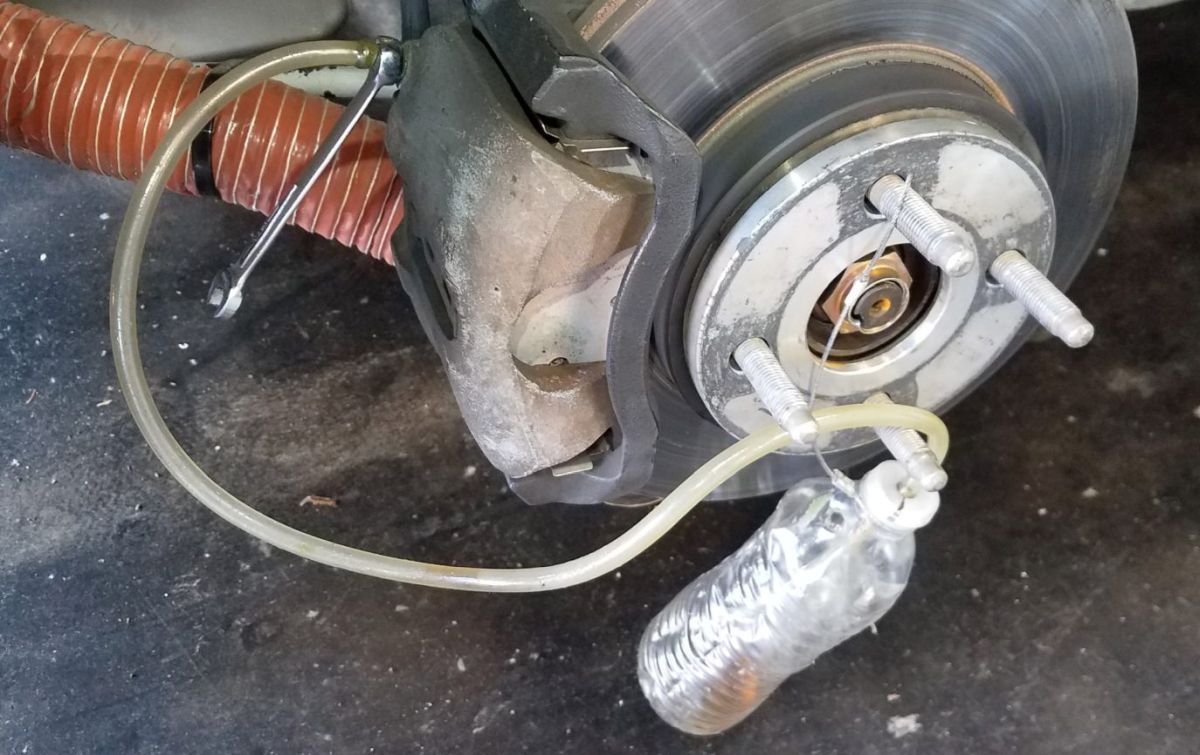
Attach a suitable transparent hose to the bleeder screw and place the other end in a suitable container.
6. Press the brake pedal
With a helper in the driver's seat, ask them to press the brake pedal several times and then hold it down.
The exact pedal-pumping procedure can vary by manufacturer.
7. Open the bleeder screw
While the pedal is held down, the technician briefly opens the bleeder screw.
Brake fluid and air bubbles flow through the hose.
The bleeder screw is then closed before the pedal is released, depending on the procedure being used.
This prevents air from being drawn back into the system.
8. Repeat the process
The process is repeated until the fluid leaving the hose is free of visible air bubbles and the manufacturer-specified bleeding procedure has been completed.
The reservoir must be monitored continuously.
Which Wheel Should Be Bled First?
There is no universal bleeding order that applies to every vehicle.
Many conventional systems are bled beginning with the wheel farthest from the master cylinder and then moving toward the closest wheel.
For example, a traditional layout may use an order similar to:
-
Rear right
-
Rear left
-
Front right
-
Front left
But this is only an example.
Some vehicles use diagonal hydraulic circuits, split systems, ABS modules, or manufacturer-specific procedures.
The correct sequence should therefore be confirmed using the vehicle's service information.
Why Must the Brake Fluid Reservoir Not Run Empty?
This is one of the most important points during brake bleeding.
If the reservoir becomes empty, the master cylinder can draw air into the hydraulic circuit.
The air can then travel deeper into the brake system.
Instead of finishing the bleeding procedure, you may end up introducing more air and having to bleed the system again.
The fluid level should therefore be checked frequently throughout the process.
How Do You Know When the Air Is Gone?
The fluid coming through the bleeding hose should eventually become free of visible air bubbles.
The brake pedal should also become firmer and more consistent.
However, the absence of visible bubbles alone does not guarantee that the brake system is correctly bled.
Air can sometimes remain trapped in:
-
ABS hydraulic units
-
High points in brake lines
-
Calipers
-
Master cylinders
-
Complex hydraulic circuits
A proper pedal test and manufacturer-specific procedure are therefore important.
What Is Pressure Brake Bleeding?
Pressure bleeding uses a dedicated pressure bleeder to push brake fluid through the hydraulic system.
This method can provide a more consistent flow than manual pedal pumping.
A pressure bleeder is connected to the brake-fluid reservoir or an appropriate adapter.
Brake fluid is then pushed through the system while the bleeder screws are opened according to the required procedure.
Pressure bleeding is commonly used by professional technicians because it can make bleeding faster and more controlled.
However, the equipment must be compatible with the vehicle and the brake system.
What Is Vacuum Brake Bleeding?
Vacuum bleeding uses a vacuum pump connected to the bleeder screw.
The pump draws brake fluid through the brake circuit.
This can be useful for certain applications, but it has an important limitation.
Air can sometimes enter around the threads of the bleeder screw during vacuum bleeding.
This can create bubbles in the hose even when there is not necessarily a large amount of air inside the hydraulic system.
For this reason, visible bubbles during vacuum bleeding should be interpreted carefully.
Can One Person Bleed the Brakes?
Yes, with suitable equipment.
A pressure bleeder or vacuum bleeding tool can allow one person to perform the procedure.
Some traditional manual bleeding methods can also be performed alone using specialized one-way valves or other equipment.
However, having a second person is often useful for conventional pedal bleeding.
The important issue is not the number of people but whether the correct procedure is followed without allowing air to enter the system.
Should the Brake Pedal Be Pumped During Bleeding?
This depends on the bleeding method and vehicle.
Traditional two-person bleeding often involves controlled pedal applications.
However, repeatedly pushing the pedal aggressively to the floor is not always recommended.
On an older master cylinder, the piston may travel into an area of the bore that it does not normally use.
If corrosion or deposits exist in that area, aggressive full-stroke pedal pumping can potentially damage the master-cylinder seals.
A controlled procedure appropriate for the vehicle is preferable.
Can ABS Contain Air?
Yes.
Air can become trapped inside the hydraulic circuits of an ABS unit, particularly after certain hydraulic components are replaced or the system has been allowed to run dry.
In some vehicles, conventional bleeding is sufficient.
In others, the ABS hydraulic control unit may need to be electronically activated using a diagnostic scan tool during the bleeding procedure.
The scan tool can command ABS valves and pump operation so trapped air can be moved into a position where it can be removed.
This procedure is highly vehicle-specific.
When Is a Scan Tool Needed for Brake Bleeding?
A scan tool may be required when the manufacturer's procedure specifies an ABS automated bleeding procedure.
This is more likely when:
-
The ABS hydraulic unit has been replaced
-
The master cylinder has been replaced
-
The hydraulic system has been completely emptied
-
Air has entered the ABS modulator
-
The manufacturer specifies a scan-tool procedure
-
The vehicle uses a complex electronically controlled braking system
A basic OBD scanner may not support this function.
The diagnostic tool must have the appropriate ABS service function for that specific vehicle.
What Happens If You Do Not Bleed the Brakes Properly?
Poor bleeding can leave air trapped inside the hydraulic system.
Possible results include:
-
Spongy pedal
-
Long pedal travel
-
Inconsistent braking
-
Reduced braking performance
-
Brake imbalance
-
ABS-related problems in some circumstances
If the pedal remains soft after bleeding, continuing to bleed randomly may not solve the problem.
The system should be inspected for leaks, mechanical problems, trapped air, master-cylinder faults, and other possible causes.
Can New Brake Fluid Solve a Spongy Pedal?
Not necessarily.
Old brake fluid should be replaced according to the manufacturer's maintenance recommendations, but simply replacing the fluid does not automatically solve a soft pedal.
A spongy pedal may be caused by:
-
Air
-
Hydraulic leakage
-
Flexible hose expansion
-
Master-cylinder problems
-
Incorrect drum-brake adjustment
-
Caliper problems
-
ABS hydraulic issues
Brake fluid condition and pedal feel are related but not identical issues.
Does Brake Fluid Absorb Water?
Most conventional glycol-based brake fluids, including common DOT 3, DOT 4, and DOT 5.1 fluids, are hygroscopic, meaning they absorb moisture from the environment.
Over time, water contamination can lower the fluid's boiling point and contribute to corrosion inside the hydraulic system.
This is one reason brake fluid replacement intervals exist.
Water-contaminated brake fluid can be particularly problematic during heavy braking because excessive temperature can cause vapor formation.
What Is Brake Fade and Is It the Same as Air in the Brakes?
No.
Brake fade and air in the hydraulic system are different problems.
Air in the brakes affects hydraulic pressure transmission and typically produces a soft or spongy pedal.
Brake fade generally occurs when braking components become excessively hot and their ability to produce or maintain braking force decreases.
Brake fade can occur during:
-
Long downhill driving
-
Repeated heavy braking
-
Track driving
-
Towing heavy loads
-
Severe braking conditions
A vehicle can have brake fade without having air in the hydraulic system.
Can Brake Fluid Boil and Create a Spongy Pedal?
Yes.
During extreme braking, brake fluid can become hot enough to boil if its boiling point has been sufficiently reduced by moisture contamination or if temperatures become excessive.
The resulting vapor is compressible.
This can create a soft or spongy pedal similar to the effect of air.
This phenomenon is sometimes called brake fluid vapor lock.
It is different from ordinary air entering the brake system.
How Often Should Brake Fluid Be Changed?
There is no single interval that applies to every vehicle.
The manufacturer's maintenance schedule should be followed.
Many manufacturers specify brake-fluid replacement based on time rather than mileage because moisture contamination occurs even when the vehicle is driven relatively little.
Brake-fluid condition can also be checked using appropriate testing equipment.
A vehicle that is rarely driven should not automatically be assumed to have perfect brake fluid simply because it has low mileage.
Can Brake Bleeding Damage the ABS System?
The bleeding process itself should not damage a properly functioning ABS system when performed according to the correct procedure.
Problems can occur if:
-
The wrong fluid is used
-
The reservoir is allowed to run dry
-
Incorrect pressure is applied
-
The hydraulic system is opened incorrectly
-
The wrong bleeding procedure is used
-
ABS service procedures are ignored
Modern braking systems can be more complicated than traditional hydraulic systems, so manufacturer-specific procedures are particularly important.
Is Brake Bleeding a DIY Job?
Brake bleeding can be performed by an experienced DIY mechanic using the correct tools and procedures.
However, brakes are a safety-critical system.
A person who is unfamiliar with hydraulic brake systems should not experiment with bleeding procedures on a vehicle that will be driven on public roads.
Before driving after bleeding, the system should be checked for:
-
Fluid leaks
-
Correct fluid level
-
Properly tightened bleeder screws
-
Secure brake-line connections
-
Firm and consistent pedal feel
-
Normal braking performance
If there is any doubt about the repair, professional inspection is the safer choice.
Final Thoughts
Air in the brake system occurs when air enters the hydraulic circuit and interferes with the transmission of hydraulic pressure.
Because air is compressible while brake fluid is designed to transmit pressure with very little compression, trapped air can produce a soft or spongy brake pedal, excessive pedal travel, inconsistent braking, and potentially reduced braking performance.
Brake bleeding is the process of removing air and ensuring that the hydraulic circuit contains the correct brake fluid without trapped air.
However, bleeding the brakes should not be treated as a universal solution for every soft brake pedal.
A similar symptom can be caused by a brake-fluid leak, master-cylinder failure, flexible brake hose problems, incorrect drum-brake adjustment, caliper or wheel-cylinder problems, ABS hydraulic issues, or other mechanical faults.
The correct bleeding sequence and procedure also vary between vehicles. Some systems can be bled conventionally, while others may require pressure bleeding or a scan-tool-assisted ABS bleeding procedure.
Because braking directly affects vehicle safety, the brake system should be diagnosed as a complete system and the manufacturer's specified procedure and brake-fluid type should always be followed.