TR
TR EN
EN

What Is a Transmission Filter? Symptoms of a Clogged Transmission Filter
A transmission filter is an important part of an automatic transmission system. Its main purpose is to keep dirt, metal particles, clutch material, and other contaminants from circulating through the transmission fluid and reaching sensitive components such as the valve body, solenoids, bearings, and clutch assemblies.
A properly functioning filter helps maintain clean transmission fluid and supports stable hydraulic pressure. When the filter becomes restricted, however, the transmission may struggle to receive enough fluid, particularly under higher load or during gear changes.
It is important to understand that a transmission filter does not have a single universal replacement interval. The correct service interval depends on the vehicle, transmission design, transmission fluid specification, driving conditions, and manufacturer's maintenance schedule.
What Does a Transmission Filter Do?
Automatic transmissions rely heavily on transmission fluid. The fluid performs several jobs at the same time:
-
Lubricates gears and bearings
-
Transfers hydraulic pressure
-
Operates clutch packs and brakes
-
Controls shift solenoids and valves
-
Removes heat from internal components
-
Reduces wear and corrosion
-
Carries contaminants toward the transmission filter
The transmission filter removes suspended contaminants from the fluid before the fluid is recirculated through the hydraulic system.
As the transmission operates, friction materials and microscopic metal particles can enter the fluid. Some contamination is normal as a transmission accumulates mileage, but excessive debris can indicate internal wear.
Where Is the Transmission Filter Located?
The location and design of the filter vary considerably between transmissions.
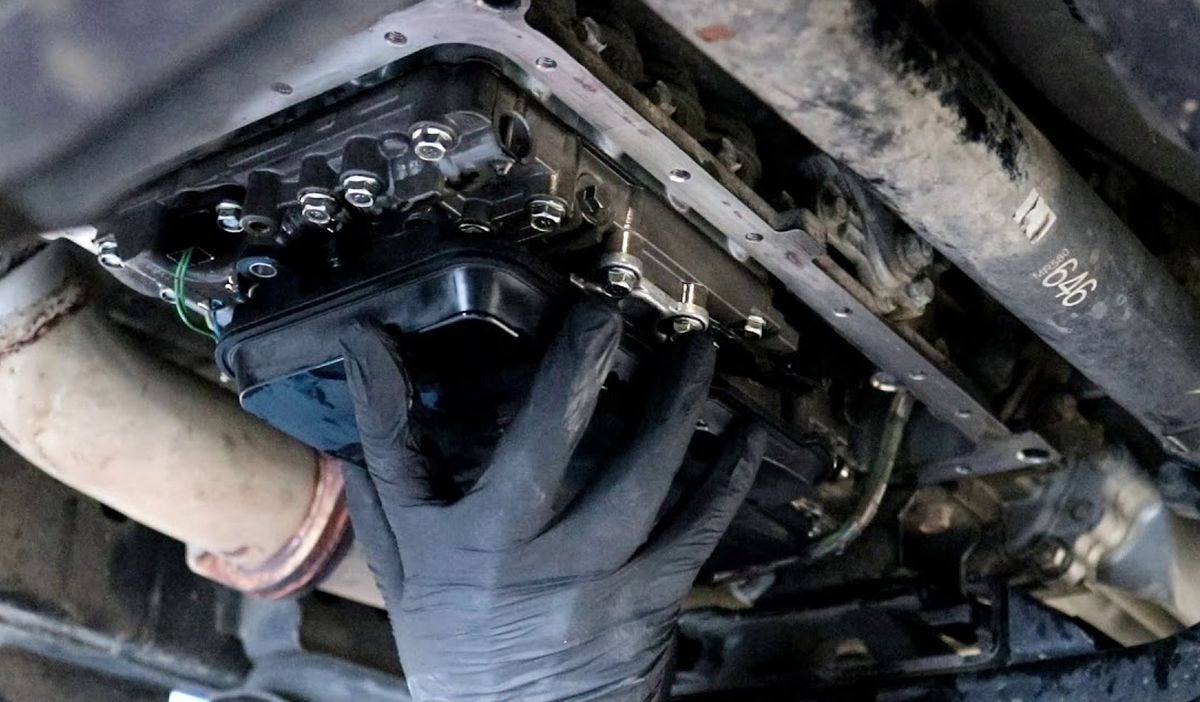
On many traditional automatic transmissions, the filter is located inside the transmission pan. Access usually requires removing the pan before the filter can be replaced.
Some transmissions use a cartridge-style filter, while others use a flat screen or pickup filter.
Certain modern transmissions use more complex filtration systems, and some filters may be integrated into the transmission housing, valve body, or another component.
This is why the filter replacement procedure cannot be determined simply from the vehicle model. The exact transmission code and transmission design should be identified first.
What Happens When a Transmission Filter Becomes Clogged?
A transmission filter can gradually become restricted as it collects contaminants.
As restriction increases, the transmission fluid pump may have difficulty drawing sufficient fluid through the filter. This can become particularly noticeable when the transmission is hot, under heavy load, or operating at higher engine speeds.
A restricted filter can contribute to:
-
Insufficient hydraulic pressure
-
Delayed gear engagement
-
Harsh or abnormal shifting
-
Transmission slipping
-
Poor clutch application
-
Transmission overheating
-
Whining or unusual transmission noises
-
Intermittent transmission faults
However, these symptoms are not proof that the transmission filter itself is clogged. Many other transmission problems can produce almost identical symptoms.
Symptoms of a Clogged Transmission Filter
One of the most common symptoms is a delay when selecting Drive or Reverse.
For example, the driver may move the selector into Drive, but the vehicle does not move immediately. After a few seconds, the transmission may suddenly engage.
This can happen because the transmission is not building hydraulic pressure normally.
Another possible symptom is slipping during acceleration. The engine speed may increase without a corresponding increase in vehicle speed.
However, slipping can also be caused by worn clutch packs, low fluid level, incorrect fluid, low hydraulic pressure, solenoid problems, or internal mechanical damage.
Delayed Shifting
A restricted filter can reduce the amount of fluid available to the hydraulic system.
The transmission may therefore take longer than normal to complete a shift.
The driver may notice:
-
Delayed upshifts
-
Delayed downshifts
-
Delay when selecting Reverse
-
Delay when selecting Drive
-
A noticeable pause before the transmission responds
If the problem occurs only when the transmission is hot, the fluid condition, filter restriction, pump condition, and hydraulic pressure should be investigated carefully.
Harsh or Jerky Gear Changes
A transmission with a fluid-flow or hydraulic-pressure problem may shift harder than normal.
The vehicle may produce a noticeable bump when changing from one gear to another.
A clogged filter can potentially contribute to this problem, but harsh shifting has many other possible causes, including:
-
Faulty shift solenoids
-
Valve body problems
-
Incorrect fluid level
-
Incorrect transmission fluid
-
Pressure-control problems
-
Transmission control module faults
-
Worn clutch components
-
Faulty transmission sensors
Therefore, replacing the filter without diagnosing the transmission may not solve the problem.
Transmission Slipping
Slipping is one of the more serious symptoms associated with an automatic transmission.
During slipping, the engine may rev higher while the vehicle accelerates poorly.
A restricted filter can contribute to inadequate hydraulic pressure, which may prevent clutch packs from applying correctly.
But transmission slipping can also be caused by:
-
Low transmission fluid
-
Severely degraded fluid
-
Worn clutch packs
-
Damaged seals
-
Faulty pressure-control solenoids
-
Valve body wear
-
Transmission pump problems
-
Internal mechanical damage
If slipping is severe, continuing to drive can cause additional internal damage.
Whining or Unusual Transmission Noise
A transmission that is not receiving sufficient fluid may produce abnormal noises.
A whining sound can sometimes become more noticeable when:
-
Selecting Drive
-
Selecting Reverse
-
Accelerating
-
Increasing engine speed
-
The transmission becomes hot
A restricted filter can contribute to fluid starvation, but a whining transmission does not automatically mean the filter is clogged.
The pump, bearings, gears, low fluid level, torque converter, and other internal components can also produce similar noises.
Transmission Overheating
Transmission fluid performs an important cooling function.
If fluid circulation is restricted, heat transfer may become less effective.
Excessive transmission temperature can accelerate fluid degradation and internal wear.
Overheating can also be caused by:
-
Low transmission fluid
-
Old or incorrect fluid
-
Blocked transmission cooler
-
Faulty cooling system
-
Heavy towing
-
Excessive load
-
Torque converter problems
-
Internal transmission slipping
Therefore, a transmission that runs hot should be diagnosed as a complete system rather than assuming the filter is responsible.
Can a Transmission Filter Cause Low Pressure?
Yes, a severely restricted filter can contribute to inadequate fluid supply and hydraulic pressure problems.
However, low transmission pressure has many possible causes.
For example:
-
Low fluid level
-
Incorrect fluid
-
Restricted filter
-
Weak transmission pump
-
Internal fluid leakage
-
Worn valve body
-
Faulty pressure-control solenoid
-
Excessive clutch clearance
-
Damaged seals
A pressure measurement can therefore be much more useful than simply replacing parts based on symptoms.
When Should the Transmission Filter Be Replaced?
There is no universal mileage interval that applies to every automatic transmission.
Some manufacturers specify transmission fluid and filter replacement at a particular mileage or time interval. Others use longer service intervals, while some transmissions are marketed with “lifetime” fluid.
The manufacturer's maintenance schedule should be the starting point.
As a general principle, a transmission that has a serviceable filter should have the filter inspected or replaced when the transmission fluid is serviced, if the transmission design and manufacturer procedure call for it.
What Does “Lifetime Transmission Fluid” Mean?
The term “lifetime fluid” can be misleading.
It generally means that the manufacturer does not specify a routine replacement interval under certain operating conditions. It does not mean that transmission fluid can never deteriorate.
Transmission fluid is exposed to:
-
Heat
-
Pressure
-
Friction
-
Oxidation
-
Shear forces
-
Contamination
-
Clutch material
Over time, these conditions can change the fluid's chemical and friction characteristics.
Whether a transmission with “lifetime” fluid should be serviced depends on the specific transmission and manufacturer's recommendations.
Severe Driving Conditions Require More Attention
Transmission fluid and filtration systems can experience considerably more stress under severe operating conditions.
Examples include:
-
Frequent towing
-
Heavy loads
-
Stop-and-go traffic
-
Driving in very hot climates
-
Mountain driving
-
Frequent steep climbs
-
Commercial use
-
Repeated high-load acceleration
-
Off-road driving
-
Long periods of low-speed operation
If the vehicle is used under severe conditions, the manufacturer's severe-service schedule should be considered.
Does Dark Transmission Fluid Mean the Filter Is Clogged?
Not necessarily.
Transmission fluid naturally changes color as it ages and is exposed to heat.
Dark fluid can indicate oxidation or degradation, but color alone cannot determine whether the filter is clogged.
A proper inspection should also consider:
-
Fluid smell
-
Fluid level
-
Fluid consistency
-
Metal particles
-
Clutch material
-
Service history
-
Transmission temperature
-
Hydraulic pressure
-
Shift quality
A strong burnt smell combined with abnormal shifting or slipping is more concerning than color alone.
What Does Metal in the Transmission Filter Mean?
Small amounts of fine material may accumulate over time, depending on the transmission design and mileage.
However, large quantities of metal particles, shiny metallic debris, or significant clutch material can indicate internal transmission wear.
For example, excessive debris may be associated with:
-
Worn gears
-
Bearing damage
-
Clutch-pack wear
-
Torque converter problems
-
Pump wear
-
Valve body wear
In such cases, installing a new filter does not repair the underlying mechanical problem.
The debris itself should be investigated.
Can a Transmission Filter Be Cleaned Instead of Replaced?
Some transmission filters are reusable screens and can potentially be cleaned according to the manufacturer's procedure.
Many modern filters, however, are designed to be replaced.
A disposable filter should not normally be treated as a permanent component simply because it can be physically cleaned.
The correct procedure depends on the transmission design and filter type.
Transmission Filter Replacement and Fluid Replacement
On transmissions where the filter is located inside the transmission pan, filter replacement often involves:
-
Removing the transmission pan
-
Draining the old fluid
-
Removing the old filter
-
Inspecting the pan and magnets
-
Cleaning the pan as specified
-
Installing the correct filter and seal
-
Reinstalling the pan
-
Filling with the specified transmission fluid
-
Checking the fluid level using the correct procedure
-
Checking for leaks
-
Performing any required adaptation or initialization
Some modern transmissions require a very specific fluid temperature and procedure for setting the correct fluid level.
Adding fluid until it “looks full” is not an appropriate method for these transmissions.
Why Is the Correct Transmission Fluid Important?
Transmission filters and fluid work together, but using the wrong fluid can cause problems even if the filter is new.
Automatic transmissions are designed around specific friction characteristics, viscosity, additives, and hydraulic behavior.
Using an incorrect fluid can potentially cause:
-
Harsh shifting
-
Slipping
-
Shudder
-
Abnormal clutch operation
-
Poor cold operation
-
Accelerated wear
The correct fluid specification should always be verified before servicing the transmission.
Can a Clogged Filter Cause a Transmission Warning Light?
It can contribute indirectly to a transmission fault, particularly if fluid flow or hydraulic pressure becomes abnormal.
Modern vehicles may detect problems through:
-
Transmission pressure sensors
-
Fluid temperature sensors
-
Input/output speed sensors
-
Shift solenoid monitoring
-
Gear-ratio monitoring
-
Hydraulic pressure monitoring
The transmission control module may then store a diagnostic trouble code.
However, a transmission fault code does not automatically mean the transmission filter is clogged.
For example, a pressure-related code could be caused by a solenoid, wiring problem, pressure sensor, pump, valve body, fluid level, or internal mechanical problem.
OBD Diagnosis Can Help
An OBD scanner can provide valuable information when transmission problems occur.
Depending on the vehicle, diagnostic data may include:
-
Transmission fluid temperature
-
Input shaft speed
-
Output shaft speed
-
Commanded gear
-
Actual gear
-
Solenoid operation
-
Line pressure information
-
Torque converter clutch status
-
Gear-ratio errors
-
Transmission-related fault codes
Live data can help determine whether the problem is related to hydraulic pressure, electronic control, temperature, or mechanical operation.
However, a basic OBD scanner cannot physically determine whether a conventional transmission filter is clogged.
Checking the Transmission Pan
On transmissions with an accessible pan, removing it can provide valuable information.
The technician can inspect:
-
Filter condition
-
Fluid condition
-
Magnets
-
Metal particles
-
Clutch material
-
Pan debris
-
Seal condition
The amount and type of debris can sometimes provide important clues about the internal condition of the transmission.
This is one reason transmission service can be useful beyond simply replacing old fluid.
Should You Change the Filter if the Transmission Is Already Slipping?
This depends on the cause of the slipping.
If the transmission has a low fluid level or restricted filter, correcting the problem may improve operation.
But if the clutch packs are already severely worn or internal components are damaged, a filter and fluid change will not restore the worn components.
In some severely worn transmissions, changing the fluid may even make existing symptoms more noticeable, although the service itself is not necessarily the cause of the underlying wear.
A slipping transmission should therefore be diagnosed before deciding which service is appropriate.
Can a Transmission Filter Cause a Transmission to Stop Moving?
In a severe fluid-supply problem, insufficient hydraulic pressure can potentially prevent proper clutch engagement.
However, a vehicle that suddenly loses Drive or Reverse should not automatically be diagnosed as having a clogged filter.
Other possibilities include:
-
Very low fluid level
-
Transmission pump failure
-
Broken internal components
-
Valve body failure
-
Solenoid problems
-
Torque converter failure
-
Electrical/control-module problems
-
Severe clutch failure
This type of failure requires prompt diagnosis.
Is It Safe to Drive With a Clogged Transmission Filter?
Driving with a suspected restricted transmission filter is not recommended for long periods.
If the transmission is slipping, overheating, delaying engagement, producing abnormal noises, or repeatedly entering limp mode, continued driving can increase the risk of internal damage.
A short drive to a repair facility may be possible in some situations, but severe slipping, loss of Drive or Reverse, overheating, or significant transmission noise should be treated as a serious fault.
Transmission Filter vs Transmission Fluid Filter
The terms can sometimes be used interchangeably, but the actual filtration system depends on the transmission design.
Some transmissions have a replaceable filter.
Others use a screen or integrated filtration system.
Some transmissions have multiple filtration elements.
Therefore, it is important to identify the exact transmission rather than assuming every automatic transmission uses the same type of filter.
Automatic, CVT and Dual-Clutch Transmissions
Transmission filtration is particularly important, but the design differs between transmission types.
Traditional automatic transmissions use hydraulic pressure and clutch packs controlled by valves and solenoids.
CVT transmissions have their own lubrication and hydraulic requirements and can be particularly sensitive to fluid specification.
Dual-clutch transmissions also use specialized fluid and filtration systems, with differences between wet-clutch and dry-clutch designs.
A filter replacement procedure suitable for a conventional automatic transmission should not automatically be applied to a CVT or dual-clutch transmission.
Final Thoughts
A transmission filter protects the hydraulic and mechanical components of an automatic transmission by removing contaminants from the transmission fluid.
A clogged or restricted filter can contribute to delayed engagement, harsh shifting, slipping, abnormal noise, overheating, and hydraulic-pressure problems. However, these symptoms do not prove that the filter itself is clogged.
The correct replacement interval depends on the specific transmission and manufacturer's maintenance recommendations. Fluid condition, service history, driving conditions, transmission temperature, pressure readings, diagnostic codes, and the amount of debris found during service can all help determine what is actually happening.
If a transmission is already slipping, losing Drive or Reverse, overheating, or making serious mechanical noises, replacing the filter alone may not be enough. The underlying cause should be diagnosed before assuming that a transmission service will solve the problem.