TR
TR EN
EN

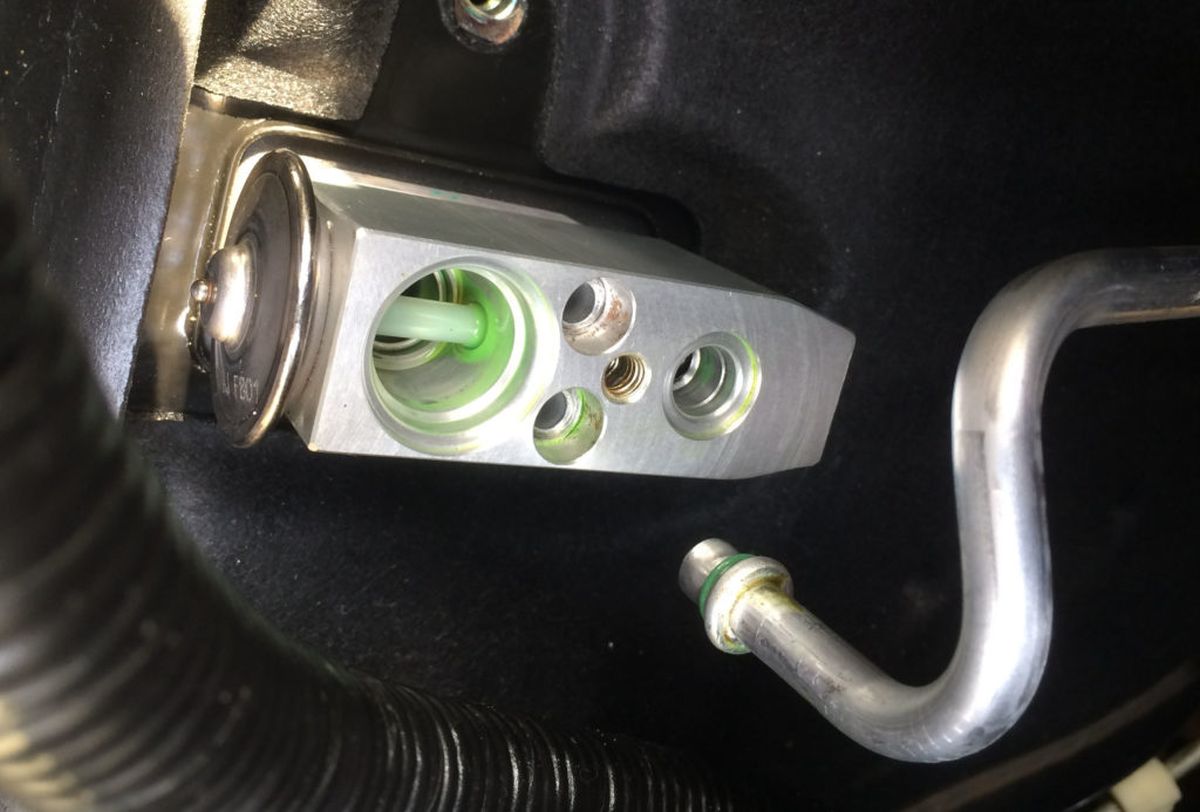
What Is an A/C Expansion Valve? What Are the Symptoms of Failure?
The A/C expansion valve is one of the key components in a vehicle’s air conditioning system. Its main job is to control the amount of refrigerant entering the evaporator and reduce the refrigerant pressure before it enters the evaporator.
When the expansion valve does not operate correctly, the air conditioning system may fail to cool properly, cooling performance may become inconsistent, or the evaporator may become excessively cold and freeze.
However, poor A/C cooling does not automatically mean that the expansion valve is faulty. Low refrigerant, compressor problems, condenser airflow issues, pressure sensors, the receiver-drier, evaporator temperature sensors and electrical faults can produce very similar symptoms.
What Does an A/C Expansion Valve Do?
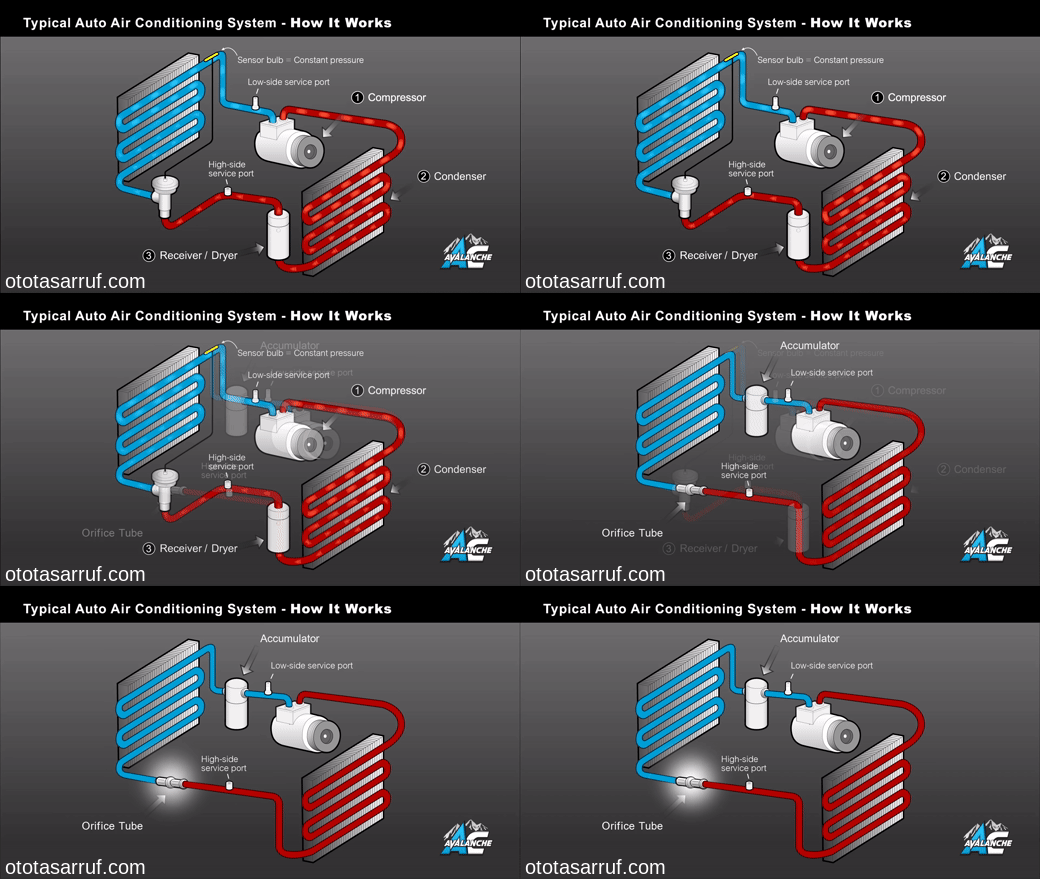
The refrigerant is compressed by the A/C compressor and sent toward the condenser at high pressure and temperature.
The condenser removes heat from the refrigerant and changes it into a high-pressure liquid.
The refrigerant then reaches the expansion valve.
The expansion valve restricts and controls the flow of this high-pressure liquid refrigerant. As the refrigerant passes through the valve, its pressure drops.
The low-pressure refrigerant then enters the evaporator, where it can evaporate and absorb heat from the air passing through the evaporator.
This is how the air conditioning system produces cold air.
The basic refrigerant circuit is:
Compressor → Condenser → Expansion Valve → Evaporator → Compressor
The expansion valve therefore plays an important role in controlling refrigerant flow into the evaporator.
How Does an A/C Expansion Valve Work?
The expansion valve regulates refrigerant flow according to the operating conditions of the evaporator.
Too much refrigerant entering the evaporator can create undesirable operating conditions, while too little refrigerant can reduce cooling performance.
A traditional thermostatic expansion valve changes its opening according to conditions at the evaporator outlet.
Some modern vehicles use electronically controlled expansion valves instead. These valves can be controlled by the vehicle’s A/C control system.
The exact operating principle therefore depends on the vehicle and A/C system design.
What Are the Symptoms of a Bad Expansion Valve?
A faulty expansion valve can produce several different symptoms.
Common symptoms include:
-
Air conditioning does not cool sufficiently
-
Cooling performance is inconsistent
-
Air temperature changes unexpectedly
-
A/C sometimes blows cold and sometimes warm
-
Evaporator may freeze
-
Compressor may cycle more frequently than normal
-
A/C operating pressures may be abnormal
-
Low-side pressure may be too high or too low
-
High-side pressure may be abnormal
-
Abnormal temperature differences may occur around the valve
-
Unusual A/C system noises may develop
None of these symptoms alone proves that the expansion valve has failed.
What Happens If the Expansion Valve Stays Open?
If the expansion valve remains more open than it should, excessive refrigerant may enter the evaporator.
This can disturb the normal evaporation process and change the pressure balance of the A/C system.
In some situations, liquid refrigerant could potentially return toward the compressor. Because liquid refrigerant cannot be compressed like a gas, this can create a serious risk for the compressor.
Possible symptoms include:
-
Reduced cooling performance
-
Abnormally high low-side pressure
-
Incorrect evaporator operating conditions
-
Irregular compressor operation
-
Abnormal refrigerant flow
The actual pressure readings must always be compared with the vehicle manufacturer’s specifications and the current ambient conditions.
What Happens If the Expansion Valve Stays Closed?
If the expansion valve does not open sufficiently, too little refrigerant may enter the evaporator.
The evaporator will then be unable to absorb enough heat from the cabin air.
The A/C may be switched on, but the air coming from the vents may not become sufficiently cold.
Possible symptoms include:
-
Weak cooling
-
Low low-side pressure
-
Reduced evaporator performance
-
Abnormal compressor operation
-
Poor cooling performance, especially in hot weather
However, low low-side pressure does not automatically mean the expansion valve is faulty.
Low refrigerant charge, restrictions elsewhere in the system and other problems can produce similar pressure readings.
Can a Clogged Expansion Valve Cause A/C Problems?
Yes.
The small passages inside an expansion valve can become restricted by contamination or debris.
This can be especially important after a major compressor failure. If a compressor suffers internal mechanical damage, metal particles may circulate through the A/C system.
These particles can interfere with the expansion valve.
A restricted expansion valve may cause:
-
Insufficient refrigerant flow to the evaporator
-
Low low-side pressure
-
Reduced cooling
-
Abnormal temperature differences across the valve
-
Unusual system pressure readings
If a compressor has suffered severe internal damage, replacing only the compressor may not be enough. The rest of the A/C system should also be inspected and cleaned as necessary.
Can the Expansion Valve Freeze?
Ice can sometimes form around the expansion valve or nearby refrigerant lines.
However, ice around the expansion valve does not automatically mean that the valve is defective.
Other possible causes include:
-
Low refrigerant charge
-
Poor airflow through the evaporator
-
Clogged cabin air filter
-
Dirty evaporator
-
Faulty evaporator temperature sensor
-
Incorrect refrigerant flow
-
Expansion valve restriction
-
Moisture inside the A/C system
-
Airflow-control problems
The entire system should therefore be checked before replacing the valve.
The A/C Is Not Cooling. Is the Expansion Valve Faulty?
Not necessarily.
Poor A/C cooling can be caused by many different problems, including:
-
Low refrigerant
-
Refrigerant leakage
-
Compressor failure
-
Compressor clutch problems
-
Electronic compressor control problems
-
Condenser fan failure
-
Pressure sensor failure
-
Evaporator temperature sensor failure
-
Expansion valve problems
-
Restricted receiver-drier
-
Dirty condenser
-
Dirty evaporator
-
Clogged cabin filter
-
Electrical problems
Therefore, warm air from the vents is not enough evidence to condemn the expansion valve.
How Can Low Refrigerant Be Distinguished From an Expansion Valve Problem?
Low refrigerant and expansion valve problems can produce similar symptoms.
When the refrigerant charge is too low, the amount of refrigerant circulating through the system decreases. This changes evaporator operating conditions and can result in low low-side pressure and poor cooling.
A restricted or incorrectly operating expansion valve can also produce abnormal low-side pressure.
For this reason, a technician should not diagnose the expansion valve by looking at only one pressure reading.
A proper diagnosis may consider:
-
High-side pressure
-
Low-side pressure
-
Ambient temperature
-
Evaporator temperature
-
Condenser temperature
-
Compressor operation
-
Refrigerant charge
-
Airflow through the evaporator
The measured values should be compared with the vehicle manufacturer’s specifications.
Can an Expansion Valve Cause a Refrigerant Leak?
The expansion valve itself does not create refrigerant, but its housing, seals or connections can develop leaks.
If refrigerant escapes, the system gradually loses charge and cooling performance decreases.
An oily area around an expansion valve or its connections can be an important clue because refrigerant normally circulates together with compressor oil.
However, an oily area does not automatically prove that the A/C system is leaking.
A proper leak test is required.
Is an Expansion Valve the Same as an Orifice Tube?
No.
Some vehicle A/C systems use an expansion valve, while others use a fixed orifice tube.
An expansion valve can regulate refrigerant flow according to operating conditions.
An orifice tube provides a fixed restriction.
These systems are designed differently and should not be treated as interchangeable components.
Before diagnosing an expansion valve, it is important to know which type of refrigerant metering device the vehicle uses.
What Is an Electronic Expansion Valve?
Modern vehicles may use electronically controlled expansion valves.
Instead of relying solely on mechanical or thermal control, an electronic expansion valve can receive commands from the A/C control system.
Depending on the vehicle, the system may use information from:
-
Refrigerant pressure sensors
-
Temperature sensors
-
A/C control module
-
Compressor control system
-
Evaporator temperature sensor
-
Electrical wiring
-
Electronic expansion valve
If an electronic expansion valve is suspected, the valve itself should not immediately be replaced.
Power supply, ground, wiring, connector condition and control signals should also be checked.
Can an Expansion Valve Fault Be Detected With an OBD Scanner?
Some modern vehicles electronically monitor their A/C systems.
Depending on the vehicle, diagnostic trouble codes may be stored for:
-
Refrigerant pressure
-
A/C compressor control
-
Temperature sensors
-
Electronic expansion valve operation
-
Communication problems
-
A/C control module faults
However, not every vehicle has a dedicated fault code for a mechanically restricted expansion valve.
A conventional thermostatic expansion valve may therefore fail mechanically without producing a direct "expansion valve fault" code.
For this reason, an OBD scan alone may not be sufficient for A/C diagnosis.
How Is an Expansion Valve Tested?
Expansion valve diagnosis normally involves checking the operating conditions of the entire A/C system.
A technician may inspect:
-
High-side pressure
-
Low-side pressure
-
Refrigerant charge
-
Refrigerant leaks
-
Evaporator temperature
-
Condenser temperature
-
Compressor operation
-
Temperature before and after the expansion valve
-
Electronic valve control signals
-
Pressure sensor readings
-
Airflow through the system
-
Receiver-drier condition
-
Possible restrictions
The measurements need to be interpreted according to the vehicle, refrigerant type, ambient temperature and operating conditions.
Simply saying "the low-side pressure is low" is not enough to prove that the expansion valve is defective.
How Is an Expansion Valve Replaced?
Replacing an expansion valve usually requires opening the refrigerant circuit.
The refrigerant should be recovered using appropriate A/C service equipment rather than released into the atmosphere.
The typical procedure may involve:
-
Recovering the refrigerant
-
Depressurizing the system
-
Removing the old expansion valve
-
Inspecting the connections
-
Replacing seals as required
-
Installing the new valve
-
Evacuating the system with a vacuum pump
-
Performing a vacuum/leak check
-
Charging the specified amount of refrigerant
-
Checking system pressures and temperatures
-
Confirming correct A/C operation
The exact procedure varies depending on the vehicle.
Should Other Components Be Checked When Replacing the Expansion Valve?
Yes.
This is particularly important if the expansion valve has become contaminated or restricted because of another component failure.
For example, if the A/C compressor has suffered internal damage, metal debris may have entered the refrigerant circuit.
In that situation, the technician may need to inspect:
-
A/C compressor
-
Condenser
-
Receiver-drier
-
Expansion valve
-
Refrigerant lines
-
Evaporator
-
System contamination
Simply replacing the expansion valve without addressing the source of contamination may result in another failure.
Can a Dirty Cabin Filter Look Like an Expansion Valve Problem?
Yes.
A severely clogged cabin air filter can dramatically reduce airflow through the evaporator.
The A/C system may actually be producing cold air, but insufficient air reaches the cabin.
The driver may therefore think that the A/C is not cooling.
This is why airflow should be checked before condemning expensive A/C components.
Can an Expansion Valve Problem Increase Fuel Consumption?
It can contribute indirectly.
The A/C compressor places an additional load on the engine.
If the A/C system does not operate correctly, the compressor may operate under abnormal conditions or run for longer periods than expected.
This can affect fuel consumption in some situations.
However, increased fuel consumption should not automatically be attributed to the expansion valve.
Engine operating conditions, compressor load, outside temperature, traffic and driving style also have a significant effect.
Expansion Valve vs. Compressor Failure
Expansion valve and compressor problems can produce similar A/C complaints.
A compressor problem may involve:
-
Insufficient pressure generation
-
Abnormal compressor noise
-
Clutch problems
-
Electronic compressor control problems
-
Internal mechanical damage
-
Metal contamination
An expansion valve problem is more closely related to controlling refrigerant flow into the evaporator.
The distinction should be made by examining system pressures, temperatures, compressor operation and refrigerant flow rather than replacing components based only on the symptom.
Can You Drive With a Faulty Expansion Valve?
In many cases, the vehicle itself can still be driven because the expansion valve is part of the A/C system rather than the engine's basic propulsion system.
However, continuing to operate a malfunctioning A/C system for a long period is not recommended if there are signs of a more serious system problem.
Particular attention should be paid to:
-
Abnormal compressor noises
-
Repeated compressor cycling
-
Refrigerant leaks
-
Abnormally high system pressure
-
Belt or pulley noises
-
Signs of compressor damage
The compressor and the rest of the refrigerant circuit should be checked if these symptoms occur.
How Can Expansion Valve Problems Be Prevented?
Not every expansion valve failure can be prevented, but proper A/C maintenance can reduce the risk.
Good practices include:
-
Repair refrigerant leaks promptly
-
Use the correct refrigerant
-
Use the correct refrigerant quantity
-
Use the correct compressor oil
-
Replace the cabin filter at appropriate intervals
-
Keep the condenser clean
-
Pay attention to abnormal compressor noises
-
Avoid adding incorrect refrigerant or oil
-
Use proper evacuation procedures when the system is opened
-
Inspect the system for contamination after compressor failure
Using the wrong refrigerant, incorrect oil or an incorrect refrigerant quantity can negatively affect the entire A/C system.
Final Assessment
The A/C expansion valve is a critical component that controls refrigerant flow into the evaporator and helps create the pressure conditions required for effective cooling.
A faulty expansion valve can cause poor cooling, inconsistent A/C performance, abnormal system pressures and evaporator icing.
However, these symptoms do not automatically mean that the expansion valve itself has failed. Low refrigerant, refrigerant leaks, compressor problems, condenser airflow issues, pressure sensors, evaporator temperature sensors, receiver-drier restrictions and electrical faults can produce very similar symptoms.
For an accurate diagnosis, the A/C system should be evaluated as a complete system. Refrigerant pressures, temperatures, airflow, compressor operation, sensor data and refrigerant charge should be considered together.
The correct approach is to diagnose the entire A/C system before replacing the expansion valve.