TR
TR EN
EN

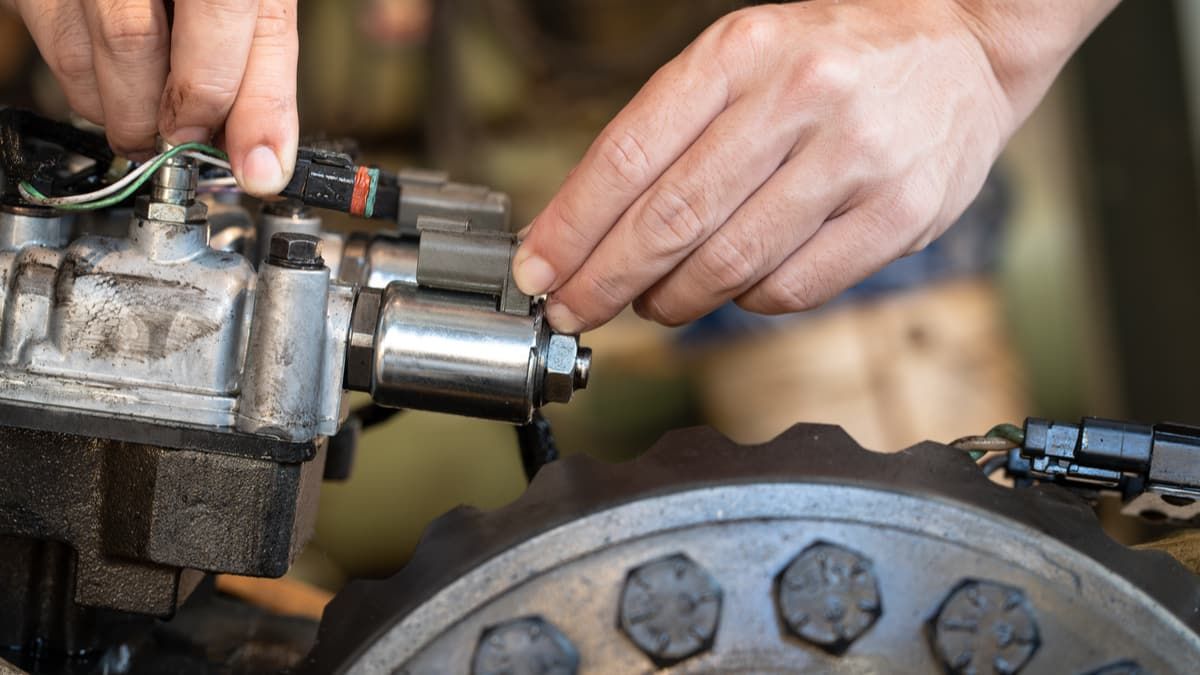
What Is a Transmission Shift Solenoid? What Are Its Failure Symptoms?
The transmission shift solenoid is an electrically controlled component inside an automatic transmission that helps control the flow of transmission fluid. By opening and closing hydraulic passages, shift solenoids allow the transmission control system to control when and how the transmission changes gears.
Although the component is often called a "gear shift solenoid," Transmission Shift Solenoid is the more appropriate general term.
A shift solenoid is not a mechanical gear itself. Instead, it controls hydraulic pressure that operates components such as valves, clutch packs, and bands inside the transmission.
When the solenoid does not operate correctly, the transmission may shift too early, too late, harshly, or may remain in a particular gear.
How Does a Transmission Shift Solenoid Work?
An automatic transmission uses hydraulic pressure to engage and release different internal components.
The transmission control module (TCM), or sometimes the engine control module (ECM), controls the shift solenoids electrically.
A simplified sequence is:
TCM command → shift solenoid → hydraulic fluid flow → valve-body movement → clutch/band operation → gear change
The solenoid contains an electromagnetic coil and a movable internal mechanism. When the control module energizes the coil, the solenoid changes the position of its internal valve or plunger.
This controls the flow of transmission fluid through the valve body.
The exact design varies between transmissions. Some transmissions use conventional on/off solenoids, while others use solenoids that can regulate hydraulic pressure more progressively.
What Does a Shift Solenoid Control?
The exact function of each solenoid depends on the transmission.
A transmission may have several solenoids identified as:
-
Shift Solenoid A
-
Shift Solenoid B
-
Shift Solenoid C
-
Shift Solenoid D
-
Shift Solenoid E
These letters are manufacturer-specific. Solenoid A in one transmission does not necessarily perform the same function as Solenoid A in another.
Depending on the transmission design, shift solenoids can control hydraulic circuits responsible for different gear combinations.
They may also work together with pressure-control solenoids to regulate the force and timing of clutch engagement.
What Are the Symptoms of a Bad Shift Solenoid?
A shift solenoid problem can produce very noticeable transmission symptoms.
Common symptoms include:
-
Hard gear shifts
-
Delayed shifting
-
Gear changes occurring too early
-
Gear changes occurring too late
-
Transmission stuck in one gear
-
Failure to shift into a particular gear
-
Transmission slipping
-
Unexpected downshifts
-
Unexpected upshifts
-
Transmission entering limp mode
-
Check Engine Light
-
Transmission warning light
-
Increased engine RPM during shifts
-
Poor acceleration
-
Reduced fuel economy
The exact symptoms depend on which solenoid is affected and how the transmission is designed.
Hard or Harsh Gear Changes
One of the most common symptoms is a hard shift.
Instead of changing gears smoothly, the transmission may engage the next gear with a noticeable bump or jolt.
This can happen if a shift solenoid:
-
Does not open correctly
-
Does not close correctly
-
Responds too slowly
-
Allows incorrect hydraulic pressure
-
Becomes mechanically stuck
However, harsh shifting does not automatically mean the shift solenoid is faulty.
Old or contaminated transmission fluid, a damaged valve body, worn clutch components, incorrect adaptations, and pressure problems can produce similar symptoms.
Delayed Gear Shifting
A delayed shift occurs when the transmission takes longer than expected to change gears.
For example, the engine RPM may rise significantly before the transmission finally engages the next gear.
Possible causes include:
-
Shift solenoid malfunction
-
Low hydraulic pressure
-
Restricted fluid passages
-
Dirty transmission fluid
-
Valve-body problems
-
Internal hydraulic leakage
-
Worn clutch components
-
Faulty speed sensors
The solenoid should therefore be tested rather than replaced based solely on delayed shifting.
Transmission Stuck in One Gear
A failed shift solenoid can prevent the transmission from selecting certain gears.
The vehicle may remain in:
-
First gear
-
Second gear
-
Third gear
-
Another fixed gear
Some automatic transmissions deliberately enter a fail-safe or limp mode when a serious control problem is detected.
The transmission may then stay in one gear to allow the vehicle to reach a repair facility.
This behavior is a protective strategy and does not necessarily mean that the transmission has suffered catastrophic mechanical damage.
Transmission Slipping
A shift solenoid problem can sometimes contribute to slipping by causing incorrect hydraulic pressure or incorrect clutch engagement.
The engine may rev higher without a corresponding increase in vehicle speed.
However, actual transmission slipping can also be caused by:
-
Worn clutch packs
-
Low transmission fluid
-
Incorrect fluid level
-
Internal hydraulic leakage
-
Worn seals
-
Weak transmission pump
-
Valve-body problems
-
Internal mechanical damage
Therefore, a slipping transmission should not automatically be diagnosed as a bad shift solenoid.
Check Engine Light or Transmission Warning Light
Modern vehicles monitor transmission operation continuously.
If the control module detects a problem with a shift solenoid's electrical circuit or operation, it can store a diagnostic trouble code.
Depending on the vehicle, the code may describe:
-
Solenoid circuit malfunction
-
Circuit open
-
Circuit low
-
Circuit high
-
Range/performance problem
-
Stuck on
-
Stuck off
-
Incorrect shift performance
These descriptions are important because they point toward different diagnostic paths.
What Does "Shift Solenoid Circuit Low" Mean?
A low circuit code generally describes an electrical condition.
It does not automatically mean that the transmission has low hydraulic pressure.
Possible causes include:
-
Short to ground
-
Wiring problem
-
Connector fault
-
Solenoid electrical failure
-
Power supply problem
-
Control-module driver problem
Likewise, a high circuit code generally refers to an electrically high signal or circuit condition. It does not automatically mean that transmission hydraulic pressure is too high.
This distinction is particularly important when diagnosing transmission DTCs.
What Does "Shift Solenoid Range/Performance" Mean?
A range/performance fault is different from a simple electrical open or short.
It generally means the control module has detected that the solenoid or the hydraulic response is not behaving as expected.
For example, the TCM may command a gear change but detect that the transmission does not respond within the expected range or time.
Possible causes include:
-
Faulty solenoid
-
Restricted hydraulic passage
-
Valve-body problem
-
Incorrect fluid pressure
-
Internal leakage
-
Worn clutch
-
Incorrect adaptation
-
Speed-sensor problem
-
Wiring or electrical issue
A range/performance code therefore requires broader diagnosis.
Why Do Shift Solenoids Fail?
Several different problems can cause a shift solenoid to malfunction.
Transmission fluid contamination
Dirty or degraded fluid can carry particles that interfere with the solenoid or valve body.
Internal solenoid wear
The plunger or internal valve can wear over time.
This may cause the solenoid to respond slowly or become stuck.
Electrical coil failure
The electromagnetic coil can develop an open circuit, short circuit, or other electrical fault.
Connector corrosion
Transmission connectors can be exposed to heat, oil, moisture, and vibration.
Corrosion or poor terminal contact can interfere with the solenoid signal.
Damaged wiring
Wiring near the transmission can be exposed to heat and movement.
A broken or chafed wire can create an intermittent or permanent fault.
Valve-body contamination
Debris inside the hydraulic system can restrict passages or prevent valves from moving correctly.
Low transmission fluid
Insufficient fluid can cause hydraulic pressure problems and poor shift quality.
It can also create symptoms that resemble a solenoid problem.
Incorrect transmission fluid
Using the wrong fluid can affect hydraulic behavior, clutch operation, and solenoid control.
The correct fluid specification should always be followed.
Can Transmission Fluid Cause a Shift Solenoid Problem?
Yes.
Transmission fluid is not simply a lubricant. It also acts as a hydraulic working fluid.
It transfers pressure through the valve body and interacts with clutch and solenoid operation.
If the fluid is:
-
Contaminated
-
Degraded
-
Low
-
Overheated
-
Incorrect for the transmission
shift quality can deteriorate.
In some cases, changing the fluid may improve symptoms. In others, fluid replacement will not repair a mechanically worn or electrically failed solenoid.
How Is a Shift Solenoid Diagnosed?
The best diagnosis combines electrical testing, scan-tool data, and hydraulic/mechanical inspection.
Start with the transmission fault codes
Scan the TCM and ECM and record all stored and pending codes.
Do not focus on only one code if multiple transmission codes are present.
Related pressure, speed-sensor, communication, and temperature codes can provide important information.
Check live transmission data
A suitable scan tool may allow the technician to observe:
-
Commanded gear
-
Actual gear
-
Solenoid commands
-
Transmission pressure
-
Input speed
-
Output speed
-
Transmission temperature
-
Shift time
-
Adaptation values
Comparing commanded behavior with actual transmission behavior can help identify whether the problem is electrical, hydraulic, or mechanical.
Inspect the wiring and connectors
Check for:
-
Broken wires
-
Chafed insulation
-
Corrosion
-
Loose terminals
-
Oil contamination
-
Water intrusion
-
Damaged connectors
An intermittent electrical connection can create symptoms that look like a failing solenoid.
Test the solenoid electrically
Depending on the transmission, the technician may measure:
-
Coil resistance
-
Power supply
-
Control signal
-
Current draw
-
Circuit continuity
The correct specifications are transmission-specific. There is no universal resistance value for every shift solenoid.
Perform hydraulic tests when necessary
If electrical testing does not explain the problem, transmission hydraulic pressure may need to be checked.
This can help determine whether the commanded solenoid operation is actually producing the expected hydraulic response.
Does a Shift Solenoid Need to Be Replaced When a Code Appears?
Not necessarily.
A diagnostic trouble code identifies a condition detected by the control system. It does not automatically identify the failed component.
For example, a shift-solenoid performance code could be caused by:
Solenoid → wiring → connector → valve body → fluid pressure → internal leakage → clutch problem → speed sensor → control module
Any of these may need to be investigated.
Replacing the solenoid without determining why the fault occurred can result in unnecessary repairs.
Can a Shift Solenoid Be Cleaned?
In some situations, contamination can affect solenoid operation.
However, simply removing a solenoid and spraying it with cleaner is not always an appropriate repair.
The solenoid may have internal wear or electrical damage that cleaning cannot correct.
If the valve body is contaminated, the correct repair may require a more comprehensive inspection and cleaning procedure.
The transmission manufacturer's service procedure should be followed.
Can You Drive With a Bad Shift Solenoid?
It depends on the severity of the fault.
If the vehicle has only a minor intermittent shift-quality problem, it may continue to operate for some time.
However, continued driving with a serious transmission-control problem can increase wear.
Driving should be minimized if you experience:
-
Severe slipping
-
Strong impact during gear changes
-
Loss of drive
-
Transmission stuck in one gear
-
Burning transmission-fluid smell
-
Transmission overheating
-
Major fluid leakage
-
Severe loss of acceleration
A transmission that is slipping significantly can suffer additional internal damage.
Shift Solenoid vs Pressure Control Solenoid
These terms are sometimes confused.
A shift solenoid is generally used to control hydraulic circuits involved in selecting or changing gears.
A pressure control solenoid primarily regulates hydraulic pressure.
However, the exact terminology and architecture differ between transmissions.
Some transmissions use solenoids that perform both switching and pressure-regulation functions, so the manufacturer's transmission documentation should always be used when identifying a specific solenoid.
Why Modern Automatic Transmissions Are More Sensitive
Modern automatic transmissions are highly dependent on precise electronic and hydraulic control.
The TCM constantly evaluates information from sensors such as:
-
Input speed sensor
-
Output speed sensor
-
Transmission temperature sensor
-
Pressure sensors
-
Throttle position
-
Engine torque information
The TCM then determines when and how strongly the solenoids should operate.
This means a transmission shift problem may involve much more than the solenoid itself.
A speed sensor providing incorrect information, for example, can make the TCM command shifts incorrectly even though the solenoid is physically healthy.
The Most Important Point in Shift Solenoid Diagnosis
A Transmission Shift Solenoid is an electrically controlled hydraulic component that helps an automatic transmission select and change gears.
When it fails, the vehicle may experience harsh shifting, delayed shifts, slipping, a transmission stuck in one gear, warning lights, or limp mode.
But a shift-solenoid fault code should never be interpreted as proof that the solenoid itself needs to be replaced.
The correct diagnosis should establish whether the problem is electrical, hydraulic, electronic, or mechanical.
Checking the transmission fluid, wiring, connectors, solenoid operation, live data, hydraulic pressure, valve body, speed sensors, and internal transmission condition provides a much more reliable path to the actual cause.
This approach is especially important with modern automatic transmissions, where one faulty signal or hydraulic restriction can produce symptoms that closely resemble a defective shift solenoid.