TR
TR EN
EN

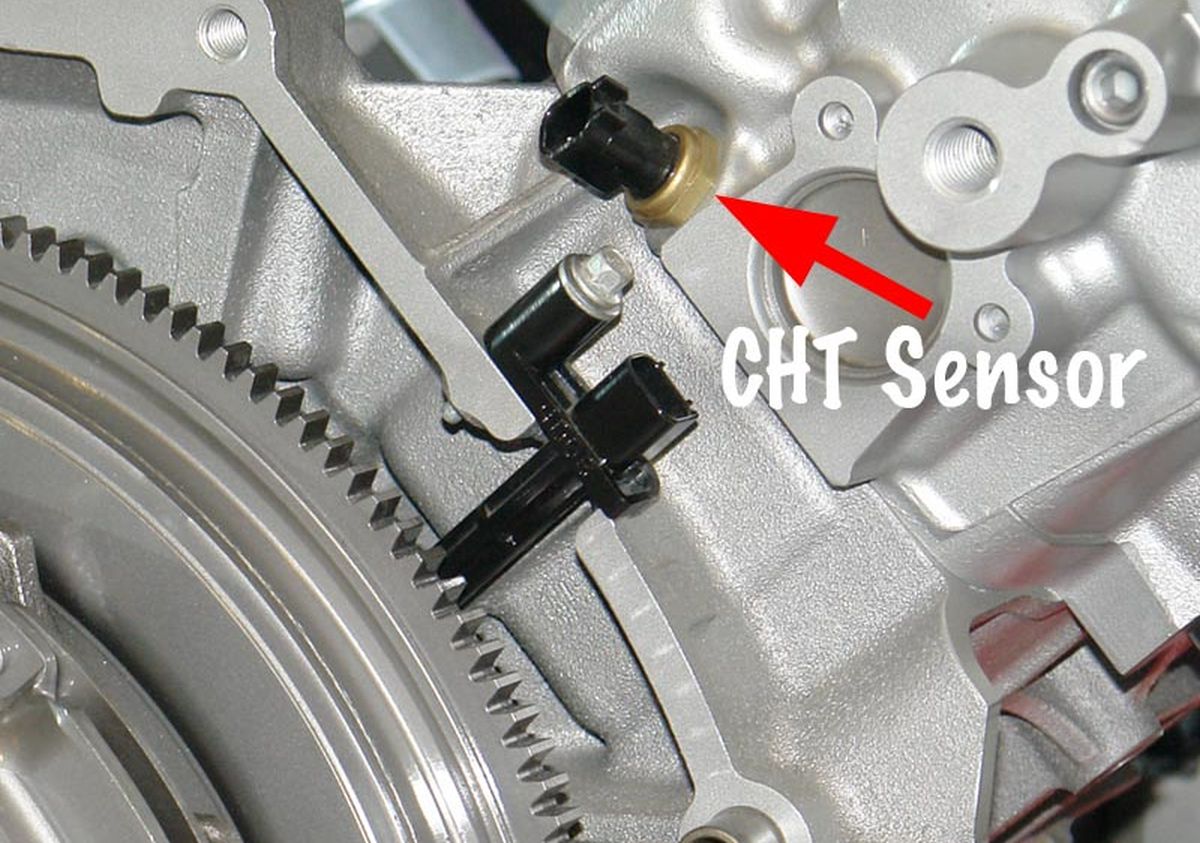
What Is a Cylinder Head Temperature (CHT) Sensor? Failure Symptoms and Causes
The Cylinder Head Temperature (CHT) sensor is a temperature-sensing component used by the engine control unit (ECU/ECM) to monitor the temperature of the cylinder head.
Unlike a conventional engine coolant temperature (ECT) sensor, the CHT sensor does not necessarily measure the temperature of the coolant. Instead, it measures the temperature of the cylinder head itself, or the temperature at a specific point closely associated with the cylinder head.
This distinction is particularly important on engines where monitoring the actual cylinder-head temperature provides more useful information than simply measuring coolant temperature.
The ECU can use the CHT signal to adjust engine operation and, most importantly, to recognize potentially excessive engine temperature.
What Does the CHT Sensor Do?
The main purpose of the CHT sensor is to provide the ECU with information about cylinder-head temperature.
Depending on the engine design, this information may be used for:
-
Engine temperature monitoring
-
Fuel injection adjustments
-
Ignition timing control
-
Cold-start enrichment
-
Cooling fan control
-
Engine protection strategies
-
Over-temperature detection
-
Limp-mode activation
-
Emissions control
-
Air-fuel mixture calculations
-
Spark timing correction
The exact functions vary by manufacturer.
Some engine-management systems use the CHT sensor as one of several temperature inputs rather than relying exclusively on coolant temperature.
How Does a Cylinder Head Temperature Sensor Work?
Many CHT sensors use an NTC thermistor.
NTC means Negative Temperature Coefficient.
As temperature increases, the electrical resistance of the sensor generally decreases. The ECU measures the electrical characteristics of the circuit and converts the signal into an estimated temperature.
A simplified relationship is:
Temperature increases → sensor resistance decreases → ECU detects a higher temperature
The actual voltage and resistance values depend on the sensor and vehicle.
This means you should not use a generic resistance value to diagnose every CHT sensor. The correct specifications must come from the vehicle manufacturer's service information.
Where Is the CHT Sensor Located?
The CHT sensor is normally positioned so that it can accurately represent the temperature of the cylinder head.
Depending on the engine, it may be:
-
Mounted directly in the cylinder head
-
Installed under the cylinder-head cover
-
Bolted against the cylinder head
-
Positioned near a combustion chamber
-
Mounted in a location specifically designed to monitor head temperature
Some designs use a sensor that is physically attached to the cylinder head rather than screwed into a coolant passage.
This is one of the major differences between a CHT sensor and many conventional coolant temperature sensors.
CHT Sensor vs ECT Sensor
The two sensors are often confused.
The ECT sensor measures engine coolant temperature.
The CHT sensor measures cylinder head temperature.
The two temperatures are related, but they are not necessarily identical.
For example, the cylinder head can become extremely hot even if the coolant temperature does not immediately reflect the same temperature.
This can be useful for detecting conditions such as:
-
Localized overheating
-
Cooling-system problems
-
Low coolant conditions
-
Combustion-related heat
-
Abnormal engine operating conditions
Some vehicles use a CHT sensor instead of a traditional coolant-temperature measurement strategy, while others use both.
What Are the Symptoms of a Bad CHT Sensor?
A defective CHT sensor can cause symptoms related to both temperature management and engine control.
Common symptoms include:
-
Check Engine Light
-
Incorrect temperature information
-
Difficult cold starting
-
Difficult hot starting
-
Rough running
-
Poor acceleration
-
Increased fuel consumption
-
Cooling fan operating unexpectedly
-
Cooling fan not operating correctly
-
Reduced engine performance
-
Limp mode
-
Engine overheating warnings
-
Incorrect ignition timing or fueling
-
Intermittent engine operation
Not every vehicle will show all of these symptoms.
The effect depends on how the ECU uses the CHT signal and what backup strategy is programmed into the system.
Check Engine Light
One of the most common signs is the Check Engine Light.
If the ECU detects that the CHT signal is electrically abnormal or inconsistent with other engine information, it can store a diagnostic trouble code.
A fault may be caused by:
-
Open circuit
-
Short circuit
-
Implausible temperature reading
-
Intermittent signal
-
Sensor response problem
-
Wiring fault
-
Connector problem
The exact DTC determines what type of fault the ECU has detected.
Cooling Fan Problems
The CHT signal can contribute to cooling-system control on some vehicles.
If the ECU incorrectly believes the cylinder head is extremely hot, it may command the cooling fan to operate more frequently or continuously.
Conversely, if the control system cannot correctly determine engine temperature, cooling behavior may become abnormal.
However, a cooling fan problem does not automatically mean that the CHT sensor is defective.
Fan relays, fan modules, wiring, temperature sensors, ECU commands, and cooling-system faults must also be considered.
Difficult Starting
Temperature information is particularly important during starting.
When the engine is cold, the ECU may need to provide additional fuel and use different ignition or idle strategies.
If the CHT sensor incorrectly reports that the engine is already hot, the ECU may not provide the expected cold-start enrichment.
This can result in:
-
Extended cranking
-
Difficult cold starting
-
Starting and immediately stalling
-
Rough idle after startup
A sensor that incorrectly reports an extremely cold temperature can have the opposite effect and potentially cause excessive enrichment.
Increased Fuel Consumption
Incorrect cylinder-head temperature information can affect fuel and ignition strategies.
If the ECU believes the engine is colder than it really is, it may maintain temperature-related enrichment for longer than necessary.
This can contribute to:
-
Increased fuel consumption
-
Rich combustion
-
Higher emissions
-
Carbon deposits
-
Poor engine response
However, fuel consumption should not be blamed on the CHT sensor without checking other causes.
Reduced Engine Performance
The ECU may alter engine operation when it detects excessive cylinder-head temperature.
Depending on the engine, it can reduce ignition advance, modify fueling, limit engine load, or activate a protection strategy.
If the CHT signal is incorrect, the ECU may activate these strategies unnecessarily.
The driver may then notice:
-
Reduced power
-
Slower acceleration
-
Limited RPM
-
Throttle response changes
-
Limp mode
CHT Sensor Failure Causes
A CHT sensor can fail for several reasons.
Internal sensor failure
The thermistor or electronic sensing element can deteriorate over time.
The resistance may become incorrect or unstable.
Excessive heat exposure
The sensor operates in a very hot environment. Repeated thermal cycling can eventually damage the sensing element or its housing.
Damaged wiring
The wiring around the cylinder head can be exposed to:
-
High temperatures
-
Engine vibration
-
Oil
-
Coolant
-
Mechanical movement
This can cause insulation damage, broken conductors, or intermittent connections.
Corroded connector
Moisture, oil, contamination, and heat can damage connector terminals.
Even a small increase in contact resistance can affect the temperature signal.
Poor electrical ground or reference
Depending on the circuit design, the sensor may rely on a stable reference and ground circuit.
A problem in either can produce an incorrect temperature reading.
Incorrect installation
A sensor that is not installed correctly, is damaged during installation, or does not make proper thermal contact can provide inaccurate information.
Engine overheating
Extreme overheating can damage the sensor or its wiring.
In this situation, replacing the sensor without investigating the reason for the overheating may only treat a secondary problem.
Can a CHT Sensor Cause Overheating?
A faulty CHT sensor can contribute to incorrect cooling-system control on some vehicles, but it is important not to confuse a sensor fault with actual mechanical overheating.
Real engine overheating can be caused by:
-
Low coolant
-
Coolant leaks
-
Thermostat failure
-
Water pump problems
-
Radiator blockage
-
Cooling fan failure
-
Head gasket problems
-
Air trapped in the cooling system
-
Restricted coolant passages
If the engine is genuinely overheating, the cause should be investigated immediately.
A temperature sensor should not be replaced simply because the engine is running hot.
What Does a CHT Sensor Circuit High or Low Mean?
This terminology is frequently misunderstood.
If a diagnostic code says the CHT sensor circuit is high, it generally describes an electrically high signal or circuit condition.
It does not necessarily mean that the cylinder head is physically too hot.
Likewise, a CHT circuit low code generally refers to an electrically low signal.
It does not automatically mean that the cylinder head is physically cold.
A range/performance fault is different. It means the ECU considers the temperature information implausible, inconsistent, or outside the expected operating relationship.
How Is a CHT Sensor Diagnosed?
Replacing the sensor should not be the first step.
A proper diagnosis can follow several stages.
Read the complete fault code
Start by scanning the vehicle and recording all relevant DTCs.
Other temperature, voltage, engine-performance, or communication codes may provide important clues.
Check live temperature data
Observe the CHT value using a diagnostic scanner if the vehicle provides it.
Compare the reading with:
-
Ambient temperature
-
Engine coolant temperature
-
Intake air temperature
-
Actual engine condition
When the engine has been sitting overnight and is completely cold, temperature readings from several sensors should generally be reasonably comparable, although exact values can differ.
A CHT reading that is dramatically different without a plausible reason deserves investigation.
Look for sudden changes
A temperature reading that suddenly jumps from a normal value to an extreme temperature can indicate an electrical or sensor problem.
A real cylinder-head temperature change normally does not behave like an instantaneous electrical switch.
Inspect the wiring and connector
Check the entire circuit around the cylinder head.
Look for:
-
Melted insulation
-
Broken wires
-
Oil contamination
-
Corrosion
-
Loose terminals
-
Damaged connectors
-
Wiring touching hot engine components
Test the sensor according to manufacturer specifications
Depending on the vehicle, testing may include resistance, voltage, signal behavior, or continuity.
There is no universal CHT sensor specification that applies to every engine.
Can a Multimeter Test a CHT Sensor?
A multimeter can be useful for testing some CHT sensors, particularly those using a conventional thermistor.
The technician can measure resistance and compare it with the manufacturer's temperature/resistance specifications.
The sensor can also be monitored while its temperature changes.
However, a resistance test alone does not always identify an intermittent fault.
The wiring and connector should also be tested, and live-data behavior can be extremely valuable.
Can You Drive With a Bad CHT Sensor?
It depends on the symptoms and the vehicle's backup strategy.
If the sensor has a minor electrical fault and the engine is operating normally, the vehicle may continue to run using a substitute value.
But if the CHT signal is associated with:
-
Overheating warnings
-
Severe power loss
-
Limp mode
-
Cooling fan abnormalities
-
Rough running
-
Misfires
-
Difficult starting
the vehicle should be inspected promptly.
If there is evidence that the engine is actually overheating, continuing to drive can cause severe engine damage.
Does a Bad CHT Sensor Mean the Cylinder Head Is Damaged?
No.
A CHT sensor fault does not mean that the cylinder head itself has failed.
The sensor is simply reporting temperature information.
A CHT-related fault can be caused by a relatively simple wiring or connector problem, while genuine cylinder-head damage is a separate mechanical issue.
Likewise, an overheating engine does not automatically mean that the CHT sensor is bad.
Why the CHT Sensor Is Important
The cylinder head operates in one of the hottest areas of the engine, and accurate temperature information can be important for both engine performance and protection.
The CHT sensor allows the ECU to understand the thermal condition of the cylinder head and, depending on the vehicle, adjust engine operation or initiate protective measures.
For this reason, a CHT fault should not be treated simply as an ordinary temperature-sensor problem.
The most reliable diagnosis is to compare the sensor's live-data reading with other temperature information, inspect the electrical circuit carefully, and determine whether the engine is actually experiencing a temperature problem.
Most importantly, never assume that a CHT sensor fault means the sensor itself must be replaced. The wiring, connector, reference/ground circuits, cooling system, and the actual thermal condition of the engine should all be considered before the final repair is decided.