TR
TR EN
EN

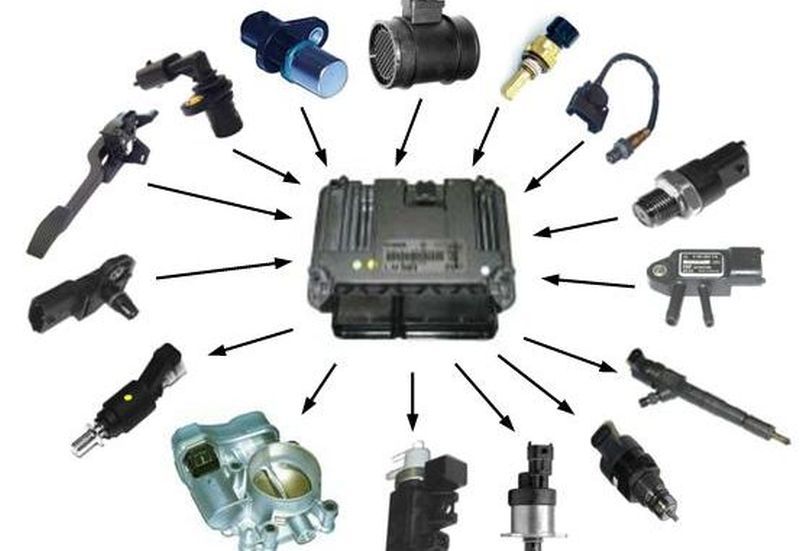
What Are the Sensors in Cars and What Are Their Functions?
Modern vehicles rely on many sensors to monitor the engine, transmission, braking system, suspension, safety systems, and driving environment. These sensors measure physical or chemical conditions and send electrical signals to electronic control units.
The ECU, TCU, ABS/ESP module, airbag control unit, and other modules use this information to make decisions about fuel injection, ignition timing, transmission operation, braking, emissions, safety, and driver assistance systems.
A faulty sensor can therefore affect much more than the component where the sensor is installed.
What Is a Vehicle Sensor?
A vehicle sensor is a component that detects a physical or chemical condition and converts it into an electrical signal that can be interpreted by a control module.
Depending on its application, a sensor may measure:
-
Temperature
-
Pressure
-
Airflow
-
Engine speed
-
Shaft position
-
Throttle position
-
Accelerator pedal position
-
Wheel speed
-
Fuel level
-
Oxygen concentration
-
Steering angle
-
Acceleration
-
Brake pressure
-
Vehicle height
-
Tire pressure
The control unit evaluates these signals and adjusts the operation of the related system.
Engine Sensors and Their Functions
The engine contains many sensors that work together to provide the ECU with information about operating conditions.
MAF Sensor – Mass Air Flow Sensor
The MAF (Mass Air Flow) sensor measures the amount of air entering the engine.
It is commonly installed between the air filter and throttle body. The ECU uses MAF information to calculate fuel injection and engine load.
A faulty MAF sensor can cause:
-
Poor engine performance
-
Increased fuel consumption
-
Rough idle
-
Hesitation during acceleration
-
Stalling
-
Misfires
-
Black smoke
-
Check Engine Light
MAP Sensor – Manifold Absolute Pressure Sensor
The MAP (Manifold Absolute Pressure) sensor measures the absolute pressure inside the intake manifold.
The ECU can use this information to calculate engine load, control fuel injection, adjust ignition timing, and manage boost pressure on turbocharged engines.
A MAP sensor problem may cause poor acceleration, rough running, increased fuel consumption, hard starting, or reduced engine power.
IAT Sensor – Intake Air Temperature Sensor
The IAT (Intake Air Temperature) sensor measures the temperature of the air entering the engine.
Because air density changes with temperature, the ECU uses IAT information when calculating fuel and engine operating conditions.
Most IAT sensors use an NTC thermistor. Resistance decreases as temperature increases.
ECT Sensor – Engine Coolant Temperature Sensor
The ECT (Engine Coolant Temperature) sensor measures engine coolant temperature.
The ECU uses this information for:
-
Cold-start fuel enrichment
-
Fuel injection control
-
Idle control
-
Ignition timing
-
Cooling fan operation
-
Emissions control
A faulty ECT sensor can cause hard starting, rough idle, increased fuel consumption, poor engine performance, or incorrect cooling fan operation.
TPS Sensor – Throttle Position Sensor
The TPS (Throttle Position Sensor) monitors the position of the throttle valve.
On electronically controlled throttle systems, the throttle position may be monitored by multiple position sensors for safety and accuracy.
The ECU uses this information to determine throttle opening and engine operating conditions.
TPS-related problems can result in:
-
Poor throttle response
-
Hesitation
-
Rough idle
-
Stalling
-
Reduced engine power
-
Throttle-related fault codes
APP Sensor – Accelerator Pedal Position Sensor
The APP (Accelerator Pedal Position) sensor detects how far the accelerator pedal has been pressed.
In modern drive-by-wire systems, the accelerator pedal may not have a direct mechanical connection to the throttle body. Instead, the APP sensor communicates the driver's demand to the ECU.
The ECU then controls the electronic throttle accordingly.
CKP Sensor – Crankshaft Position Sensor
The CKP (Crankshaft Position) sensor determines crankshaft position and engine speed.
It is one of the most important sensors in the engine management system because the ECU needs crankshaft position information to correctly control fuel injection and ignition timing.
A CKP sensor failure can cause:
-
No-start condition
-
Long cranking
-
Sudden engine stalling
-
Loss of RPM signal
-
Misfires
-
Intermittent starting problems
CMP Sensor – Camshaft Position Sensor
The CMP (Camshaft Position) sensor monitors camshaft position.
The ECU can use CMP and CKP signals together to determine engine position and synchronize fuel injection and ignition.
CMP information is especially important on engines equipped with variable valve timing.
A faulty CMP sensor may cause hard starting, reduced performance, increased fuel consumption, misfires, and a Check Engine Light.
Knock Sensor
The knock sensor detects abnormal combustion and engine knock vibrations.
When knock is detected, the ECU can modify ignition timing to help protect the engine.
A knock sensor is therefore an important part of the engine's protection and combustion-control strategy.
Oxygen Sensor – O2/Lambda Sensor
The oxygen sensor, also called a Lambda sensor, measures the oxygen content of the exhaust gas.
The ECU uses this information to determine whether the air-fuel mixture is too rich or too lean.
Modern vehicles may have more than one oxygen sensor. One may be installed before the catalytic converter and another after it.
A faulty oxygen sensor can cause:
-
Increased fuel consumption
-
Higher emissions
-
Poor engine performance
-
Rough running
-
Check Engine Light
NOx Sensor
A NOx sensor measures nitrogen oxide levels in the exhaust.
It is particularly important in modern diesel vehicles and some advanced gasoline engines.
In diesel vehicles equipped with SCR and AdBlue systems, NOx sensors are an important part of the emissions-control system.
A failed NOx sensor may cause an emissions warning, Check Engine Light, or an AdBlue/SCR-related warning.
Differential Pressure Sensor
Diesel vehicles equipped with a Diesel Particulate Filter (DPF) commonly use a differential pressure sensor.
The sensor measures the pressure difference between the inlet and outlet sides of the DPF.
The ECU uses this information to estimate the restriction of the filter and determine when regeneration may be required.
Fuel System Sensors
Fuel systems also use several different sensors.
Fuel Level Sensor
The fuel level sensor measures the amount of fuel remaining in the fuel tank.
It is often integrated into the fuel pump module or float mechanism.
A faulty fuel level sensor can cause the fuel gauge to display an incorrect level or remain stuck at a particular position.
Fuel Pressure Sensor
The fuel pressure sensor measures pressure within the fuel system.
It is especially important in common-rail diesel and gasoline direct-injection systems.
The ECU can use fuel pressure information to control fuel delivery and injection system operation.
Fuel Temperature Sensor
Some vehicles use a fuel temperature sensor to monitor fuel temperature.
Fuel temperature affects fuel density and other operating characteristics, so the ECU may use this information for fuel-system calculations.
Transmission Sensors
Automatic, dual-clutch, and other electronically controlled transmissions can contain numerous sensors.
Transmission Input Speed Sensor
The transmission input speed sensor measures the rotational speed of the transmission input shaft.
The TCU can use this information for gear-shift timing, clutch control, and transmission-speed calculations.
Transmission Output Speed Sensor
The transmission output speed sensor measures the rotational speed of the output shaft.
This information can be used to calculate vehicle speed and determine whether the transmission is operating at the expected gear ratio.
Transmission Fluid Temperature Sensor
The transmission fluid temperature sensor monitors transmission fluid temperature.
If the fluid becomes excessively hot, the transmission control system may change its operating strategy to protect the transmission.
Transmission Pressure Sensors
Some automatic transmissions use pressure sensors to monitor hydraulic pressure.
The TCU can use these signals to control hydraulic circuits, solenoids, clutch operation, and gear changes.
ABS and ESP Sensors
Sensors used by ABS and electronic stability systems are essential for vehicle safety.
ABS Wheel Speed Sensor
The ABS wheel speed sensor monitors the rotational speed of each wheel.
The ABS control module uses this information to detect when a wheel is approaching a locked condition during braking.
Wheel-speed information may also be shared with:
-
ABS
-
ESP/ESC
-
Traction control
-
Hill-start assist
-
Cruise control
-
Emergency braking systems
Steering Angle Sensor
The steering angle sensor measures the direction and amount of steering-wheel rotation.
The ESP/ESC system can compare the driver's intended direction with the actual movement of the vehicle.
A steering angle sensor problem can trigger ABS, ESP, or steering-system warning lights.
Lateral Acceleration Sensor
The lateral acceleration sensor measures side-to-side acceleration acting on the vehicle.
ESP/ESC systems can use this information to determine how the vehicle is behaving during cornering.
Yaw Rate Sensor
The yaw rate sensor measures the vehicle's rotational movement around its vertical axis.
It is particularly important for electronic stability control because it helps the system determine whether the vehicle is rotating as expected.
Brake Pressure Sensor
Some vehicles use sensors to monitor hydraulic brake pressure or braking force.
These signals can be used by ABS, ESP, and other electronic braking systems.
Suspension and Body Sensors
Modern vehicles may also use sensors to monitor body movement and suspension conditions.
Ride Height Sensor
A ride height sensor measures the height of the vehicle body relative to the suspension.
It is commonly used with air suspension and adaptive suspension systems.
Some vehicles also use ride-height information for automatic headlight leveling.
Acceleration Sensors
Acceleration sensors measure changes in vehicle movement.
Depending on the application, they can be used by:
-
ESP/ESC
-
Air suspension
-
Adaptive suspension
-
Airbag systems
-
Driver assistance systems
Airbag Sensors
Airbag systems require extremely fast and accurate information.
Crash sensors detect sudden deceleration or impact forces and send information to the airbag control module.
Depending on the vehicle, the system may include:
-
Front impact sensors
-
Side impact sensors
-
Occupant detection sensors
-
Seat belt sensors
-
Acceleration sensors
The airbag control module evaluates these signals before deploying the appropriate restraint system.
Parking and Driver Assistance Sensors
Modern vehicles use additional sensors to monitor the environment around the vehicle.
Parking Sensors
Ultrasonic parking sensors measure the distance between the vehicle and nearby objects.
They provide audible or visual warnings when parking or maneuvering at low speed.
Radar Sensors
Radar sensors are used in systems such as:
-
Adaptive cruise control
-
Automatic emergency braking
-
Forward collision warning
-
Blind-spot monitoring
-
Other driver assistance systems
Radar can help detect the distance and movement of vehicles or other objects.
Camera Systems
Cameras are used by systems such as:
-
Lane departure warning
-
Lane keeping assist
-
Traffic sign recognition
-
Automatic high-beam control
-
Forward collision detection
-
Other advanced driver assistance systems
Although cameras work differently from conventional temperature or pressure sensors, they serve the same basic purpose of providing the vehicle's electronic systems with information about the surrounding environment.
Oil Pressure Sensor
The oil pressure sensor monitors engine oil pressure.
If oil pressure falls below a critical level, the vehicle can activate the oil pressure warning light.
However, an illuminated oil pressure warning does not automatically mean that the sensor itself has failed. Actual oil pressure should also be checked mechanically when necessary.
Oil Level Sensor
Some vehicles have an electronic oil level sensor that measures engine oil level.
This allows the vehicle to display an oil-level warning or provide oil-level information through the instrument cluster.
Oil Temperature Sensor
The oil temperature sensor measures engine oil temperature.
The ECU or instrument cluster can use this information to monitor engine operating conditions and, depending on the vehicle, modify certain control strategies.
Air Conditioning Sensors
The air-conditioning system can contain several sensors, including:
-
Evaporator temperature sensor
-
Outside air temperature sensor
-
A/C pressure sensor
-
Cabin temperature sensor
-
Sunlight sensor
These sensors help the climate-control system manage compressor operation, cooling fans, air distribution, and cabin temperature.
Outside Air Temperature Sensor
The outside air temperature sensor measures ambient temperature.
It is often installed in the front area of the vehicle where it can measure outside air.
Its information can be displayed on the instrument cluster and may also be used by the climate-control system.
Tire Pressure Sensors – TPMS
TPMS (Tire Pressure Monitoring System) monitors tire pressure.
In direct TPMS systems, individual sensors inside the wheels can measure tire pressure and transmit the information electronically.
If tire pressure falls below the specified level, the system warns the driver.
Correct tire pressure is important for:
-
Safety
-
Fuel economy
-
Tire life
-
Braking performance
-
Vehicle stability
Brake and Clutch Pedal Sensors
Some sensors monitor the position of the pedals operated by the driver.
For example, the brake pedal switch/sensor detects whether the brake pedal is being pressed.
This signal can be used by:
-
Brake lights
-
Cruise control
-
Start/Stop systems
-
Automatic transmission shift-lock systems
-
Engine management systems
Manual-transmission vehicles may also use a clutch pedal sensor for starter authorization, cruise control, and other functions.
How Can You Diagnose a Faulty Vehicle Sensor?
A sensor fault cannot always be diagnosed simply by looking at the warning light or reading one diagnostic code.
Proper diagnosis may involve:
-
Reading OBD-II fault codes
-
Checking live sensor data
-
Measuring sensor supply voltage
-
Checking ground circuits
-
Inspecting wiring and connectors
-
Measuring sensor resistance
-
Comparing readings with manufacturer specifications
-
Checking the sensor signal with an oscilloscope when necessary
For example, an IAT, MAP, or MAF-related fault code does not automatically mean that the corresponding sensor must be replaced.
The problem may instead be caused by wiring, a connector, power supply, ground, reference voltage, an intake leak, or another mechanical or electrical problem.
Why Do Sensor Faults Generate Diagnostic Trouble Codes?
Electronic control units continuously monitor sensor signals.
The ECU does not only ask whether a sensor is producing a signal. It can also determine whether that signal is plausible under the current operating conditions.
For example, if the engine has been sitting overnight and the ECT sensor reports an extremely high coolant temperature, the ECU may recognize the reading as implausible.
Similarly, if the engine is running but the expected crankshaft position signal is missing, the ECU can store a diagnostic trouble code.
This is why a diagnostic code should be considered a starting point for diagnosis rather than an automatic instruction to replace a particular component.
Should You Replace a Sensor Immediately?
Not always.
One of the most common diagnostic mistakes is interpreting a fault code as proof that the sensor itself has failed.
For example, a message indicating an IAT sensor circuit problem does not necessarily mean that the IAT sensor needs to be replaced.
The actual problem could be:
-
The sensor itself
-
Damaged wiring
-
A loose connector
-
Corrosion
-
Poor electrical contact
-
Missing power supply
-
Ground problems
-
Signal-wire problems
-
Reference-voltage problems
-
A mechanical problem affecting the measured value
-
Another faulty sensor
-
An ECU or control-module problem
For this reason, testing the sensor and its circuit before replacing the part is usually the better approach.
Why Are Sensors So Important in Modern Vehicles?
Modern vehicles depend on communication between mechanical systems and electronic control modules.
For example, the engine ECU may simultaneously evaluate information from:
MAF + MAP + IAT + ECT + TPS/APP + CKP + CMP + O2
The ECU uses these signals together to determine engine load, temperature, air quantity, fuel requirements, ignition timing, and operating conditions.
As a result, a single incorrect sensor signal can sometimes affect fuel economy, performance, emissions, idle quality, starting, and drivability.
Final Overview
Vehicle sensors are the components that allow electronic control systems to understand what is happening inside and around the vehicle.
MAF, MAP, IAT, ECT, TPS, APP, CKP, CMP, oxygen sensors, knock sensors, ABS wheel-speed sensors, TPMS sensors, oil-pressure sensors, fuel-pressure sensors, and transmission sensors are only some of the sensors found in modern vehicles.
Although their functions are different, they all serve a common purpose: measuring real-world conditions and providing accurate information to the vehicle's control systems.
When a sensor-related fault occurs, replacing the sensor based solely on a diagnostic code is not always the correct solution. The sensor's actual reading, electrical circuit, wiring, connector, and the mechanical system associated with that reading should be evaluated together.