TR
TR EN
EN

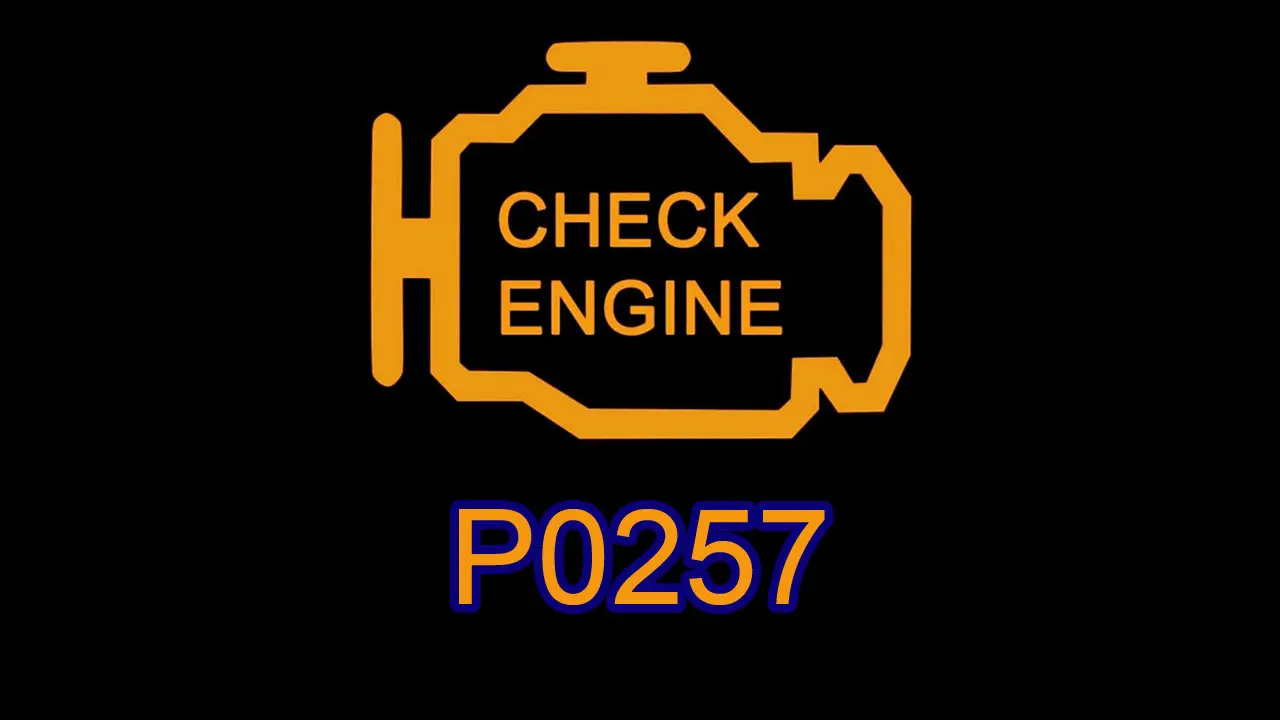
P0257 Injection Pump Fuel Metering Control "B" Circuit Range / Performance (Cam/Rotor/Injector)
P0257 is an OBD-II diagnostic trouble code that means the engine control module (ECM/PCM) has detected that the fuel metering control “B” system is operating outside its expected range or is not responding as commanded.
This code is commonly associated with electronically controlled diesel injection systems. Depending on the injection system, the monitored circuit or component can be related to the injection pump, pump cam/rotor mechanism, fuel-metering actuator, or injector/fuel-control assembly.
The important distinction is that P0257 is a range/performance code, not automatically an injection-pump failure.
The ECM is essentially saying that the fuel-metering system's expected command and its actual response do not agree sufficiently.
What Does P0257 Mean?
The ECM must control fuel delivery very precisely.
Depending on the engine design, it may command a fuel-metering actuator or another component responsible for regulating how much fuel enters the high-pressure injection system.
The control module then monitors feedback from the fuel system.
If the ECM commands a particular fuel-metering position or operating condition but the resulting response is outside the expected range, it can store P0257.
This can happen because of an electrical problem, a mechanical problem, incorrect fuel pressure, contamination, a sticking actuator, sensor feedback problems, or problems inside the injection pump.
Unlike P0258, which indicates a circuit-low condition, or P0259, which indicates a circuit-high condition, P0257 focuses on the range or performance of the system.
What Does “Range / Performance” Mean?
“Range / Performance” generally means that the ECM has determined that the system's signal, response, or relationship between commanded and actual operation is not behaving as expected.
It does not necessarily mean that the signal is simply too high or too low electrically.
For example, the ECM could command the fuel-metering system to increase or decrease fuel delivery, but the measured response may:
-
Remain outside the expected position
-
Change too slowly
-
Fail to follow the command
-
Move inconsistently
-
Reach an unexpected limit
-
Produce an implausible feedback signal
The exact criteria are manufacturer-specific.
What Does “B” Refer To?
The “B” designation is not universal.
Depending on the vehicle and injection system, it may refer to a particular fuel-metering control circuit, actuator, sensor, or portion of the injection pump system.
The additional description “Cam/Rotor/Injector” reflects the terminology used for certain electronically controlled diesel injection systems.
It should not be assumed that “B” always means the same physical component on every vehicle.
The correct component must be identified using the vehicle-specific wiring diagram and service information.
Is P0257 an Injection Pump Failure?
No.
This is one of the most important points when diagnosing this code.
P0257 can be caused by a problem inside the injection pump, but the ECM cannot determine simply from this code that the entire pump has failed.
Possible causes can include:
-
Fuel-metering actuator
-
Injection pump
-
Wiring
-
Connector
-
Fuel pressure
-
Fuel contamination
-
Fuel filter restriction
-
Sensor feedback
-
Mechanical sticking
-
Pump cam/rotor mechanism
-
Electrical power supply
-
ECM control circuit
Replacing an expensive injection pump without first testing the rest of the system can therefore result in an unnecessary repair.
Common Causes of P0257
Fuel metering actuator problem
A fuel-metering actuator may become contaminated, stick mechanically, or develop an internal electrical problem.
If the actuator cannot move to the position requested by the ECM, the actual fuel delivery may not match the commanded value.
This can trigger a range/performance fault.
Injection pump mechanical wear
Internal wear within the injection pump can affect fuel delivery and control.
Depending on the design, problems involving the pump's cam, rotor, internal pressure generation, or metering mechanism may cause the ECM to detect an abnormal response.
However, mechanical pump failure should be confirmed through testing rather than assumed from P0257.
Sticking fuel-metering mechanism
Diesel fuel systems contain precision components that can be affected by contamination or deposits.
A metering mechanism that does not move freely can respond incorrectly to ECM commands.
The problem may be intermittent at first and become more noticeable under certain engine loads or temperatures.
Fuel contamination
Water, dirt, incorrect fuel, or other contamination can interfere with precision injection components.
Contaminated fuel can cause:
-
Metering actuator sticking
-
Pump wear
-
Injector problems
-
Abnormal fuel pressure
-
Poor fuel delivery
If P0257 appeared after refueling, fuel quality should be considered.
Restricted fuel filter
A severely restricted fuel filter can prevent the injection system from receiving the fuel supply it needs.
This can affect the pump's ability to maintain the expected operating conditions.
A filter problem can therefore contribute to a fuel-metering performance code even though the metering actuator itself is functional.
Fuel pressure problem
Fuel pressure must remain within the expected range for the injection system to operate correctly.
Possible causes include:
-
Low-pressure fuel pump problems
-
High-pressure pump problems
-
Pressure regulator faults
-
Pressure-control valve problems
-
Fuel restrictions
-
Air entering the fuel system
-
Fuel leakage
Live fuel-pressure data can be extremely useful when diagnosing P0257.
Sensor or feedback problem
The ECM may rely on pressure, position, or other feedback signals to determine whether the fuel-metering system is responding correctly.
A faulty sensor or damaged sensor wiring can therefore make a properly functioning fuel system appear to be operating incorrectly.
This is why feedback signals should be verified before replacing mechanical components.
Wiring or connector problems
Electrical problems can cause an actuator or sensor to respond incorrectly.
Possible causes include:
-
Corroded connectors
-
Loose terminals
-
Broken wires
-
Chafed wiring
-
High resistance
-
Short circuits
-
Poor power supply
-
Poor ground
-
Water or oil contamination
An intermittent connection can be particularly difficult to identify because the system may work normally under some conditions.
Air entering the fuel system
Air in the diesel fuel supply can interfere with fuel delivery and pressure.
Possible entry points include:
-
Fuel filter housing
-
Fuel hoses
-
Connections
-
Seals
-
Pump inlet
-
Other low-pressure fuel-system components
This should be considered particularly when the vehicle has difficult starting, extended cranking, or unstable operation.
ECM control problem
The ECM controls the fuel-metering system and interprets its feedback.
A control-module problem is possible, but it should generally be considered only after the fuel system, actuator, wiring, connectors, sensors, and mechanical components have been properly tested.
Symptoms of P0257
The symptoms depend on the injection system and how far the actual fuel-metering behavior has deviated from the expected range.
Possible symptoms include:
-
Check Engine Light
-
Difficult starting
-
Extended cranking
-
Rough idle
-
Engine hesitation
-
Poor acceleration
-
Reduced engine power
-
Unstable engine speed
-
Engine stalling
-
Poor fuel economy
-
Limp-home mode
-
Limited engine performance
-
Increased exhaust smoke
-
In severe cases, a no-start condition
Some vehicles may continue to run relatively normally while storing P0257.
Other vehicles may immediately reduce engine power because the ECM cannot reliably control fuel delivery.
Why Can P0257 Cause Hard Starting?
Diesel engines require precise fuel delivery during starting.
If the fuel-metering system cannot produce the correct operating condition, the injection system may struggle to establish the fuel quantity or pressure required for combustion.
This can result in:
-
Longer cranking
-
Starting only after several attempts
-
Rough running immediately after starting
-
Stalling shortly after startup
However, hard starting should never be attributed to P0257 alone. Battery voltage, starter speed, fuel pressure, injector operation, engine compression, glow-plug operation where applicable, and crankshaft/camshaft signals may also need to be checked.
How Is P0257 Diagnosed?
A good diagnosis should determine whether the problem is electrical, hydraulic/fuel-related, mechanical, or related to feedback information.
1. Scan all diagnostic trouble codes
Begin by recording all active, pending, and stored DTCs.
Look for codes involving:
-
Fuel pressure
-
Injection pump
-
Fuel metering
-
Injectors
-
Rail pressure
-
Pressure regulators
-
Camshaft position
-
Crankshaft position
-
Fuel-pressure sensors
-
ECM power supply
Additional codes can provide important clues.
2. Check freeze-frame data
Freeze-frame information can show what the engine was doing when P0257 was detected.
Useful information may include:
-
Engine RPM
-
Engine load
-
Coolant temperature
-
Fuel pressure
-
Rail pressure
-
Accelerator position
-
Battery voltage
-
Vehicle speed
This can help determine whether the fault occurs during starting, idle, acceleration, or heavy load.
3. Identify the exact “B” circuit
Before testing components, determine exactly what the manufacturer calls Fuel Metering Control “B.”
The technician should use the vehicle-specific wiring diagram and service information.
This prevents testing or replacing the wrong component.
4. Inspect connectors and wiring
Inspect the relevant actuator and sensor connectors.
Look for:
-
Corrosion
-
Loose terminals
-
Bent pins
-
Damaged locks
-
Water intrusion
-
Oil contamination
Then inspect the wiring harness for chafing, broken conductors, heat damage, and previous repairs.
5. Check fuel filter and fuel quality
The basic fuel supply should be checked before condemning the injection pump.
Inspect the fuel filter and look for evidence of:
-
Water contamination
-
Dirt
-
Metal particles
-
Incorrect fuel
-
Restricted fuel flow
If contamination is discovered, simply replacing an actuator or pump without addressing the source can lead to another failure.
6. Check for air in the fuel system
The low-pressure side should be checked for unwanted air entry.
This can be particularly important if the engine has hard-starting symptoms or if the problem began after fuel-system maintenance.
7. Compare commanded and actual values
If the scan tool supports the required parameters, compare the ECM's requested fuel-metering value with the actual response.
This is often one of the most useful parts of diagnosing a range/performance code.
For example, if the ECM repeatedly commands the metering system to change but the actual value barely changes, the technician can investigate whether the actuator is sticking, the feedback signal is incorrect, or a mechanical fuel-system problem is preventing the commanded response.
8. Check fuel pressure
Fuel pressure should be measured under the appropriate operating conditions and compared with manufacturer specifications.
A pressure problem can prevent the metering system from behaving as expected.
Do not assume that P0257 itself means low or high fuel pressure.
9. Test the metering actuator
The actuator should be tested for both electrical and mechanical operation.
Depending on the system, testing may include:
-
Resistance
-
Current
-
Control signal
-
Duty cycle
-
Position feedback
-
Activation test
-
Oscilloscope waveform
The correct specifications depend entirely on the injector-pump design.
10. Check the injection pump
If the electrical system, fuel supply, sensors, and actuator pass their tests, the injection pump may require further mechanical evaluation.
Depending on the system, this can involve pump pressure testing, internal inspection, specialized diagnostic equipment, or bench testing.
11. Evaluate the ECM last
If all external components and circuits test correctly, the ECM and its driver circuits may need to be evaluated.
An ECM should not be replaced simply because P0257 is present.
P0257 vs P0258
These codes are closely related but describe different types of faults.
P0257 – Injection Pump Fuel Metering Control “B” Range / Performance
The ECM detects that the fuel-metering control system is not operating within the expected range or is not responding correctly.
P0258 – Injection Pump Fuel Metering Control “B” Circuit Low
The ECM detects an abnormally low electrical condition in the specified control circuit.
Therefore, P0257 is primarily concerned with system response or performance, while P0258 specifically identifies a low electrical circuit condition.
P0257 vs P0259
P0257 indicates a range/performance problem.
P0259 – Injection Pump Fuel Metering Control “B” Circuit High indicates an abnormally high electrical condition in the same general control system.
A range/performance fault does not necessarily mean that the circuit voltage is simply too high or too low. The ECM may be detecting that the commanded and actual fuel-metering behavior do not correspond.
Can P0257 Be Caused by a Bad Injector?
Yes, depending on the injection system.
The wording “Cam/Rotor/Injector” reflects the different fuel-system architectures covered by this family of codes.
A fuel injector or injector-related control problem can potentially affect the expected fuel-metering behavior.
However, on a common-rail diesel engine, P0257 should not automatically be interpreted as “bad injector.”
The fuel pump, metering valve, pressure-control system, rail-pressure sensor, wiring, and fuel supply may all need to be evaluated.
Can You Drive With P0257?
It depends on the symptoms.
If the engine runs normally and the code is intermittent, it may be possible to drive a short distance to a repair facility.
However, continued driving is not recommended if the vehicle experiences:
-
Severe power loss
-
Engine stalling
-
Difficult starting
-
Limp mode
-
Strong hesitation
-
Unstable engine operation
-
Heavy smoke
-
Multiple fuel-system warning codes
An engine that can unexpectedly lose power or stall presents a safety risk.
What Is the Correct Repair for P0257?
There is no single repair for P0257 – Injection Pump Fuel Metering Control “B” Circuit Range / Performance.
The repair depends on the actual cause.
Possible repairs include:
-
Replacing a defective fuel-metering actuator
-
Repairing damaged wiring
-
Repairing or replacing a connector
-
Correcting a power or ground problem
-
Replacing a restricted fuel filter
-
Repairing a fuel-pressure problem
-
Removing contaminated fuel
-
Repairing an air leak in the fuel supply
-
Correcting a sensor or feedback problem
-
Repairing the injection pump
-
Correcting injector-related problems
-
Repairing the ECM circuit when it has been properly confirmed
The injection pump should not be replaced simply because P0257 is stored.
The Key Point About P0257
P0257 – Injection Pump Fuel Metering Control “B” Circuit Range / Performance means that the ECM has detected that the specified fuel-metering control system is not responding within its expected operating range or is not performing as commanded.
Unlike a circuit-low or circuit-high code, P0257 does not simply identify an electrical signal as too low or too high. The ECM is detecting a problem with the relationship between the requested control and the actual system response.
The correct diagnosis therefore requires more than checking the injection pump.
The fuel supply, filter, fuel quality, wiring, connectors, metering actuator, pressure system, feedback sensors, injection pump, and ECM control strategy may all need to be evaluated.
In short, P0257 is a fuel-metering performance code, not an automatic injection-pump replacement code. The actual cause should be identified through commanded-versus-actual data and systematic fuel-system testing before expensive components are replaced.