TR
TR EN
EN

Idle Speed Fluctuation Problems: Causes, Symptoms, and Solutions
Idle speed should remain relatively stable when the engine is running without pressing the accelerator. Small changes can occur when the air conditioning, electrical systems, cooling fan, or other loads are activated, but continuous fluctuations in engine speed are generally not normal.
An engine with an idle problem may repeatedly increase and decrease its RPM, shake, misfire, or even stall. The cause can range from a simple vacuum leak to problems with the throttle body, fuel system, ignition system, sensors, or engine management.
What Does Idle Speed Fluctuation Mean?
Idle fluctuation occurs when engine speed repeatedly rises and falls while the accelerator pedal is released.
For example, an engine that should idle around 700–900 RPM may behave like this:
800 → 1,100 → 750 → 1,000 → 700 RPM
The exact RPM range varies by engine, but continuous and noticeable changes indicate that the engine is struggling to maintain a stable idle.
Other symptoms may include:
-
Engine vibration
-
Rough idle
-
Delayed throttle response
-
Stalling
-
Misfire
-
Increased fuel consumption
-
Check engine light
-
Irregular exhaust sound
Vacuum and Intake Air Leaks
An intake air leak is one of the most common causes of unstable idle.
When air enters the intake system through an unintended opening, the engine may receive more air than the ECU expects. This can disturb the air-fuel mixture, particularly at idle.
Common leak points include:
-
Intake manifold gasket
-
Vacuum hoses
-
PCV hoses
-
Brake booster hose
-
Throttle body gasket
-
Intake pipes
-
Turbocharger hoses
-
Manifold connections
A small vacuum leak can be especially noticeable at idle because the engine generates relatively high intake vacuum under these conditions.
A smoke test is often an effective way to locate difficult-to-find leaks.
Dirty Throttle Body
The throttle body controls the amount of air entering the engine.
Over time, oil vapor and carbon deposits can accumulate around the throttle plate. This buildup can interfere with the precise airflow needed to maintain stable idle speed.
Possible symptoms include:
-
Fluctuating idle
-
High idle speed
-
Engine vibration
-
Delayed throttle response
-
RPM remaining high after releasing the accelerator
Some vehicles may also require a throttle adaptation or relearn procedure after the throttle body has been cleaned or removed.
A dirty throttle body should not automatically be considered the cause, however. Its condition should be confirmed before replacement.
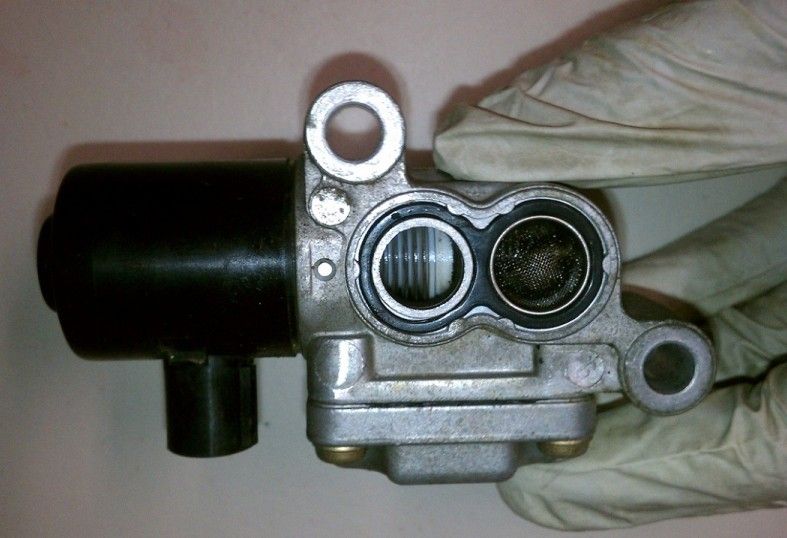
Idle Air Control Valve Problems
Older fuel-injected engines may use an IAC (Idle Air Control) valve to regulate the amount of air entering the engine at idle.
If the valve becomes dirty, sticks, or develops an electrical problem, the ECU may no longer be able to control idle airflow correctly.
This can cause:
-
High idle
-
Low idle
-
Fluctuating RPM
-
Stalling
-
Greater fluctuations when the air conditioner is switched on
Modern vehicles with electronic throttle control may not have a separate IAC valve. In these systems, the electronic throttle body performs the idle-air control function.
MAF Sensor Problems
The MAF (Mass Air Flow) sensor measures the amount of air entering the engine.
If the sensor is contaminated or provides inaccurate readings, the ECU may calculate the wrong amount of fuel.
This can result in unstable idle and poor drivability.
Possible symptoms include:
-
Fluctuating idle
-
Poor throttle response
-
Increased fuel consumption
-
Lean or rich mixture conditions
-
Hesitation
-
Check engine light
The MAF sensor should not automatically be replaced because of an idle problem. Its live data, power supply, ground, connector, and wiring should be checked first.
MAP Sensor Problems
The MAP (Manifold Absolute Pressure) sensor measures pressure inside the intake manifold.
The ECU can use this information to calculate engine load and control fuel delivery and ignition.
If the MAP sensor provides an incorrect signal, idle speed may become unstable.
The sensor itself is not the only possible cause. On systems where the MAP sensor uses a vacuum hose, the hose should also be checked for cracks, blockage, or incorrect connections.
Low or Unstable Fuel Pressure
The engine needs a stable fuel supply to maintain a consistent idle.
If fuel pressure is too low or fluctuates, the injectors may not deliver the expected amount of fuel.
Possible causes include:
-
Weak fuel pump
-
Restricted fuel filter
-
Faulty fuel pressure regulator
-
Low voltage at the fuel pump
-
Wiring problems
-
Fuel pump control problems
-
Restricted fuel supply
A fuel pressure problem can affect both idle and acceleration.
Fuel pressure should therefore be measured rather than assumed to be correct.
Dirty or Faulty Fuel Injectors
Fuel injectors must deliver the correct amount of fuel to each cylinder.
A partially restricted injector may deliver too little fuel, while a leaking injector may deliver too much.
Either condition can disturb idle quality.
Possible symptoms include:
-
Rough idle
-
Engine vibration
-
Misfire
-
Poor acceleration
-
Increased fuel consumption
-
Check engine light
Injector flow, leakage, and cylinder balance should be tested when the symptoms indicate a possible injector problem.
Ignition Coil Problems
A weak ignition coil can cause misfires, particularly at idle or under load.
Some coils may appear to work normally at low load but fail when cylinder pressure increases.
A misfire caused by an ignition coil can make the engine speed fluctuate as the ECU attempts to maintain stable operation.
The following should be inspected:
-
Ignition coils
-
Spark plugs
-
Coil connectors
-
Wiring
-
Misfire counters
Diagnostic equipment can help identify whether a particular cylinder is repeatedly misfiring.
Worn or Incorrect Spark Plugs
Spark plugs have a major effect on combustion quality.
Worn electrodes, incorrect spark plug specifications, excessive gap, carbon deposits, or damaged plugs can cause incomplete combustion.
At idle, even a small combustion problem can be felt as engine vibration or RPM fluctuation.
The correct spark plug type and gap should always be determined according to the engine manufacturer's specifications.
EGR Valve Problems
The EGR system recirculates a controlled amount of exhaust gas under specific operating conditions.
If the EGR valve remains open when it should be closed, excessive exhaust gas can enter the intake system.
This may cause:
-
Rough idle
-
RPM fluctuation
-
Engine vibration
-
Stalling
-
Poor low-speed response
EGR operation varies significantly between engines, so the valve should be tested rather than replaced simply because an idle problem exists.
Oxygen Sensor and Fuel Trim Problems
Oxygen sensors provide exhaust oxygen information that helps the ECU adjust the air-fuel mixture.
Once the engine reaches operating temperature, oxygen sensor feedback becomes an important part of closed-loop fuel control on many engines.
A faulty or slow oxygen sensor can contribute to unstable fuel trims and poor idle quality.
However, replacing an oxygen sensor without checking the rest of the fuel-control system is not a reliable diagnostic method.
Fuel trims should be evaluated together with:
-
MAF data
-
MAP data
-
Intake air temperature
-
Engine coolant temperature
-
Oxygen sensor data
-
Vacuum conditions
Engine Coolant Temperature Sensor
The ECU needs accurate engine temperature information to determine the appropriate fuel and idle strategy.
If the coolant temperature sensor incorrectly reports that the engine is cold when it is actually warm, the ECU may use an inappropriate fuel strategy.
A simple diagnostic check is to compare the coolant temperature shown by the scan tool with the actual ambient temperature when the engine has been sitting cold.
An unrealistic temperature reading can point toward a sensor or wiring problem.
PCV System Problems
The Positive Crankcase Ventilation system controls the flow of crankcase gases back into the intake.
A damaged PCV hose, incorrectly installed hose, or faulty PCV valve can affect the amount of air entering the engine.
A PCV valve that remains open when it should not can create symptoms similar to a vacuum leak.
For this reason, the PCV system should be included when investigating unexplained idle fluctuations.
EVAP Purge Valve Problems
The EVAP system stores fuel vapors and sends them into the engine under appropriate conditions.
The purge valve controls this flow.
If the purge valve remains open when it should be closed, an unexpected amount of air and fuel vapor can enter the intake system.
This may cause:
-
Fluctuating idle
-
Difficult starting
-
Stalling
-
Rough running
-
Abnormal fuel trims
The purge valve should be tested for proper operation rather than replaced solely based on the presence of an idle problem.
Why Does the Idle Fluctuate When the Air Conditioning Is Turned On?
The air conditioning compressor places an additional mechanical load on the engine.
A properly functioning engine management system detects this additional load and adjusts the throttle or idle control accordingly.
If the idle is already unstable, turning on the air conditioning may make the problem much more noticeable.
If the fluctuation occurs mainly when the A/C compressor engages, the diagnosis should include:
-
Throttle control
-
Idle compensation strategy
-
Compressor load
-
Engine RPM response
-
Electrical system condition
Can Electrical Loads Affect Idle Speed?
Yes.
Headlights, rear-window defrosters, cooling fans, blower motors, and other electrical equipment increase the load on the alternator.
The ECU normally compensates for this load.
However, if the charging system is weak, the engine may struggle to maintain stable idle speed.
The following should be checked:
-
Battery voltage
-
Alternator charging voltage
-
Engine and chassis grounds
-
Alternator connections
-
Voltage under electrical load
Poor grounds can cause particularly confusing symptoms because they can affect both engine sensors and actuators.
Idle Fluctuation Only When the Engine Is Cold
A cold engine normally operates differently from a fully warmed-up engine.
After starting, the ECU may temporarily increase idle speed and change the fuel mixture to help the engine warm up.
A brief increase in RPM during cold start is therefore not necessarily a fault.
However, if the RPM repeatedly rises and falls or the engine shakes and nearly stalls, the following should be investigated:
-
Coolant temperature sensor
-
Vacuum leaks
-
Throttle body
-
MAF/MAP sensor
-
Fuel delivery
-
Ignition system
Idle Fluctuation After the Engine Warms Up
If the engine runs normally when cold but develops an unstable idle after reaching operating temperature, this is an important diagnostic clue.
Once the engine warms up:
-
Closed-loop fuel control becomes active.
-
Oxygen sensor feedback becomes more important.
-
EGR operation may change.
-
EVAP purge may become active.
-
Different fuel and ignition strategies may be used.
Therefore, a problem that appears only after warming up should not be diagnosed in exactly the same way as a cold-start problem.
How Is Idle Fluctuation Diagnosed?
Reading diagnostic trouble codes is a useful starting point, but fault codes alone do not always identify the failed component.
A proper diagnosis should combine fault codes, live data, physical inspection, and testing.
Important parameters may include:
-
Engine RPM
-
MAF airflow
-
MAP pressure
-
Throttle position
-
Accelerator pedal position
-
Short-term fuel trim
-
Long-term fuel trim
-
Oxygen sensor data
-
Fuel pressure
-
Coolant temperature
-
Ignition timing
-
Misfire counters
-
Battery and charging voltage
Recording live data while the RPM is actually fluctuating can be especially useful.
Why Should Parts Not Be Replaced Randomly?
An unstable idle can be caused by many different systems.
Replacing the MAF sensor, MAP sensor, throttle body, oxygen sensor, ignition coil, or injectors one after another without testing can become expensive without solving the actual problem.
For example, if an intake leak is causing excessive fuel-trim correction, replacing the oxygen sensor may not solve anything.
Likewise, replacing a throttle body without checking its wiring, connector, power supply, ground, and adaptation values may result in an unnecessary repair.
The goal should be to identify what changes when the idle begins to fluctuate.
Common Causes of Idle Speed Fluctuation
The most common causes include:
-
Intake or vacuum leaks
-
Dirty throttle body
-
Throttle adaptation problems
-
IAC valve problems
-
MAF sensor faults
-
MAP sensor faults
-
Low or unstable fuel pressure
-
Dirty or faulty fuel injectors
-
Weak ignition coils
-
Worn or incorrect spark plugs
-
EGR problems
-
PCV system faults
-
EVAP purge valve problems
-
Coolant temperature sensor faults
-
Alternator or charging system problems
-
Poor electrical grounds
-
Wiring or connector problems
-
Incorrect ignition timing
-
Mechanical engine problems
Idle fluctuation is therefore not a fault that should automatically be associated with one particular component.
A systematic diagnosis should begin with intake and vacuum inspection, followed by fuel and ignition checks and analysis of sensor live data. It is also important to determine whether the problem occurs only when the engine is cold, only after reaching operating temperature, or when additional loads such as the air conditioner and electrical equipment are activated.
When idle fluctuation is accompanied by engine shaking, misfires, hesitation, or stalling, the problem should be treated as a broader engine-management or combustion issue rather than simply an idle adjustment problem.