TR
TR EN
EN

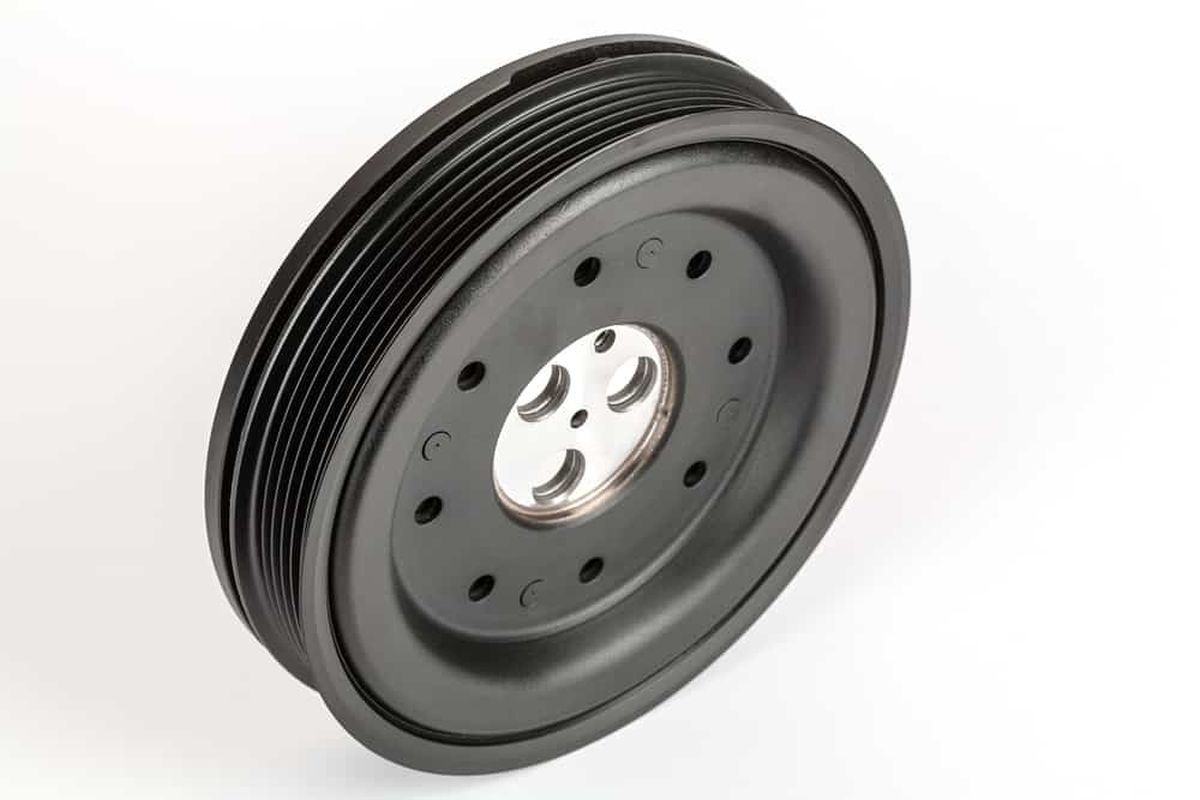
What Is a Crankshaft Pulley? What Are the Symptoms of Crankshaft Pulley Failure?
The crankshaft pulley is one of the components that connects the engine's crankshaft to several belt-driven systems. It is mounted directly to the crankshaft and rotates whenever the engine runs.
Although it may look like a simple metal wheel, its condition can have a major effect on engine accessories, belt operation and, on many engines, vibration control.
A particularly important type is the harmonic balancer, also called a crankshaft damper. Many modern crankshaft pulleys incorporate a rubber or elastomer element between an inner and outer section to absorb torsional vibrations produced by the crankshaft.
When this component begins to deteriorate, the symptoms can range from unusual noises and belt vibration to serious belt failure.

What Does a Crankshaft Pulley Do?
The crankshaft pulley transfers the rotational movement of the crankshaft to the accessory drive belt.
Depending on the engine, that belt may drive components such as:
-
Alternator
-
Air-conditioning compressor
-
Power steering pump
-
Water pump
-
Idler and tensioner pulleys
-
Other engine accessories
The pulley therefore plays an important role in keeping the accessory drive system operating correctly.
On engines equipped with a harmonic damper, the pulley has another important job: reducing torsional vibrations in the crankshaft.
Every combustion event creates a small twisting force in the crankshaft. These forces are not perfectly smooth. The damper helps absorb some of these oscillations and reduces the transmission of harmful vibration through the crankshaft and accessory drive system.
Crankshaft Pulley vs. Harmonic Balancer
These terms are sometimes used interchangeably, but they are not always exactly the same.
A basic crankshaft pulley can simply transfer crankshaft rotation to the accessory belt.
A harmonic balancer or crankshaft damper combines the pulley function with vibration damping.
A typical damper may have:
-
An inner hub attached to the crankshaft
-
An outer pulley section
-
A rubber or elastomer layer between them
Some designs use other damping technologies instead of a traditional rubber element.
This distinction is important because a pulley can look acceptable from the outside while its internal damping element is already deteriorating.
What Are the Symptoms of a Bad Crankshaft Pulley?
A failing crankshaft pulley can produce several symptoms. Some are obvious, while others can initially be mistaken for a problem with the belt, alternator or tensioner.
Visible pulley wobble
One of the strongest warning signs is a crankshaft pulley that does not rotate smoothly.
When viewed with the engine running, a defective pulley may appear to:
-
Wobble from side to side
-
Move unevenly
-
Run out of alignment
-
Have an outer ring that moves independently of the center
A slight visual movement should not automatically be considered proof of failure because some pulleys can have characteristics that are difficult to judge by eye.
However, obvious wobbling is a reason for immediate inspection.
Accessory belt vibration
A damaged pulley can cause the accessory belt to move irregularly.
You may notice:
-
Belt flutter
-
Excessive belt movement
-
Belt tracking toward one side
-
Uneven belt tension
-
Repeated belt squealing
The belt itself may be perfectly good, while the pulley is causing the abnormal movement.
Squealing or chirping noise
A failing crankshaft pulley can contribute to belt noise.
The noise may become more noticeable:
-
During cold starts
-
When the air conditioner is switched on
-
During sudden acceleration
-
When electrical loads increase
-
At certain engine speeds
However, belt noise is not specific to the crankshaft pulley.
A worn tensioner, idler pulley, alternator pulley, A/C compressor bearing, contaminated belt or incorrect belt tension can produce similar noises.
Clunking or knocking from the belt area
If the internal damping element of a harmonic balancer deteriorates, the outer portion of the pulley may move abnormally.
This can create:
-
Clunking
-
Rattling
-
Knocking
-
Irregular belt-drive noises
A noise coming from the front of the engine should be diagnosed carefully because timing-system components, accessory bearings and other pulleys can produce similar sounds.
Engine vibration
A damaged harmonic balancer can allow more crankshaft torsional vibration to reach the engine and accessory drive.
The driver may notice increased vibration at certain RPM ranges.
This can sometimes be felt through:
-
Steering wheel
-
Engine bay
-
Vehicle body
-
Floor
-
Pedals
The relationship between vibration and engine speed can provide useful diagnostic information.
However, engine mounts, ignition problems, misfires and drivetrain components can also create vibration.
Accessory belt coming off
If the pulley becomes severely misaligned, the accessory belt may move away from its correct path and eventually come off.
This can immediately disable belt-driven accessories.
Depending on the engine design, losing the accessory belt can result in:
-
Loss of alternator charging
-
Loss of air conditioning
-
Loss of power steering assistance
-
Loss of water-pump operation on some engines
The last situation is particularly important because coolant circulation can be affected on engines where the water pump is accessory-belt driven.
Damaged or rapidly worn belt
A defective pulley can cause abnormal belt wear.
Look for:
-
Frayed belt edges
-
Cracks
-
Glazing
-
Uneven wear
-
Rubber dust around the pulley
-
Belt tracking marks
If a new belt repeatedly becomes damaged, replacing the belt alone may not solve the problem.
The pulleys, tensioner and belt alignment should be checked.
Why Does a Crankshaft Pulley Fail?
There are several possible causes.
Deterioration of the rubber damper
This is one of the most important failure modes on harmonic balancers.
Over time, the rubber or elastomer section can:
-
Crack
-
Harden
-
Separate
-
Deform
-
Lose its bonding strength
Once the damping element deteriorates, the outer pulley section may no longer remain properly positioned.
Age and heat
The pulley operates in a hot and mechanically demanding environment.
Repeated heating and cooling cycles can gradually deteriorate the damping material.
Oil or coolant contamination can accelerate deterioration of some rubber components.
Oil contamination
Engine oil leaking onto the pulley can damage certain rubber damping materials over time.
This is why repairing an oil leak is important even if the pulley itself appears to be functioning normally.
Incorrect installation
The crankshaft pulley is attached to a critical rotating assembly. Incorrect installation can create serious problems.
Potential issues include:
-
Incorrect tightening torque
-
Incorrect bolt installation
-
Damaged mounting surfaces
-
Improper alignment
-
Reusing a torque-to-yield bolt when replacement is required
The manufacturer's specified procedure should be followed when removing or installing the pulley.
Can a Bad Crankshaft Pulley Cause a Timing Problem?
This depends heavily on the engine design.
The crankshaft pulley that drives the accessory belt is not necessarily the same component as the timing-belt drive pulley.
On some engines, however, the crankshaft pulley and timing drive components are closely related in design or location.
A damaged accessory pulley should therefore not automatically be described as a timing-system failure.
More importantly, if the pulley becomes loose or the crankshaft mounting area is damaged, the resulting mechanical problem can potentially affect other systems.
This is one reason unusual crankshaft pulley movement should not be ignored.
Can a Bad Crankshaft Pulley Cause the Battery Light to Come On?
Yes, indirectly.
If the crankshaft pulley or accessory belt drive fails and the alternator stops rotating correctly, the alternator may stop charging the battery.
The vehicle can then display a battery or charging-system warning.
The important point is that the battery light does not necessarily mean the battery itself is defective.
Possible causes include:
-
Alternator failure
-
Broken accessory belt
-
Belt tensioner failure
-
Crankshaft pulley failure
-
Wiring or charging-system problems
The entire charging system should be tested before replacing the battery.
Can a Bad Crankshaft Pulley Cause Overheating?
It can, but only on engines where the water pump depends on the affected accessory drive.
If a damaged pulley causes the accessory belt to slip or come off, a belt-driven water pump may stop operating correctly.
Coolant circulation can then be reduced or interrupted, potentially causing engine overheating.
However, many modern engines use different water-pump arrangements, including timing-belt, timing-chain or electrically driven pumps.
Therefore, whether a crankshaft pulley failure can cause overheating depends on the specific engine.
How Is a Crankshaft Pulley Diagnosed?
Diagnosis should begin with a visual inspection of the complete accessory drive.
The technician should check:
-
Crankshaft pulley alignment
-
Pulley wobble
-
Damper rubber condition
-
Accessory belt condition
-
Belt tracking
-
Belt tension
-
Automatic tensioner movement
-
Idler pulleys
-
Alternator pulley and bearing
-
A/C compressor pulley and bearing
-
Power steering pulley where applicable
-
Oil or coolant contamination
With the engine running, the pulley and belt should be observed from a safe distance.
Hands, clothing and tools should never be placed near a rotating belt system.
If the damper is suspected, the engine should be switched off before attempting any close inspection.
What Does a Failed Harmonic Balancer Look Like?
A severely deteriorated harmonic balancer may show visible signs such as:
-
Cracked rubber
-
Rubber pushed outward
-
Separation between inner and outer sections
-
Outer ring movement
-
Uneven pulley rotation
-
Evidence of the pulley shifting relative to the hub
Some failures are less obvious.
A damper can deteriorate internally without showing dramatic external damage. This is why simply looking at the pulley is not always enough.
The correct diagnostic procedure depends on the engine and pulley design.
Is a Crankshaft Pulley the Same as an Idler Pulley?
No.
The crankshaft pulley is directly connected to the crankshaft and is therefore a driven component.
An idler pulley does not receive direct crankshaft rotation. Instead, it guides the accessory belt and helps maintain the correct belt path.
A bad idler pulley can produce noises and belt problems that look very similar to a crankshaft pulley failure.
The tensioner pulley is also different. Its job is to maintain the correct belt tension.
Because these components work together, replacing the crankshaft pulley without inspecting the rest of the system can lead to an incomplete repair.
Can You Drive With a Bad Crankshaft Pulley?
Driving with a suspected failing crankshaft pulley is not recommended, particularly when there is obvious wobbling, severe belt movement, unusual knocking or visible damper separation.
A pulley failure can progress from a relatively minor vibration to an accessory-belt failure.
The consequences can include:
-
Loss of alternator charging
-
Loss of power steering assistance on some vehicles
-
Loss of air conditioning
-
Engine overheating on certain engines
-
Damage to the belt and surrounding components
-
Additional damage caused by a failed pulley or belt
If the pulley is visibly separating or moving significantly, continuing to drive can turn a relatively contained repair into a much more expensive mechanical problem.
Does a Crankshaft Pulley Failure Trigger an OBD-II Code?
Not necessarily.
A purely mechanical crankshaft pulley or harmonic balancer problem may not generate a dedicated diagnostic trouble code.
However, secondary problems can sometimes produce codes.
For example, if abnormal crankshaft movement affects sensor readings or engine operation, the ECU may detect irregular crankshaft speed or timing-related behavior.
Depending on the vehicle, this can potentially be associated with:
-
Crankshaft position-related codes
-
Engine timing-related codes
-
Misfire codes
-
Charging-system-related warnings
An OBD code should therefore be interpreted together with the mechanical symptoms rather than used as proof that the crankshaft pulley itself has failed.
What Happens If the Crankshaft Pulley Is Ignored?
A small amount of belt noise may initially seem harmless, but a deteriorating crankshaft pulley can become progressively worse.
The possible progression is:
Initial deterioration → vibration or noise → belt misalignment → belt damage → accessory failure → possible overheating or loss of charging
Not every pulley failure follows this exact sequence, but the possibility is why abnormal pulley movement should be investigated rather than simply masking the noise by replacing the belt.
Crankshaft Pulley Replacement
Replacement procedures vary considerably between engines.
The pulley is mounted directly to the crankshaft, and the retaining bolt may require a specific tightening angle, torque sequence or special procedure.
Depending on the engine, replacement may involve:
-
Removing the accessory belt
-
Locking the crankshaft
-
Removing the crankshaft pulley bolt
-
Inspecting the crankshaft mounting surface
-
Installing the new pulley
-
Using a new retaining bolt where specified
-
Correctly tightening the fastener
-
Reinstalling and tensioning the accessory belt
-
Checking belt alignment
-
Verifying pulley operation
The correct torque specification is particularly important. Guessing the torque or using a generic value can create serious mechanical problems.
Final Thoughts
The crankshaft pulley is a relatively simple-looking component, but it plays an important role in the engine's accessory drive system. On engines equipped with a harmonic damper, it also helps control crankshaft torsional vibration.
The most important warning signs are visible pulley wobble, abnormal belt movement, unusual noises, belt misalignment, vibration and deterioration or separation of the damper material.
A squealing belt does not automatically mean the crankshaft pulley is defective, and a worn crankshaft pulley does not always produce an OBD-II fault code. The pulley, belt, tensioner, idler pulleys and driven accessories should be evaluated as one system.
If the pulley is visibly wobbling or separating, it is better to stop using the vehicle until the cause is identified. A relatively straightforward pulley problem can otherwise lead to belt failure and potentially much more serious engine or accessory-system damage.