TR
TR EN
EN

What Is an Air Filter? What Are the Symptoms of a Clogged Air Filter?
The air filter is one of the simplest but most important components in an internal combustion engine. Its primary job is to prevent dust, dirt, sand, insects, and other airborne particles from entering the engine while allowing sufficient clean air to reach the intake system.
An engine needs a precise mixture of air and fuel to operate efficiently. If the air filter becomes heavily restricted, the engine may not receive the amount of air it needs, particularly when the driver demands high power.
A slightly dirty air filter may have little noticeable effect, while a severely clogged filter can contribute to poor acceleration, reduced engine performance, increased fuel consumption, and unstable engine operation.
However, these symptoms can also be caused by many other problems. A vehicle should not automatically be diagnosed with a clogged air filter simply because it feels weak or consumes more fuel.
What Does an Air Filter Do?
An internal combustion engine continuously draws air into the intake system.
That air contains microscopic and sometimes relatively large contaminants, including:
-
Dust
-
Sand
-
Road debris
-
Pollen
-
Insects
-
Soot
-
Dirt
-
Moisture
-
Small particles from the surrounding environment
The air filter captures these contaminants before they reach the engine.
This is important because dirt entering the engine can eventually contaminate the intake system and, more seriously, contribute to wear of internal engine components.
The air filter therefore performs two jobs at the same time:
It protects the engine while allowing sufficient airflow.
These two requirements have to be balanced carefully.
A filter that is too restrictive can reduce airflow, while a filter that allows excessive contamination can reduce engine durability.
Where Is the Air Filter Located?
On most vehicles, the engine air filter is located inside an air-filter housing in the engine compartment.
The typical airflow path is:
Outside air → air intake → air filter → intake duct → throttle body or diesel intake system → intake manifold → engine
The exact arrangement varies considerably between gasoline and diesel engines.
Some vehicles have a relatively simple rectangular filter element, while others use large cylindrical or specialized filter assemblies.
On turbocharged engines, the filter is located upstream of the turbocharger.
This makes filtration particularly important because contaminants entering the turbocharger can damage its compressor wheel and other components.
What Happens When an Air Filter Becomes Clogged?
As dirt accumulates on the filter element, airflow resistance increases.
At first, the engine may compensate without any obvious symptoms.
Modern engine-management systems can continuously adjust fuel injection and other parameters according to available airflow and operating conditions.
Eventually, however, a heavily restricted filter can become a significant limitation.
The engine may be unable to obtain the airflow required for maximum power.
The effect is usually more noticeable when the engine is operating under high load.
For example, you may notice the problem more clearly when:
-
Accelerating hard
-
Climbing a hill
-
Carrying a heavy load
-
Towing
-
Driving at high speed
-
Operating at high RPM
Symptom 1: Reduced Engine Power
One of the most common symptoms of a severely clogged air filter is reduced engine performance.
The vehicle may feel less responsive, particularly when more power is demanded.
The driver may notice that:
-
Acceleration is slower
-
The engine feels restricted
-
High-RPM performance is weaker
-
The vehicle struggles on inclines
-
Overtaking requires more time
-
Turbocharged engines may feel less responsive
A mildly dirty filter generally does not produce dramatic power loss.
A major reduction in performance should therefore prompt a broader diagnosis rather than assuming the filter is the only problem.
Symptom 2: Poor Acceleration
A restricted air filter can become more noticeable during acceleration.
When the throttle opens, the engine attempts to draw in a larger volume of air.
If the filter creates excessive restriction, the engine may not receive the airflow necessary to produce its expected torque.
The vehicle may then feel sluggish or hesitant.
However, acceleration problems can also result from:
-
Fuel-pressure problems
-
Faulty injectors
-
Ignition faults
-
Electronic throttle problems
-
MAF sensor problems
-
MAP sensor problems
-
Turbocharger faults
-
Exhaust restrictions
-
EGR problems
-
Transmission problems
Therefore, poor acceleration alone is not sufficient evidence of a clogged filter.
Symptom 3: Increased Fuel Consumption
A severely restricted air filter can contribute to increased fuel consumption, although this effect is often exaggerated.
Modern engines use airflow measurements and oxygen-sensor feedback to control the air-fuel mixture.
A restricted filter does not necessarily cause the engine to simply "receive less air and inject the same amount of fuel."
The ECU can compensate within its operating range.
Nevertheless, if airflow becomes significantly restricted, combustion efficiency and engine performance can be affected.
The driver may then use more throttle to achieve the same acceleration, which can increase fuel consumption.
Increased fuel consumption should therefore be considered a possible consequence rather than a definitive indication of a dirty air filter.
Symptom 4: Poor High-RPM Performance
A clogged air filter may be most noticeable at higher engine speeds.
At low RPM, the engine's airflow requirement is relatively modest.
As RPM increases, the engine needs to move considerably more air.
A restricted filter can therefore become a greater limitation under high-load, high-RPM conditions.
You may notice that the vehicle accelerates reasonably well at low speeds but becomes noticeably weaker as engine speed increases.
This symptom can also be caused by fuel delivery restrictions, turbocharger problems, exhaust restrictions, or incorrect sensor readings.
Symptom 5: Engine Hesitation
A heavily restricted intake system can contribute to hesitation during acceleration.
The driver may feel that the engine does not respond immediately when the accelerator is pressed.
However, hesitation is a very broad symptom.
Potential causes include:
-
Dirty or faulty MAF sensor
-
Faulty MAP sensor
-
Electronic throttle problems
-
Fuel-pressure problems
-
Injector problems
-
Ignition problems
-
Vacuum leaks
-
EGR problems
-
Turbocharger issues
-
Crankshaft or camshaft sensor faults
For this reason, an air-filter inspection should be one of the simple checks rather than the final diagnosis.
Symptom 6: Unusual Intake Noise
A restricted air filter can sometimes change the sound of the intake system.
The engine may produce an unusual suction or intake noise because it is attempting to draw air through a restricted filter.
However, intake noise can also come from:
-
Cracked intake ducts
-
Loose airbox covers
-
Damaged seals
-
Vacuum leaks
-
Turbocharger problems
-
Resonator damage
A change in intake noise should therefore be investigated rather than automatically attributed to the filter.
Symptom 7: Black Smoke on a Diesel Engine
A heavily restricted air supply can contribute to incomplete combustion in a diesel engine.
If the engine receives insufficient oxygen relative to the amount of fuel being injected, combustion can become less efficient and soot production can increase.
This may contribute to black exhaust smoke under load.
However, black smoke is much more commonly associated with a broader air-fuel or boost problem than simply a dirty air filter.
Possible causes include:
-
Turbocharger problems
-
Boost leaks
-
Faulty injectors
-
EGR problems
-
MAF sensor faults
-
MAP sensor faults
-
Intake manifold contamination
-
DPF-related problems
-
Incorrect fuel delivery
Therefore, replacing the air filter without investigating the entire intake and fuel system may not solve the problem.
Can a Clogged Air Filter Cause a Check Engine Light?
A severely restricted air filter does not necessarily trigger a Check Engine Light by itself.
A modern engine-management system may detect airflow that does not match expected operating conditions, but the ECU cannot always determine that the physical filter is dirty.
Other problems can produce similar airflow readings.
Depending on the vehicle, possible diagnostic codes may include airflow or intake-related codes such as:
-
P0101 – Mass or Volume Air Flow Sensor Performance
-
P0102 – Mass or Volume Air Flow Sensor Circuit Low
-
P0103 – Mass or Volume Air Flow Sensor Circuit High
-
P0106 – MAP/Barometric Pressure Sensor Range or Performance
These codes do not automatically mean the air filter is clogged.
The MAF sensor, MAP sensor, intake system, wiring, air leaks, turbocharger, or ECU calibration may be responsible.
Can a Clogged Air Filter Damage the Engine?
A severely restricted air filter is generally more likely to cause performance problems than immediate engine damage.
The filter's primary purpose is actually to prevent engine damage by keeping contaminants out of the intake.
However, continued operation with a badly restricted filter can contribute to poor combustion, increased engine workload, and reduced efficiency.
There is another important point: removing the air filter to increase airflow is not a proper solution.
Without adequate filtration, dust and abrasive particles can enter the engine.
Over time, this can contribute to accelerated wear of:
-
Cylinder walls
-
Piston rings
-
Intake components
-
Turbocharger components
-
Valves
The correct solution is to use the appropriate replacement filter rather than operating without filtration.
Air Filter Problems on Turbocharged Engines
Turbocharged engines can be particularly sensitive to intake restrictions because the turbocharger is responsible for moving large quantities of air.
The air filter is located before the turbocharger.
A severely restricted filter can therefore affect the amount of air available to the compressor.
Possible symptoms include:
-
Reduced boost response
-
Poor acceleration
-
Reduced high-load performance
-
Increased exhaust smoke on some diesel engines
-
Increased turbocharger workload
However, a lack of boost should never automatically be blamed on the air filter.
A boost leak, faulty wastegate, variable-geometry mechanism, turbocharger actuator, MAP sensor, MAF sensor, or exhaust problem can produce similar symptoms.
Air Filter vs MAF Sensor
These two components are often confused during diagnosis.
The air filter removes contaminants from incoming air.
The MAF sensor measures the amount of air entering the engine.
A dirty air filter can potentially affect airflow, while a dirty or faulty MAF sensor can produce an incorrect airflow measurement even when the filter itself is perfectly good.
For example, if a vehicle has poor acceleration and a MAF-related diagnostic code, replacing the air filter may not solve the problem.
The MAF sensor, wiring, intake system, and actual airflow should also be checked.
Can a Dirty Air Filter Cause Rough Idle?
Usually, a moderately dirty air filter is not the first suspect when an engine has a rough idle.
At idle, the engine requires relatively little airflow.
A filter would generally need to be severely restricted before it became a major cause of an idle problem.
Rough idle is more commonly associated with:
-
Vacuum leaks
-
PCV problems
-
Ignition faults
-
Fuel injectors
-
Electronic throttle problems
-
MAF or MAP sensor issues
-
EGR problems
-
Low fuel pressure
-
Engine mechanical problems
A severely restricted filter can still contribute to poor operation, but it should not automatically be blamed for an unstable idle.
Can a Clogged Air Filter Cause Stalling?
It is possible in extreme circumstances, but a clogged air filter is not one of the first things to suspect when a vehicle repeatedly stalls.
Stalling can have many causes, including:
-
Fuel delivery failure
-
Crankshaft position sensor failure
-
Camshaft position sensor failure
-
Electronic throttle faults
-
Ignition problems
-
Low system voltage
-
EGR problems
-
Vacuum leaks
-
Engine timing problems
If the engine repeatedly stalls, a complete diagnostic procedure is much more appropriate than simply replacing the air filter.
How Often Should the Air Filter Be Replaced?
There is no single replacement interval that applies to every vehicle.
The manufacturer's maintenance schedule should be the starting point.
Depending on the vehicle and operating environment, an air filter may be replaced at intervals such as:
-
Around 15,000–30,000 km
-
Around 30,000–60,000 km
-
At a specified time interval
-
Earlier under severe operating conditions
These figures are only general examples.
A vehicle driven frequently on dusty roads, construction sites, rural roads, or unpaved surfaces may require much more frequent inspection and replacement.
A vehicle operating in a clean urban environment may be able to use the filter for longer.
Why Is the Air Filter Dirtier in Some Cars?
Air-filter life depends heavily on the environment.
Two vehicles with identical engines can have completely different filter conditions at the same mileage.
Factors include:
-
Dust levels
-
Road conditions
-
Traffic
-
Climate
-
Construction activity
-
Unpaved-road use
-
Agricultural environments
-
Desert or dry conditions
-
Industrial pollution
-
Seasonal pollen
A filter that looks acceptable from the outside may also contain significant contamination in the inner layers.
Should You Clean or Replace a Paper Air Filter?
Most conventional automotive air filters use pleated paper or synthetic filter media.
A disposable paper filter is normally intended to be replaced rather than washed.
Cleaning it with water can damage the filter material.
Aggressive compressed air can also damage the filter media or create holes that allow unfiltered air to pass through.
For a disposable filter, replacement is generally the correct approach when it is excessively dirty or reaches the manufacturer's service interval.
What About Reusable Performance Air Filters?
Some aftermarket filters are designed to be cleaned and reused.
These filters require the cleaning and servicing procedure specified by their manufacturer.
An important point is that more airflow is not automatically better.
The engine needs enough airflow, but the air also needs to be properly filtered.
An improperly serviced reusable filter can potentially allow excessive contamination into the intake system or contaminate the MAF sensor with filter oil, depending on the design.
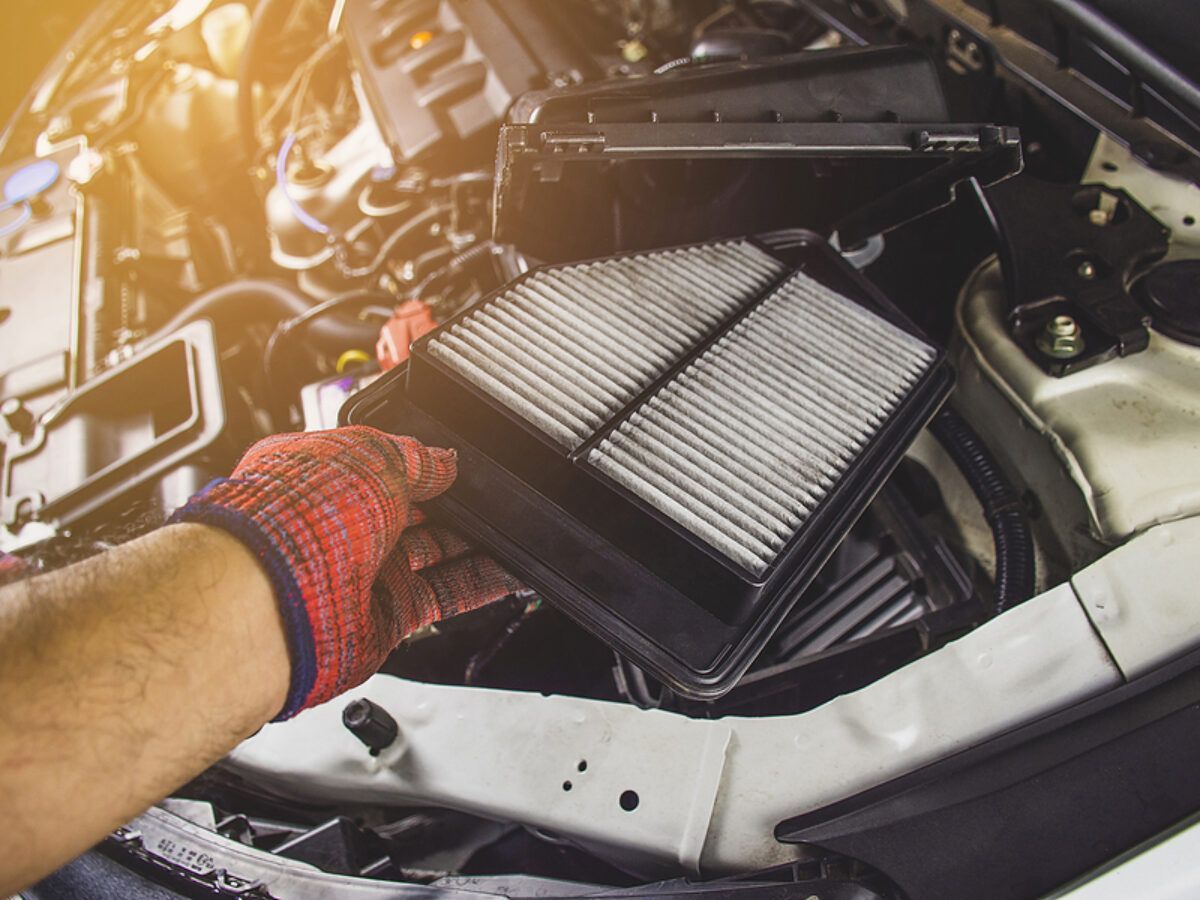
How Can You Tell If an Air Filter Is Clogged?
A visual inspection is a useful first step.
Remove the filter according to the manufacturer's procedure and inspect the filter media.
Look for:
-
Heavy dust accumulation
-
Mud
-
Leaves
-
Insects
-
Oil contamination
-
Water damage
-
Damaged filter media
-
Collapsed or deformed pleats
However, appearance alone does not always determine airflow restriction.
A filter can look dirty without creating a significant restriction, while some filters can become restrictive in ways that are not obvious from a quick visual inspection.
Can You Drive With a Dirty Air Filter?
If the filter is only moderately dirty and the vehicle is operating normally, immediate failure is unlikely.
However, a severely restricted filter should be replaced as soon as practical.
If the vehicle has significant power loss, heavy smoke, severe hesitation, or a Check Engine Light, the underlying cause should be diagnosed rather than assuming that the filter is responsible.
Driving problems should be treated more seriously when the vehicle is being used for:
-
Heavy loads
-
Towing
-
Long highway journeys
-
High-speed driving
-
Steep climbs
These conditions increase the engine's airflow requirements.
What Happens If You Drive Without an Air Filter?
Driving without an air filter is not a proper way to improve engine performance.
Although removing the filter can reduce intake restriction, it also removes the component that protects the engine from airborne contaminants.
Dust and abrasive particles can enter the engine and contribute to accelerated wear.
On turbocharged engines, contaminants can also damage the turbocharger compressor.
The small potential airflow benefit is therefore not worth sacrificing filtration.
Does a New Air Filter Increase Horsepower?
Replacing a severely clogged filter can restore performance that has been lost because of excessive restriction.
However, replacing a normal, correctly functioning filter does not automatically produce a significant horsepower increase.
The engine and intake system are designed to operate within a particular airflow range.
A new standard replacement filter primarily restores proper airflow and filtration.
Claims of large horsepower gains from simply replacing a normal air filter should therefore be treated carefully.
Air Filter Problems and Diesel Engines
Airflow is especially important on diesel engines because diesel engines generally control power primarily through fuel quantity rather than a conventional gasoline-style throttle strategy.
Modern diesel engines also use sophisticated systems involving:
-
Turbochargers
-
EGR
-
MAF sensors
-
MAP sensors
-
Variable-geometry turbochargers
-
DPF systems
-
Exhaust aftertreatment
A restricted air filter can therefore interact with several other systems.
For example, if the engine cannot obtain the expected amount of air, boost and fuel-management strategies may be affected.
However, a diesel engine with poor performance or black smoke requires a complete intake, boost, fuel, and exhaust diagnosis.
Air Filter Problems and Gasoline Engines
Gasoline engines also require clean and sufficient airflow.
Modern gasoline engines typically use electronic throttle control and closed-loop fuel management.
The ECU uses information from several sensors to determine the appropriate fuel quantity.
A dirty filter may therefore have little effect until the restriction becomes significant.
If a gasoline engine has poor acceleration, rough idle, or increased fuel consumption, the air filter should be inspected, but other causes should also be considered.
What Other Problems Can Look Like a Clogged Air Filter?
This is one of the most important diagnostic points.
Reduced engine performance does not automatically mean that the air filter is clogged.
Similar symptoms can result from:
-
Dirty MAF sensor
-
Faulty MAF sensor
-
Faulty MAP sensor
-
Vacuum leak
-
Intake duct restriction
-
Electronic throttle problem
-
Fuel filter restriction
-
Low fuel pressure
-
Injector problems
-
Ignition problems
-
Turbocharger failure
-
Boost leak
-
EGR malfunction
-
DPF restriction
-
Catalytic converter restriction
-
Engine timing problems
-
Low compression
-
Transmission problems
A proper diagnosis should therefore consider the entire air, fuel, ignition, exhaust, and drivetrain system.
How Is a Clogged Air Filter Diagnosed?
Diagnosis normally begins with a simple visual inspection.
If the filter is obviously contaminated or has reached its replacement interval, replacement may be appropriate.
If symptoms remain, additional testing may be required.
A technician may check:
-
MAF readings
-
MAP readings
-
Intake pressure
-
Fuel trims
-
Boost pressure
-
Air-fuel ratio
-
Exhaust pressure
-
Engine load
-
Throttle position
-
Fuel pressure
-
Diagnostic trouble codes
On some vehicles, airflow or intake restriction can be measured more directly.
The important principle is to determine whether the engine is actually suffering from insufficient airflow before blaming the filter.
Final Thoughts
The air filter is a relatively simple component, but it plays a critical role in protecting an engine while supplying the clean air required for combustion.
A severely clogged air filter can cause reduced power, poor acceleration, weak high-RPM performance, increased fuel consumption, hesitation, and, in some diesel applications, increased smoke.
However, these symptoms are not exclusive to air-filter problems.
A dirty MAF sensor, restricted fuel filter, boost leak, turbocharger fault, electronic throttle problem, EGR malfunction, exhaust restriction, or fuel-system problem can produce very similar symptoms.
For this reason, the best approach is to inspect the air filter first because it is inexpensive and easy to check, but do not assume that every performance problem is caused by the filter.
The correct replacement interval depends on the vehicle and operating environment. Vehicles driven in dusty, rural, industrial, or unpaved environments may need more frequent inspection than vehicles used primarily on clean paved roads.
Most importantly, an air filter should never be removed simply to increase airflow. The engine needs both adequate airflow and effective filtration. A properly maintained filter provides both, helping maintain engine performance while protecting internal components from damaging contaminants.