TR
TR EN
EN

What Is a Fuel Cell? Where Are Fuel Cells Used?
A fuel cell is an energy conversion system that converts the chemical energy of a fuel directly into electrical energy without burning the fuel.
The operating principle is somewhat similar to a battery. However, there is an important difference: a battery stores a limited amount of chemical energy internally, while a fuel cell can continue producing electricity as long as fuel and an oxidizing agent are supplied.
In the most common type of fuel cell, hydrogen is used as the fuel and oxygen from the air is used as the oxidizing agent. The electrochemical reaction produces electricity and heat, with water being the primary reaction product in a hydrogen fuel-cell system.
For this reason, hydrogen fuel cells are attracting attention in transportation, electricity generation, backup power, and several industrial applications.
How Does a Fuel Cell Work?
A fuel cell uses an electrochemical reaction to generate electricity.
In a simplified hydrogen fuel-cell system, the main components include:
-
Anode
-
Cathode
-
Electrolyte
-
Fuel and air channels
-
Electrical connections
Hydrogen enters the anode side. Here, hydrogen molecules are separated into protons and electrons.
The protons pass through the electrolyte, while the electrons are forced to travel through an external electrical circuit. This movement of electrons creates an electric current.
At the cathode, oxygen combines with the protons and electrons to form water.
The overall reaction can be simplified as:
2H₂ + O₂ → 2H₂O + electrical energy + heat
The important point is that electricity is produced through an electrochemical reaction, rather than through combustion as in a conventional internal combustion engine.
What Is the Difference Between a Fuel Cell and a Battery?
Fuel cells and batteries can both provide electrical energy, but they operate differently.
A battery stores chemical energy internally and converts it into electricity. Once its stored energy is depleted, it must be recharged.
A fuel cell generates electricity using fuel supplied from outside the system.
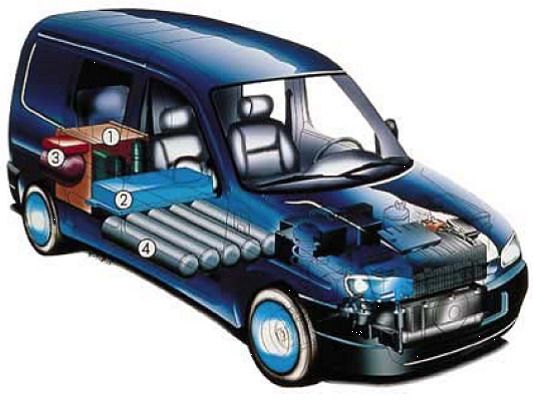
For example, in a hydrogen fuel-cell vehicle, hydrogen is supplied from onboard storage tanks to the fuel-cell system. Oxygen is obtained from the surrounding air. The fuel cell then uses these inputs to generate electricity.
This means that a fuel-cell vehicle uses a fundamentally different energy-storage approach from a fully electric vehicle that stores most of its energy in a large battery.
What Are the Main Components of a Fuel-Cell System?
A fuel cell is not simply a single component operating on its own. Especially in automotive and power-generation applications, it works together with several supporting systems.
Fuel-cell stack
A single fuel cell produces a relatively low voltage. Therefore, many individual cells are connected together to form a fuel-cell stack capable of producing the required voltage and power.
Hydrogen storage system
Hydrogen must be stored and supplied to the fuel cell. In automotive applications, high-pressure hydrogen tanks are commonly used.
Air supply system
Oxygen is required on the cathode side. A controlled air-supply system delivers atmospheric air to the fuel cell.
Power electronics
The electrical output of a fuel cell may not be directly suitable for every motor or electrical system. DC/DC converters and other power-electronic components regulate voltage and energy flow.
Cooling system
Fuel cells produce heat while generating electricity. High-power systems therefore require an effective thermal-management system.
Control system
Electronic controls monitor hydrogen flow, air supply, pressure, temperature, humidity, electrical output, and safety parameters.
What Are the Main Types of Fuel Cells?
Fuel cells are classified according to the electrolyte they use and their operating temperature.
PEMFC – Proton Exchange Membrane Fuel Cell
Proton exchange membrane fuel cells are particularly important for transportation.
Their relatively low operating temperature and fast response make them suitable for cars, buses, trucks, and other vehicles.
SOFC – Solid Oxide Fuel Cell
Solid oxide fuel cells operate at high temperatures.
They can provide high efficiency and are mainly considered for stationary power generation and certain industrial applications.
MCFC – Molten Carbonate Fuel Cell
Molten carbonate fuel cells operate at high temperatures and are primarily used in stationary power-generation applications.
PAFC – Phosphoric Acid Fuel Cell
Phosphoric acid fuel cells are another type of fuel cell used mainly for stationary electricity generation.
AFC – Alkaline Fuel Cell
Alkaline fuel cells have historically been important in space applications and can also be used in certain specialized energy systems.
Where Are Fuel Cells Used?
Fuel cells are not limited to automobiles.
They can be used in transportation, electricity generation, backup power, industrial systems, and specialized applications requiring reliable energy.
Fuel-Cell Cars
One of the most visible applications of fuel-cell technology is the automotive industry.
In a hydrogen fuel-cell vehicle, hydrogen is supplied to the fuel-cell stack, where electricity is generated through an electrochemical reaction.
That electricity powers an electric motor.
Therefore, a fuel-cell vehicle is technically an electric vehicle. The main difference is that electricity is generated onboard from hydrogen instead of being supplied primarily from a large rechargeable battery.
Fuel-cell cars may also contain a relatively small battery. This battery can store energy recovered through regenerative braking and provide additional power when necessary.
Hydrogen Fuel-Cell Buses
Buses are another important application.
Public transportation vehicles can operate for long periods and require significant amounts of energy.
Fuel-cell buses can provide electric propulsion while offering the potential for long driving ranges and relatively fast hydrogen refueling.
This can make the technology attractive for certain urban and intercity bus applications, particularly where suitable hydrogen infrastructure is available.
Fuel-Cell Trucks
Fuel cells have significant potential in heavy-duty transportation.
Using a very large battery in a heavy commercial vehicle can increase vehicle weight and may require substantial charging time.
Hydrogen offers a different approach. Its energy can be stored in high-pressure tanks, and refueling can be relatively fast when suitable infrastructure exists.
This makes fuel cells particularly interesting for long-distance heavy trucks.
However, whether fuel-cell trucks are economically advantageous depends on factors such as hydrogen prices, refueling infrastructure, vehicle utilization, and the continuing development of battery-electric trucks.
Fuel Cells in Trains
Fuel-cell technology can also be used in trains.
On railway lines without full electrification infrastructure, hydrogen fuel-cell trains can provide an alternative to diesel-powered trains.
The fuel cell generates electricity for electric traction motors, meaning the train still uses an electric drivetrain.
Fuel Cells in Marine Transportation
Fuel cells are also being investigated and used in marine applications.
Reducing emissions in ports and coastal areas is particularly important, making hydrogen and fuel-cell systems attractive for certain marine vessels.
For larger ships, other hydrogen-based fuels and different fuel-cell technologies are also being considered.
Backup Power Systems
Fuel cells can be used as backup power sources when the main electricity supply fails.
Potential applications include:
-
Telecommunications infrastructure
-
Data centers
-
Critical facilities
-
Industrial facilities
-
Emergency power systems
Fuel cells can operate as alternatives or complements to conventional generators in applications requiring long-duration backup power.
Electricity and Heat Generation in Buildings
Some fuel-cell systems can generate both electricity and useful heat.
This type of application is often associated with combined heat and power (CHP) systems.
Instead of allowing the heat produced during electricity generation to be wasted, it can be recovered and used for:
-
Hot water
-
Building heating
-
Industrial processes
This can significantly improve the overall energy efficiency of the system.
Fuel Cells in Space Applications
Fuel cells have an important historical connection with space technology.
Hydrogen and oxygen fuel cells have been used to generate electricity in spacecraft.
One of their major advantages in certain applications is that the electrochemical reaction can produce water in addition to electricity.
Because water is an extremely valuable resource during space missions, this characteristic can be particularly useful.
Industrial Applications
Fuel cells can provide stationary electricity for factories and other industrial facilities.
They may be considered where reliable power, distributed generation, or reduced local emissions are important.
Depending on the fuel-cell technology, fuels other than pure hydrogen can also be used. Some fuel-cell systems can process fuels such as natural gas internally or through an external reforming system to obtain hydrogen-rich gas.
Therefore, it would be incorrect to say that every type of fuel cell can operate only on hydrogen.
Fuel Cells in Forklifts
Fuel cells are also used in warehouse and logistics operations, particularly in forklifts.
Battery-electric forklifts need to be recharged or have their batteries replaced after extended operation.
Hydrogen fuel-cell forklifts can instead be refueled relatively quickly when suitable hydrogen infrastructure is available.
This can be valuable in large logistics facilities where vehicles operate continuously and minimizing downtime is important.
What Are the Advantages of Fuel Cells?
Fuel-cell technology offers several important advantages.
Low local emissions
A hydrogen fuel cell can produce electricity with water as the primary reaction product at the point of use.
However, this does not automatically mean that the entire hydrogen energy chain is emissions-free. The method used to produce the hydrogen has a major influence on its overall environmental impact.
High efficiency
Fuel cells convert chemical energy directly into electrical energy through an electrochemical process.
This can avoid some of the energy losses associated with conventional combustion-based energy conversion.
When the heat generated by the fuel cell is also recovered and used, overall system efficiency can be increased further.
Quiet operation
A fuel cell does not require pistons, a crankshaft, or the continuous mechanical movement associated with a conventional combustion engine to generate electricity.
As a result, fuel-cell systems can operate relatively quietly.
Fast hydrogen refueling
One of the potential advantages of fuel-cell vehicles is relatively fast hydrogen refueling when a suitable station is available.
This can be particularly valuable for commercial vehicles that cannot afford long charging periods.
Long operating periods
A fuel cell can continue generating electricity as long as fuel is supplied.
This characteristic can be useful for stationary applications requiring long periods of continuous operation.
What Are the Disadvantages of Fuel Cells?
Fuel-cell technology also has several important challenges.
Limited hydrogen infrastructure
One of the biggest obstacles is the limited availability of hydrogen refueling infrastructure in many regions.
Buying a fuel-cell vehicle is not enough by itself. Hydrogen must be produced, transported, stored, and safely delivered to vehicles.
Environmental impact of hydrogen production
Hydrogen itself can be used in a fuel cell with very low local emissions, but the production method is extremely important.
Hydrogen produced using renewable electricity through electrolysis has a very different environmental profile from hydrogen produced using fossil fuels.
Therefore, it is not accurate to evaluate hydrogen solely by looking at what comes out of the vehicle's exhaust or what happens inside the fuel cell.
High system cost
Fuel-cell stacks, high-pressure hydrogen tanks, power electronics, cooling systems, and other supporting components can be expensive.
Higher production volumes and technological improvements may reduce these costs over time, but cost remains an important factor.
Hydrogen storage
Hydrogen has physical properties that make storage and transportation more demanding than storing conventional liquid fuels.
High-pressure tanks are commonly used in automotive applications.
These tanks must meet strict safety and durability requirements.
System complexity
A fuel-cell system consists of much more than the fuel-cell stack itself.
It can include:
-
Air compressors
-
Hydrogen supply systems
-
Cooling systems
-
Humidity-management systems
-
Sensors
-
Control modules
-
Power electronics
The interaction between these components makes diagnosis and maintenance more specialized.
What Comes Out of a Hydrogen Fuel-Cell Vehicle?
In a hydrogen fuel-cell vehicle, the basic reaction inside the fuel cell combines hydrogen and oxygen.
The primary product is water.
Because a fuel-cell vehicle does not use a conventional internal combustion engine for propulsion, it does not produce combustion exhaust gases in the same way as a gasoline or diesel vehicle.
However, the overall environmental impact should not be evaluated only by looking at the vehicle itself.
Hydrogen production, compression, transportation, storage, and distribution must also be considered.
Fuel Cell or Battery?
Both technologies have important advantages and disadvantages.
In a battery-electric vehicle, electricity is stored directly in a battery and supplied to the electric motor when required.
In a fuel-cell vehicle, hydrogen is stored onboard and converted into electricity through the fuel cell.
Battery-electric systems generally have an efficiency advantage across the complete electricity-to-wheel energy chain.
Fuel cells, however, can offer advantages such as fast refueling and potentially long operating ranges, particularly for vehicles with intensive utilization.
Therefore, neither technology is universally superior. The appropriate solution depends on the application.
Where Could Fuel Cells Become More Common?
Fuel cells may have their strongest future potential in areas where long range, fast refueling, or long-duration operation is particularly important.
Potential applications include:
-
Long-distance trucks
-
Buses
-
Certain trains
-
Marine vessels
-
Backup power systems
-
Industrial facilities
-
Warehouse and logistics vehicles
-
Long-duration stationary power systems
In passenger cars, however, the rapid development of battery-electric vehicles and charging infrastructure may make the market more competitive for hydrogen fuel-cell technology.
The Basic Principle of Fuel-Cell Technology
A fuel cell should not simply be thought of as another type of battery.
It is better understood as an energy-conversion system that produces electricity from a supplied fuel.
In a hydrogen fuel cell, hydrogen and oxygen undergo an electrochemical reaction that produces electrical energy and heat, with water as the primary reaction product.
The major advantages of fuel cells include low local emissions, quiet operation, high efficiency, and potentially fast refueling. Their major challenges include hydrogen production, storage costs, limited infrastructure, and the complexity of the complete system.
For these reasons, fuel cells are unlikely to be a universal replacement for every energy technology. Instead, they are particularly interesting for applications where long range, rapid refueling, high utilization, or long-duration power generation provide advantages over conventional batteries.