TR
TR EN
EN

What Is a Coolant Level Sensor? What Are the Symptoms of Failure?
The coolant level sensor is an electrical component that monitors the amount of coolant in the vehicle’s cooling system or expansion tank. Its main purpose is to warn the driver when the coolant level falls below a safe limit.
Coolant is essential for maintaining the engine at the correct operating temperature. If the coolant level becomes too low, the engine may overheat, which can lead to serious damage.
The coolant level sensor itself does not measure engine temperature. Its primary function is to determine whether there is enough coolant in the system and, depending on the vehicle design, send this information to the instrument cluster, BCM, or engine control module.
What Does a Coolant Level Sensor Do?
The sensor monitors whether the coolant level is above or below a predetermined threshold.
When the coolant level is normal, the sensor allows the vehicle to operate without a low-coolant warning.
When the level drops too far, the sensor changes its electrical signal or switch state. The vehicle can then display a warning such as:
-
Low coolant
-
Check coolant level
-
Coolant level low
-
Coolant warning light
Some vehicles may also display a message on the instrument cluster.
The exact warning depends on the vehicle manufacturer and cooling system design.
Where Is the Coolant Level Sensor Located?
The location varies considerably between vehicles.
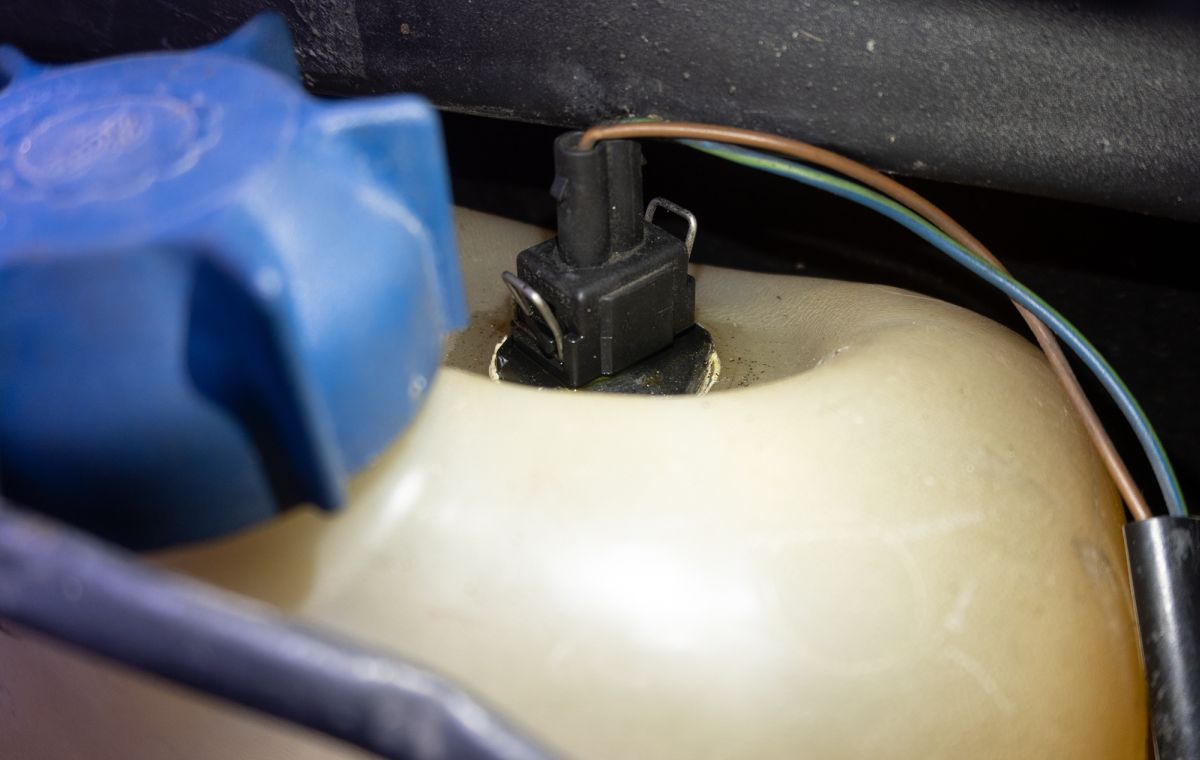
In many vehicles, the coolant level sensor is installed directly in the coolant expansion tank.
Some systems use a sensor mounted near the radiator or coolant reservoir, while others integrate the sensor into the expansion tank itself.
A typical expansion tank with a level sensor may have:
-
Electrical connector
-
Sensor body
-
Float or level-detection mechanism
-
Sealing components
On some vehicles, the sensor is not separately replaceable. The entire expansion tank may need to be replaced if the integrated sensor fails.
How Does a Coolant Level Sensor Work?
There are several different sensor designs.
A common design uses a float mechanism.
As the coolant level changes, the float moves up or down. The sensor detects the position of the float and determines whether the coolant level is within the acceptable range.
Other systems use electrical conductivity or different electronic sensing principles.
The exact circuit can vary significantly between manufacturers.
Some coolant level sensors operate like a simple switch:
Coolant level normal → switch state normal
Coolant level too low → switch state changes → warning activated
Other systems provide a signal that is interpreted by an electronic control module.
What Are the Symptoms of a Bad Coolant Level Sensor?
A failed coolant level sensor can produce several different symptoms.
The most common include:
-
Low coolant warning when the coolant level is normal
-
Coolant warning light staying on
-
Warning appearing intermittently
-
Warning disappearing and returning while driving
-
Low coolant message immediately after starting the vehicle
-
Warning appearing when cornering or braking
-
Warning appearing only when the engine is cold
-
Warning appearing only when the engine is hot
-
No low-coolant warning even when the coolant level is actually low
The last symptom is particularly dangerous because a faulty sensor may prevent the driver from receiving an important warning.
Low Coolant Warning When the Coolant Level Is Normal
One of the most common complaints is a low-coolant warning even though the expansion tank appears to contain enough coolant.
Possible causes include:
-
Faulty coolant level sensor
-
Sticking float
-
Contaminated expansion tank
-
Corroded electrical connector
-
Damaged wiring
-
Poor electrical connection
-
Incorrect coolant level
-
Air trapped in the cooling system
-
Incorrectly installed reservoir
-
Sensor calibration or control-system problem
The sensor should not immediately be blamed.
The coolant level should first be checked correctly according to the manufacturer's procedure.
Why Does the Coolant Warning Appear When Turning or Braking?
If the coolant level is close to the minimum mark, acceleration, braking, or cornering can cause the coolant to move inside the expansion tank.
This can temporarily expose the level sensor.
As a result, the sensor may detect a low level and activate the warning.
In this situation, the sensor may actually be working correctly.
The real problem may simply be that the coolant level is too close to the minimum threshold.
If the warning repeatedly appears during cornering or braking, check the coolant level before replacing the sensor.
Can a Dirty Expansion Tank Cause a Coolant Level Sensor Problem?
Yes.
Over time, coolant can become contaminated with deposits, corrosion products, sludge, or other material.
Depending on the sensor design, contamination can interfere with the movement of a float or affect the sensor's ability to detect the coolant level correctly.
A float can become stuck and remain in the wrong position.
This can result in a warning that remains active even when the coolant level is correct.
However, cleaning the reservoir is not always an appropriate repair. If the sensor or expansion tank is damaged, replacement may be necessary.
Can a Coolant Level Sensor Cause an Overheating Problem?
Normally, the sensor itself does not control engine cooling.
Its primary purpose is to monitor coolant level and provide a warning.
A faulty sensor can therefore cause the driver to receive an incorrect warning or fail to receive a warning.
However, a low coolant level caused by an actual leak can absolutely lead to overheating.
This distinction is important:
A bad coolant level sensor does not normally cause the coolant level to drop.
If the coolant is genuinely disappearing, the cooling system needs to be inspected for leaks.
Coolant Level Sensor vs. Coolant Temperature Sensor
These two sensors are often confused, but they perform completely different functions.
The coolant level sensor monitors the amount of coolant.
The coolant temperature sensor measures coolant temperature and provides temperature information to the engine control system.
A temperature sensor can influence:
-
Fuel injection
-
Ignition timing
-
Cooling fan operation
-
Cold-start enrichment
-
Engine operating strategy
-
Temperature gauge information
A coolant level sensor generally does not perform these functions.
Therefore, a coolant temperature problem should not automatically be diagnosed as a coolant level sensor failure.
Can a Coolant Level Sensor Trigger the Check Engine Light?
It depends on the vehicle.
Some vehicles monitor the coolant level independently through the instrument cluster or body electronics and may simply display a coolant warning.
Other vehicles may monitor the sensor through an electronic control module and potentially store a diagnostic trouble code.
Therefore, a coolant level sensor problem may or may not trigger the Check Engine Light.
An OBD scanner should be used according to the vehicle's system architecture rather than assuming every coolant level fault will generate an engine-related code.
How Do You Test a Coolant Level Sensor?
The correct test depends on the sensor design.
The first step is to verify the actual coolant level.
The engine should be allowed to cool before opening the cooling system because hot coolant can be under pressure and cause serious burns.
After confirming the coolant level, inspect:
-
Sensor connector
-
Wiring
-
Terminals
-
Expansion tank
-
Sensor mounting area
-
Coolant contamination
-
Float movement, if applicable
If the sensor is a simple switch-type design, its continuity can often be tested according to the manufacturer's specifications.
If it is an electronic sensor, voltage, resistance, signal behavior, or scan-tool data may need to be checked.
Can You Test the Sensor With a Multimeter?
In many cases, yes.
A multimeter can be useful for checking:
-
Continuity
-
Resistance
-
Reference voltage
-
Ground
-
Wiring continuity
-
Short circuits
-
Open circuits
However, the correct testing procedure must come from the vehicle's service information.
For example, a sensor that operates as a switch should not be tested using the same method as an electronic level sensor.
A resistance measurement that looks unusual does not automatically prove that the sensor is defective unless the manufacturer's specifications are known.
What Causes Coolant Level Sensor Failure?
Several problems can affect the sensor.
Internal sensor failure
Electronic components or mechanical parts can wear out over time.
Stuck float
If the sensor uses a float, contamination or deposits can prevent it from moving freely.
Connector corrosion
Coolant and moisture around the expansion tank can contribute to connector problems.
Damaged wiring
The wiring near the reservoir can become brittle, damaged, or disconnected.
Poor electrical connection
Loose terminals can create intermittent warnings.
Expansion tank damage
A cracked or damaged reservoir can affect the sensor assembly.
Incorrect coolant
Using the wrong coolant or mixing incompatible coolant types can contribute to deposits and contamination.
Does a Coolant Leak Mean the Sensor Is Bad?
No.
This is an important diagnostic distinction.
If the coolant level keeps dropping, the first priority should be finding the source of the coolant loss.
Possible leak points include:
-
Radiator
-
Expansion tank
-
Reservoir cap
-
Coolant hoses
-
Hose connections
-
Thermostat housing
-
Water pump
-
Heater core
-
Radiator end tanks
-
Engine coolant passages
A low coolant warning may therefore be completely correct even though the sensor is functioning normally.
Can Air in the Cooling System Cause a False Coolant Warning?
Yes, depending on the vehicle.
Air pockets can change the coolant level around the sensor and may cause unstable readings.
Air can enter the cooling system after:
-
Coolant replacement
-
Cooling system repairs
-
Hose replacement
-
Radiator replacement
-
Thermostat replacement
-
A coolant leak
If the cooling system has recently been serviced and the warning appeared afterward, proper bleeding or air removal should be considered.
The manufacturer's coolant filling and bleeding procedure should be followed.
Can a Bad Coolant Level Sensor Cause a False Low-Coolant Warning?
Yes.
A sensor with an internal fault, stuck float, damaged wiring, or poor connector connection can incorrectly report that the coolant level is low.
This is one of the most common reasons for replacing the sensor.
But the diagnosis should still begin with checking the actual coolant level.
Replacing the sensor while the cooling system has a real leak will not solve the underlying problem.
Can a Coolant Level Sensor Be Cleaned?
Sometimes the surrounding components can be cleaned, particularly if contamination is affecting a mechanical float.
However, cleaning is not a guaranteed repair.
If the electrical sensing element has failed internally, cleaning the outside of the sensor will not restore it.
Likewise, a damaged or cracked expansion tank should not be treated as a simple cleaning problem.
Can You Drive With a Faulty Coolant Level Sensor?
Driving with a faulty coolant level sensor is not recommended, particularly if you cannot reliably determine the actual coolant level.
The biggest risk is not usually the sensor itself.
The risk is losing coolant without receiving a warning.
If the engine overheats, continued driving can result in serious damage to components such as:
-
Cylinder head
-
Head gasket
-
Pistons
-
Valves
-
Turbocharger
-
Engine block
If the temperature gauge rises above normal, an overheating warning appears, steam is visible, coolant is leaking, or the engine behaves abnormally, stop driving and investigate the cooling system.
What Should You Check Before Replacing the Coolant Level Sensor?
Before replacing the sensor, follow a logical diagnostic process.
First, check the coolant level when the engine is cold.
Do not rely solely on the warning message.
Next, look for coolant leaks.
A genuine coolant loss must be repaired before blaming the sensor.
Then inspect the sensor connector and wiring.
Look for corrosion, loose terminals, broken wires, or moisture.
Check the expansion tank and sensor mechanism.
If the vehicle uses a float, make sure it can move correctly.
Finally, test the sensor according to the manufacturer's specifications.
Only after these checks should the sensor or expansion tank be replaced.
Why Is the Coolant Level Sensor Important?
The coolant level sensor is a relatively small component, but it can provide an important early warning.
A driver may not immediately notice a slow coolant leak.
The sensor can alert the driver before the coolant level becomes dangerously low.
It is therefore important not to ignore repeated coolant warnings.
At the same time, a coolant warning should never be dismissed simply because the sensor is suspected to be faulty.
The actual coolant level and cooling system condition must always be verified.
Conclusion
The coolant level sensor monitors the amount of coolant in the vehicle's cooling system and warns the driver when the level falls below a predetermined limit.
Depending on the vehicle, the sensor may use a float, switch, conductivity-based detection, or another electronic method. It is commonly installed in the coolant expansion tank, although the exact design varies.
The most common symptoms of a faulty coolant level sensor include a low coolant warning when the coolant level is normal, intermittent warnings, a warning that appears during cornering or braking, or failure to warn when the coolant level is genuinely low.
However, a coolant warning does not automatically mean that the sensor has failed.
A real coolant leak, low coolant level, air trapped in the cooling system, a contaminated expansion tank, damaged wiring, or a poor connector can produce similar symptoms.
The most important rule is simple: always verify the actual coolant level and check for coolant loss before replacing the sensor. A faulty warning system should be repaired, but an actual coolant leak or overheating problem should never be mistaken for a sensor fault.