TR
TR EN
EN

What Is Connecting Rod Knock?
Some noises heard while an engine is running are caused by normal vibration or relatively minor problems. Others can indicate serious internal engine damage. A deep, rhythmic metallic knocking sound that changes with engine speed is one of the noises that should never be ignored.
What is commonly called piston knock, connecting rod knock, or simply rod knock can actually refer to different mechanical conditions. In particular, connecting rod bearing knock is associated with the lower part of the engine and can eventually cause severe damage if the vehicle continues to be driven.
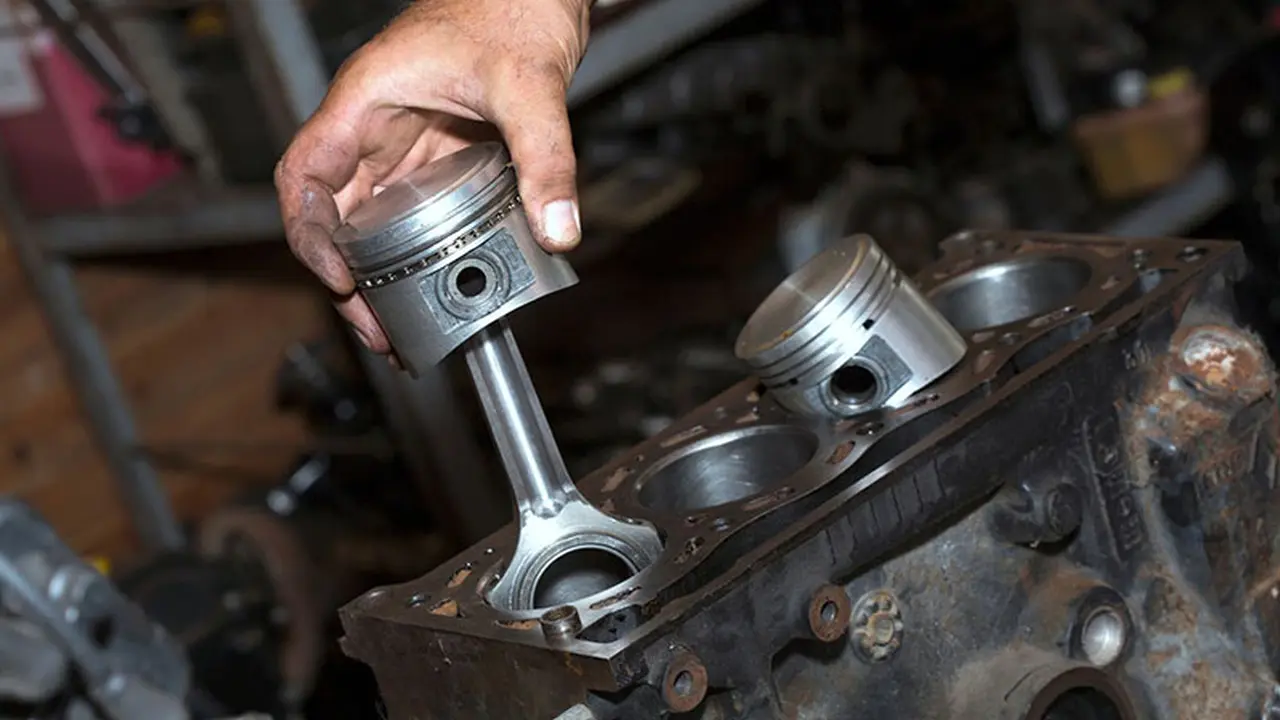
The connecting rod links the piston to the crankshaft. It transfers the force generated during combustion from the piston to the crankshaft. Because of this, the connecting rod and its bearings operate under extremely high mechanical loads.
When a knocking sound is suspected to come from the connecting rod area, replacing a part based only on the sound is not a proper diagnostic approach. The conditions under which the noise occurs, engine speed, engine load, oil pressure, engine oil condition, and the condition of the crankshaft and bearings should all be evaluated together.
What Is a Connecting Rod?
The connecting rod is the mechanical link between the piston and the crankshaft.
The piston moves up and down inside the cylinder, while the crankshaft rotates. The connecting rod transfers the forces between these two different types of movement.
The basic process is:
Combustion → Piston moves downward → Connecting rod transfers the force → Crankshaft rotates.
The crankshaft continues rotating, bringing the piston back upward, and the cycle repeats.
As a result, the connecting rod is subjected to alternating tensile and compressive forces as well as very high acceleration forces.
At the end of the connecting rod where it attaches to the crankshaft, there is a connecting rod bearing.
This bearing is particularly important when diagnosing rod knock.
What Is a Connecting Rod Bearing?
The connecting rod bearing is a type of plain bearing installed between the connecting rod and the crankshaft journal.
Its purpose is to allow the crankshaft to rotate inside the connecting rod without direct metal-to-metal contact under normal operating conditions.
A very thin film of engine oil separates the bearing surface from the crankshaft journal.
When lubrication is correct, this oil film allows the crankshaft to rotate with very little friction.
However, if the oil film breaks down or the clearance between the bearing and crankshaft becomes excessive, unwanted movement and metal contact can occur.
This is one of the main conditions associated with connecting rod knock.
What Causes Connecting Rod Knock?
One of the most common causes is excessive connecting rod bearing clearance.
As a bearing wears, the clearance between the bearing and crankshaft journal increases.
Under normal conditions, the oil film controls the movement between these components. When the clearance becomes excessive, the crankshaft can move more than intended inside the bearing.
The combustion force acting on the piston can then produce a distinct knocking sound through the connecting rod and crankshaft assembly.
However, bearing wear is not the only possible cause.
Low Engine Oil Level
A low engine oil level can create serious lubrication problems.
When the oil level is too low, the oil pump may not be able to supply sufficient oil to the engine under all operating conditions. The problem can become particularly significant during high RPM, hard acceleration, heavy braking, or cornering when the oil moves around inside the oil pan.
If the bearings repeatedly receive insufficient lubrication, their surfaces can become damaged.
Continued oil starvation can eventually lead to bearing failure and connecting rod knock.
Incorrect Engine Oil
Using engine oil with the wrong viscosity or specification can also affect the lubrication system.
For example, oil that is too thin for a particular engine may not maintain the required oil film under operating conditions.
On the other hand, oil that is unnecessarily thick can make oil circulation more difficult during cold starts.
Engine oil should therefore be selected according to the manufacturer's specifications, including:
-
Viscosity
-
API or ACEA classification
-
Manufacturer approvals
-
Required oil specification
-
Recommended change interval
Simply choosing an oil because it is marketed as “engine oil” is not enough.
Low Oil Pressure
Connecting rod bearings depend on adequate oil supply and pressure.
Low oil pressure can be caused by several different problems, including:
-
Worn oil pump
-
Blocked oil pickup screen
-
Excessive bearing clearance
-
Restricted oil passages
-
Incorrect engine oil
-
Excessive internal engine wear
This is why low oil pressure should not automatically be blamed on the oil pump.
For example, excessive bearing clearance itself can contribute to low oil pressure because more oil escapes through the enlarged clearances.
Metal Particles in the Engine Oil
A damaged connecting rod bearing can release metallic material into the engine oil.
For this reason, checking the oil can provide useful diagnostic information when rod knock is suspected.
Metallic particles in the drained oil or inside the oil filter are a warning sign.
However, finding metal in the oil does not automatically prove that the connecting rod bearing is the source. Other internal engine components can also produce metallic debris.
The source of the material must therefore be identified.
What Does Connecting Rod Knock Sound Like?
Connecting rod knock is commonly described as a deep, dull metallic knocking sound.
The frequency of the noise generally changes with engine speed.
As engine RPM increases, the knocking may occur more frequently.
The sound can also become more noticeable when the engine is under load.
For example, accelerating from low RPM in a high gear can place significant load on the engine and make an existing rod knock easier to hear.
However, sound alone is not enough to make a definite diagnosis.
Several other engine components can produce noises that resemble rod knock.
Why Can the Noise Increase Under Acceleration?
Engine load is an important diagnostic clue.
When the accelerator is pressed, the engine generally receives more air and fuel, and combustion forces increase.
Those forces are transferred from the piston through the connecting rod to the crankshaft.
If the connecting rod bearing has excessive clearance or damage, the increased combustion force can make the unwanted movement more pronounced.
As a result, some rod knock conditions may behave approximately like this:
Light at idle → More noticeable with throttle → Stronger under load
This pattern can be useful during diagnosis, but it is not enough by itself to confirm a failed bearing.
Piston Slap and Rod Knock Are Not the Same
This distinction is important.
Piston slap and connecting rod knock are different mechanical conditions.
Piston slap is generally associated with excessive clearance between the piston and cylinder wall and movement of the piston skirt within the cylinder.
Some piston slap noises are more noticeable when the engine is cold and may decrease as the engine reaches operating temperature.
Rod knock, on the other hand, is more commonly associated with the connecting rod bearing, crankshaft journal, and excessive clearance in the connecting rod assembly.
Therefore, not every metallic engine noise should be diagnosed as rod knock.
How Is Rod Knock Different From Valve Train Noise?
The valve train can also produce ticking or knocking noises.
Components such as:
-
Valve lifters
-
Rocker arms
-
Camshafts
-
Followers
-
Other valve train components
can create noises that may initially be confusing.
Valve train noise is often heard more prominently from the upper part of the engine and may have a faster, lighter ticking character.
Rod knock generally has a deeper and heavier sound and may appear to come from the lower engine area.
However, sound travels through the engine block, so identifying the source by ear alone can be difficult.
A mechanic's stethoscope or other suitable diagnostic equipment can help localize the noise.
How Is Connecting Rod Knock Diagnosed?
A proper diagnosis should not necessarily begin by disassembling the engine.
The first objective is to determine whether the noise is actually coming from the connecting rod and bearing area.
1. Check the engine oil
The oil level, condition, specification, and signs of contamination should be checked.
The drained oil can also be inspected for metallic particles.
2. Measure oil pressure
The oil pressure warning light is an important warning system, but the fact that the warning light is off does not automatically prove that oil pressure is correct under all operating conditions.
If necessary, oil pressure should be measured with a mechanical pressure gauge.
The results should be compared with the manufacturer's specifications at the appropriate engine temperature and RPM.
3. Locate the source of the noise
The upper and lower areas of the engine should be listened to carefully.
A mechanical stethoscope can help determine where the noise is strongest.
4. Observe the noise under different conditions
The noise should be evaluated at idle, during light acceleration, and under load.
However, if serious rod knock is suspected, repeatedly revving or heavily loading the engine can increase the damage.
The engine should not be aggressively tested simply to make the noise louder.
5. Inspect the oil pan
If necessary, the oil pan can be removed to inspect the connecting rod bearings and crankshaft.
6. Measure bearing clearance
The actual bearing clearance should be measured and compared with the manufacturer's specifications.
A bearing that “looks fine” is not necessarily within specification.
Accurate mechanical measurement is much more reliable than visual inspection alone.
The Crankshaft Can Also Be Damaged
A connecting rod bearing that continues operating while damaged can eventually damage the crankshaft journal.
Possible damage includes:
-
Scoring
-
Wear
-
Heat damage
-
Discoloration
-
Surface damage
-
Out-of-specification journal dimensions
In such cases, simply installing new bearings may not solve the problem.
The crankshaft may need to be measured and, depending on the damage, machined or replaced.
What Happens If a Connecting Rod Bearing Spins?
In severe bearing failures, the bearing can spin inside the connecting rod housing.
This is an extremely serious condition.
A spun bearing can interfere with proper oil flow and dramatically increase friction between the connecting rod and crankshaft.
The resulting damage can extend to:
-
Connecting rod
-
Crankshaft
-
Engine block
-
Oil passages
-
Other engine bearings
At an advanced stage, the connecting rod can even seize against the crankshaft.
Can a Connecting Rod Break?
Yes.
Severe bearing failure or another serious internal engine problem can place extreme loads on the connecting rod.
If the connecting rod breaks while the engine is running, the consequences can be catastrophic.
A broken rod can strike the inside of the engine block and, in severe cases, break through the engine block itself.
For this reason, an engine showing strong rod knock should not be repeatedly revved or driven aggressively.
Can You Drive a Car With Rod Knock?
There is no safe universal driving distance for an engine suspected of having rod knock.
A mild engine noise and a severe connecting rod bearing failure are not the same situation.
If genuine rod knock is suspected, continuing to drive the vehicle can turn a relatively limited repair into a major engine failure.
The vehicle should not be driven unnecessarily if there is:
-
Strong rhythmic metallic knocking
-
An oil pressure warning
-
Metallic debris in the engine oil
-
A sudden loss of oil pressure
-
A deep knock that increases with RPM
-
Severe engine vibration
-
Misfire or unstable engine operation
-
Rapidly worsening noise
-
Signs that the engine is beginning to seize
In serious cases, having the vehicle transported to a repair facility is safer than driving it there.
Can Connecting Rod Bearing Failure Be Repaired?
Yes, but the required repair depends heavily on the extent of the damage.
If the problem is detected early, the connecting rod bearings may be replaced after the crankshaft and related components have been properly inspected.
If the engine has continued operating with a damaged bearing, however, the repair may involve:
-
Crankshaft machining or replacement
-
Connecting rod replacement
-
Main bearing inspection
-
Oil pump inspection or replacement
-
Cleaning of oil passages
-
Inspection of the engine block
-
Complete engine rebuild
This is why simply replacing the bearings is not always the correct solution.
The important question is:
Why did the bearing fail in the first place?
The Root Cause Must Be Found
Suppose worn connecting rod bearings are replaced with new ones.
If the original cause was actually low oil pressure, a damaged oil pump, blocked oil passages, incorrect bearing clearance, or a damaged crankshaft, the new bearings may fail again.
A proper repair therefore requires the entire lubrication and rotating assembly to be evaluated.
The following should be considered together:
Lubrication system → Oil pump → Oil passages → Crankshaft → Bearing clearances → Connecting rods → Engine oil
Replacing the visibly damaged part without correcting the underlying problem can result in another failure.
Can Rod Knock Be Prevented?
Not every internal engine failure can be prevented, but proper maintenance can significantly reduce the risk.
The engine should receive the correct oil at the correct specification and viscosity.
Oil changes should not be unnecessarily delayed.
The oil level should be checked regularly, particularly on engines known to consume oil.
If the engine is losing oil, the reason should be investigated rather than simply adding oil indefinitely.
An oil pressure warning should also never be ignored.
In addition, repeatedly operating a cold engine at very high RPM or heavily loading the engine at extremely low RPM can increase mechanical stress.
Why Rod Knock Should Never Be Ignored
Connecting rod knock is not simply an annoying engine noise.
If the sound is caused by excessive connecting rod bearing clearance, the problem can progress from bearing wear to crankshaft damage, a spun bearing, connecting rod failure, and potentially complete engine destruction.
The earlier the problem is identified, the greater the chance of limiting the repair.
The most important part of the diagnosis is therefore not simply asking:
“Which part is making the noise?”
It is asking:
“Why has the connecting rod and bearing assembly developed excessive movement or lost proper lubrication?”
Finding that root cause is what determines whether the repair will remain relatively limited or become a complete engine rebuild.