TR
TR EN
EN

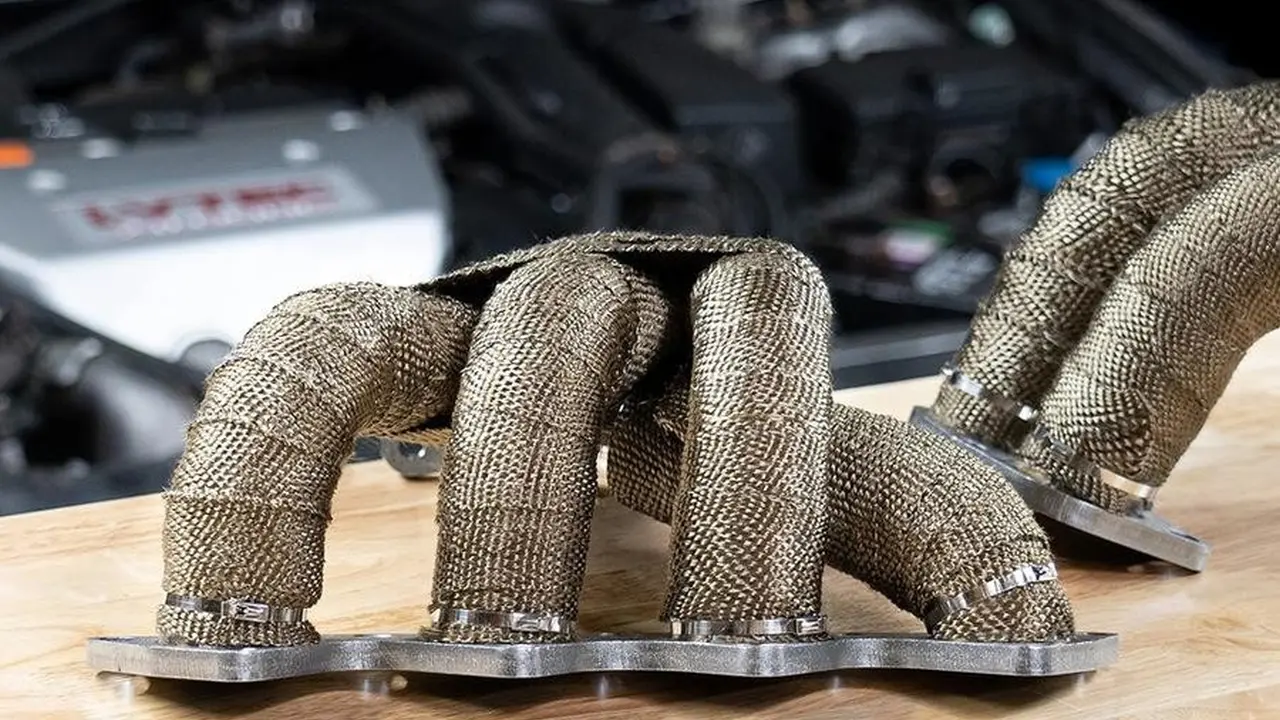
What Is Exhaust Manifold Wrap?
When an engine is running, the exhaust gases leaving the combustion chambers can reach extremely high temperatures. These hot gases pass through the exhaust manifold before entering the rest of the exhaust system.
An exhaust manifold wrap is a heat-resistant insulating material wrapped around the outside of the exhaust manifold or its individual runners.
These wraps are commonly made from materials such as fiberglass, ceramic fiber, or other high-temperature insulation materials. They are installed around the manifold pipes to reduce the amount of heat radiated into the engine bay.
The basic idea is simple:
Keep more of the exhaust heat within the exhaust system and reduce the amount of heat released into the surrounding engine compartment.
For this reason, manifold wrap is not simply a cosmetic modification. When used correctly, it can play an important role in managing under-hood temperatures.
Why Does the Exhaust Manifold Get So Hot?
To understand why an exhaust manifold is wrapped, it helps to understand where all that heat comes from.
The air-fuel mixture burns inside the combustion chamber and produces extremely high temperatures. The resulting exhaust gases leave through the exhaust valves and enter the manifold while they are still very hot.
Under high engine load and at high RPM, exhaust manifold temperatures can become extremely high.
The situation can be even more demanding in turbocharged engines. The turbocharger uses the energy of the exhaust gases to drive its turbine, making the exhaust side one of the major sources of heat in the engine bay.
That heat can affect nearby components such as:
-
Intake components
-
Wiring
-
Sensors
-
Plastic parts
-
Hoses
-
Fuel lines
-
Turbocharger components
-
Brake and clutch hydraulic lines
When these components are located close to the exhaust manifold, controlling radiant heat becomes particularly important.
What Does Exhaust Manifold Wrap Do?
The primary purpose of manifold wrap is to reduce radiant heat transfer.
A hot exhaust manifold continuously radiates heat into the surrounding area. Nearby components can absorb some of this heat, causing their temperatures to rise.
Wrapping the manifold reduces the amount of heat radiated directly from its outer surface.
However, there is an important point to understand.
The wrap does not make the heat disappear.
Instead, it changes how the heat is transferred.
The exhaust manifold remains extremely hot, and the metal itself may actually operate at a higher temperature because less heat is being released directly into the surrounding air.
Keeping Heat Inside the Exhaust System
One of the reasons performance enthusiasts use manifold wrap is to reduce heat loss from the exhaust gases.
As exhaust gases travel through the manifold, they transfer some of their heat to the manifold itself and then to the surrounding environment.
The more heat the exhaust gases lose, the cooler they become.
A thermal wrap can reduce this heat loss and help keep the exhaust gases hotter as they travel through the manifold.
This can be beneficial in certain performance applications because exhaust temperature and exhaust gas energy can influence the behavior of the exhaust system and turbocharger.
However, it would be incorrect to say that wrapping a manifold automatically produces a large increase in engine power.
The actual effect depends on the engine design, exhaust manifold geometry, turbocharger system, exhaust flow, and the type of insulation used.
Why Is It More Common on Turbocharged Engines?
Heat management becomes especially important on turbocharged engines.
A turbocharger uses exhaust gas energy to spin its turbine. The temperature and flow characteristics of the exhaust gases can therefore influence turbocharger operation.
Keeping more heat within the exhaust side can reduce the amount of thermal energy lost to the engine bay.
This is one reason manifold wraps are commonly found on performance turbocharged vehicles.
However, wrapping the manifold alone does not suddenly make a turbo engine significantly more powerful.
It is better understood as part of a broader exhaust and thermal-management strategy.
Can Manifold Wrap Cool the Engine Bay?
Yes, but the term "cool the engine bay" needs some clarification.
Manifold wrap does not function like a radiator or cooling system, and it does not directly lower the overall engine coolant temperature.
Instead, it reduces the amount of radiant heat released by the exhaust manifold into the surrounding engine compartment.
For example, if the intake pipe or air filter is positioned close to the exhaust manifold, radiant heat from the manifold can increase intake air temperature.
Reducing that radiant heat can help keep nearby intake components cooler.
This can be particularly useful on turbocharged engines because cooler intake air is denser and contains more oxygen for a given volume.
However, the actual benefit depends heavily on the vehicle's engine-bay design and airflow.
Does Cooler Intake Air Mean More Power?
Potentially, but the effect is often exaggerated.
Cooler intake air is denser, which means the engine can receive more oxygen for a given volume of air. Under the right conditions, this can support improved combustion and power output.
However, an exhaust manifold wrap by itself should not be expected to produce a major horsepower increase.
Its primary purpose is thermal management.
If an engine suffers from excessive heat around the intake system, wiring, sensors, or other components, reducing radiant heat can be useful.
On a well-designed factory engine bay where heat is already adequately controlled, the performance difference may be very small.
Can Manifold Wrap Help a Turbo Spool?
It can potentially contribute to maintaining exhaust energy, particularly in a properly designed turbo system.
Because the turbocharger relies on exhaust gas energy to drive the turbine, reducing heat loss from the exhaust side can help preserve thermal energy.
However, turbocharger response depends on many other factors, including:
-
Turbocharger size
-
Turbine design
-
Exhaust manifold design
-
Exhaust gas flow
-
Engine displacement
-
Camshaft characteristics
-
Boost pressure
-
Engine tuning
Therefore, manifold wrap should not be viewed as a simple modification that dramatically improves turbo spool by itself.
Does Exhaust Manifold Wrap Make the Engine Heat Up Faster?
Not in the same way that a thermostat or cooling-system component affects engine warm-up.
The wrap primarily changes heat transfer around the exhaust manifold.
Because less heat is radiated outward, more thermal energy remains concentrated in the exhaust side.
This can be useful for maintaining exhaust gas energy, especially in turbocharged applications.
It does not directly control the engine's coolant temperature.
The engine's operating temperature is primarily controlled by components such as:
-
Coolant
-
Radiator
-
Thermostat
-
Water pump
-
Cooling fans
-
Lubrication system
Manifold wrap should therefore be considered a heat-management device rather than an engine-cooling component.
Does Exhaust Manifold Wrap Have Any Disadvantages?
Yes.
One of the main disadvantages is that the manifold itself can operate at higher temperatures.
Because the wrap prevents heat from escaping as easily, more thermal energy remains concentrated in the manifold material.
This can increase thermal stress.
Depending on the manifold design and material, excessive temperatures can contribute to:
-
Cracking
-
Weld failure
-
Metal fatigue
-
Thermal deformation
-
Warping of mounting flanges
This is particularly important with thin-wall tubular performance manifolds.
A manifold that is not designed to handle high thermal loads may not be a good candidate for aggressive thermal wrapping.
What About Stainless Steel Manifolds?
Stainless steel performance manifolds can also be wrapped, but their thermal behavior needs to be considered.
Thin tubular stainless-steel manifolds can experience significant thermal expansion and contraction.
Repeated heating and cooling cycles create stress, particularly around welds and mounting points.
Adding insulation can increase the thermal load on the manifold.
For this reason, the quality of the manifold is just as important as the quality of the wrap.
A properly designed performance manifold made from suitable material is much better suited to high-temperature operation than a poorly manufactured component.
Can Manifold Wrap Cause Rust?
It can contribute to corrosion under certain conditions.
Some exhaust wraps can absorb and retain moisture.
If the vehicle is driven in rain, exposed to water during washing, or otherwise gets wet, moisture can remain trapped against the metal surface.
Over time, this can increase the risk of corrosion, particularly on steel components.
This is one reason why some performance applications use ceramic thermal coatings instead of traditional wraps.
The material and construction of the manifold also make a difference.
Exhaust Wrap vs. Ceramic Coating
Thermal management does not have to be done exclusively with exhaust wrap.
Ceramic coating is another common method used on exhaust manifolds and other hot exhaust components.
A ceramic coating creates a heat-resistant layer directly on the surface of the component.
Compared with traditional fabric-style wrapping, ceramic coatings can offer advantages in terms of moisture resistance and durability.
They also provide a more uniform finish and do not have the same appearance as a wrapped manifold.
However, the two approaches are not identical, and the better choice depends on the manifold, application, operating temperature, and intended use of the vehicle.
How Is Exhaust Manifold Wrap Installed?
The manifold should be clean before the wrap is installed.
Oil, dirt, and loose corrosion should be removed as much as possible.
The wrap is generally applied from one end of the manifold runner and worked progressively toward the other end.
The material should be installed firmly and consistently without leaving large gaps.
At the same time, it should not be excessively tightened, as this can damage certain types of wrap.
Curves, junctions, and tight areas around the manifold require particular attention.
Once the installation is complete, the wrap should be secured according to the manufacturer's instructions.
Some types of exhaust wrap are installed dry, while others are designed to be moistened before installation. The manufacturer's instructions should always be followed for the specific product being used.
Why Does a New Exhaust Wrap Produce Smoke?
It is not unusual for a newly installed exhaust wrap to produce some smoke or odor during its first heat cycles.
Certain wraps contain manufacturing residues or materials that burn off when exposed to high temperatures for the first time.
The smoke and smell should normally decrease after several heat cycles.
However, excessive or persistent smoke should not simply be ignored.
If there is a strong burning smell, heavy smoke, or signs that nearby components are becoming excessively hot, the installation should be inspected.
Oil or fuel contamination is especially important because extremely high exhaust temperatures can create a serious fire hazard.
Is Exhaust Manifold Wrap Necessary on Every Vehicle?
No.
For a standard daily-driven vehicle, exhaust manifold wrap is generally not a required modification.
Modern vehicles are designed with thermal management in mind. Manufacturers often use heat shields, protective panels, insulating materials, and carefully designed airflow paths around the exhaust system.
If a factory vehicle operates normally without a wrapped manifold, there is usually no reason to assume that wrapping it is necessary.
Manifold wrap is more commonly considered for:
-
Performance vehicles
-
Modified exhaust systems
-
Turbocharged applications
-
Track cars
-
Custom engine builds
-
Vehicles with serious under-hood heat problems
Is Exhaust Manifold Wrap Used for Performance?
Yes, but its main purpose is not simply to increase horsepower.
Performance applications generally use manifold wrap to control heat.
It can reduce radiant heat in the engine bay and help protect nearby components. In turbocharged applications, it may also help preserve exhaust energy.
However, the actual performance benefit depends on the entire engine and exhaust system.
Wrapping a manifold by itself should not be expected to deliver a dramatic increase in horsepower.
What Happens If the Wrap Is Installed Incorrectly?
Poor installation or low-quality material can create problems.
If the wrap is too loose, it can move, unravel, or become damaged over time.
If it is installed incorrectly, heat may not be distributed as intended.
More importantly, wrapping a damaged manifold is not a proper repair.
If the manifold already has cracks, damaged welds, or an exhaust leak, those problems should be repaired first.
The wrap can hide the damage and make future inspection more difficult.
Oil or fuel leaks near a wrapped exhaust manifold are also particularly dangerous because of the extreme temperatures involved.
Is Exhaust Manifold Wrap Actually Worth It?
It can be useful when there is a genuine thermal-management reason for using it.
If an exhaust manifold is radiating excessive heat toward an intake system, wiring, hoses, sensors, or other sensitive components, reducing that radiant heat can be beneficial.
It can also have advantages in turbocharged and performance applications where exhaust-side heat management is important.
However, the benefit varies from vehicle to vehicle.
A daily-driven factory vehicle with good factory heat shielding may see little practical difference.
A modified turbocharged engine operating at high exhaust temperatures may benefit considerably more.
The Bottom Line
Exhaust manifold wrap is a high-temperature insulation material designed to control heat around the exhaust manifold.
Its primary purpose is to reduce radiant heat entering the engine bay while helping retain more heat within the exhaust system.
This can be particularly useful in turbocharged engines, performance applications, and vehicles where sensitive components are located close to the exhaust manifold.
However, manifold wrap is not a magic horsepower modification. It does not eliminate heat; it changes where and how that heat is transferred.
It can also increase the thermal stress placed on the manifold and may contribute to corrosion if moisture becomes trapped underneath the wrap.
When the correct material is used and installed properly, exhaust manifold wrap can be an effective part of an overall thermal-management strategy.
In simple terms, it is less about "making the engine more powerful" and more about keeping exhaust heat where it belongs and preventing excessive heat from spreading throughout the engine bay.