TR
TR EN
EN

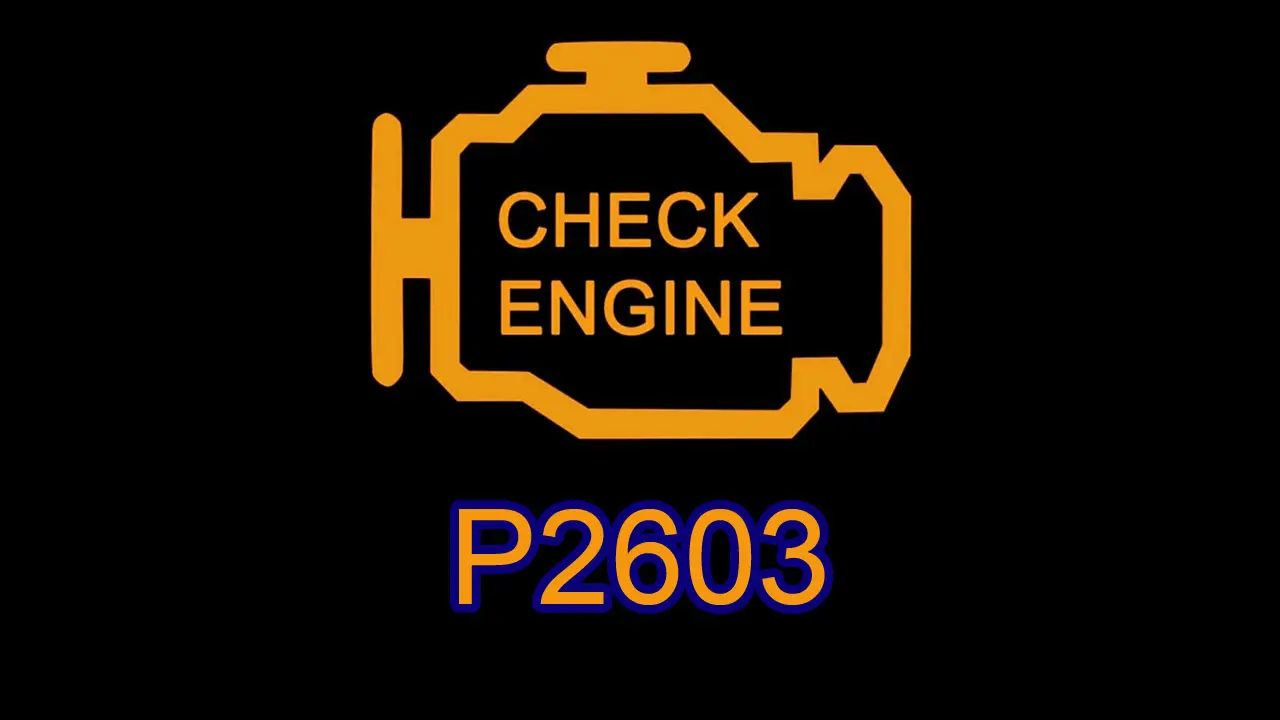
P2603 Coolant Pump "A" Control Circuit High
The P2603 diagnostic trouble code indicates that the engine control module has detected an electrical condition that is higher than expected in the control circuit of Coolant Pump "A".
Electric coolant pumps are controlled according to the vehicle's cooling and thermal-management requirements. Depending on the vehicle, the pump may be responsible for engine cooling, turbocharger cooling, cabin heating, hybrid system cooling, or another auxiliary cooling circuit.
When the control module detects that the electrical condition of the Coolant Pump "A" control circuit is above the expected operating range, it can store P2603.
The code does not automatically mean that the coolant pump itself has failed. A short to power, damaged wiring, a faulty relay, poor connector contact, an internal pump fault, or a problem in the control circuit can all produce an abnormal high condition.
What Does P2603 Mean?
P2603 is primarily an electrical control-circuit fault.
The control module monitors the Coolant Pump "A" circuit and expects the electrical signal or circuit behavior to remain within a specified range. When the monitored condition rises above the manufacturer's threshold, P2603 may be stored.
The exact way the high condition is detected depends on the vehicle's electrical design. Some systems monitor control-circuit voltage, while others may evaluate current or another electrical parameter.
For this reason, there is no single voltage value that applies to every vehicle. Diagnosis should always be performed using the manufacturer's wiring diagram and specifications.
What Is Coolant Pump "A"?
"Coolant Pump A" is a manufacturer-defined designation for a particular electric coolant pump.
The exact pump identified as "A" varies between vehicle manufacturers and models. It may be the primary electric coolant pump or an auxiliary pump serving a specific cooling circuit.
Depending on the vehicle, an electric coolant pump may be used for:
-
Main engine cooling
-
Turbocharger cooling
-
Cabin heating circuits
-
Auxiliary cooling circuits
-
Hybrid battery cooling
-
Power electronics cooling
-
After-run cooling
-
Thermal-management systems
Before diagnosing P2603, it is therefore important to identify exactly which pump the manufacturer defines as Coolant Pump "A".
Common Causes of P2603
P2603 can be caused by several different electrical problems in the pump circuit.
Short to power
If the control wire comes into contact with a battery-positive or another high-voltage circuit, the control module may detect a signal that is higher than expected.
Damaged insulation, chafed wiring, incorrect previous repairs, or a harness contacting another electrical circuit can cause this condition.
Open or damaged control circuit
Depending on the system design, an open control circuit can cause the module to see an abnormal electrical state.
A broken wire, disconnected terminal, or damaged connector should therefore be considered during diagnosis.
Damaged connector or terminals
Loose, corroded, pushed-back, bent, or overheated terminals can alter the electrical behavior of the pump circuit.
Connectors located in the engine compartment are particularly exposed to heat, moisture, vibration, and contamination.
Damaged wiring harness
Wiring that runs close to the engine, exhaust system, turbocharger, or other hot components can become brittle or damaged over time.
If the insulation wears through and the wire contacts another circuit, P2603 may occur.
Relay failure
If the coolant pump is controlled through a relay, a relay with stuck or damaged contacts can cause an abnormal electrical condition.
A relay clicking normally does not necessarily prove that its contacts are electrically healthy.
Internal coolant pump fault
The electric coolant pump may contain an electric motor and, depending on the design, internal electronic control circuitry.
An internal short circuit or electronic failure can affect the electrical behavior of the control circuit.
Control module output fault
In less common cases, the output circuit inside the engine or powertrain control module may be damaged.
However, the pump, wiring, connectors, power supply, ground, and relay should all be tested before the control module is considered responsible.
Symptoms of P2603
The symptoms depend on the role of Coolant Pump "A" in the vehicle.
Possible symptoms include:
-
Check Engine Light
-
Cooling system warning
-
Coolant pump not operating
-
Intermittent pump operation
-
Pump running continuously
-
Increased engine temperature
-
Engine overheating
-
Reduced cabin heater performance
-
Cooling fan operating differently than expected
-
Air conditioning performance problems
-
Reduced engine performance
-
Abnormal noise from the coolant pump
Not every vehicle will display all of these symptoms.
If Pump A is part of an auxiliary cooling circuit, the engine may continue to operate normally for some time. If the pump plays an important role in the main cooling system, however, the consequences can be more serious.
Can P2603 Cause Engine Overheating?
Yes, depending on the function of Coolant Pump "A".
If the affected pump is responsible for an important part of the engine cooling system and cannot operate correctly because of an electrical control problem, coolant circulation may be reduced.
This can cause engine temperature to increase, particularly under heavy load or in high ambient temperatures.
On vehicles where Pump A serves only an auxiliary cooling circuit, P2603 may not immediately affect the main engine cooling system to the same extent.
The exact function of the pump should therefore be established before determining the severity of the fault.
How Is P2603 Diagnosed?
The goal of diagnosis is not simply to replace the coolant pump. The technician must determine why the control circuit is showing an electrical condition above the expected range.
The diagnostic process normally starts by scanning all stored and pending trouble codes and checking the freeze-frame information.
The exact Coolant Pump "A" should then be identified using the manufacturer's service information and wiring diagram.
The electrical circuit can then be tested systematically.
Inspect the Pump Connector and Wiring
The pump connector and wiring harness should be inspected carefully.
Look for:
-
Corroded terminals
-
Loose terminals
-
Terminals pushed back into the connector
-
Bent terminals
-
Burned terminals
-
Melted connector housing
-
Damaged insulation
-
Chafing marks
-
Wiring contacting another circuit
-
Poor previous repairs
The routing of the harness should also be inspected.
Particular attention should be given to areas where the wiring passes near exhaust components, turbochargers, engine brackets, belts, or other sources of heat and movement.
Check for a Short to Power
A short to power is an important possibility with P2603.
The control wire should be checked according to the manufacturer's diagnostic procedure to determine whether it is unintentionally connected to a positive voltage source.
This should be done using the correct wiring diagram and test conditions for the vehicle.
A wire that has rubbed through its insulation may make intermittent contact with a power source, meaning the fault may not be present during every inspection.
Check the Power and Ground Circuits
The pump's power and ground circuits should also be tested.
Even though P2603 indicates a high condition, the pump's complete electrical circuit still needs to be evaluated.
Voltage should be checked under the conditions specified by the manufacturer, particularly when the pump is commanded to operate.
The ground circuit should also be tested for excessive resistance and voltage drop.
Check the Relay
If the pump uses a relay, the relay should be tested rather than simply replaced.
The relay may have damaged or stuck contacts that keep the circuit energized when it should not be.
The voltage at the relay input and output should be evaluated according to the vehicle's wiring diagram.
A relay that appears to operate mechanically may still have an electrical fault.
Test the Coolant Pump
If the vehicle supports active testing, a suitable scan tool can be used to command Coolant Pump "A".
The pump's response should then be observed.
If the pump does not operate, the technician should determine whether the problem is caused by missing power, poor ground, a missing control signal, damaged wiring, or an internal pump fault.
If the pump does operate but P2603 returns, its electrical behavior should still be tested.
A pump can continue to run while an internal electrical problem causes the control circuit to operate outside its expected range.
What If the Pump Still Works?
A functioning pump does not automatically rule out P2603-related electrical problems.
The pump may operate under certain conditions while the control circuit still develops an abnormal high signal.
For example, a control wire may intermittently contact a positive supply. A damaged connector may also alter the circuit only when the harness moves or the engine compartment reaches a certain temperature.
The pump itself can also develop an internal electrical fault without immediately becoming completely inoperative.
Therefore, the pump should be evaluated together with the entire control circuit.
Can P2603 Be Intermittent?
Yes.
Wiring and connector problems can make P2603 intermittent.
Engine vibration may cause a damaged wire to move against another component. A loose terminal may temporarily lose its correct position inside the connector.
Temperature can also change the behavior of damaged wiring or electrical components.
A circuit may operate normally when cold and develop a fault after the engine compartment becomes hot.
For this reason, the absence of the code immediately after clearing it does not prove that the problem has been repaired.
Should the Coolant Pump Be Replaced Immediately?
No.
P2603 alone does not prove that the coolant pump has failed.
Before replacing the pump, the following should be checked:
-
Pump connector
-
Wiring harness
-
Control circuit
-
Power supply
-
Ground circuit
-
Relay
-
Fuse
-
Terminals
-
Short-to-power condition
-
Pump electrical operation
If testing confirms an internal fault in the pump, replacement may be necessary.
If the actual problem is damaged wiring, a faulty relay, or a connector problem, replacing the pump will not correct the underlying fault.
Can You Drive With P2603?
Whether the vehicle can be driven depends on the function of Coolant Pump "A" and the symptoms present.
If the pump is used only in an auxiliary cooling circuit, the vehicle may continue to operate without immediate overheating.
If the pump is important to the main engine cooling system, however, continued driving can result in excessive engine temperature.
The vehicle should not be driven if there is:
-
Rising engine temperature
-
An overheating warning
-
Coolant loss
-
Steam from the engine compartment
-
Sudden loss of cabin heat accompanied by cooling-system symptoms
-
Abnormal cooling fan operation together with increasing engine temperature
Even if the engine temperature currently appears normal, the cause of P2603 should still be diagnosed because the affected pump may be required under specific operating conditions.
How Is P2603 Repaired?
The correct repair depends on the actual cause of the high circuit condition.
If the wiring is damaged, it should be properly repaired or replaced.
If the control wire is shorted to power, the source of the short must be located and corrected.
If a connector or terminal is damaged, it should be repaired using the appropriate components and procedures.
If the relay is faulty, it should be replaced.
If the coolant pump has an internal electrical failure, the pump should be replaced.
If the ground or power connection is defective, the connection should be repaired.
The control module should only be considered after the external circuit, pump, relay, wiring, and connections have been thoroughly tested.
The Most Important Diagnostic Point for P2603
The most important question with P2603 is not simply "Is the coolant pump defective?"
The key question is:
"Why does the control module see a higher-than-expected electrical condition in the Coolant Pump 'A' control circuit?"
The answer may be a short to power, damaged wiring, a connector problem, a faulty relay, an internal pump fault, or, less commonly, a control-module problem.
A proper diagnosis therefore requires more than checking whether the pump turns on.
The control signal, wiring, power and ground circuits, relay operation, and the pump's electrical behavior should all be evaluated using the manufacturer's specifications.
Because the exact monitoring strategy and electrical thresholds vary by vehicle, P2603 should always be diagnosed according to the specific manufacturer's service information for that vehicle.