TR
TR EN
EN

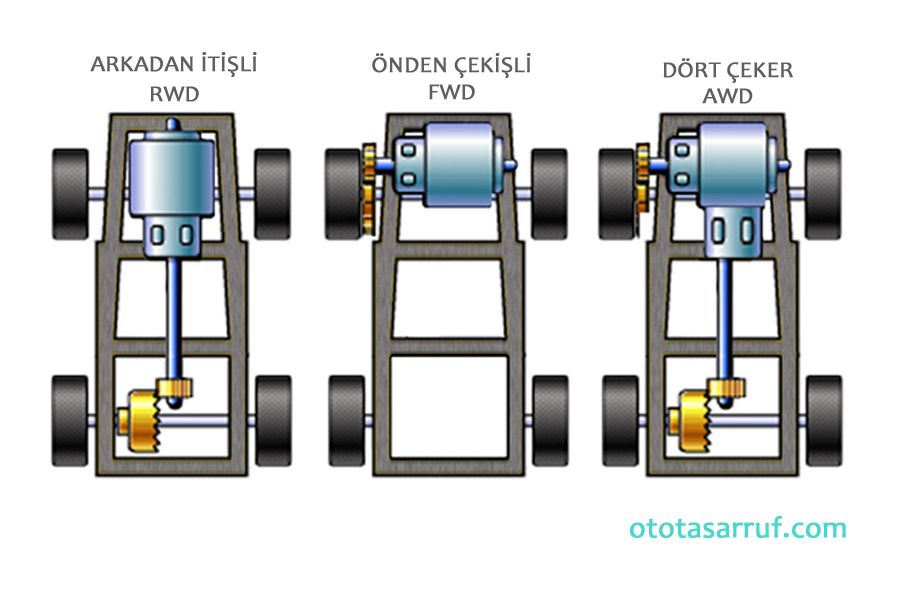
What Are the Differences Between Front-Wheel Drive and Rear-Wheel Drive Vehicles?
Front-wheel drive and rear-wheel drive are two of the most common drivetrain layouts used in passenger cars. The main difference is simple: which wheels receive the engine's power and provide the driving force.
In a front-wheel-drive vehicle, the front wheels both steer the vehicle and transfer engine power to the road. In a rear-wheel-drive vehicle, the rear wheels provide the driving force while the front wheels are primarily responsible for steering.
This basic difference affects traction, handling, weight distribution, acceleration, fuel consumption, maintenance, and driving characteristics.
What Is Front-Wheel Drive?
Front-wheel drive, commonly abbreviated as FWD, means that the engine's torque is transmitted to the front wheels.
Most modern front-wheel-drive passenger cars use a transverse-mounted engine and transmission assembly. The transmission and differential are usually integrated into a compact unit known as a transaxle.
The basic power flow is:
Engine → Transmission → Differential → Front Drive Shafts → Front Wheels
Because the engine, transmission, differential, and drive shafts are concentrated toward the front of the vehicle, the drivetrain can be relatively compact.
What Is Rear-Wheel Drive?
Rear-wheel drive, commonly abbreviated as RWD, means that engine torque is transmitted to the rear wheels.
In a traditional rear-wheel-drive layout, the engine and transmission are located toward the front of the vehicle. A driveshaft transfers torque from the transmission to the rear differential.
The basic power flow is:
Engine → Transmission → Driveshaft → Rear Differential → Rear Drive Shafts → Rear Wheels
The front wheels are primarily responsible for steering, while the rear wheels provide propulsion.
The Most Important Difference: Which Wheels Drive the Vehicle?
The fundamental difference between the two systems is the location of the driven wheels.
With FWD, the front wheels must perform two jobs at the same time:
-
Steering
-
Power transmission
With RWD, these functions are separated:
-
Front wheels steer
-
Rear wheels provide propulsion
This difference becomes particularly noticeable during hard acceleration, cornering, slippery conditions, and performance driving.
Traction Differences
Traction is strongly affected by weight transfer.
During acceleration, vehicle weight shifts toward the rear axle.
This can benefit a rear-wheel-drive vehicle because the driven rear wheels become more heavily loaded as the vehicle accelerates.
In a front-wheel-drive vehicle, acceleration transfers weight away from the front wheels.
Since the front wheels are responsible for both steering and propulsion, hard acceleration can sometimes reduce their available traction.
This is one reason powerful front-wheel-drive cars can experience torque steer or wheel spin during aggressive acceleration.
How Do FWD and RWD Behave in Snow and Rain?
Front-wheel drive can provide good traction in many everyday conditions because the engine and transmission are usually positioned over the front axle.
This places considerable weight over the driven wheels.
For normal driving in rain or light snow, a well-designed FWD vehicle with appropriate tires can perform very well.
Rear-wheel-drive vehicles can also perform safely in wet or snowy conditions, but the rear wheels may have less static weight over them in some vehicle configurations.
This can make traction management more important, particularly during acceleration.
However, tires are extremely important.
A vehicle with excellent drivetrain characteristics but poor or worn tires can perform worse in slippery conditions than a vehicle with a less sophisticated drivetrain but high-quality tires.
Handling Differences
FWD and RWD vehicles can have noticeably different handling characteristics.
A front-wheel-drive vehicle tends to experience understeer when pushed beyond the available grip.
Understeer means the vehicle turns less than the driver expects, causing the front of the vehicle to move toward the outside of the corner.
Rear-wheel-drive vehicles can offer a more balanced handling response, particularly when the chassis has good weight distribution.
However, excessive throttle during cornering can cause the rear tires to lose traction.
This can result in oversteer, where the rear of the vehicle moves toward the outside of the corner.
These are general tendencies rather than absolute rules. Suspension design, tire characteristics, electronic stability systems, weight distribution, and vehicle setup can significantly change the behavior of either drivetrain.
What Is Torque Steer?
Torque steer is a phenomenon that can occur in some front-wheel-drive vehicles during strong acceleration.
Because the front wheels are responsible for both steering and transmitting engine torque, unequal forces between the two drive shafts or changes in steering geometry can cause the steering wheel to pull in one direction.
Torque steer is more likely to become noticeable in high-powered FWD vehicles.
Modern vehicles can reduce this effect through improved suspension geometry, equal-length drive shafts, electronic controls, and better chassis design.
Why Are Many Small Cars Front-Wheel Drive?
FWD is particularly suitable for compact passenger cars because the drivetrain can be packaged efficiently.
The engine and transmission can be positioned together at the front, leaving more room for the passenger compartment.
Advantages of this layout include:
-
Compact drivetrain packaging
-
Efficient use of interior space
-
Relatively low manufacturing cost
-
Fewer major drivetrain components
-
No long driveshaft running to the rear axle
-
Good everyday traction characteristics
This is one reason FWD became extremely common in compact hatchbacks, sedans, and family cars.
Why Are Performance Cars Often Rear-Wheel Drive?
Rear-wheel drive offers several advantages for performance applications.
During acceleration, weight transfers toward the rear of the vehicle, increasing the load on the driven wheels.
At the same time, the front tires are dedicated primarily to steering rather than simultaneously handling steering and drive torque.
This can provide greater freedom when engineers are optimizing acceleration, cornering balance, and steering feel.
Rear-wheel drive is therefore common in:
-
Sports cars
-
Performance sedans
-
Luxury vehicles
-
Large pickup trucks
-
Some SUVs
-
High-performance vehicles
However, not every performance vehicle needs RWD. Modern FWD and all-wheel-drive systems can also deliver very strong performance.
FWD vs RWD During Acceleration
The difference becomes particularly noticeable when accelerating hard.
With FWD, acceleration transfers weight toward the rear of the vehicle. This reduces the load on the front tires, which are also responsible for transmitting engine torque.
If engine torque is high enough, the front wheels may begin to spin.
With RWD, acceleration increases the load on the rear wheels.
This can improve the rear tires' ability to transfer torque to the road.
However, if the engine produces more torque than the rear tires can handle, the rear wheels can also spin.
Traction control and electronic stability systems can reduce wheel spin in both drivetrain layouts.
Fuel Consumption Differences
It is difficult to say that FWD is always more fuel-efficient than RWD, but FWD vehicles can have an efficiency advantage because of their simpler and more compact drivetrain layout.
A traditional RWD system requires additional components such as:
-
Driveshaft
-
Rear differential
-
Additional bearings
-
Additional drivetrain connections
These components add weight and mechanical losses.
However, actual fuel consumption depends on much more than drivetrain layout.
Engine efficiency, transmission type, vehicle weight, aerodynamics, tire selection, gearing, hybridization, and driving style can have a much greater effect.
Maintenance Differences
The two systems also have different maintenance requirements.
A front-wheel-drive vehicle typically has front drive shafts with CV joints. These components must accommodate both suspension movement and steering angles.
Common areas to inspect include:
-
CV joints
-
CV boots
-
Front drive shafts
-
Wheel bearings
-
Differential
-
Transmission mounts
A rear-wheel-drive vehicle generally has a driveshaft and rear differential.
Important components include:
-
Universal joints
-
Driveshaft
-
Center support bearing, where fitted
-
Rear differential
-
Rear drive shafts
-
Differential mounts
The exact components vary according to the vehicle.
Common FWD Problems
Front-wheel-drive vehicles can experience several drivetrain-related problems.
CV joint wear
A worn outer CV joint may produce clicking or knocking sounds, especially during tight turns.
Damaged CV boots
A torn boot can allow grease to escape and contamination to enter the joint.
If ignored, the CV joint can eventually become damaged.
Drive shaft vibration
A damaged or worn drive shaft can cause vibration, particularly during acceleration.
Wheel hop
High-power FWD vehicles may experience wheel hop during hard acceleration when the tires repeatedly lose and regain traction.
Common RWD Problems
Rear-wheel-drive vehicles have their own drivetrain components that require attention.
Universal joint wear
A worn universal joint can cause clunking, vibration, or excessive drivetrain play.
Driveshaft problems
An unbalanced or damaged driveshaft can cause speed-related vibration.
Center support bearing failure
Two-piece driveshafts may use a center support bearing. Wear in this component can cause vibration, noise, or movement underneath the vehicle.
Differential problems
A worn rear differential may produce whining, humming, or other abnormal noises.
Which Is Better: FWD or RWD?
There is no universal winner.
The better system depends on how the vehicle will be used.
FWD may be preferable for:
-
Daily commuting
-
Compact vehicles
-
City driving
-
Lower manufacturing cost
-
Efficient packaging
-
Normal wet and winter conditions
-
Maximum interior space
RWD may be preferable for:
-
Performance driving
-
High-power vehicles
-
Balanced handling
-
Heavy towing
-
Large vehicles
-
Sports cars
-
Drivers who prefer rear-driven handling characteristics
Neither system is automatically superior in every situation.
FWD vs RWD in Towing
Rear-wheel drive is generally well suited to towing because the rear axle is responsible for propulsion and can benefit from increased rear-axle load.
Pickup trucks and many commercial vehicles therefore use RWD or four-wheel drive.
FWD vehicles can tow trailers, but the increased load on the rear of the vehicle can reduce the load available over the front driven wheels.
The vehicle manufacturer's maximum towing capacity and weight distribution requirements should always be followed.
FWD vs RWD in Cornering
When entering a corner, the tires have a limited amount of available grip.
A FWD vehicle asks the front tires to handle both steering and acceleration forces.
If the driver applies too much throttle while cornering, the front tires can exceed their available grip and the vehicle may understeer.
In a RWD vehicle, the front tires can concentrate more on steering while the rear tires handle propulsion.
However, applying too much throttle can exceed the rear tires' available grip and produce oversteer.
Neither behavior is inherently safer when driven beyond the vehicle's limits. Smooth inputs, appropriate speed, and good tires remain much more important.
FWD, RWD and AWD Are Not the Same
It is also important not to confuse front-wheel drive and rear-wheel drive with all-wheel drive.
FWD: Power is primarily delivered to the front wheels.
RWD: Power is primarily delivered to the rear wheels.
AWD: The system can distribute engine torque between the front and rear axles according to operating conditions and system design.
AWD can provide additional traction, particularly during acceleration on slippery surfaces, but it does not eliminate the limitations of tires or road conditions.
AWD also generally adds weight and mechanical complexity.
Which System Is Better for Winter Driving?
For ordinary winter driving, FWD can be very effective, particularly when combined with proper winter tires.
RWD can also perform well with appropriate tires and modern traction-control systems.
The drivetrain is only one part of the equation.
In snow and ice, tire quality, tread depth, compound, speed, road conditions, and driver behavior are critical.
A FWD vehicle with poor tires should not be assumed to be safer than a RWD vehicle equipped with proper winter tires.
Final Thoughts
The main difference between front-wheel drive and rear-wheel drive is the location of the wheels that transfer engine power to the road.
FWD vehicles drive through the front wheels, which makes the drivetrain compact and efficient in terms of packaging. This layout is particularly common in compact and family vehicles.
RWD vehicles drive through the rear wheels, separating steering and propulsion functions and offering advantages for performance driving, towing, and certain vehicle designs.
FWD generally provides practical packaging, good everyday traction, and lower drivetrain complexity. RWD can offer better acceleration traction under load, a different handling balance, and advantages for high-power and towing applications.
Ultimately, neither drivetrain is universally better. The vehicle's weight distribution, suspension, tires, engine power, electronic systems, intended use, and driving conditions are just as important as whether it is FWD or RWD.