TR
TR EN
EN

What Are the Symptoms of a Faulty Spark Plug?
Spark plugs are small components, but they have a major role in the operation of gasoline engines. They ignite the air-fuel mixture inside the combustion chamber at precisely the right moment. When a spark plug becomes worn, contaminated, damaged, or unable to produce a strong spark, the engine may begin to run poorly.
A faulty spark plug does not always fail completely. In many cases, the problem develops gradually. The engine may continue running, but starting becomes more difficult, acceleration becomes weaker, fuel consumption increases, or the engine begins to misfire.
Recognizing these symptoms early can help prevent further problems involving the ignition system, catalytic converter, and engine.
Rough or Unstable Engine Operation
One of the most common symptoms of a faulty spark plug is an engine that does not run smoothly.
If one or more cylinders are not receiving a strong enough spark, combustion becomes inconsistent. This can be especially noticeable at idle.
You may notice:
-
Engine vibration
-
Uneven idle speed
-
Shaking from the engine
-
Occasional hesitation
-
A noticeable change in engine sound
-
Intermittent misfires
The severity depends on how badly the spark plug is worn or contaminated.
Engine Misfire
A worn or damaged spark plug can cause a cylinder misfire.
A misfire occurs when the air-fuel mixture in a cylinder does not burn correctly. A faulty spark plug is only one possible cause. Ignition coils, injectors, wiring, fuel pressure, compression, and other engine components can also cause misfires.
Diagnostic trouble codes such as P0300, P0301, P0302, P0303, or P0304 may appear depending on the engine and the affected cylinder.
A misfire code does not automatically prove that the spark plug is defective. The ignition and fuel systems should be tested before replacing parts unnecessarily.
Difficult Starting
Spark plugs must produce a reliable spark during engine startup.
When a plug is heavily worn, fouled with carbon, contaminated with oil, or damaged, the spark may become weak or inconsistent.
This can result in:
-
Longer cranking before the engine starts
-
Several starting attempts
-
Rough running immediately after startup
-
Poor cold starting
-
Occasional failure to start
If the engine is difficult to start, the spark plugs should be inspected along with the battery, ignition coils, fuel system, and engine sensors.
Increased Fuel Consumption
A faulty spark plug can contribute to increased fuel consumption.
When combustion is incomplete, the engine may not extract the expected amount of energy from the fuel. The driver may compensate by pressing the accelerator more, while the engine control system may also adjust fueling in response to abnormal combustion conditions.
However, increased fuel consumption is not specific to spark plugs. Oxygen sensors, injectors, air leaks, thermostats, fuel pressure problems, and other faults can produce similar symptoms.
Poor Acceleration
A spark plug that cannot produce a strong and consistent spark may cause the engine to hesitate when the throttle is opened.
The problem can become more noticeable during:
-
Hard acceleration
-
High engine speed
-
Uphill driving
-
Heavy engine load
-
Rapid throttle application
A vehicle may feel normal during gentle driving but hesitate or lose power when the engine is placed under greater load.
This is an important clue because ignition problems often become more apparent when the voltage required to produce a spark increases under cylinder pressure.
Loss of Engine Power
If one or more cylinders are not burning the mixture correctly, overall engine power can decrease.
A driver may describe the vehicle as:
-
Weak
-
Sluggish
-
Slow to accelerate
-
Unable to maintain speed easily
-
Less responsive than normal
Severe ignition problems can make the engine run noticeably rough and may activate the check engine light.
Check Engine Light
A faulty spark plug can cause the check engine light to illuminate, particularly when it produces repeated misfires.
The engine control unit monitors combustion through various sensor signals and can detect abnormal crankshaft speed variations associated with misfires.
Depending on the vehicle, diagnostic codes may point toward:
-
Random or multiple-cylinder misfire
-
A specific cylinder misfire
-
Ignition-related problems
-
Fuel mixture problems
The check engine light should not be ignored, especially if it is flashing.
A flashing check engine light can indicate severe misfire conditions capable of damaging the catalytic converter.
Engine Vibration During Acceleration
A weak spark may cause noticeable vibration when accelerating.
The vibration can sometimes be mistaken for a transmission problem, engine mount problem, or fuel system issue.
If the vibration occurs mainly during acceleration and is accompanied by hesitation or a loss of power, the ignition system deserves particular attention.
Poor Cold-Start Performance
Some spark plug problems become more noticeable when the engine is cold.
A worn or contaminated plug may have more difficulty igniting the mixture during cold starting. The engine may start roughly and then gradually become smoother as it warms up.
Cold-start problems can also be caused by:
-
Weak ignition coils
-
Incorrect fuel mixture
-
Coolant temperature sensor problems
-
Battery weakness
-
Fuel pressure problems
-
Intake air leaks
Therefore, the spark plugs should be considered as part of a complete diagnosis rather than automatically blamed.
Black or Carbon-Fouled Spark Plugs
When a spark plug is removed, its condition can provide valuable information about combustion.
A black, dry carbon coating may indicate:
-
Rich air-fuel mixture
-
Incomplete combustion
-
Excessive idling
-
Incorrect spark plug heat range
-
Ignition problems
If only one spark plug is heavily carbon-fouled while the others look normal, the problem may be specific to that cylinder.
This is why inspecting all spark plugs together can be more useful than looking at only one.
Oily Spark Plugs
Oil contamination is different from normal carbon fouling.
If the electrode or firing end of a spark plug becomes covered with engine oil, possible causes include:
-
Worn piston rings
-
Valve stem seal problems
-
Excessive crankcase pressure
-
PCV system problems
-
Turbocharger-related oil leakage
-
Other internal engine problems
Oil on the outside of the spark plug or around the plug well can have a different cause, such as a valve cover gasket or spark plug tube seal.
Therefore, an oily spark plug should not automatically be treated as a simple spark plug failure.
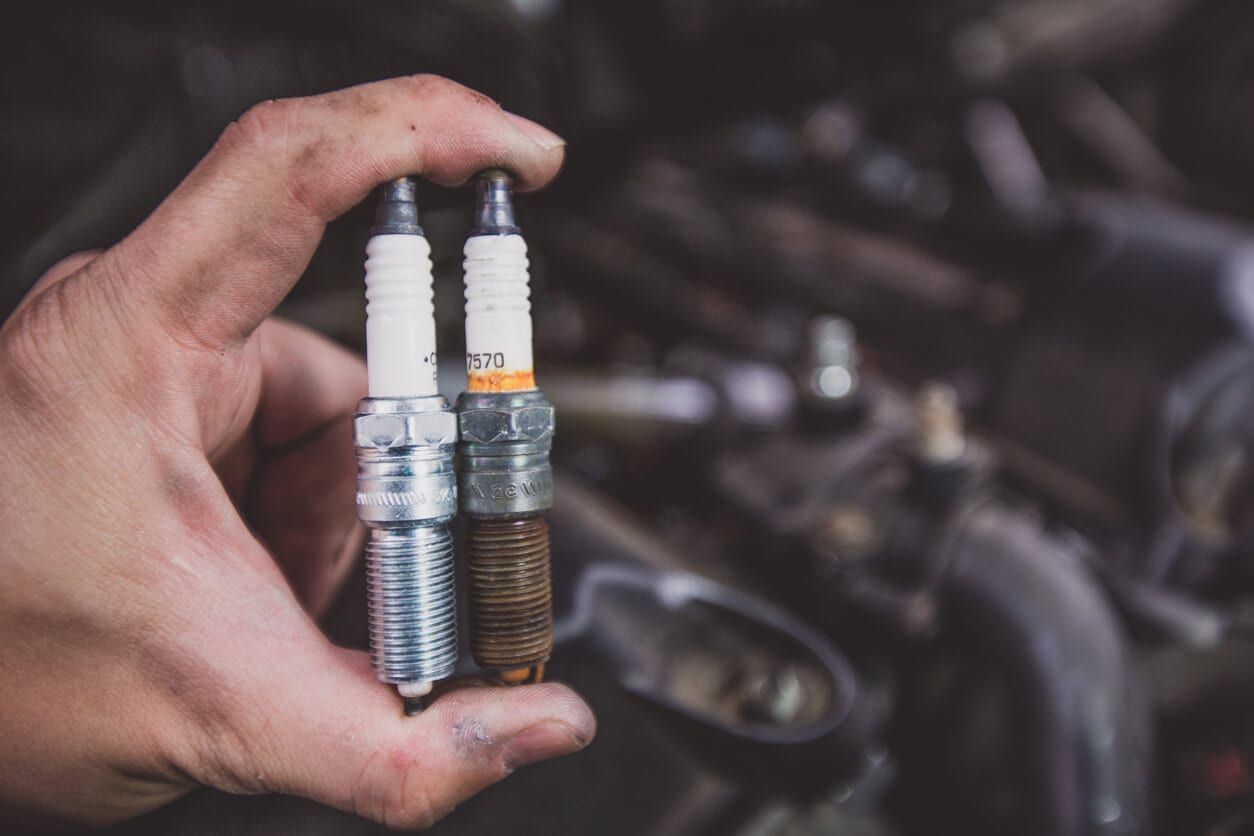
Worn Spark Plug Electrode
Spark plugs gradually wear as they operate under high temperature and electrical stress.
As the electrode wears, the spark gap can become larger than the manufacturer's specification. The ignition system then has to generate a higher voltage to bridge the gap.
Eventually, the spark may become weak or inconsistent.
This can lead to:
-
Misfires
-
Difficult starting
-
Hesitation
-
Reduced acceleration
-
Increased fuel consumption
-
Rough idle
The correct spark plug gap is important. A plug should not be adjusted outside the manufacturer's specified range simply to compensate for wear.
Damaged Spark Plug Insulator
The ceramic insulator around the spark plug can crack or become damaged.
A damaged insulator can allow electrical leakage or cause the spark to occur somewhere other than the intended electrode gap.
Physical damage may occur during installation, removal, overheating, or improper handling.
A cracked spark plug should normally be replaced rather than reused.
Spark Plug Problems at High RPM
A spark plug can sometimes appear to work normally at low engine speed but fail under higher load or RPM.
This can happen because ignition requirements increase as cylinder pressure and engine load rise.
If the engine runs smoothly during normal driving but starts misfiring during hard acceleration, possible causes include:
-
Worn spark plugs
-
Excessive spark plug gap
-
Weak ignition coils
-
Damaged ignition components
-
Fuel delivery problems
This symptom is particularly useful during diagnosis because it can help narrow down the conditions under which the ignition problem occurs.
Can a Bad Spark Plug Damage the Catalytic Converter?
Yes, prolonged misfire can damage the catalytic converter.
When a cylinder misfires, some unburned fuel can enter the exhaust system. The catalytic converter is not designed to continuously process large quantities of unburned fuel.
The resulting excessive heat can damage or melt the catalyst substrate.
For this reason, a flashing check engine light associated with severe misfire should be treated as a serious warning.
How Do You Diagnose a Faulty Spark Plug?
The diagnosis should begin with the symptoms and fault codes rather than immediately replacing every ignition component.
A technician may inspect:
-
Spark plug condition
-
Electrode wear
-
Spark plug gap
-
Ceramic insulator
-
Carbon or oil contamination
-
Ignition coil condition
-
Coil and plug connections
-
Wiring
-
Misfire data
-
Fuel injector operation
-
Compression
On some engines, swapping the suspected spark plug with another cylinder can help determine whether the misfire follows the plug. The same diagnostic approach can also be used with ignition coils when appropriate.
However, components should be swapped only as part of a controlled diagnostic process.
Can a Spark Plug Be Cleaned Instead of Replaced?
Cleaning can sometimes remove superficial contamination, but it does not restore a worn electrode or correct physical damage.
If the electrode is worn, the insulator is cracked, or the plug has reached its recommended service interval, replacement is generally the better solution.
Spark plugs are relatively inexpensive compared with the potential cost of continued misfire or catalytic converter damage.
Should All Spark Plugs Be Replaced Together?
When spark plugs have reached their service interval, replacing the complete set is generally preferable.
Installing one new plug alongside several heavily worn plugs can create differences in ignition performance between cylinders.
However, if a relatively new spark plug has failed prematurely, the underlying cause should also be investigated.
For example, repeated failure of one plug may indicate an ignition coil, injector, oil contamination, compression, or cylinder-specific problem.
How Long Do Spark Plugs Last?
Spark plug service life depends on the plug material, engine design, fuel system, operating conditions, and manufacturer's maintenance schedule.
Copper-type plugs generally have shorter service intervals, while platinum and iridium plugs can typically last much longer.
The correct replacement interval should always be based on the vehicle manufacturer's specifications rather than a universal mileage figure.
A vehicle that operates mainly in heavy traffic, experiences frequent short trips, or has an underlying engine problem may experience spark plug problems sooner.
Final Thoughts
A faulty spark plug can produce a surprisingly wide range of symptoms, from rough idle and difficult starting to misfires, poor acceleration, increased fuel consumption, and loss of engine power.
However, not every ignition-related symptom proves that the spark plug itself is defective. Ignition coils, fuel injectors, wiring, engine compression, sensors, and air-fuel mixture problems can create very similar symptoms.
The most reliable approach is to inspect the spark plugs, read the diagnostic trouble codes, evaluate misfire data, and test the related ignition and fuel systems.
Replacing the correct component after identifying the actual cause is far better than replacing parts based only on symptoms.