TR
TR EN
EN

What Is a Transmission Speed Sensor (TSS)? What Are the Symptoms of Failure?
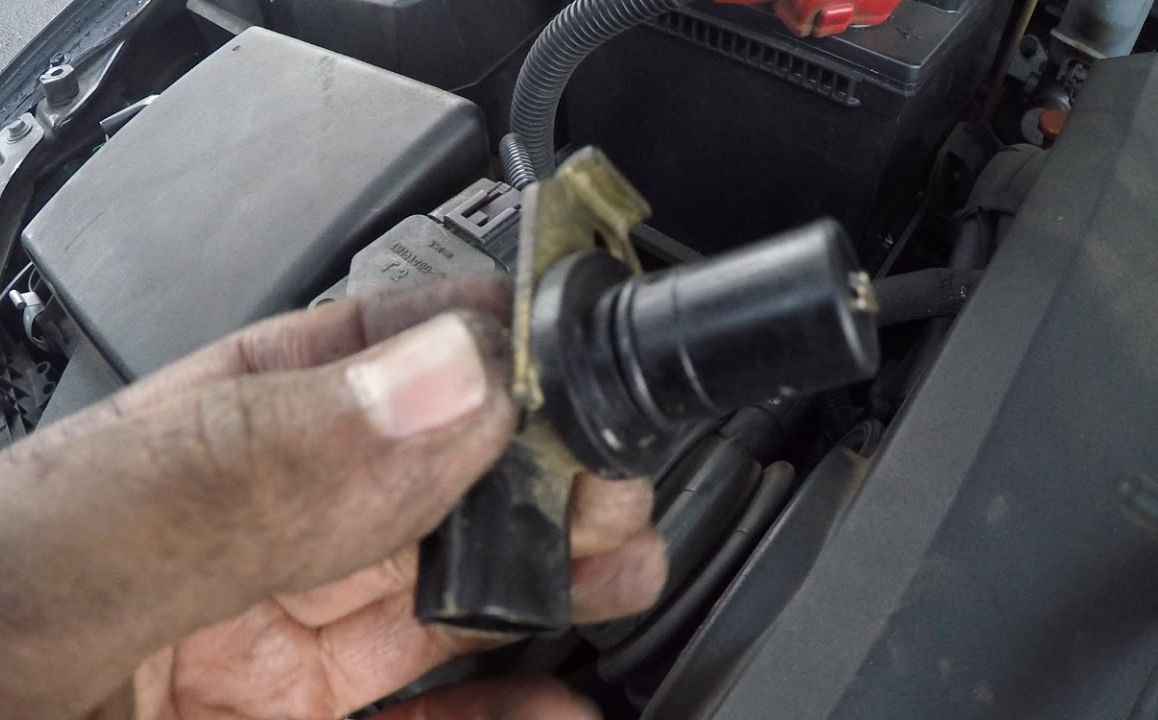
The Transmission Speed Sensor (TSS) is an important component used by the transmission control system to determine how fast the transmission or one of its rotating shafts is turning. The information from this sensor is used by the transmission control module (TCM), powertrain control module (PCM), or engine control unit (ECU) to manage gear changes and monitor transmission operation.
Depending on the vehicle and transmission design, the sensor may be called a Transmission Speed Sensor, Transmission Shaft Speed Sensor, Input Speed Sensor, or Output Speed Sensor. These sensors do not all measure the same thing, so their exact function depends on where they are installed.
What Does the Transmission Speed Sensor Do?
The transmission needs accurate speed information to determine when and how to change gears.
For example, during acceleration, the control module compares information such as:
-
Engine speed
-
Transmission input speed
-
Transmission output speed
-
Vehicle speed
-
Throttle position
-
Selected gear
-
Transmission fluid pressure
Using these signals, the transmission control system determines whether the current gear is appropriate and when another gear should be selected.
A faulty speed signal can therefore affect much more than the speedometer. It can change shift timing, shift quality, torque converter operation, and even the vehicle's ability to enter certain gears.
Input Speed Sensor and Output Speed Sensor
Some transmissions have more than one speed sensor.
The input speed sensor monitors the rotational speed entering the transmission, usually from the engine through the torque converter or clutch assembly.
The output speed sensor monitors the rotational speed leaving the transmission and heading toward the differential and drive wheels.
The control module can compare these signals to determine what is happening inside the transmission.
For example, if the input speed increases significantly while the expected output speed does not increase accordingly, the system may detect clutch or transmission slipping.
This is why a speed sensor can play an important role in transmission fault detection.
Where Is the Transmission Speed Sensor Located?
The exact location varies considerably between vehicles.
Depending on the transmission, the sensor may be mounted:
-
On the transmission housing
-
Near the input shaft
-
Near the output shaft
-
Inside the transmission
-
Near a transmission gear or reluctor wheel
-
In some designs, as part of an internal valve-body or mechatronic assembly
Some sensors are relatively easy to access from outside the transmission. Others require substantial disassembly to reach.
This difference is important when estimating repair time and cost.
Symptoms of a Bad Transmission Speed Sensor
A failed or inaccurate TSS can produce several different symptoms. The exact symptoms depend on whether the vehicle uses an input or output speed sensor and how the transmission control system is designed.
Common symptoms include:
-
Harsh or delayed gear changes
-
Incorrect shift timing
-
Transmission stuck in one gear
-
Failure to shift into higher gears
-
Unexpected downshifts
-
Transmission entering limp mode
-
Speedometer problems on some vehicles
-
Cruise control becoming unavailable
-
Increased fuel consumption
-
Engine RPM behaving abnormally during shifts
-
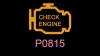
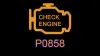
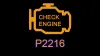
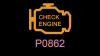
Check Engine Light
-
Transmission warning light
-
Transmission-related diagnostic trouble codes
An intermittent sensor can be particularly difficult to diagnose because the vehicle may operate normally most of the time and suddenly develop a transmission problem.
Harsh or Delayed Gear Changes
One of the most common symptoms is abnormal shifting.
If the transmission does not receive a reliable speed signal, the control module may not know exactly when the transmission shaft has reached the required speed for the next gear.
This can cause:
-
Hard shifts
-
Delayed shifts
-
Gear changes at unusually high RPM
-
Gear changes at unusually low RPM
-
A noticeable bump when selecting Drive or Reverse
The problem may become more noticeable during acceleration or when the transmission is warm.
Transmission Stuck in One Gear
A speed sensor fault can cause the transmission to enter a protective operating mode.
In this situation, the transmission may remain in one gear to prevent further damage. The driver may notice that the vehicle has very limited acceleration or that the transmission refuses to shift normally.
This is commonly referred to as limp mode or fail-safe mode.
The transmission may work normally again after the ignition is switched off and the vehicle is restarted, but the fault can return later.
Speedometer Problems
In some vehicles, transmission speed information is also used to calculate vehicle speed.
If the output speed signal is lost or becomes implausible, the speedometer may:
-
Stop working
-
Show an incorrect speed
-
Fluctuate
-
Drop to zero intermittently
However, this does not happen on every vehicle. Many modern vehicles calculate vehicle speed using wheel-speed sensors and ABS information instead of relying directly on the transmission speed sensor.
Therefore, a working speedometer does not automatically rule out a TSS problem.
Cruise Control May Stop Working
Cruise control systems need reliable vehicle-speed information.
If the vehicle's control modules detect a problem with speed information, cruise control may be disabled as a safety precaution.
This can happen even when the engine and transmission appear to operate normally.
Check Engine or Transmission Warning Light
A defective transmission speed sensor will often cause a diagnostic trouble code.
Depending on the vehicle, codes may relate to:
-
Input speed sensor performance
-
Output speed sensor performance
-
Implausible speed signals
-
Missing speed signals
-
Sensor circuit problems
-
Intermittent signals
-
Transmission ratio errors
The exact code should always be interpreted according to the specific vehicle and transmission.
A speed sensor code does not automatically mean that the sensor itself is defective.
Electrical Problems Can Mimic a Bad Sensor
Before replacing the sensor, the electrical circuit should be checked.
Possible causes include:
-
Damaged wiring
-
Broken wires
-
Corroded connectors
-
Loose terminals
-
Poor electrical contact
-
Short circuits
-
Open circuits
-
Poor grounding
-
Water or transmission-fluid contamination around the connector
An intermittent wiring problem can produce exactly the same symptoms as a defective sensor.
This is particularly important when the problem appears after transmission work, engine work, repairs, or connector removal.
Transmission Fluid Can Also Be a Factor
Transmission speed sensors operate in an environment where heat, vibration, and transmission fluid are present.
If the transmission has:
-
Low fluid level
-
Incorrect fluid
-
Severely contaminated fluid
-
Internal mechanical damage
-
Excessive metal debris
the speed signal or transmission operation can be affected.
However, a transmission fluid problem and a sensor problem should not automatically be treated as the same fault. Proper diagnosis is necessary to determine which one is actually causing the symptoms.
How Is a Transmission Speed Sensor Diagnosed?
A proper diagnosis should begin with a scan tool.
The technician should check the stored and pending transmission-related fault codes and examine live data.
One particularly useful test is monitoring the speed sensor signal while driving.
For example, the technician can compare:
Engine RPM → Input Shaft Speed → Output Shaft Speed → Vehicle Speed
The signals should change in a logical relationship as the vehicle accelerates and changes gears.
If one speed signal suddenly drops to zero, jumps unrealistically, or becomes intermittent while the others remain consistent, the sensor or its circuit becomes a strong suspect.
Sensor Testing
Depending on the sensor type, a technician may check:
-
Power supply
-
Ground
-
Signal voltage
-
Resistance
-
Signal frequency
-
Wiring continuity
-
Connector condition
-
Sensor waveform with an oscilloscope
Some modern speed sensors are Hall-effect sensors and require a proper power supply and signal circuit. Others use different sensing technologies.
For this reason, resistance testing alone is not always sufficient.
Mechanical Problems Can Look Like a Sensor Failure
This is an important point during diagnosis.
A transmission speed sensor can report an abnormal speed because something inside the transmission is actually wrong.
For example:
-
A damaged reluctor wheel
-
Broken or damaged transmission components
-
Excessive internal play
-
Clutch pack problems
-
Transmission slipping
-
Incorrect gear ratio
-
Valve-body problems
can cause the speed relationship to become abnormal.
In such a case, replacing the sensor may not solve the problem because the sensor was only reporting a real mechanical problem.
Can You Drive With a Bad Transmission Speed Sensor?
It depends on the severity of the problem.
If the sensor has an intermittent fault, the vehicle may continue to drive normally for a while. However, unpredictable shifting or limp mode can occur without warning.
Continuing to drive for a long time with incorrect transmission control can potentially increase wear on:
-
Internal clutches
-
Transmission bands where applicable
-
Torque converter
-
Gears
-
Valve-body components
If the transmission is slipping, shifting violently, or remaining in one gear, continued driving should be avoided until the problem is diagnosed.
Does a Bad TSS Always Mean the Sensor Must Be Replaced?
No.
The actual fault may be caused by the sensor, wiring, connector, power supply, control module, reluctor wheel, or an internal transmission problem.
The correct diagnostic approach is therefore:
Fault code → Live data → Electrical circuit → Sensor signal → Mechanical condition
Replacing the sensor without testing these areas can result in unnecessary parts replacement.
Transmission Speed Sensor Failure vs Vehicle Speed Sensor
These terms are sometimes used interchangeably, but they are not necessarily the same component.
A transmission speed sensor may measure the rotational speed of a transmission shaft, while a vehicle-speed signal may be calculated from the output shaft, wheel-speed sensors, ABS system, or other inputs.
Modern vehicles often share speed information between several control modules through the CAN network.
As a result, a fault in one system can sometimes create symptoms in another.
Final Diagnostic Point
A Transmission Speed Sensor is a relatively small component, but its signal can have a major effect on transmission operation. Incorrect speed information can cause harsh shifting, delayed gear changes, limp mode, warning lights, and abnormal transmission behavior.
The most reliable diagnosis is not simply replacing the sensor after seeing a transmission fault code. The sensor signal, wiring, connectors, power supply, live data, and the mechanical condition of the transmission should all be considered before replacing parts.