TR
TR EN
EN

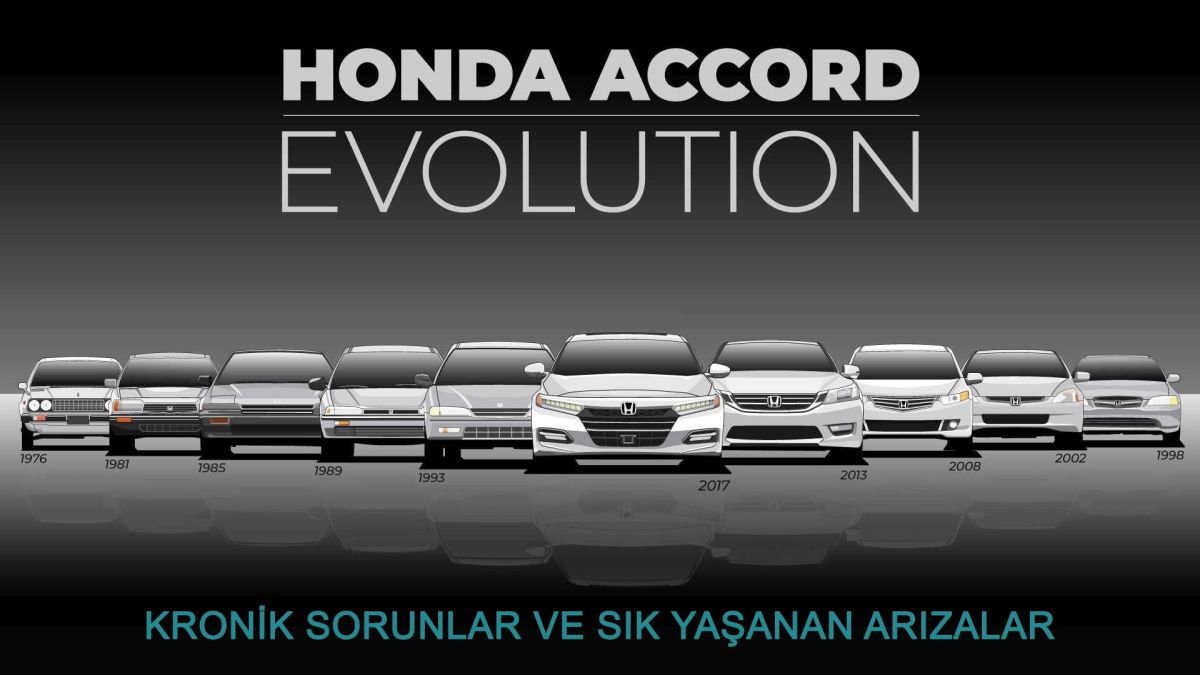
Is a Used Honda Accord Worth Buying? Honda Accord Common Problems and Failures
Honda Accord has been one of Honda's most important models for decades. It has built a strong reputation for durability, comfortable driving, good engines, and relatively low running costs.
However, like any high-volume vehicle, the Accord has experienced its share of mechanical, electrical, transmission, braking, and safety-related problems. Some issues are strongly associated with particular generations or powertrains, while others are simply common wear items that can appear on a high-mileage vehicle.
This distinction is important when buying a used Accord. It would be misleading to say that every 2002, 2003, 2008, 2009, or 2013 Accord is unreliable. Complaint numbers alone do not establish a universal failure rate. The engine, transmission, production date, maintenance history, and previous use can make a much bigger difference.
That said, several Accord generations deserve closer inspection before purchase.
Is the Honda Accord Reliable?
In general, yes, the Honda Accord can be a very reliable used car.
Honda has produced the Accord with many different engines and transmissions over the years. Some combinations have developed well-known weaknesses, while others have earned a much stronger reputation for long-term durability.
The biggest mistake is evaluating an Accord only by its model year.
For example, two Accords from the same year can have completely different reliability characteristics depending on:
-
Engine
-
Transmission
-
Market
-
Production date
-
Maintenance history
-
Mileage
-
Driving conditions
-
Previous accident history
A well-maintained Accord with 180,000 km can be a better purchase than a neglected example with 120,000 km.
Honda Accord Automatic Transmission Problems
Transmission problems are among the most important issues to investigate when looking at older Accord models.
Certain four-speed and five-speed automatic transmissions used in older Accords developed significant reliability problems. The early-2000s Accords are particularly important because some vehicles experienced premature transmission wear or failure.
Symptoms can include:
-
Harsh shifting
-
Delayed engagement
-
Slipping
-
Shuddering
-
Failure to select a gear properly
-
Flare between shifts
-
Transmission warning lights
-
Loss of drive
-
Abnormal transmission noises
The 2002–2003 Accord deserves particular attention in this area, but it would be incorrect to claim that every vehicle from these years requires a transmission replacement.
Some vehicles have lasted considerably longer, while others experienced serious problems at relatively low mileage.
Check the transmission carefully before buying.
During the test drive, allow the vehicle to become fully warm and test:
-
Cold start
-
Reverse engagement
-
Drive engagement
-
Low-speed acceleration
-
Moderate acceleration
-
Upshifts
-
Downshifts
-
Uphill driving
-
Stop-and-go traffic
A transmission that shifts smoothly when cold but begins to shudder or slip after warming up should be considered a major warning sign.
Honda Accord V6 Automatic Transmission Considerations
The V6 versions of older Accords deserve particular attention because they can have different transmission characteristics from four-cylinder versions.
Some Honda automatic transmissions from this period developed internal wear, shift problems, or torque-converter-related symptoms.
A buyer should therefore identify the exact engine and transmission before assuming that a particular Accord generation has the same reliability profile across the entire range.
Transmission fluid condition is also important.
A neglected transmission can suffer from:
-
Accelerated clutch wear
-
Valve-body problems
-
Shift-quality deterioration
-
Overheating
-
Internal damage
A proper service history is therefore much more valuable than simply seeing a low odometer reading.
Honda Accord Brake Problems
Brake complaints are frequently mentioned in relation to various Accord generations, but premature brake-pad wear should not automatically be classified as a design defect.
Brake-pad life depends heavily on:
-
Driving style
-
Traffic conditions
-
Vehicle weight
-
Brake-pad material
-
Rotor condition
-
Caliper condition
-
Road conditions
-
Automatic braking systems on newer models
Some 2008–2009 Accord owners reported relatively rapid brake wear. However, saying that every Accord needs brake pads before 20,000 km would be an overstatement.
If the brakes are wearing unusually quickly, the entire braking system should be inspected rather than replacing the pads repeatedly.
Possible causes include:
-
Sticking calipers
-
Incorrectly fitted brake components
-
Rotor problems
-
Poor-quality pads
-
Aggressive driving
-
Uneven braking
-
Brake-system faults
Honda Accord Airbag Problems and Recalls
Airbag-related issues are an important part of the Accord's history.
However, an illuminated airbag/SRS warning light should not simply be described as an airbag that "will not deploy."
The SRS warning light indicates that the system has detected a fault. Depending on the problem, certain components or functions of the restraint system may be disabled.
Possible causes include:
-
Seat-belt pretensioner faults
-
Occupant sensors
-
Airbag wiring
-
Impact sensors
-
SRS control-module faults
-
Clock spring problems
-
Connector problems
An Accord with an illuminated SRS warning light should be diagnosed before purchase.
Honda Accords have also been affected by various safety recalls over the years, including recalls related to airbags and other safety components. The exact applicability depends on the vehicle's VIN, production date, market, and equipment.
Therefore, recall history should always be checked for the specific vehicle rather than relying on a generic model-year list.
Honda Accord Engine Problems
The Accord has used a large variety of engines, so engine reliability varies considerably.
Common complaints across certain generations and powertrains can include:
-
Oil consumption
-
Oil leaks
-
Engine vibration
-
Rough idle
-
Misfires
-
Check Engine Light
-
Starting problems
-
Variable valve timing problems
-
Cooling-system leaks
-
Ignition-coil or spark-plug problems
Not every engine complaint represents an internal engine failure.
For example, rough running can be caused by ignition components, sensors, vacuum leaks, fuel delivery, or throttle-related problems rather than a damaged engine.
A used Accord should therefore be checked for diagnostic trouble codes as well as mechanical symptoms.
Honda Accord Oil Consumption Problems
Oil consumption has been reported on some Accord engines, particularly certain four-cylinder applications.
If an engine requires frequent oil top-ups, do not simply assume that this is normal for an older Honda.
Possible causes include:
-
Piston-ring problems
-
Valve-seal wear
-
External oil leaks
-
PCV-system problems
-
Engine wear
-
Incorrect oil viscosity
-
Previous poor maintenance
Before buying a high-mileage Accord, check the engine for oil leaks around the valve cover, timing-cover area, oil pan, and other common sealing points.
Also check the exhaust for signs of abnormal oil burning.
Honda Accord Timing Belt and Timing Chain
This is one area where the exact engine is extremely important.
Some Accord engines use timing belts, while others use timing chains.
A timing belt is a scheduled maintenance component. If the vehicle uses a timing belt and there is no reliable record showing that it was replaced at the appropriate interval, the buyer should budget for the service.
A timing-belt service may also involve:
-
Water pump
-
Tensioner
-
Idler pulleys
-
Seals, depending on condition
Timing-chain-equipped engines do not have the same scheduled replacement requirement, but chains, guides, and tensioners can still wear.
A rattling sound during cold starts should therefore not be ignored.
Honda Accord 2001 Model Problems
The 2001 Accord is now an old vehicle, so age itself has become one of the biggest factors.
Potential problems include:
-
Automatic transmission wear
-
Suspension deterioration
-
Rubber-bushing deterioration
-
Oil leaks
-
Air-conditioning problems
-
Electrical faults
-
Rust
-
SRS warning lights
-
Cooling-system problems
At this age, condition is far more important than the original specification.
A low-mileage 2001 Accord that has spent years sitting unused can actually have more age-related problems than a regularly driven and properly maintained example.
Honda Accord 2002–2003 Model Problems
The 2002 and 2003 Accords deserve particular attention because of the history of automatic-transmission complaints associated with certain configurations.
Symptoms may include:
-
Harsh gear changes
-
Delayed shifting
-
Transmission slipping
-
Shuddering
-
Loss of drive
-
Gear-selection problems
A transmission replacement can be expensive, making a thorough inspection especially important.
However, these model years should not automatically be rejected.
If the transmission has already been professionally rebuilt or replaced, and there is documentation proving the work, that changes the buying decision considerably.
The engine should also be checked for oil leaks, cooling problems, ignition issues, and abnormal noises.
Honda Accord 2004–2007 Model Problems
The mid-2000s Accord generally represents a more mature stage of the seventh generation, but these cars are now old enough that maintenance condition becomes increasingly important.
Potential areas to inspect include:
-
Automatic transmission operation
-
Power steering system
-
Suspension bushings
-
Engine mounts
-
Air conditioning
-
Electrical accessories
-
Oil leaks
-
Brake components
-
Rust and body repairs
Four-cylinder and V6 versions should not be treated as identical vehicles because their engines, transmissions, and maintenance requirements can differ.
Honda Accord 2008–2009 Model Problems
The 2008 model introduced a new Accord generation, bringing changes to the engines, chassis, interior, and electronics.
Some owners have reported:
-
Premature brake wear
-
Excessive oil consumption
-
Starting problems
-
Electrical issues
-
Airbag/SRS warnings
-
Suspension noise
-
Air-conditioning problems
Oil consumption deserves particular attention.
If the engine consumes an excessive amount of oil, determine whether the problem is due to normal age-related wear, external leakage, or an internal engine issue.
Do not purchase the vehicle based solely on the assumption that regular oil changes will solve excessive oil consumption.
Honda Accord 2010–2012 Model Problems
The later eighth-generation Accords benefited from many improvements, but they are not immune to age and mileage-related problems.
Inspect:
-
Engine mounts
-
Suspension
-
Power steering
-
Automatic transmission
-
Air conditioning
-
Electrical components
-
Brakes
-
Engine oil leaks
V6 models can require additional attention because of their more complex powertrain and, depending on the exact configuration, timing-belt maintenance.
Honda Accord 2013 Model Problems
The 2013 Accord belongs to the ninth generation and represents a major redesign.
Some owners have reported starting difficulties, electrical problems, warning lights, steering-related complaints, and oil-consumption concerns.
However, these complaints should not be interpreted as evidence that every 2013 Accord has a major defect.
A no-start or repeated-start problem can have many causes, including:
-
Weak battery
-
Starter motor
-
Ignition system
-
Brake-pedal switch
-
Keyless-start system
-
Electrical connection
-
Control-module communication
-
Fuel-delivery problem
Similarly, steering complaints need to be diagnosed according to the exact system installed on the vehicle.
Some versions use electric power steering rather than a conventional hydraulic system, so the terminology should not be generalized across every 2013 Accord.
Honda Accord 2013–2017 Model Problems
The ninth-generation Accord is generally an attractive choice on the used market, but buyers should still check the specific powertrain.
Potential issues include:
-
CVT behavior on four-cylinder versions
-
V6 transmission operation
-
Electrical and infotainment problems
-
Air-conditioning issues
-
Suspension wear
-
Engine mounts
-
Battery and charging-system problems
-
Driver-assistance components on appropriately equipped versions
A CVT should be tested carefully for smooth engagement and acceleration.
Do not confuse the normal operating characteristics of a CVT with a transmission failure, but also do not ignore shuddering, slipping, abnormal noises, or delayed response.
Honda Accord 2018 and Newer Models
Newer Accords use increasingly sophisticated electronics and, depending on the version, turbocharged or hybrid powertrains.
These vehicles can offer excellent efficiency and performance, but their increased complexity means that diagnosis can be more expensive when something goes wrong.
Potential areas to inspect include:
-
Turbocharger system on turbocharged engines
-
Cooling system
-
Direct-injection components
-
CVT operation where applicable
-
Hybrid system on hybrid versions
-
12-volt battery
-
Infotainment
-
Driver-assistance systems
-
Cameras and sensors
For newer Accords, complete service records and warranty history become especially valuable.
Honda Accord Suspension Problems
Suspension wear is inevitable on an older Accord, particularly one that has spent years on rough roads.
Listen for:
-
Knocking
-
Clunking
-
Squeaking
-
Steering vibration
-
Excessive body movement
-
Uneven tire wear
Inspect:
-
Shock absorbers
-
Control-arm bushings
-
Ball joints
-
Stabilizer links
-
Tie-rod ends
-
Wheel bearings
-
Springs
Suspension problems are usually not a reason to reject an Accord, but they should be reflected in the purchase price.
Honda Accord Power Steering Problems
Power-steering complaints vary by generation because Honda has used different steering technologies over the years.
Older models may have hydraulic power steering, while newer generations increasingly use electric power steering.
A used Accord should be checked for:
-
Heavy steering
-
Steering warning lights
-
Uneven steering assistance
-
Pump noise on hydraulic systems
-
Fluid leaks
-
Unusual steering vibration
-
Excessive play
The exact system should be identified before diagnosis.
Honda Accord Air Conditioning Problems
Air conditioning should be tested thoroughly before buying a used Accord.
Check whether the system:
-
Produces cold air quickly
-
Remains cold at idle
-
Continues cooling while driving
-
Has unusual compressor noises
-
Has abnormal odors
-
Has weak blower performance
Potential causes of poor cooling include:
-
Low refrigerant
-
Refrigerant leaks
-
Compressor problems
-
Condenser problems
-
Expansion-valve issues
-
Blower problems
-
Electrical faults
Simply adding refrigerant is not always the correct repair.
Honda Accord Electrical and Infotainment Problems
As Accords have become more electronically sophisticated, electrical and infotainment complaints have also become more complicated.
Possible symptoms include:
-
Display problems
-
Radio issues
-
Bluetooth problems
-
Camera malfunctions
-
Warning lights
-
Keyless-start problems
-
Battery drain
-
Intermittent electrical failures
If several unrelated warning lights appear at the same time, do not immediately assume that multiple components have failed.
A weak battery, charging-system problem, poor ground connection, or communication fault can sometimes trigger several warning messages simultaneously.
What Are the Best Honda Accord Years to Buy?
It is difficult to identify one universally "best" Accord model year.
Instead, concentrate on the generation and powertrain.
For older Accords, a buyer should be particularly cautious with vehicles known to have transmission or engine-related complaints, especially when there is no documentation of previous repairs.
For newer models, the priority should be finding a vehicle with:
-
Complete service history
-
Properly maintained transmission
-
No unresolved recalls
-
No warning lights
-
Clean accident history
-
Healthy engine
-
Good suspension
-
Properly functioning electronics
A documented transmission replacement can also change the risk profile of an otherwise questionable older Accord.
What Should You Check Before Buying a Used Honda Accord?
A professional pre-purchase inspection is strongly recommended.
First, inspect the engine while cold.
Look for:
-
Difficult starting
-
Excessive smoke
-
Abnormal ticking or knocking
-
Rough idle
-
Oil leaks
-
Coolant leaks
-
Misfires
A cold start provides information that may be hidden after the engine has already warmed up.
Then test the transmission thoroughly.
Do not limit the test drive to a few minutes around the dealership.
Test:
-
Reverse
-
Drive
-
Low-speed acceleration
-
Moderate acceleration
-
Downshifts
-
Uphill acceleration
-
Stop-and-go traffic
-
Highway driving
Watch for any hesitation, slipping, shuddering, harsh engagement, or abnormal noises.
Perform a diagnostic scan.
This is particularly important on older Accords with multiple warning lights or intermittent problems.
Check the:
-
Engine control system
-
Transmission
-
ABS/ESC
-
SRS/airbag system
-
Body-control systems
-
Steering system
-
Driver-assistance systems where equipped
A dashboard with no warning lights does not necessarily mean that the car has no stored or pending faults.
Inspect the body and chassis.
Look for:
-
Accident repairs
-
Uneven panel gaps
-
Repainted panels
-
Rust
-
Chassis damage
-
Water leaks
-
Windshield replacement
-
Poor-quality bodywork
Check the service history.
Look for documented maintenance involving:
-
Engine oil
-
Transmission fluid
-
Timing belt where applicable
-
Spark plugs
-
Coolant
-
Brake fluid
-
Brake components
-
Suspension
-
Battery
A documented history is one of the strongest advantages a used Accord can have.
Honda Accord Advantages
The Accord remains attractive on the used market for several reasons.
Strong overall reputation
Honda has built the Accord around durability and everyday usability for decades.
Good engine options
Many Accord engines have proven capable of high mileage when properly maintained.
Comfortable driving
The Accord generally offers a good balance between comfort, handling, and highway stability.
Good fuel economy
Four-cylinder versions can offer reasonable fuel consumption, while newer turbocharged and hybrid models can improve efficiency further.
Large and practical interior
The Accord provides considerably more passenger and luggage space than many compact sedans.
Good parts availability
Because the Accord has been produced in large numbers, replacement parts and technical knowledge are generally easy to find.
Honda Accord Disadvantages
Despite its strengths, the Accord also has some weaknesses.
-
Certain older automatic transmissions have a poor reputation.
-
Some engines can develop excessive oil consumption.
-
Suspension components wear with mileage.
-
Older vehicles may suffer from electrical and air-conditioning problems.
-
V6 models can have higher maintenance costs than four-cylinder versions.
-
Newer versions have more sophisticated electronics and therefore potentially more expensive diagnostics.
-
A neglected Accord can become expensive even if the basic engine is reliable.
Is a Used Honda Accord Worth Buying?
Yes, a used Honda Accord is generally worth considering, but the right Accord is much more important than simply choosing a Honda badge or a particular model year.
The 2002–2003 cars deserve special attention because of their history of automatic-transmission problems. The 2008–2009 models should be inspected carefully for brake wear and excessive oil consumption. The 2013 model should be checked for starting, electrical, steering, and powertrain complaints rather than automatically being labeled unreliable.
The important point is that these are areas to inspect, not automatic reasons to reject every vehicle from those years.
If you find an Accord with a clean history, properly maintained engine and transmission, no unresolved recalls, a healthy electrical system, good suspension, and documented maintenance, it can be an excellent used-car choice.
Before buying, spend more time on the engine, transmission, diagnostic scan, accident history, service records, and cold-start behavior than on cosmetic details.
In short, the Honda Accord can be one of the better used sedans to buy—but buy the condition and the powertrain, not just the model year.