TR
TR EN
EN

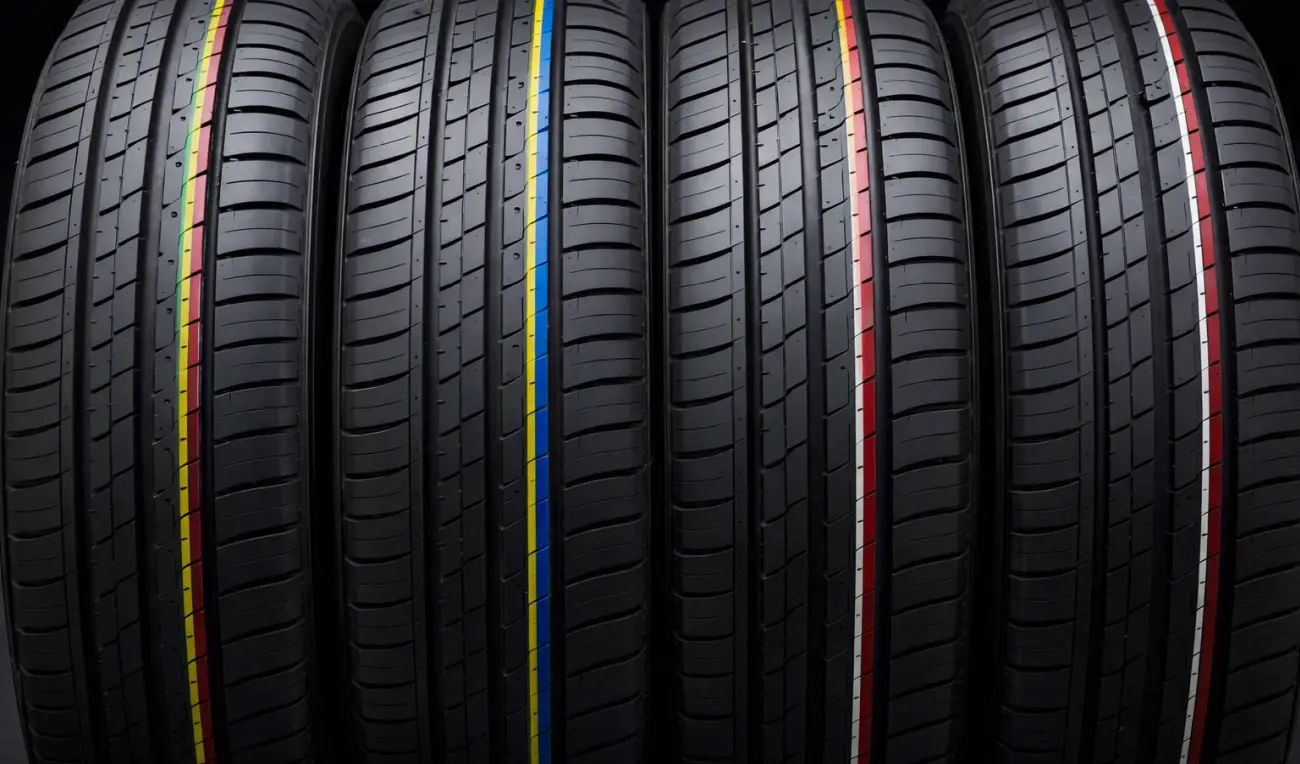
What Do the Colored Lines on Tires Mean?
When you buy a new tire or inspect the tires on a new vehicle, you may notice yellow, red, white, blue, or other colored lines running along the tread. These lines are especially visible on brand-new tires and often attract attention because they look like they must have a specific technical meaning.
So, what do these colored lines actually mean? Do they indicate tire quality, production date, mounting position, or something else?
In most cases, colored tread lines are factory markings used during the tire manufacturing process. They can help identify production batches, manufacturing processes, tire versions, or quality-control information. However, there is an important point to understand: the meaning of each color is not standardized across all tire manufacturers.
Therefore, it is not correct to assume that a red line or yellow line always has exactly the same meaning regardless of the tire brand.
Why Do Manufacturers Put Colored Lines on Tires?
Tire manufacturing is a complex process involving many different materials and stages. Rubber compounds, steel belts, fabric layers, beads, sidewalls, and tread components must all be assembled accurately.
Manufacturers produce large numbers of tires, often using multiple production lines and molds. Visual markings can make it easier to identify and track tires during manufacturing, inspection, storage, and handling.
Depending on the manufacturer and production system, colored lines may be used for purposes such as:
-
Identifying a production line
-
Tracking a production batch
-
Supporting quality-control procedures
-
Distinguishing different tire versions
-
Assisting production and inventory management
-
Providing an internal manufacturing reference
In other words, these lines are generally factory markings rather than information intended for the driver.
Do Colored Lines Indicate Tire Quality?
No.
The color of a line on the tire tread does not, by itself, indicate whether the tire is high quality, low quality, premium, or defective.
For example, a tire with a red line is not automatically better than one with a yellow line. Likewise, two tires from the same manufacturer may have different colored markings without one being inferior to the other.
When evaluating a tire, much more important information includes:
-
Tire model
-
Tire size
-
Production date
-
Load index
-
Speed rating
-
Season and intended use
-
Manufacturer specifications
-
Physical condition
The colored line should not be used as a quality indicator.
What Does a Yellow Line Mean?
A yellow line may be visible around the circumference of the tread on some new tires.
Depending on the manufacturer, yellow markings may be used as a production reference or as part of a specific tire identification system. However, it is not correct to say that a yellow tread line always identifies the lightest point of the tire.
Some manufacturers use colored markings for specific assembly or manufacturing purposes, while another manufacturer may use the same color for something completely different.
Therefore, the color itself should not be used to determine where the tire should be positioned on the wheel.
What Does a Red Line Mean?
A red line is another type of factory marking that can be found on some tires.
There is a common claim that a red marking identifies the tire's highest point while a yellow marking identifies its lightest point. Such markings can indeed be used for specific manufacturing or mounting systems, but this is not a universal rule for every tire manufacturer.
The exact meaning depends on the manufacturer's marking system.
It is also important not to confuse a colored tread line with a colored dot on the tire sidewall. These are separate markings and can serve different purposes.
Colored Lines and Colored Dots Are Not the Same
This is one of the most common sources of confusion.
There are generally two different types of colored markings that people notice on tires:
Colored lines running across the tread
These are generally related to manufacturing and production processes.
Colored dots on the sidewall
These may be used as reference points for tire mounting and balancing, depending on the manufacturer.
For example, some manufacturers may use a yellow dot to identify a particular light spot of the tire, while a red dot may be associated with a particular geometric or radial force characteristic.
However, these conventions are not universal either.
So, a colored tread line should not automatically be interpreted as the same thing as a colored sidewall dot.
What Is the Yellow Dot on a Tire?
Some tires have a yellow dot painted on the sidewall.
Depending on the manufacturer, this marking may identify the light spot of the tire. During mounting, the technician may use this reference together with an appropriate reference point on the wheel to help optimize the assembly.
The purpose is generally to reduce the amount of correction required during balancing.
However, the exact meaning and mounting procedure should always be confirmed according to the tire manufacturer's instructions.
Not every manufacturer uses the same marking system.
What Is the Red Dot on a Tire?
A red dot may also appear on the sidewall of some tires.
Depending on the manufacturer's specifications, it can be used as a reference for the tire's radial force variation (RFV) or another geometric characteristic.
During professional mounting, this reference may be aligned with a specific point on the wheel to optimize the tire-and-wheel assembly.
Again, the important point is that a red dot does not have one universal meaning across all tire brands.
Therefore, it would be incorrect to automatically assume that every red dot means exactly the same thing.
Do Colored Tread Lines Matter During Wheel Balancing?
For the average driver, usually not.
When a tire is mounted on a wheel, the complete tire-and-wheel assembly is placed on a balancing machine. The machine measures the imbalance while the wheel rotates and determines where balancing weights are required.
Therefore, the presence of colored lines does not eliminate the need for balancing.
Even a brand-new tire should normally be checked after installation because the tire and wheel have their own individual mass distributions.
Colored factory markings may assist the mounting process in some cases, but the final assembly should still be checked with appropriate balancing equipment.
Do Colored Lines Show Where the Tire Should Be Mounted?
Generally, no.
Colored tread lines do not normally indicate whether a tire belongs on the front or rear axle, nor do they identify a specific left or right wheel.
They should not be interpreted as:
-
Front-left
-
Front-right
-
Rear-left
-
Rear-right
mounting instructions.
If a tire has a required direction of rotation, the important marking is normally found on the sidewall.
For directional tires, you may see ROTATION together with an arrow. For asymmetric tires, markings such as OUTSIDE and INSIDE indicate the correct mounting orientation.
These sidewall markings are much more important than colored tread lines.
Do Colored Lines Show the Tire's Production Date?
No.
The colored lines on the tread should not be used to determine when a tire was manufactured.
For the production date, check the DOT code on the tire sidewall.
The final four digits of the date code indicate the production week and year.
For example:
3525
means the tire was manufactured during the 35th week of 2025.
Therefore, when purchasing new tires, checking the DOT production date is far more useful than trying to interpret the color of a tread line.
Why Do Colored Lines Disappear?
Colored lines are usually very noticeable when a tire is brand new. After the tire is driven, however, the markings gradually disappear.
This is completely normal.
The tread is constantly exposed to:
-
Road contact
-
Friction
-
Heat
-
Water
-
Braking forces
-
Acceleration forces
-
Normal tread wear
As the tread surface wears, the paint or marking also disappears.
Therefore, if the colored lines are no longer visible after the tire has been driven for some time, this does not mean that the tire has developed a problem.
Do Colored Lines Affect Tire Performance?
Under normal circumstances, no.
The colored markings themselves do not determine the tire's grip, braking performance, handling, or durability.
The line can:
-
Fade
-
Become partially visible
-
Disappear completely
without changing the tire's intended performance.
When evaluating tire safety, much more important factors include tread depth, uneven wear, cracks, bulges, cuts, tire pressure, age, and overall physical condition.
Can Used Tires Still Have Colored Lines?
Most colored tread lines are easiest to see on new tires because the tread surface has not yet worn.
On a used tire, the markings may have disappeared completely.
If a used tire still has visible colored lines, however, that alone does not prove that the tire has seen very little use. Tire condition should be evaluated using several factors together, including:
-
Tread depth
-
DOT production date
-
Uneven wear
-
Sidewall damage
-
Cracks
-
Repairs
-
Signs of abnormal wear or alignment problems
The colored line should not be used as evidence of the tire's remaining service life.
Why Do Different Tire Manufacturers Use Different Colors?
The main reason is that colors are an easy visual reference during production.
A tire factory may produce thousands of tires using different lines, molds, batches, or specifications. A simple colored marking can help workers identify and track products during the manufacturing process.
Depending on the manufacturer, colored lines may be associated with:
-
Production lines
-
Tire specifications
-
Production batches
-
Manufacturing processes
-
Quality-control procedures
-
Internal identification systems
There is no universal color dictionary that applies to every tire manufacturer.
This is why statements such as “yellow always means this” or “red always means that” should be treated cautiously.
Should You Pay Attention to Colored Lines When Buying Tires?
Colored tread lines should not be an important factor when choosing a tire.
Instead, pay attention to the tire's actual technical specifications, including:
Correct tire size
Load index
Speed rating
Season and intended use
DOT production date
Manufacturer and tire model
Vehicle manufacturer's requirements
Physical condition
Two tires with different colored lines can be perfectly equivalent in terms of their intended specifications.
What Matters More Than the Colored Lines?
If you are checking a tire before purchasing or installing it, the sidewall information is far more useful than the colored lines on the tread.
Look for markings such as:
-
Tire size
-
Load index
-
Speed rating
-
DOT code
-
ROTATION
-
OUTSIDE
-
INSIDE
-
Manufacturer markings
-
Approved vehicle or equipment markings where applicable
These markings provide information that is directly relevant to the correct use of the tire.
The Bottom Line
The colored lines you see on new tires are generally factory markings used during tire production and quality-control processes. They do not normally indicate tire quality, production date, or which corner of the vehicle the tire belongs on.
Some manufacturers may use specific colors as part of their internal production or mounting systems, but these meanings are not universal across all tire brands.
It is also important to distinguish colored tread lines from colored dots on the tire sidewall. Sidewall dots can have specific mounting-related meanings depending on the manufacturer, while tread lines are generally production-related markings.
As the tire is driven, the colored lines naturally wear away. Their disappearance is normal and does not indicate a problem with the tire.
When choosing, mounting, or evaluating a tire, focus on the DOT date, size, load index, speed rating, correct mounting markings, tread condition, tire pressure, age, and physical condition rather than the color of the lines on the tread.