TR
TR EN
EN

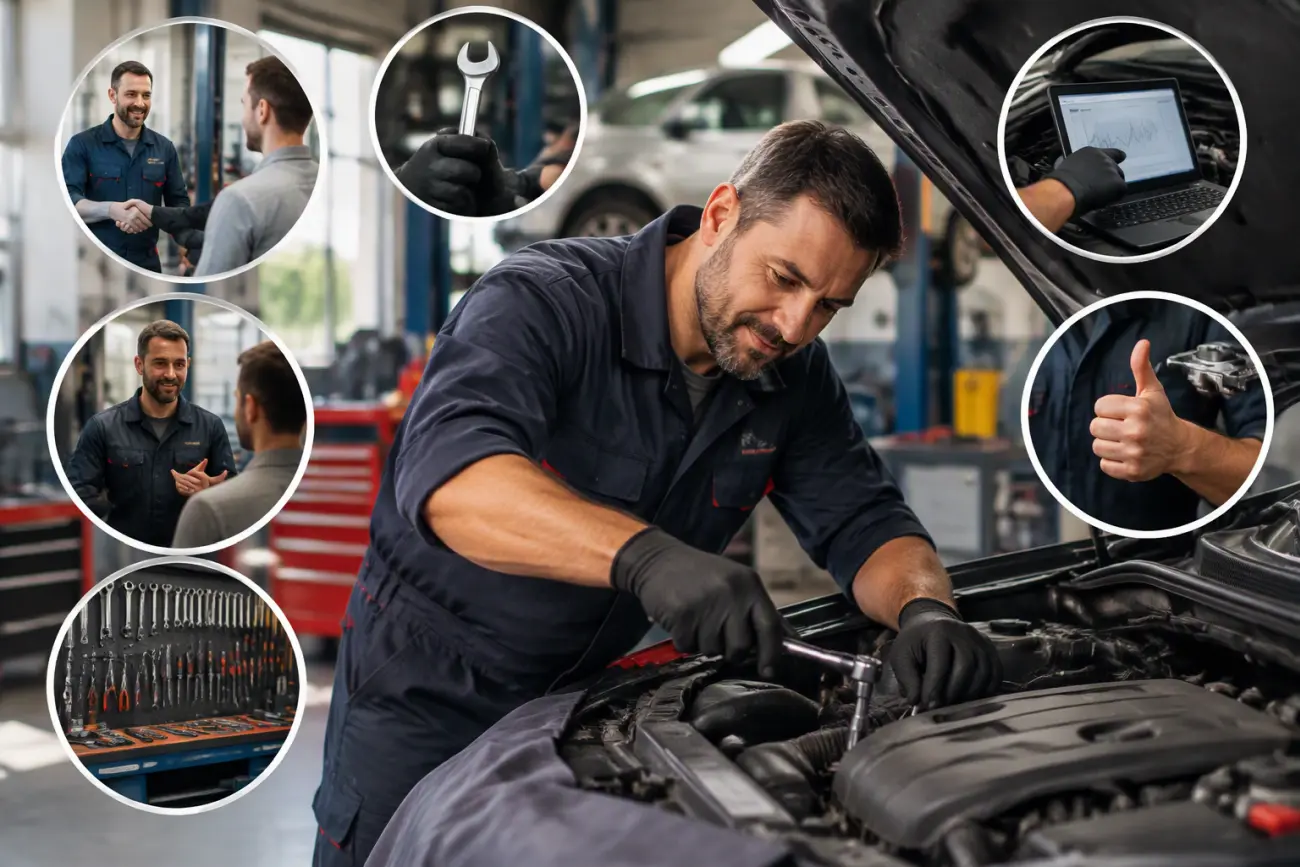
How to Recognize a Good Auto Repair Mechanic
When something goes wrong with your car, one of the first questions that comes to mind is usually, “Which part needs to be replaced?”
But there is actually a more important question to answer first:
How do you find a mechanic who can correctly diagnose the problem?
Modern vehicles are complicated machines, and the symptom of a problem is not always the same as its actual cause. A fault that appears to be related to a sensor may actually be caused by a wiring problem, a damaged connector, a poor ground connection, an incorrect voltage supply, a mechanical problem, or another component in the system.
This is one of the biggest differences between a good mechanic and someone who simply replaces parts.
A good mechanic does not rely entirely on guesses. Instead, they try to collect evidence, perform appropriate tests, and identify the actual cause of the problem.
A Good Mechanic Listens Before Starting the Repair
One of the first things a good mechanic does is listen to the vehicle owner.
They want to know when the problem started, whether it occurs when the engine is cold or hot, at what speed or engine RPM it happens, under what conditions it can be reproduced, and whether any work was recently performed on the vehicle.
For example, saying:
“My car sometimes stalls.”
does not provide enough information for a proper diagnosis.
A good mechanic will ask questions such as:
-
When does it stall?
-
Does it happen when the engine is cold?
-
Does it happen at idle?
-
Does it happen while driving?
-
Does it happen when the air conditioning is turned on?
-
Did it start after refueling?
-
Does the check engine light come on?
-
Does the engine restart immediately?
-
Has any component recently been replaced?
These questions are not unnecessary.
They are part of the diagnostic process.
A Good Mechanic Diagnoses the Problem Instead of Guessing
One of the most common mistakes in automotive repair is identifying a symptom and immediately blaming a component.
For example, a diagnostic scan may reveal a fault code related to a particular sensor.
A mechanic might simply say:
“The sensor is bad. Replace it.”
But a diagnostic trouble code does not always mean that the named component itself has failed.
The wiring could be damaged. The connector could be corroded. The sensor may not be receiving its required power supply. There could be a ground problem. The signal reaching the ECU may be incorrect for another reason.
A good mechanic considers these possibilities before replacing the part.
Reading a Fault Code Is Not the Same as Diagnosing a Fault
Modern OBD diagnostic equipment makes it possible to read fault codes within seconds.
However, knowing how to use a scan tool and knowing how to diagnose a vehicle are two different things.
Suppose a diagnostic tool reports a fault involving a sensor. A good mechanic does not simply read the description and replace the sensor.
They may check:
-
Power supply voltage
-
Ground connection
-
Signal voltage
-
Wiring continuity
-
Connector condition
-
Live data
-
Reference values
-
Sensor operation under different conditions
Depending on the problem, they may also use a multimeter, oscilloscope, pressure gauge, or manufacturer-specific diagnostic software.
In other words, a fault code is often the starting point of the diagnosis, not the final answer.
A Good Mechanic Is Comfortable With Testing and Measurements
One of the best ways to determine whether a component has failed is to support the diagnosis with actual measurements whenever possible.
Instead of simply saying:
“The battery is dead,”
a good mechanic can check the battery voltage and observe the voltage drop during cranking.
Instead of saying:
“The alternator is not charging,”
they can measure charging voltage and, when necessary, check how the charging system behaves under load.
Instead of saying:
“The fuel pump is bad,”
they can measure fuel pressure.
Instead of saying:
“The injector is faulty,”
they can perform the appropriate electrical or operational tests.
A good mechanic tries to base the diagnosis on measurable evidence rather than assumptions.
A Good Mechanic Does Not Replace Parts Without a Reason
This is one of the most important characteristics of a good mechanic.
Some repair approaches rely heavily on replacing parts until the problem disappears.
The vehicle has a problem, so the first suggestion is:
“Let's replace this.”
If that does not solve it, another component is replaced.
Then another one.
This approach can become expensive and time-consuming for the vehicle owner.
A good mechanic first tries to identify the source of the problem. If the component is actually defective, it should be replaced. If the problem is in the wiring, the wiring should be repaired. If the connector is corroded, the connector should be corrected or repaired.
The goal is not to replace as many parts as possible.
The goal is to replace the part that is actually responsible for the problem.
Be Careful With “Let's Replace This and See If It Fixes It”
This sentence is not automatically a sign of a bad mechanic.
There are situations where a component is very strongly suspected to have failed and replacement is a reasonable diagnostic or repair step.
However, if almost every diagnosis follows the pattern:
“Let's replace this and see what happens. If it doesn't work, we'll try something else.”
it is reasonable to ask more questions.
This is especially important when expensive components are involved.
A good mechanic should be able to explain something like:
“I performed this test, obtained this result, and based on that result, I believe this component has failed.”
That is much more informative than simply replacing parts until the symptom disappears.
A Good Mechanic Is Not Afraid to Say “I Don't Know Yet”
This may sound surprising, but it can actually be a positive sign.
No mechanic can know every engine, every transmission, every electrical system, and every vehicle model in existence.
Modern vehicles include increasingly complex systems such as:
-
Turbocharged engines
-
Direct fuel injection
-
Hybrid systems
-
Advanced automatic transmissions
-
Electronic throttle systems
-
Networked control modules
-
Sophisticated driver-assistance systems
A good mechanic may sometimes say:
“I need to check the technical information for this system.”
or:
“I need to research this fault and proceed based on the test results.”
That does not necessarily indicate a lack of knowledge.
It can indicate that the mechanic prefers to find the correct information rather than make an unsupported guess.
A Good Mechanic Uses Technical Information
Experience is extremely valuable in automotive repair, but experience alone is not always enough.
Manufacturer service information, wiring diagrams, technical service bulletins, diagnostic procedures, component specifications, and repair manuals can all be important.
A good mechanic is willing to use these resources when necessary.
For example, instead of guessing the normal voltage or resistance of a sensor, the mechanic can check the manufacturer's specifications.
This is particularly important because two components that appear similar may have completely different operating characteristics.
A Good Mechanic Follows a Logical Diagnostic Process
Good diagnosis usually follows a logical sequence.
For example, if an engine will not start, the mechanic may first verify battery condition and cranking performance.
Then they can evaluate the fuel, ignition, and engine-management requirements.
Depending on the vehicle and symptoms, they may check crankshaft and camshaft signals, fuel pressure, injector operation, ignition components, and other systems.
The objective is not to replace random parts.
It is to eliminate possible causes step by step.
A good mechanic may not explain every technical detail to the customer, but they should be able to explain the basic reasoning behind the repair.
A Good Mechanic Uses Test Drives Properly
Some problems cannot be reproduced inside a workshop.
For example:
-
A vibration that occurs at a particular speed
-
Power loss during hard acceleration
-
A fault that appears only when the engine is hot
-
A noise that occurs while braking
-
A noise that appears while turning
-
A transmission shift problem under certain conditions
may only occur during actual driving.
A good mechanic may therefore need to perform a controlled road test under the conditions described by the customer.
Simply saying:
“It didn't happen while the car was here.”
does not necessarily solve the problem.
The mechanic should try to understand under which conditions the fault occurs.
A Good Mechanic Asks About Previous Repairs
The vehicle's repair history can provide extremely valuable diagnostic information.
If a problem started immediately after a repair or maintenance procedure, that information should not be ignored.
This is especially important when:
-
The engine has recently been worked on
-
The intake system has been removed
-
The transmission has been removed
-
Electrical wiring has been disturbed
-
The battery has been replaced
-
An ECU or other control module has been replaced or reprogrammed
-
Sensors or actuators have recently been disconnected
A good mechanic considers recently performed work when investigating a new problem.
A Good Mechanic Takes Intermittent Problems Seriously
Intermittent faults can be much more difficult to diagnose.
Suppose a vehicle develops a problem only once a week. It may operate perfectly during several hours at the workshop.
A good mechanic should then try to determine what conditions are associated with the fault.
For example:
-
Engine temperature
-
Outside temperature
-
Engine RPM
-
Vehicle speed
-
Accelerator pedal position
-
Electrical load
-
Air conditioning operation
-
Fuel level
may all be relevant.
Modern diagnostic equipment can sometimes record live data or fault conditions, making it easier to identify problems that are difficult to reproduce.
A Good Mechanic Explains Why a Part Was Replaced
After a repair, it is completely reasonable for the customer to ask:
“Why did you replace this part?”
A good mechanic should be able to provide an understandable answer.
For example:
“The sensor has the correct power supply, but its signal is outside the manufacturer's specified range.”
or:
“We found a vacuum leak at this hose.”
These explanations do not require the customer to be an automotive technician.
The important thing is that the mechanic can explain the reasoning behind the repair.
A Good Mechanic Can Show You the Failed Part
Showing an old part does not automatically prove that a mechanic is trustworthy.
However, when a component has obvious physical damage, showing it to the customer can be useful.
For example, a mechanic may be able to show:
-
A broken connector
-
A damaged hose
-
A cracked component
-
A burnt electrical part
-
A severely worn brake component
More importantly, the mechanic should explain why the part was considered defective.
A Good Mechanic Does Not Dismiss Every Noise as “Normal”
Some vehicle noises are completely normal.
However, if a customer repeatedly reports a specific noise, it deserves proper attention.
Statements such as:
“They all do that.”
“That's normal for this model.”
“Don't worry about it.”
may sometimes be correct, but they should ideally be supported by an explanation or inspection.
If the noise really is normal, a good mechanic should be able to explain why.
A Good Mechanic Does Not Turn Every Problem Into an Expensive Repair
Some serious-looking symptoms can be caused by surprisingly simple problems.
For example:
-
A loose connector
-
A corroded terminal
-
A broken wire
-
A vacuum leak
-
A disconnected hose
-
A loose clamp
can sometimes create symptoms that appear to indicate a major component failure.
A good mechanic checks simple and logical possibilities before recommending expensive repairs.
This does not mean always choosing the cheapest possible repair.
It means avoiding unnecessary component replacement when a basic inspection could identify the actual cause.
A Good Mechanic Works Carefully and Systematically
The size of a workshop does not determine the quality of the mechanic.
A small independent workshop can have an excellent technician, while a large facility can also have poor diagnostic practices.
However, certain habits can provide useful clues.
Organized tools, careful handling of removed components, protecting the vehicle's interior, avoiding unnecessary damage to plastic parts, and keeping wiring and connectors properly secured can all indicate a disciplined working approach.
These things do not prove technical competence by themselves, but they can tell you something about the mechanic's working habits.
A Good Mechanic Does Not Interfere With Systems Unnecessarily
A repair should involve the work that is actually necessary to solve the problem.
Unnecessary intervention can sometimes create additional problems, particularly in modern electronic vehicles.
For example, unnecessarily disconnecting connectors, disturbing wiring, forcing plastic components, or removing unrelated parts can create new faults.
A good mechanic tries to make only the necessary intervention.
A Good Mechanic Takes Responsibility for the Work
Sometimes a repair does not immediately solve the problem.
That does not automatically mean that the mechanic is incompetent. Some faults are genuinely complex, and additional testing may reveal information that was not available initially.
What matters is how the mechanic responds when the problem remains.
Instead of simply saying:
“That's not my problem anymore.”
a responsible mechanic should be willing to review the work, reconsider the diagnosis, and perform additional tests when necessary.
Being able to say:
“That repair did not solve the problem. Let's check it again.”
can actually be a sign of a responsible approach.
How Should a Good Mechanic Handle Pricing?
A good mechanic is not necessarily the mechanic who offers the lowest price.
Low labor costs do not automatically mean good service, and a high price does not automatically mean high-quality diagnosis.
What matters is understanding what you are paying for.
Whenever possible, the mechanic should explain:
-
Labor costs
-
Parts costs
-
Consumables
-
Diagnostic charges
-
The work that will be performed
If an unexpected and significant additional repair becomes necessary, the customer should ideally be informed before the work proceeds.
Do Not Judge a Mechanic Only by Price
Two workshops may quote different prices for what appears to be the same repair.
However, the difference may come from several factors.
One workshop may use an original-equipment part while another uses an aftermarket component. One may include detailed diagnostics while another may only quote the replacement itself. Labor coverage and warranty conditions may also differ.
Therefore, when comparing prices, compare what is actually included in the price, not just the final number.
A Good Mechanic Does Not Claim to Know Everything
A mechanic who says:
“I know these cars perfectly. I can tell what's wrong just by looking at it.”
may sound confident.
But modern vehicles are too complex to diagnose every problem through intuition alone.
A good mechanic knows when to use a scan tool, when to take measurements, when to consult technical documentation, when to examine a wiring diagram, and when to seek additional expertise.
True expertise is not about knowing everything from memory.
It is about knowing how to find the correct answer when you do not immediately have it.
What Should You Look For During Your First Visit?
If you are visiting a new workshop for the first time, even a relatively simple problem can give you an idea of how the mechanic works.
Does the mechanic ask when the problem started?
Do they ask what repairs have already been performed?
Do they inspect or test the vehicle before recommending parts?
Do they interpret diagnostic codes instead of simply reading them?
Do they take measurements?
Can they explain why a component needs to be replaced?
Do they immediately recommend an expensive component without performing basic checks?
The answers to these questions can provide valuable clues about the mechanic's diagnostic approach.
What Really Makes a Good Mechanic?
A good auto repair mechanic should not be judged only by whether they eventually repair the vehicle.
The way they approach the problem is just as important.
A good mechanic listens to the customer, asks relevant questions, considers the vehicle's repair history, tests the vehicle when necessary, takes measurements, uses diagnostic equipment correctly, and bases repairs on evidence.
They do not automatically treat every fault code as a command to replace a part.
They try to avoid unnecessary repairs.
They are willing to consult technical information when needed.
They can explain what they found and why a particular repair is necessary.
And perhaps most importantly, they approach automotive repair as a diagnostic process rather than a process of replacing parts until something works.
In the end, a good mechanic is not simply the person who can replace almost any component on a vehicle.
A good mechanic is the person who can identify what is actually wrong, explain why it is wrong, and repair it using the most appropriate method.
That combination of technical knowledge, practical experience, diagnostic ability, careful workmanship, and honest communication is what makes a mechanic truly valuable to a vehicle owner.