TR
TR EN
EN

What to Consider When Buying a Rear View Camera
A rear view camera is a useful piece of equipment that can make parking, reversing and maneuvering in tight spaces much easier. By showing the area behind the vehicle on a screen, it gives the driver a better view of obstacles that may be difficult to see through the mirrors alone.
However, not every rear view camera offers the same performance. Resolution, viewing angle, night vision, weather resistance, compatibility with the vehicle's multimedia system and installation method can all affect how useful the camera will be.
Choosing a camera based only on its price or the highest resolution number on the box is therefore not the best approach.
Check Your Vehicle's Existing System First
Before buying a rear view camera, determine what kind of system you already have in the vehicle.
If the vehicle has a multimedia screen with a compatible camera input, you may only need to purchase a suitable camera. If there is no camera input, an additional interface, monitor or compatible multimedia system may be necessary.
Check the following before buying:
-
Does the existing screen support a rear camera?
-
What type of camera input does it have?
-
Does it support CVBS, AHD or another video standard?
-
What resolution does the screen support?
-
Does the system automatically switch to the camera when reverse gear is selected?
This is particularly important with aftermarket multimedia systems because the camera and screen need to support compatible video standards.
Pay Attention to the Viewing Angle
The viewing angle is one of the most important characteristics of a rear view camera.
A narrow-angle camera may provide a clear view directly behind the vehicle but leave larger blind areas on the sides. A very wide-angle camera can show a larger area but may create significant distortion around the edges.
A viewing angle of around 120 to 150 degrees can provide a good balance for many passenger vehicles. However, the number printed on the product specifications should not be the only consideration.
For example, a camera advertised with a 170-degree viewing angle may appear attractive, but excessive distortion can make it harder to judge distances and objects around the vehicle.
Resolution Is Not Everything
Rear view cameras are commonly advertised with resolutions such as 720p, 1080p and higher.
A higher resolution can provide more detail, but it does not automatically mean that the camera produces a better image.
The image sensor, lens, image processor and vehicle display also affect the final picture.
For example, if a high-resolution camera is connected to a low-resolution screen, you may not benefit from the camera's full resolution.
For everyday use, a good-quality 1080p camera can provide more than enough image quality for many vehicles. A good sensor and strong low-light performance may be more important than simply choosing the highest resolution available.
Night Vision Is Extremely Important
A rear view camera can be especially useful when parking at night, so low-light performance should not be overlooked.
A camera that produces a sharp image during the day may perform poorly in a dark parking lot or on a poorly illuminated street.
Look for a camera with good low-light performance. Some models use sensors designed to perform better in low-light conditions, while others use infrared illumination.
However, simply seeing "Night Vision" written on the packaging does not guarantee good nighttime performance.
If possible, look at actual nighttime footage from the camera before buying it.
HDR and WDR Can Be Useful
A rear camera can struggle when the scene contains both very bright and very dark areas.
For example, the headlights of another vehicle or a strong streetlight behind the car can cause parts of the image to become overexposed while darker areas become difficult to see.
HDR and WDR technologies can help produce a more balanced image under these conditions.
However, the presence of an HDR or WDR label alone does not guarantee excellent performance. The actual image quality is much more important than the feature name printed on the box.
Check Water and Dust Resistance
A rear view camera is mounted outside the vehicle, so it is exposed to rain, snow, mud, road salt and water during car washing.
For this reason, the camera should be designed to withstand outdoor conditions.
IP ratings such as IP67 or IP68 can be desirable for an exterior-mounted camera. However, the camera itself is not the only part that needs protection.
The cable connections and installation points should also be properly sealed. Even if the camera housing is well protected, water entering through a poorly sealed connection can eventually cause image problems or complete failure.
Do Not Ignore Lens Quality
The lens is just as important as the image sensor.
A poor-quality lens can cause blurred edges, color distortion and excessive image distortion.
The position and angle of the lens also affect the usefulness of the camera. If it points too far downward, the area immediately behind the bumper may be easy to see but more distant objects may become difficult to monitor. If it points too far upward, obstacles close to the vehicle may disappear from the image.
An adjustable camera can therefore be useful because its angle can be positioned correctly during installation.
Are Parking Guidelines Useful?
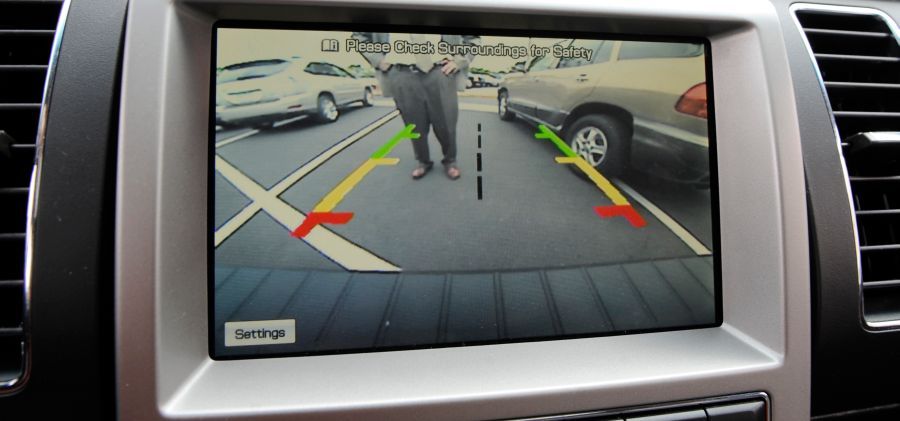
Many rear view cameras display parking guidelines on the screen.
These lines can make it easier to estimate the vehicle's position and direction while reversing. However, not all parking guidelines work in the same way.
Some systems use fixed lines that remain in the same position regardless of steering input.
More advanced systems can display dynamic guidelines that move according to the steering wheel position.
Dynamic guidelines can be particularly useful when properly calibrated. Incorrectly positioned guidelines, however, can be misleading.
Choose the Right Camera Position
Where the camera is installed has a major effect on the image.
Rear view cameras are commonly mounted around the license plate area, trunk lid or rear bumper.
A camera mounted higher up generally provides a different perspective from one mounted lower on the bumper. The best location depends on the vehicle and the camera's viewing angle.
There is no single mounting position that is ideal for every vehicle.
The camera should generally be positioned as close to the center of the vehicle as practical and installed in a way that keeps the image properly aligned.
Wired or Wireless?
Rear view camera systems can be either wired or wireless.
Wired systems use a physical video cable between the camera and display. Installation may take more time because the cable needs to be routed through the vehicle, but a properly installed wired connection can provide stable performance.
Wireless systems can reduce the amount of video cabling required. This can be convenient, particularly in vehicles where cable installation is difficult.
However, wireless systems can introduce concerns about connection stability and latency.
For a safety-related device such as a rear view camera, a delayed or intermittently interrupted image is not desirable.
Therefore, choosing a wireless camera simply because it requires less wiring is not necessarily the best decision.
Pay Attention to Image Delay
Latency is particularly important with wireless camera systems.
If there is a noticeable delay between the vehicle's actual movement and the image displayed on the screen, reversing in tight spaces can become more difficult.
Before buying a wireless camera, it can be useful to watch real-world demonstrations or test the system in person.
Make Sure the Camera Is Compatible With the Display
Physical connection alone does not guarantee that a rear view camera will work with a multimedia system.
The camera's video format and resolution need to be supported by the display.
For example, an AHD camera may not work with an older multimedia system designed only for a particular analog video standard.
Before buying a camera, check both the camera's output specification and the display's camera input requirements.
Mirror Mode and Reversed Images
Rear view cameras commonly use a mirrored image.
This is intended to make the camera view more similar to what the driver would see in a rear-view mirror.
Some cameras allow the image to be flipped horizontally, which can be useful if the camera is being used for different applications.
If you plan to use the camera in more than one position, adjustable image orientation can be a useful feature.
Pay Attention to Cable Installation
Buying a good camera is only part of the process. Proper installation is equally important.
The cable needs to be protected when it passes through the trunk lid, tailgate or vehicle body. If it is repeatedly pinched or rubbed against sharp metal edges, its insulation can eventually become damaged.
If a hole is drilled into the vehicle body for installation, it should be properly sealed to prevent water from entering.
The wiring between the tailgate and vehicle body also needs enough flexibility because this area moves every time the trunk or tailgate is opened.
Adding a Camera to a Factory Screen
If you want to keep the vehicle's original multimedia screen, camera compatibility becomes even more important.
Some factory systems already have a camera input, while others may require an additional interface before a rear camera can be used.
In some vehicles, the system also needs to recognize the reverse gear signal so that the screen automatically switches to the camera view.
Therefore, it is not enough to ask whether the camera itself works. You should also determine whether it will automatically work with the vehicle's original screen when reverse gear is selected.
A Cheap Camera Is Not Always Bad, and an Expensive Camera Is Not Always Better
Price alone is not a reliable way to choose a rear view camera.
A very inexpensive camera may advertise a high resolution but still have poor nighttime performance, weak image quality, an inferior lens or inadequate weather resistance.
On the other hand, an expensive camera may offer features that you will never actually need.
For most drivers, a better approach is to choose a camera that is compatible with the vehicle's existing system, provides sufficient resolution, has good low-light performance, offers a suitable viewing angle and is properly protected against outdoor conditions.
What Are the Most Important Things to Check?
Before buying a rear view camera, it is useful to evaluate the features in roughly this order.
Compatibility: Does the vehicle's screen or multimedia system support the camera?
Image quality: Does it provide a clear image during both daytime and nighttime?
Viewing angle: Does it show enough of the area behind the vehicle without excessive distortion?
Durability: Can it withstand rain, snow, dirt and car washing?
Connection: Would a wired or wireless system be more suitable for your vehicle?
Installation: Can the camera be mounted in the correct position and at the correct angle?
Parking guidelines: Are the fixed or dynamic guidelines accurate and properly calibrated?
A good rear view camera should provide a clear and reliable view without creating unnecessary distortion or delay.
However, a camera should always be considered a driving aid rather than a replacement for checking the vehicle's surroundings. Mirrors and direct visual checks remain important, especially when there may be children, pedestrians, bicycles, pets or small obstacles directly behind the vehicle.