TR
TR EN
EN

What Is a Radar Sensor? Where Is It Used?
Radar sensors are electronic systems that use radio waves to detect objects, measure distance, determine relative speed, and sometimes estimate the direction or position of moving objects. Although radar technology was originally developed for military and aviation applications, it has become an important part of modern vehicles, industrial equipment, security systems, smart infrastructure, and many consumer technologies.
Today, radar sensors are particularly important in automotive safety systems. Features such as adaptive cruise control, automatic emergency braking, blind-spot monitoring, and forward collision warning often rely on radar to understand what is happening around the vehicle.
How Does a Radar Sensor Work?
The basic operating principle of radar is relatively simple. A radar sensor transmits electromagnetic waves, usually in the radio-frequency or microwave range. These waves travel through the environment and may reflect when they encounter an object.
The sensor receives the reflected signal and analyzes it to determine information such as:
-
How far away the object is
-
Whether the object is moving
-
The object's relative speed
-
The approximate direction of movement
-
In some systems, the object's position and characteristics
The time required for the transmitted signal to return can be used to calculate distance. When the reflected signal changes in frequency because of relative movement between the sensor and the target, the Doppler effect can be used to determine relative velocity.
Modern radar systems can process many reflected signals simultaneously. This allows them to monitor several objects rather than simply detecting whether something is present.
What Types of Radar Sensors Are There?
Radar sensors are designed for different purposes, and their characteristics can vary considerably.
Short-range radar
Short-range radar is designed to detect objects relatively close to the sensor. It is commonly used for parking assistance, blind-spot monitoring, door and gate automation, and industrial object detection.
Medium-range radar
Medium-range systems can monitor a larger area and are often used in automotive applications where the vehicle needs to detect surrounding traffic.
Long-range radar
Long-range radar can detect objects at considerably greater distances. In vehicles, it can be used for functions such as adaptive cruise control and forward collision detection.
Imaging radar
More advanced radar systems can create a much more detailed representation of the environment. Instead of simply detecting a target, imaging radar can help determine the location and movement of multiple objects with greater precision.
Radar Sensors in Cars
One of the most visible applications of radar technology today is the automotive industry.
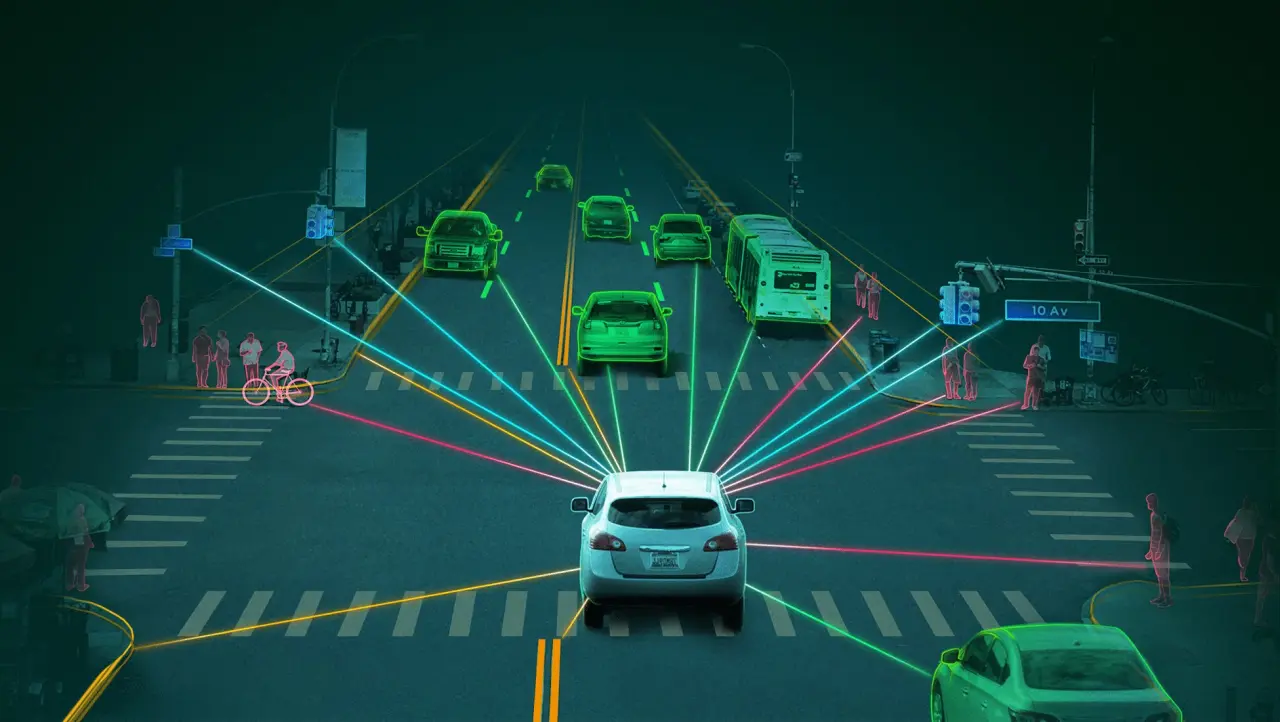
Modern vehicles can contain several radar sensors positioned at the front, rear, and sometimes the sides of the vehicle. These sensors provide information to electronic control units responsible for driver-assistance and safety functions.
A typical vehicle may use radar sensors behind the front grille, inside or behind the front bumper, near the rear bumper, or in other locations designed to provide a suitable field of view.
Adaptive Cruise Control
Adaptive Cruise Control, commonly known as ACC, is one of the best-known automotive applications of radar.
A conventional cruise control system can maintain a selected speed, but it does not necessarily understand traffic ahead. Radar-based adaptive cruise control can detect a vehicle in front and estimate its distance and relative speed.
If the vehicle ahead slows down, the system can reduce the host vehicle's speed. When the road becomes clear again, the system can accelerate toward the selected cruising speed, within the system's operating limits.
This requires continuous measurement rather than a simple object-presence signal.
Forward Collision Warning
Radar can also be used to monitor the area in front of a vehicle for potential collision risks.
The system can compare the vehicle's speed, the detected object's distance, and relative speed. If the calculated situation suggests that a collision may become likely, the vehicle can warn the driver.
Depending on the vehicle and system design, radar information may also contribute to automatic emergency braking.
Automatic Emergency Braking
Automatic Emergency Braking, or AEB, can use radar to identify obstacles or vehicles ahead and determine whether the closing speed is becoming dangerous.
If the driver does not react appropriately, the system may apply the brakes automatically.
Many modern systems combine radar with cameras because the two technologies provide different types of information. Radar is particularly useful for measuring distance and relative velocity, while cameras can provide visual information about objects and road conditions.
Blind-Spot Monitoring
Radar sensors can also monitor areas beside and slightly behind a vehicle that are difficult for the driver to see directly.
When another vehicle enters the monitored area, the blind-spot monitoring system can provide a warning, often through a light in the side mirror or another display.
Radar is useful for this application because it can continuously monitor the surrounding area without requiring the driver to actively look at a screen.
Rear Cross-Traffic Alert
When reversing out of a parking space, the driver may have limited visibility of traffic approaching from the sides.
Rear cross-traffic alert systems can use radar sensors to monitor the area behind the vehicle. If a vehicle, cyclist, or other moving object approaches from the side, the system can warn the driver.
Parking and Low-Speed Applications
Radar is also used in low-speed vehicle applications.
Parking-related radar systems can detect nearby objects and estimate their distance from the vehicle. This information can be used to provide audible or visual warnings while maneuvering.
However, conventional parking sensors often use ultrasonic technology rather than radar. These technologies should not be confused with each other.
Ultrasonic sensors are generally designed for very short-range detection, while automotive radar can provide longer-range detection and relative-speed information.
Radar vs. Camera Sensors
Radar and cameras do not perform exactly the same job.
A camera records visual information. It can recognize lane markings, traffic signs, vehicle shapes, pedestrians, and other visual characteristics when conditions allow.
Radar, on the other hand, is particularly effective at measuring distance and relative speed.
For this reason, modern driver-assistance systems increasingly combine data from radar and cameras. This approach is known as sensor fusion.
For example, a camera may identify an object as a vehicle while radar determines how far away it is and how quickly the distance between the two vehicles is changing.
Radar vs. Ultrasonic Sensors
Radar and ultrasonic sensors both detect objects without relying on a conventional camera image, but they operate using different physical principles.
Radar uses electromagnetic radio waves, while ultrasonic sensors use high-frequency sound waves.
Ultrasonic sensors are particularly common in parking assistance because they work well at short distances. Radar is more suitable when the system needs to monitor objects farther away or determine relative velocity.
Some vehicles use both technologies simultaneously.
Radar Sensors in Industrial Applications
Radar technology is not limited to automobiles.
Factories and industrial facilities use radar sensors for object detection, distance measurement, level measurement, and process monitoring.
For example, radar can measure the level of liquids, powders, or other materials inside tanks and silos. Because radar does not need to physically contact the material, it can be useful in demanding industrial environments.
Radar sensors can also monitor moving machinery, detect objects on production lines, and provide information for automated systems.
Radar in Security Systems
Radar sensors are increasingly used for security and surveillance applications.
A radar system can detect movement over a defined area and identify the direction or speed of moving objects. This makes radar useful for perimeter security, restricted areas, airports, industrial facilities, and other locations requiring continuous monitoring.
Unlike a conventional camera, radar can continue detecting movement in conditions where visual information is limited.
Radar in Aviation and Maritime Systems
Radar has a long history in aviation and maritime applications.
Aircraft use radar systems for navigation, weather observation, traffic awareness, and other purposes. Ships and coastal systems use radar to detect other vessels, land formations, and obstacles.
These applications require reliable detection over significant distances, making radar particularly valuable.
Radar in Smart Infrastructure
Radar sensors are also becoming part of modern traffic infrastructure.
They can be used to monitor traffic flow, count vehicles, estimate speeds, and detect congestion. Unlike systems that rely exclusively on visible images, radar can provide traffic measurements under a wide range of lighting conditions.
This makes radar useful for intelligent transportation systems and smart-city applications.
Can Radar Sensors Work in Rain, Fog, or Darkness?
One of the major advantages of radar is that it is not dependent on visible light.
A camera can be affected by darkness, glare, fog, heavy rain, dirt, or snow. Radar can continue operating in many of these conditions because it uses radio waves rather than visible light.
However, radar is not completely immune to environmental conditions.
Heavy rain, snow, contamination, interference, sensor positioning, and the physical characteristics of an object can affect radar performance. Modern systems therefore use signal processing and, increasingly, information from other sensors to improve reliability.
What Happens When a Vehicle's Radar Sensor Fails?
A radar sensor malfunction can affect one or more driver-assistance functions.
Depending on the vehicle, possible symptoms may include:
-
Adaptive cruise control becoming unavailable
-
Forward collision warning being disabled
-
Automatic emergency braking becoming unavailable
-
Blind-spot monitoring warnings
-
Driver-assistance warning messages
-
Sensor obstruction messages
-
Diagnostic trouble codes
-
Incorrect or intermittent object detection
A radar-related fault does not always mean that the radar sensor itself has failed.
The problem can also be caused by damaged wiring, connector corrosion, power or ground problems, communication faults, incorrect sensor mounting, bumper damage, software problems, or calibration issues.
Why Is Radar Calibration Important?
Radar sensors are extremely sensitive to their mounting position.
Even a small change in the sensor's angle can affect the area that it monitors. This is why radar calibration may be required after certain repairs or accidents.
For example, replacing a bumper, repairing the front end, changing suspension components, or repositioning a radar sensor can potentially affect its alignment.
Depending on the vehicle, calibration may require specialized diagnostic equipment and a controlled workshop procedure.
Simply clearing a fault code does not necessarily correct a radar alignment problem.
Where Else Are Radar Sensors Used?
Radar technology has applications far beyond vehicles. It can be found in:
-
Aircraft
-
Ships
-
Airports
-
Traffic monitoring systems
-
Industrial automation
-
Liquid and material level measurement
-
Security systems
-
Automatic doors and gates
-
Robotics
-
Drones
-
Weather observation
-
Smart-city infrastructure
-
Speed measurement systems
The technology can be adapted to different environments by changing the radar's frequency, antenna design, range, resolution, and signal-processing capabilities.
The Future of Radar Technology
Radar sensors are becoming smaller, more powerful, and more sophisticated.
In automotive applications, newer radar systems are moving beyond simple distance and speed measurement. High-resolution radar can provide more detailed information about the surrounding environment and help distinguish multiple objects.
This development is particularly important for advanced driver-assistance systems and future automated-driving technologies.
Instead of treating radar as a simple “object detector,” modern systems can use radar data to build a more detailed understanding of traffic and the vehicle's surroundings.
Why Are Radar Sensors Important?
The biggest advantage of radar is its ability to measure the environment using radio waves rather than relying solely on visible images.
It can measure distance and relative speed continuously, operate in darkness, and complement camera and ultrasonic systems. These characteristics make radar an important sensing technology in modern vehicles, industrial automation, transportation, and security.
As vehicles and other machines become increasingly automated, radar sensors will play an even greater role in helping electronic systems understand what is happening around them.