TR
TR EN
EN

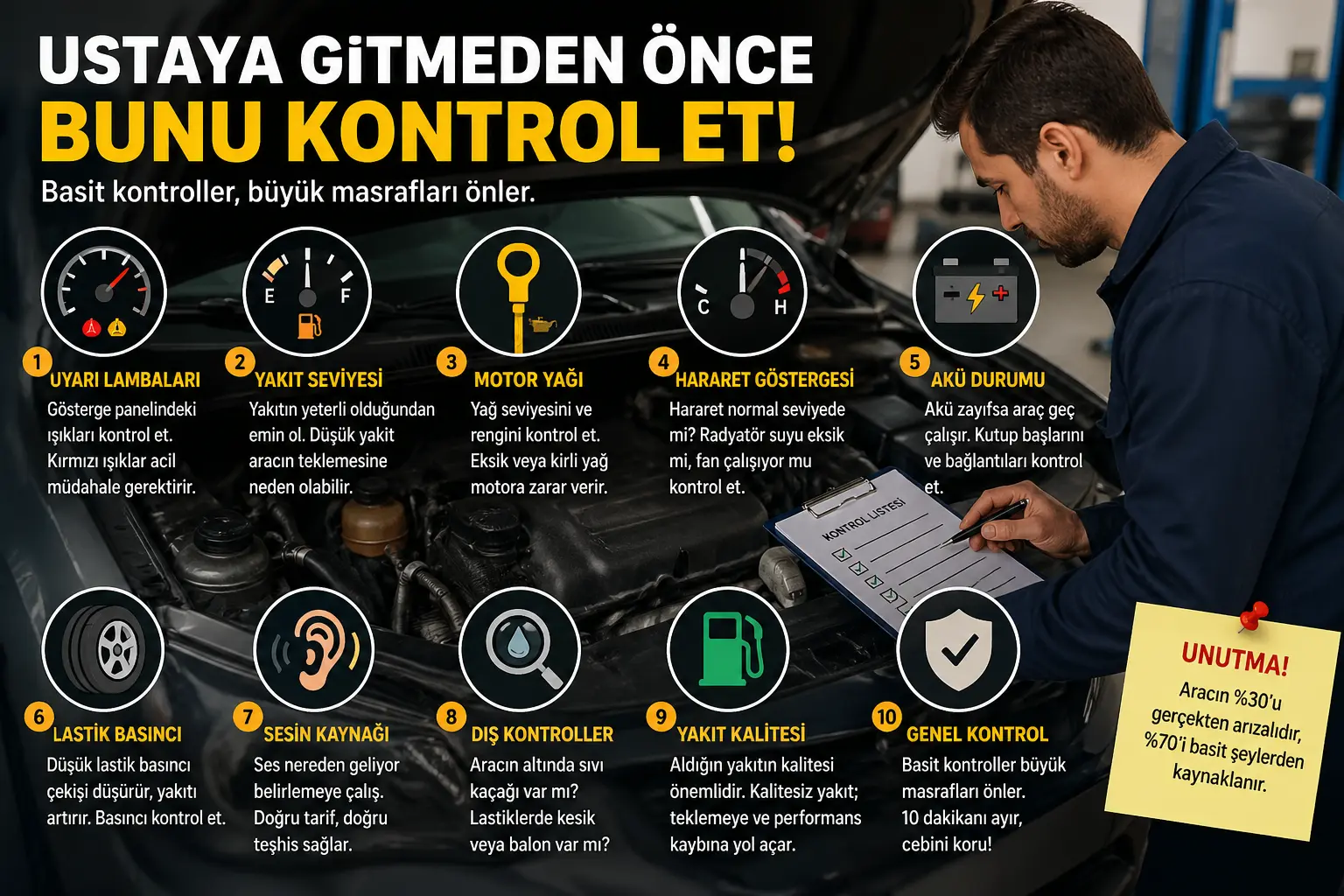
Things to Check Before Taking Your Car to a Mechanic
Hearing an unusual noise? Has your car lost power, or has a warning light appeared on the dashboard? Many drivers head straight to a repair shop, but not every problem requires an immediate visit to a mechanic.
In many cases, a few simple checks can help you identify the cause of the issue—or at least provide useful information that can lead to a faster and more accurate diagnosis. Spending just a few minutes inspecting your vehicle may save you time, prevent unnecessary repairs, and even reduce repair costs.
Here are the most important things to check before scheduling a visit to the workshop.
Understand the dashboard warning lights
Your dashboard is designed to communicate the condition of your vehicle.
Different warning light colors indicate different levels of urgency:
-
Yellow or amber: A warning that should be checked soon but may not require stopping immediately.
-
Red: A serious issue that often requires immediate attention.
-
Blue or green: Usually indicates that a system is operating normally, such as high beams or cruise control.
Never ignore a warning light simply because the vehicle still seems to drive normally. Even minor warnings can develop into expensive repairs if left unresolved.
Check the fuel level
It may sound obvious, but low fuel is responsible for more problems than many drivers realize.
Symptoms of low fuel can include:
-
Engine hesitation
-
Loss of power
-
Stalling
-
Difficulty starting
Fuel gauges are not always perfectly accurate, especially when the vehicle is parked on a steep incline. If the fuel level is very low, refueling should be your first step before assuming a mechanical problem exists.
Inspect the engine oil level
Engine oil is essential for lubrication, cooling, and protecting internal engine components.
Using the dipstick, check:
-
Whether the oil level is between the minimum and maximum marks.
-
Whether the oil appears excessively dirty or contaminated.
-
Whether the engine has been consuming oil unusually quickly.
Low oil levels may cause:
-
Engine noise
-
Reduced performance
-
Increased engine wear
-
Serious mechanical damage if ignored
Always check the oil when the engine is cool and the vehicle is parked on level ground.
Monitor the engine temperature
If the temperature gauge is reading higher than normal, don't immediately assume the engine has suffered major damage.
Before driving further, inspect:
-
Coolant level (only when the engine is completely cool)
-
Signs of coolant leaks
-
Whether the cooling fan is operating
-
Visible damage to hoses
Sometimes a low coolant level or a minor leak is responsible for an overheating warning.
However, if the engine is overheating significantly, avoid continuing to drive, as severe engine damage can occur.
Check the battery
If your car struggles to start, the battery should be one of the first things you inspect.
Common signs of a weak battery include:
-
Slow engine cranking
-
Dim headlights
-
Flickering interior lights
-
Electrical accessories operating poorly
Also inspect the battery terminals for:
-
Loose connections
-
Corrosion
-
Dirt buildup
Cleaning or tightening the battery terminals may solve starting problems without further repairs.
Verify tire pressure
Incorrect tire pressure affects much more than fuel economy.
Driving with underinflated tires can lead to:
-
Reduced handling
-
Longer braking distances
-
Increased fuel consumption
-
Uneven tire wear
-
Poor steering response
Use a tire pressure gauge and compare the readings with the manufacturer's recommended values, usually found on the driver's door frame or in the owner's manual.
Identify where the noise is coming from
If your vehicle is making an unusual sound, try to determine its location before visiting the mechanic.
Ask yourself:
-
Is the noise coming from the front or rear?
-
Does it occur while accelerating?
-
Does it happen during braking?
-
Does it appear only while turning?
-
Does it disappear at higher speeds?
Different noises often point to different systems.
For example:
-
Squealing during braking may indicate worn brake pads.
-
Knocking over bumps could suggest suspension wear.
-
Clicking while turning may indicate a worn CV joint.
-
Whining from the engine compartment could point to accessory belt or bearing issues.
The more accurately you describe the symptoms, the easier it will be for a technician to diagnose the problem.
Perform a quick visual inspection
A simple walk around your vehicle can reveal issues that might otherwise go unnoticed.
Look for:
-
Fluid leaks underneath the vehicle
-
Tire damage or sidewall bulges
-
Loose body panels
-
Broken lights
-
Cracked mirrors or glass
-
Objects caught underneath the vehicle
Even small observations can provide valuable clues about developing mechanical problems.
Think about your most recent fuel purchase
If the problem started immediately after refueling, fuel quality may be worth considering.
Poor-quality or contaminated fuel can cause:
-
Rough idling
-
Engine hesitation
-
Reduced acceleration
-
Misfires
-
Increased fuel consumption
If the symptoms appeared shortly after filling up at an unfamiliar fuel station, mention this to your mechanic.
Consider when the problem started
Before visiting a repair shop, think about exactly when the symptoms first appeared.
Questions to consider include:
-
Did the issue begin after hitting a pothole?
-
Did it appear after a recent service?
-
Was the weather unusually hot or cold?
-
Did it start after a long road trip?
-
Did it occur immediately after refueling?
This information can significantly reduce diagnostic time.
Gather as much information as possible
Professional technicians often rely on customer descriptions during the diagnostic process.
Useful information includes:
-
When the problem occurs
-
How often it happens
-
Whether warning lights appear
-
Any unusual smells
-
Changes in performance
-
Recent repairs or maintenance
Providing detailed information helps avoid unnecessary parts replacement and speeds up troubleshooting.
When should you visit a mechanic immediately?
Some situations should never be ignored.
Seek professional assistance promptly if you notice:
-
A red warning light
-
Severe overheating
-
Loss of braking performance
-
Heavy smoke from the engine
-
Significant fluid leaks
-
Loud knocking from the engine
-
Transmission slipping or refusing to engage gears
-
Strong fuel smells
These symptoms may indicate serious mechanical or safety-related problems.
Final thoughts
Not every unusual sound, warning light, or performance issue signals a major repair. Many problems have surprisingly simple causes that can be identified through a quick inspection.
Spending just ten minutes checking your vehicle before visiting a mechanic can help you:
-
Avoid unnecessary repair costs.
-
Provide better information for diagnosis.
-
Save time during the repair process.
-
Prevent small issues from becoming expensive failures.
Being an informed vehicle owner doesn't replace professional repairs—but it can help you make smarter decisions and better understand what your car is trying to tell you.