TR
TR EN
EN

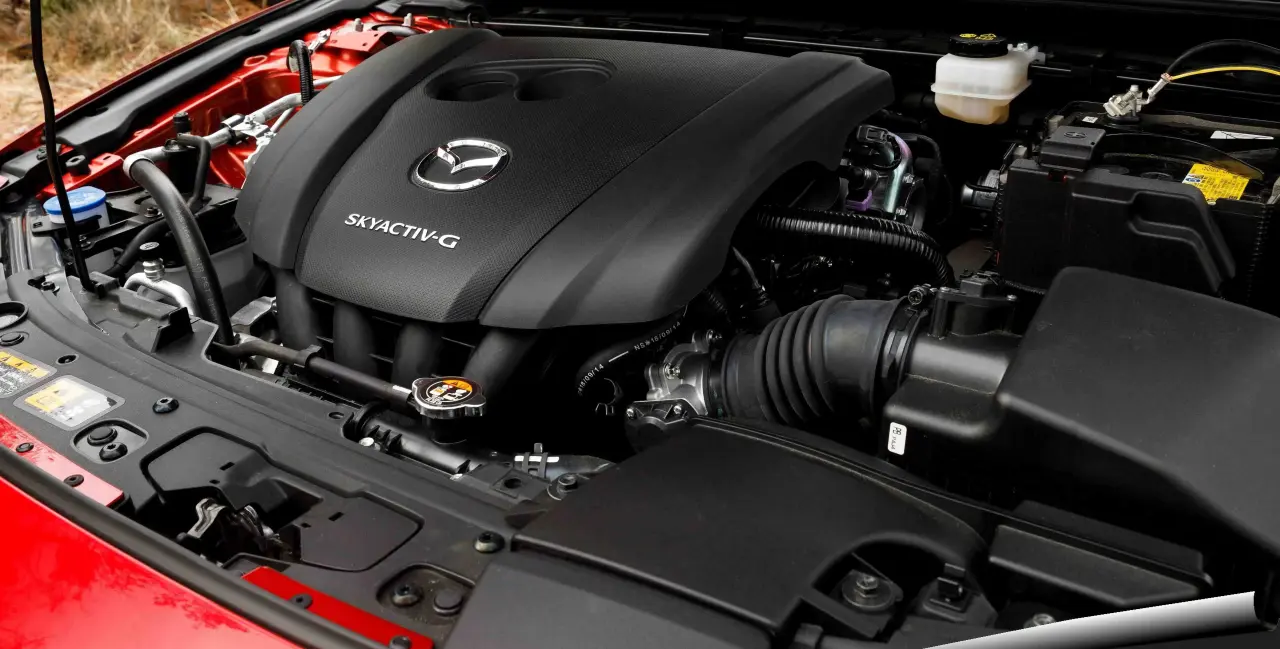
Mazda Launched the Skyactiv-X Engine in 2019
2019 was an important year for Mazda, not only because of its new vehicle launches, but also because the Japanese automaker brought one of its most ambitious engine technologies into a production vehicle.
The Skyactiv-X engine represented a different approach to improving the efficiency of gasoline engines. Instead of relying exclusively on conventional spark ignition, Mazda developed a combustion system that could also use the principles of compression ignition under certain operating conditions.
The technology was introduced in a production Mazda3 in 2019 and became one of the most distinctive developments in Mazda's modern engine history.
What Is the Skyactiv-X Engine?
Skyactiv-X is a gasoline engine developed by Mazda with a combustion system known as SPCCI, which stands for Spark Controlled Compression Ignition.
In a conventional gasoline engine, the air-fuel mixture is ignited primarily by a spark from the spark plug.
A diesel engine works differently. It compresses air to a high temperature and then injects fuel, allowing the fuel to ignite through compression.
Mazda's approach with Skyactiv-X was to combine elements of these two combustion principles.
The engine remains a gasoline engine and continues to use spark plugs, but under suitable operating conditions it can use compression ignition to improve combustion efficiency.
Why Did Mazda Develop Skyactiv-X?
Mazda believed that internal combustion engines would remain an important part of the automotive industry for many years.
Instead of focusing exclusively on electric vehicles, the company also wanted to make gasoline engines more efficient.
This led Mazda to invest heavily in combustion technology.
The company announced the Skyactiv-X concept before its production launch and planned to introduce the technology around 2019.
That plan eventually became reality with the new-generation Mazda3.
How Does Skyactiv-X Work?
The central technology behind Skyactiv-X is SPCCI.
The system attempts to create conditions in which the compressed air-fuel mixture can ignite in a controlled manner.
However, the spark plug remains an important part of the process.
The spark helps control the combustion event and allows the engine management system to establish the conditions required for compression ignition.
This means Skyactiv-X is not simply a gasoline engine with a diesel-style combustion system.
It is a sophisticated combination of combustion control, high compression, fuel injection, electronic engine management, and spark ignition.
What Makes SPCCI Different?
The main objective of SPCCI is to use compression ignition across as wide an operating range as possible.
That is a significant engineering challenge.
Engine speed, load, temperature, air pressure, fuel mixture, and many other conditions constantly change while a vehicle is being driven.
The combustion process therefore has to be precisely controlled.
When conditions are suitable, the engine can take advantage of compression ignition. When they are not, the system can use spark ignition.
This flexibility is one of the defining characteristics of Skyactiv-X.
Can Skyactiv-X Combine Gasoline and Diesel Advantages?
That was one of Mazda's main goals.
Gasoline engines are traditionally associated with smooth operation and the ability to operate at relatively high engine speeds.
Diesel engines are known for strong low-speed torque and high thermal efficiency.
Mazda wanted Skyactiv-X to combine some of these characteristics while retaining the basic nature of a gasoline engine.
The objective was therefore not to create a diesel engine using gasoline, but to improve the efficiency of a gasoline engine through a different combustion strategy.
Which Car First Used Skyactiv-X?
The first production application of Skyactiv-X was the 2019 Mazda3.
The new Mazda3 represented an important step in Mazda's next-generation vehicle strategy.
It introduced the Skyactiv-X engine alongside other new technologies and was one of the first vehicles to demonstrate Mazda's new approach to vehicle design, chassis engineering, and powertrain development.
Why Was the 2019 Mazda3 Important?
The 2019 Mazda3 was more than a redesigned compact car.
It represented a new generation of Mazda engineering.
The vehicle introduced Mazda's new Skyactiv-Vehicle Architecture, while the company's Kodo design philosophy was developed further.
The introduction of Skyactiv-X made the Mazda3 particularly significant because the car became a showcase for Mazda's new-generation technology.
Did Skyactiv-X Replace Diesel Engines?
No.
Skyactiv-X was not designed simply to replace diesel engines.
Mazda continued to develop different powertrain technologies for different markets and applications.
Skyactiv-X was primarily an attempt to improve gasoline-engine efficiency while maintaining the driving characteristics expected from a gasoline-powered vehicle.
Calling it a “gasoline diesel engine” would therefore be misleading.
It is a gasoline engine that uses a sophisticated combustion strategy incorporating compression ignition under appropriate conditions.
Does Skyactiv-X Use Less Fuel?
Improving fuel efficiency was one of the main reasons Mazda developed the technology.
Compression ignition can allow combustion to take place efficiently under certain operating conditions, while the engine's high compression ratio and other Skyactiv technologies also contribute to overall efficiency.
However, real-world fuel consumption depends on much more than the engine itself.
Vehicle weight, driving style, traffic, road conditions, temperature, tire pressure, and acceleration patterns can all have a significant effect on fuel consumption.
Is Skyactiv-X Basically a Diesel Engine?
No.
The technology has one important similarity to diesel engines: it can use compression ignition.
However, the overall engine design and combustion control strategy are very different.
Skyactiv-X still uses gasoline, spark plugs, and a gasoline-engine operating philosophy.
Its purpose is to take advantage of compression ignition without turning the engine into a conventional diesel.
What Was the Biggest Challenge for Mazda?
The biggest challenge was controlling compression ignition reliably under real-world conditions.
Compression ignition can be difficult to control because the combustion process depends heavily on temperature, pressure, mixture conditions, and engine load.
A production vehicle has to work in a wide range of situations.
The engine may be started when it is extremely cold, driven gently through city traffic, accelerated onto a highway, or operated under high load.
The combustion process must remain stable in all of these situations.
Mazda's SPCCI system was developed specifically to address this challenge.
Why Did Mazda Choose Such a Different Approach?
Mazda has traditionally followed its own engineering philosophy.
The company recognized that electric vehicles were becoming increasingly important, but it also believed that internal combustion engines would remain relevant for a considerable period.
As a result, Mazda pursued several technologies simultaneously, including:
-
More efficient gasoline engines
-
Diesel technology
-
Hybrid systems
-
Battery-electric vehicles
-
Rotary engines
-
Advanced combustion systems
Skyactiv-X was an important part of this strategy.
What Happened to Skyactiv-X in 2019?
The year 2019 was particularly important for Mazda because several major developments came together.
The new-generation Mazda3 was introduced.
The CX-30 was unveiled as a new crossover model.
Mazda also introduced the MX-30 concept as part of its move toward electrification.
At the same time, Skyactiv-X finally moved from development into production.
This made 2019 one of the most significant years in Mazda's modern technological development.
Was Skyactiv-X a Turning Point for Mazda?
It certainly represented an important milestone.
Mazda had spent years developing the technology before bringing it to market.
In 2019, the company demonstrated that its idea of improving gasoline-engine combustion could be implemented in a production vehicle.
Skyactiv-X therefore became a practical example of Mazda's belief that internal combustion engines could still be improved through engineering rather than simply being replaced.
The Importance of Skyactiv-X Today
The introduction of Skyactiv-X is still interesting because it happened during a major transition in the automotive industry.
While many manufacturers were increasing their investment in electric vehicles, Mazda was simultaneously working on a highly advanced gasoline engine.
The company was effectively pursuing two directions at once: developing electrified vehicles while continuing to improve the efficiency of internal combustion engines.
That approach made Skyactiv-X one of the most unusual gasoline-engine technologies introduced during the transition toward electrification.
Why Is the 2019 Skyactiv-X Launch Important?
The launch of Skyactiv-X in 2019 was more than the introduction of another engine option.
It demonstrated Mazda's willingness to take a different engineering path at a time when the automotive industry was rapidly changing.
The technology attempted to combine the characteristics of spark ignition and compression ignition while maintaining the driving feel of a gasoline engine.
The Mazda3 became the first production vehicle to bring this technology to customers, making 2019 an important milestone in Mazda's modern history.
Skyactiv-X ultimately became one of the clearest examples of Mazda's engineering philosophy: rather than abandoning the internal combustion engine immediately, the company continued looking for ways to make it cleaner, more efficient, and technologically more advanced.