TR
TR EN
EN

What Should Tire Pressure Be? How Many PSI or Bar Should a Car Tire Have?
Tire pressure is one of the most important factors affecting vehicle safety, handling, braking, fuel consumption, and tire life. Yet many drivers rely on a generic pressure value or simply use the number written on the tire sidewall.
This can be a mistake.
The correct tire pressure is determined primarily by the vehicle manufacturer, not by the maximum pressure printed on the tire.
So, what should tire pressure be?
For most passenger cars, recommended pressures commonly fall somewhere around 30–36 PSI (2.1–2.5 bar), but there is no single pressure that is correct for every vehicle. The appropriate value can be significantly different depending on the vehicle, tire size, load, and driving conditions.
Where Can You Find the Correct Tire Pressure?
The most reliable source is the vehicle manufacturer's recommended pressure.
You can usually find it in one of these locations:
-
Driver's door frame
-
Driver's door pillar
-
Fuel-filler flap
-
Glovebox area
-
Owner's manual
Some vehicles have a sticker showing separate pressures for:
-
Front tires
-
Rear tires
-
Normal load
-
Full load
-
High-speed driving
For example, a vehicle may require a slightly higher pressure at the rear when carrying several passengers or a heavy luggage load.
The values on the vehicle's tire-pressure label should therefore be followed instead of using a universal pressure number.
What Does PSI Mean?
PSI stands for pounds per square inch.
It is one of the most common units used for tire pressure, particularly in the United States.
For example:
-
30 PSI ≈ 2.1 bar
-
32 PSI ≈ 2.2 bar
-
35 PSI ≈ 2.4 bar
-
36 PSI ≈ 2.5 bar
-
40 PSI ≈ 2.8 bar
In Europe and many other countries, bar is commonly used instead of PSI.
The two units measure the same thing; they simply use different scales.
What Does Bar Mean?
Bar is another unit used to describe pressure.
A typical passenger-car tire pressure may be around 2.0–2.5 bar, depending on the vehicle.
However, drivers should not assume that 2.2 bar or 2.4 bar is universally correct.
The correct value depends on the specific vehicle and tire configuration.
Do Not Use the Number on the Tire Sidewall as the Recommended Pressure
This is one of the most common tire-pressure mistakes.
The tire sidewall may display a pressure value such as:
MAX PRESS 50 PSI
This does not mean that the tire should normally be inflated to 50 PSI.
That number generally indicates the tire's maximum permitted inflation pressure under the specified conditions.
It is not the vehicle manufacturer's recommended everyday operating pressure.
The correct pressure should come from the vehicle's information label or owner's manual.
Should Tire Pressure Be Checked When the Tires Are Cold?
Yes.
The recommended tire-pressure figures are generally specified for cold tires.
This is important because tire pressure increases as the tire heats up during driving.
For example, after driving for a while, the air inside the tire becomes warmer and expands. The pressure measured at that moment may therefore be higher than the cold pressure.
This does not necessarily mean that the tire is overinflated.
For the most accurate measurement, check the pressure:
-
Before driving
-
After the vehicle has been parked for several hours
-
When the tires have not been exposed to significant heat
If the pressure is checked immediately after a long drive, it should not simply be reduced to the cold recommended value.
Why Does Tire Pressure Increase When Driving?
Air pressure is affected by temperature.
As the tire rolls, it flexes against the road surface. This generates heat inside the tire.
The brakes and surrounding components can also transfer heat to the wheel and tire.
As the temperature rises, the pressure inside the tire increases.
This is why a tire that shows the correct pressure when cold may show a noticeably higher value after a highway journey.
The increase is a normal consequence of tire temperature.
What Happens If Tire Pressure Is Too Low?
Underinflation is one of the most common tire-pressure problems.
When a tire is underinflated, its sidewalls flex more than intended.
This can result in:
-
Increased rolling resistance
-
Higher fuel consumption
-
Increased tire temperature
-
Faster shoulder wear
-
Reduced handling precision
-
Longer braking distances in some conditions
-
Increased risk of tire damage
-
Reduced tire life
An underinflated tire can also feel softer and less responsive.
In extreme cases, excessive flexing and heat can contribute to serious tire damage.
How Does Low Tire Pressure Affect Fuel Consumption?
A tire with insufficient pressure generally has greater rolling resistance.
The engine therefore has to work harder to move the vehicle.
This can increase fuel consumption.
The effect depends on how far the pressure deviates from the recommended value, as well as the vehicle, tire, road, speed, temperature, and driving style.
Keeping the tires at the manufacturer's recommended pressure is therefore one of the simplest ways to avoid unnecessary rolling resistance.
What Happens If Tire Pressure Is Too High?
Overinflation creates a different set of problems.
A tire with excessive pressure has a smaller effective contact area and can feel harder over bumps.
Possible effects include:
-
Reduced ride comfort
-
Reduced grip in certain conditions
-
Increased center-tread wear
-
More abrupt handling
-
Greater sensitivity to road irregularities
-
Increased risk of impact damage in some situations
This does not mean that slightly increasing tire pressure is always dangerous. Some vehicles specify different pressures for heavy loads or high-speed driving.
The important point is to use the pressure specified for the particular operating condition.
Does Tire Pressure Affect Braking?
Yes.
Tire pressure influences the way the tire contacts the road.
A tire that is significantly underinflated or overinflated may not behave as intended during braking.
This can affect:
-
Tire deformation
-
Contact characteristics
-
Steering response
-
ABS intervention
-
Overall vehicle stability
The braking system may be working perfectly, but the tires remain the only components actually transferring braking forces to the road.
Maintaining the correct pressure is therefore an important part of braking performance.
Does Tire Pressure Affect Handling?
Absolutely.
Tire pressure influences steering response and vehicle behavior.
If the pressure is too low, the vehicle may feel less precise during cornering.
If the pressure is too high, the vehicle may feel harsh and more sensitive to road imperfections.
The front and rear axle pressures can also be different because the vehicle's weight distribution and suspension characteristics are not necessarily identical.
This is why manufacturers often specify different pressures for the front and rear tires.
What Tire Pressure Should Be Used When the Car Is Fully Loaded?
Many vehicles have separate pressure recommendations for normal and full-load conditions.
When the car carries:
-
Several passengers
-
Heavy luggage
-
Equipment
-
Cargo
the manufacturer may recommend increasing tire pressure, particularly at the rear axle.
The correct values should be taken from the vehicle's tire-pressure sticker or owner's manual.
Do not simply add a few PSI based on guesswork.
Should Tire Pressure Be Different in Summer and Winter?
The recommended cold tire pressure does not normally change simply because it is summer or winter.
However, ambient temperature changes affect tire pressure.
As the weather becomes colder, tire pressure decreases.
As temperatures rise, pressure increases.
This means that a tire that was correctly inflated in warm weather can show lower pressure during a cold winter morning.
Drivers should therefore check their tires more frequently when seasonal temperatures change.
The solution is not to use a completely different arbitrary pressure for winter. Instead, maintain the manufacturer's recommended cold pressure.
How Much Does Tire Pressure Change With Temperature?
There is no single exact PSI change that applies to every situation because pressure changes depend on the initial pressure, temperature difference, tire volume, and measurement conditions.
As a general rule, a significant drop in ambient temperature can cause a noticeable decrease in tire pressure.
This is why tire-pressure warnings can appear during sudden cold weather even when there is no puncture.
The pressure should be measured with a reliable gauge and corrected to the manufacturer's specified cold value.
What Is the Correct Tire Pressure for Highway Driving?
Some vehicles specify a different pressure for high-speed driving.
If the manufacturer provides a high-speed recommendation, that value should be followed.
High-speed driving generates more heat and places greater loads on the tires.
However, drivers should not simply increase pressure because they plan to drive on a highway.
The correct procedure is to check the manufacturer's recommended values.
Can Front and Rear Tire Pressures Be Different?
Yes.
It is completely normal for a vehicle to have different recommended pressures at the front and rear.
For example, the front tires may carry more weight because of the engine and other components located toward the front of the vehicle.
A vehicle may therefore have:
-
Higher front pressure
-
Lower rear pressure
or the opposite, depending on its design.
The important thing is to follow the vehicle-specific recommendation.
Does Tire Size Change the Required Pressure?
It can.
When changing from the original tire size to another approved size, the correct pressure may not necessarily remain identical.
For example, a vehicle may be available with different wheel and tire combinations from the factory.
The manufacturer can specify different pressures for different approved tire sizes and load conditions.
Therefore, when changing wheel or tire size, the recommended pressure should be checked rather than simply carrying over the old value.
What Happens After Installing New Tires?
Installing new tires does not automatically mean that the pressure should be changed.
If the new tires have the same approved size and load characteristics, the vehicle manufacturer's recommended pressure generally remains the starting point.
However, if the tire specification, load index, speed rating, or wheel size has changed, the correct pressure should be verified.
The tire itself also has a maximum inflation-pressure rating, but that remains different from the vehicle's recommended operating pressure.
How Often Should Tire Pressure Be Checked?
Checking tire pressure at least once a month is a useful routine for many drivers.
It is also worth checking before:
-
Long-distance trips
-
Highway journeys
-
Carrying heavy loads
-
Seasonal temperature changes
-
Extended periods of vehicle storage
A tire can lose pressure gradually without looking obviously flat.
Visual inspection alone is therefore not enough.
What About TPMS?
Modern vehicles are often equipped with a Tire Pressure Monitoring System (TPMS).
TPMS monitors tire pressure and warns the driver when pressure falls below a specified threshold.
There are two main approaches.
Direct TPMS
A pressure sensor is installed inside each wheel or tire assembly and measures actual pressure.
Indirect TPMS
The system uses wheel-speed information and other data to detect differences associated with changes in tire pressure.
TPMS is useful, but it does not eliminate the need for manual pressure checks.
The warning threshold is not necessarily the same as the vehicle's recommended pressure.
A tire can therefore be below the ideal pressure without immediately triggering a warning.
Why Should You Not Wait for the TPMS Warning?
A TPMS warning generally indicates that pressure has dropped enough for the system to consider it abnormal.
It does not mean that the tire has only just become unsuitable.
For example, a tire may gradually lose pressure over time while remaining above the warning threshold.
The driver may not notice the difference.
Regular manual checks allow the tires to be maintained closer to the manufacturer's recommended pressure.
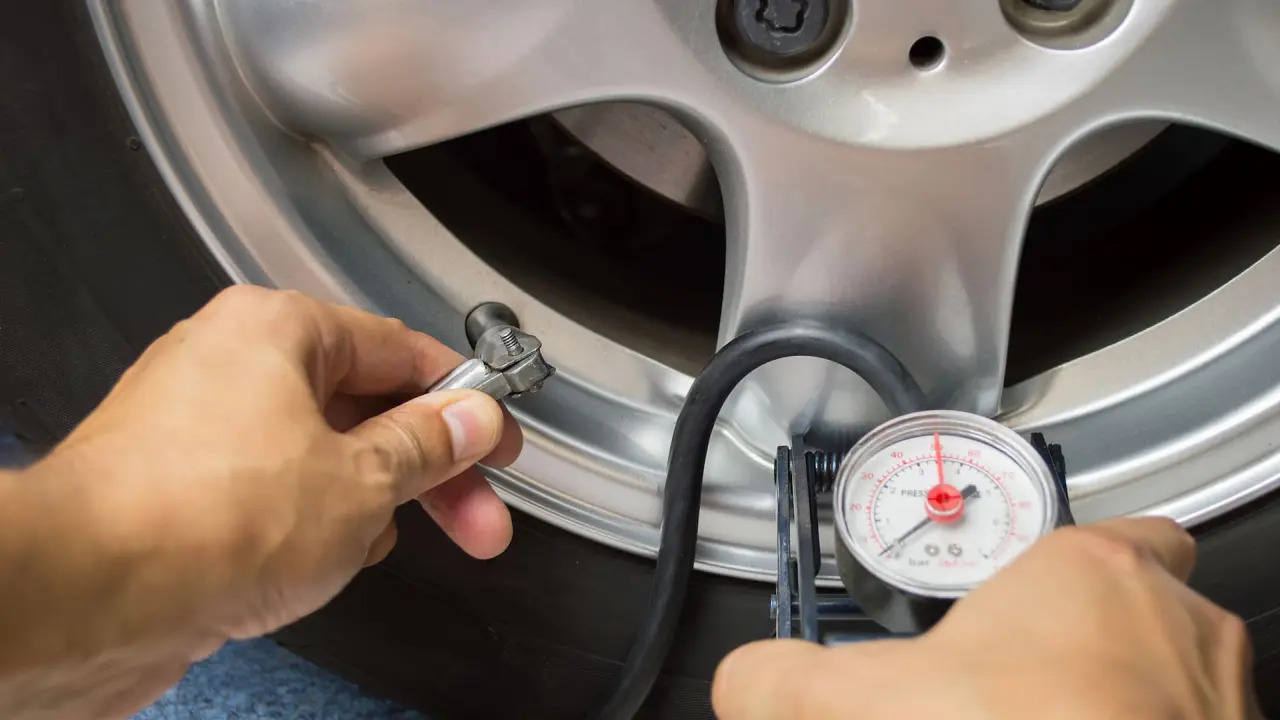
Can Tire Pressure Be Checked at a Gas Station?
Yes.
Many fuel stations have tire inflators and pressure gauges.
However, the accuracy of these devices can vary.
A small personal digital tire-pressure gauge can be useful for checking pressure regularly.
The important point is to measure consistently and ideally when the tires are cold.
Should You Adjust Tire Pressure After a Long Drive?
Not simply because the pressure is higher.
If the tires are hot after driving, their pressure will normally be higher than the cold specification.
Reducing the pressure while the tire is hot to match the cold recommended number can result in underinflation once the tire cools.
If you need to adjust pressure after driving, it is generally better to allow the tires to cool and then measure them.
What If One Tire Keeps Losing Pressure?
A tire that repeatedly loses pressure should not simply be inflated every few days without investigation.
Possible causes include:
-
Puncture
-
Nail or screw
-
Damaged valve
-
Valve-core leak
-
Bead leak
-
Bent wheel
-
Cracked wheel
-
Tire damage
A slow leak can be difficult to detect visually.
If one tire consistently loses more pressure than the others, the tire and wheel assembly should be inspected.
Should Tire Pressure Be Increased for Better Fuel Economy?
Some drivers deliberately increase tire pressure above the recommended value in an attempt to reduce rolling resistance.
While higher pressure can reduce rolling resistance under some conditions, this does not mean that the highest possible pressure is the best choice.
The vehicle manufacturer has selected its recommended pressure by considering:
-
Safety
-
Handling
-
Ride comfort
-
Tire load
-
Braking
-
Rolling resistance
-
Vehicle dynamics
Drivers should therefore not sacrifice safety and handling simply to achieve a small potential fuel-economy benefit.
Should You Use the Same Pressure on All Four Tires?
Not necessarily.
The correct pressure may differ between the front and rear axles.
The best approach is to check the vehicle's pressure label.
If the label specifies 2.3 bar at the front and 2.1 bar at the rear, for example, those values should be followed rather than using 2.2 bar everywhere.
What About the Spare Tire?
The spare tire may require a different pressure from the normal tires.
Some compact spare tires are designed to operate at significantly higher pressure.
Never assume that the spare should be inflated to the same pressure as the four road tires.
Check the marking on the spare tire and the vehicle manufacturer's instructions.
Common Tire Pressure Mistakes
Several simple mistakes can reduce tire performance.
Using the sidewall maximum as the normal pressure
The maximum pressure is not necessarily the recommended vehicle pressure.
Checking only when the tire looks flat
A tire can be significantly underinflated while still appearing normal.
Checking immediately after driving
Hot tire pressure is higher than cold pressure.
Ignoring seasonal changes
Cold weather can cause noticeable pressure reductions.
Using the same pressure front and rear
The vehicle may specify different values.
Ignoring slow leaks
Repeated pressure loss indicates that the tire or wheel should be inspected.
Relying exclusively on TPMS
TPMS is a warning system, not a replacement for regular pressure checks.
What Is the Best Tire Pressure?
There is no universal number such as 30, 32, or 35 PSI that is correct for every car.
The best tire pressure is the pressure specified by the vehicle manufacturer for the particular tire size, load, and driving condition.
As a general reference, many passenger cars operate somewhere around 30–36 PSI (approximately 2.1–2.5 bar), but this should never replace the vehicle-specific recommendation.
The pressure label on the vehicle is the number that matters.
Final Thoughts
Correct tire pressure is a small maintenance detail that has a major effect on vehicle safety and performance.
Underinflation can increase rolling resistance, tire temperature, fuel consumption, and tire wear. Overinflation can affect ride comfort, contact characteristics, handling, and wear patterns.
The correct value should always be checked on the driver's door-frame label, fuel-filler flap, or owner's manual. Tire pressure should normally be measured when the tires are cold, and the maximum PSI printed on the tire sidewall should not be confused with the vehicle manufacturer's recommended pressure.
Checking tire pressure regularly takes only a few minutes, but it can help maintain proper handling, braking performance, tire life, and fuel efficiency. For something as important as the only part of the vehicle that actually contacts the road, keeping the pressure correct is one of the simplest maintenance habits a driver can develop.