TR
TR EN
EN


Étienne Lenoir: A Pioneer of the Internal Combustion Engine
Étienne Lenoir was a French engineer and inventor. He is best known for his invention of an engine that is regarded as one of the pioneers of the internal combustion engine. Lenoir played an important role in the development of modern internal combustion engines and became a key figure in the evolution of motorized transportation. Here is the story of Étienne Lenoir’s life and work:
His Life and Early Years
Birth: Étienne Lenoir was born on October 12, 1822, in the town of Mussy-la-Ville, France.
Education: From a young age, he developed a strong interest in engineering and mechanical design. Although there is limited information about his formal education, he participated in various projects to improve his engineering skills. The technical talent he demonstrated at an early age helped lay the foundation for his future inventions.
His Inventions and Achievements
The First Internal Combustion Engine (1860)
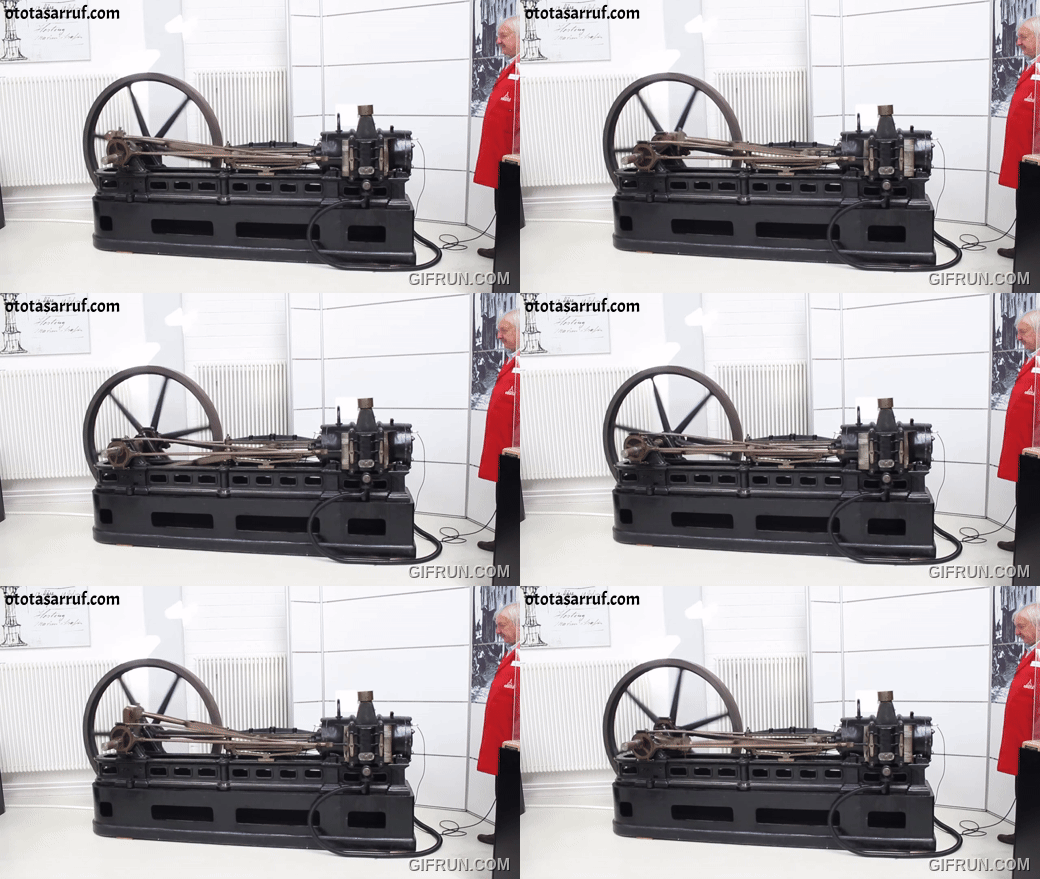
In 1860, Lenoir invented the first successful internal combustion engine. Unlike earlier external combustion engines, such as steam engines, his engine operated by igniting a gaseous fuel inside the cylinder. This design became an important precursor to modern internal combustion engines. Lenoir’s engine generated power by electrically igniting a mixture of air and gas. These engines were initially used in various applications, including electric lighting systems, pumping machines, and light industrial machinery.
The First Motorized Vehicle (1863)
In 1863, Lenoir integrated his internal combustion engine into a transportation vehicle, creating what is considered one of the earliest motorized vehicles in history. The vehicle was tested on the streets of Paris and was documented at the time. Although it was not fast, it represented an important step in the development of automobiles.
Gas Engines and Later Contributions
Lenoir’s gas-powered engine offered a smaller and potentially more efficient alternative to steam engines. However, because the design was not yet powerful and practical enough, it did not become widely adopted. Later, Nikolaus Otto was inspired by Lenoir’s design and developed the four-stroke internal combustion engine, helping establish the foundations of modern engine technology.
Challenges and Decline
Although Lenoir’s engine was smaller and more efficient than steam engines in certain respects, it was relatively inefficient and underpowered compared with modern internal combustion engines. Its design also had limitations in terms of durability and safety. Before motor vehicles became widely adopted, more efficient four-stroke engines were developed, and Lenoir’s engine gradually fell out of use.
His Later Years and Legacy
Despite his innovations in engine technology, Lenoir did not achieve major commercial success. However, his inventions inspired the further development of modern internal combustion engines. Nikolaus Otto and other engineers improved upon Lenoir’s engine and contributed to the technological foundations of the automotive industry.
Death: Étienne Lenoir died on August 4, 1900.
His Legacy
Although Lenoir’s inventions played an important role in the development of automobiles and motorized transportation, Nikolaus Otto and other engineers made some of the most significant later contributions to modern internal combustion engine technology. By developing one of the first successful gas-powered internal combustion engines, Lenoir became a critical milestone in the evolution of engine technology.