TR
TR EN
EN

What Is Mazda MDARS? Fault Diagnosis in Mazda Vehicles
Modern Mazda vehicles contain a large number of electronic control units that communicate with each other continuously. Engine management, transmission control, ABS, airbag systems, body electronics, steering, climate control, parking systems, and driver assistance features can all generate their own diagnostic information.
Because of this complexity, diagnosing a modern Mazda often requires more than a basic OBD-II scanner. This is where Mazda-specific diagnostic equipment and software such as MDARS become useful.
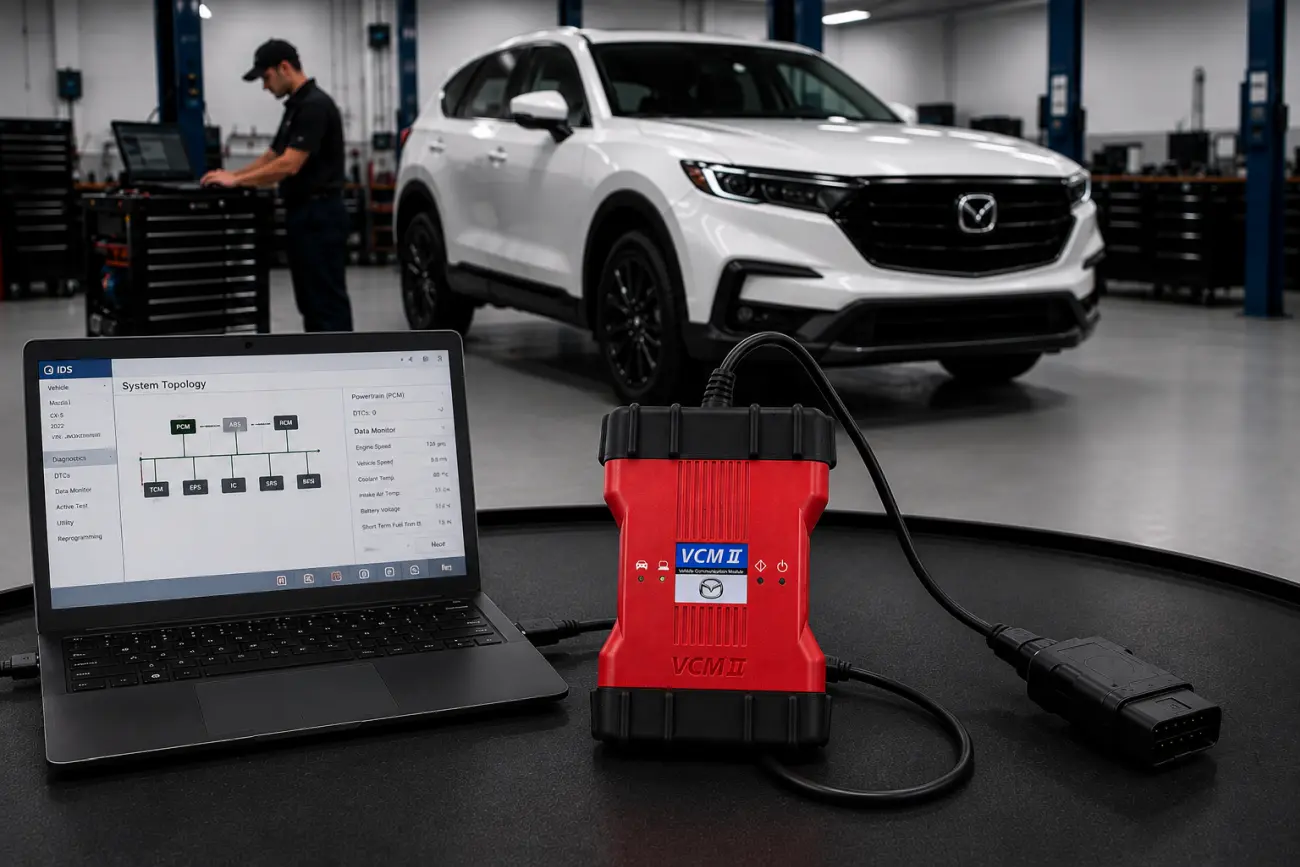
MDARS is a Mazda diagnostic system designed to communicate with the vehicle's electronic control units and assist technicians with fault-code reading, live-data analysis, system testing, and supported service procedures. Compared with a generic OBD-II scanner, a manufacturer-specific diagnostic system can provide access to a much broader range of vehicle systems and Mazda-specific functions.
What Is Mazda MDARS Used For?
The primary purpose of MDARS is to help technicians investigate electronic faults in Mazda vehicles.
A generic OBD-II scanner may be able to read many engine-related diagnostic trouble codes, but it may not provide the same level of access to other control modules. Depending on the vehicle and system, MDARS can communicate with different electronic modules throughout the vehicle.
These may include:
-
Engine control systems
-
Automatic transmission systems
-
ABS and DSC
-
SRS and airbag systems
-
Body control systems
-
Electric power steering
-
Climate control
-
Instrument cluster
-
Keyless entry and security systems
-
Parking assistance systems
-
Cameras and driver assistance systems
The exact functions available depend on the Mazda model, model year, engine, electronic architecture, and control unit being diagnosed.
Reading Fault Codes Is Only the Beginning
One of the most important functions of a professional diagnostic system is reading stored fault codes. However, an error code should not automatically be interpreted as proof that a particular component has failed.
For example, if a Mazda records a fault related to a sensor, the sensor itself may not necessarily be defective. The problem could also be caused by damaged wiring, a poor electrical connection, an incorrect supply voltage, corrosion in a connector, or an issue inside the relevant control unit.
A proper diagnostic process therefore starts with the fault code and then investigates the system responsible for generating it.
The technician may read the code, examine live data, perform an active test, inspect the wiring, measure electrical values, and compare the results with the manufacturer's specifications.
Live Data and Sensor Information
Live-data analysis is one of the most useful parts of electronic fault diagnosis.
When the engine is running, the diagnostic system can display information being reported by different sensors and control units. Depending on the vehicle and module, this can include engine speed, temperatures, throttle position, airflow information, fuel-related parameters, and other operating values.
Suppose a technician suspects a sensor problem. Instead of immediately replacing the sensor, the actual value reported by that sensor can be observed under different operating conditions.
If the value is clearly incorrect, further electrical testing can determine whether the sensor itself is responsible or whether the problem exists somewhere else in the circuit.
This approach can prevent unnecessary parts replacement.
Active Tests and Actuator Testing
Some faults cannot be properly diagnosed by looking at sensor data alone. The technician may also need to determine whether a particular actuator responds correctly to a command.
Where supported, diagnostic systems can perform active or actuator tests by sending commands to specific components and monitoring their response.
Depending on the system, these tests may involve components such as:
-
Relays
-
Cooling fans
-
Valves
-
Motors
-
Body electrical components
-
Other electronically controlled actuators
An active test can help determine whether the component responds to the command and whether the problem may be related to the actuator, wiring, power supply, or control system.
Access to Different Mazda Control Modules
A modern Mazda can contain many separate electronic control modules. Not every fault will originate in the engine ECU.
For example, the engine may operate normally while the ABS/DSC module stores a fault. Similarly, an airbag warning may be related to the SRS system rather than the engine control system.
This is one of the important differences between a basic engine-focused scan and manufacturer-level diagnostics.
MDARS can help technicians investigate the vehicle as an interconnected electronic system rather than simply looking at the check-engine light.
ECU Identification and Module Information
Diagnostic work can also involve identifying the control unit itself.
Depending on the vehicle and available functions, information such as the module identification, part information, software details, and communication status may be available through the diagnostic system.
This information becomes particularly useful when an ECU or another electronic module has been replaced.
Installing a replacement control unit does not necessarily mean that the vehicle is ready to operate normally. Depending on the system, configuration, initialization, programming, or learning procedures may also be required.
ECU Programming Is Different From Fault Diagnosis
ECU programming and fault diagnosis are two different processes.
Fault diagnosis involves investigating the condition of a vehicle and determining why a system has generated a fault.
ECU programming involves operations such as updating or reprogramming software in a supported control unit.
These functions should not be confused with ECU cloning either.
Copying data from one ECU to another, programming an ECU, configuring a replacement module, and carrying out a learning procedure are separate operations that can have different requirements.
For this reason, replacing an ECU should not be approached simply as a matter of installing another unit and copying software. The correct procedure depends on the vehicle, module, security system, and manufacturer-supported service process.
What Happens When an ECU Is Replaced?
A replacement control unit may need to be configured for the vehicle after installation.
Depending on the Mazda model and the specific module, the required procedure may involve:
-
Configuration
-
Coding
-
Initialization
-
Learning
-
Calibration
-
Security-related pairing
-
Software programming
Not every vehicle requires all of these operations, and the procedure can vary considerably between different generations of Mazda vehicles.
This is why the correct service procedure should be determined before replacing an expensive electronic module.
Diagnosing Mazda Transmission Problems
Electronic transmission systems can also require manufacturer-level diagnostic equipment.
When a transmission-related problem occurs, the technician may need to examine fault codes, operating temperatures, gear-position information, and other available parameters.
A transmission fault does not necessarily mean that the transmission itself has suffered a mechanical failure.
Electronic sensors, solenoids, wiring, connectors, control modules, and communication problems can also affect transmission operation.
A diagnostic code therefore needs to be interpreted together with the vehicle's symptoms and the results of electrical and mechanical testing.
ABS and DSC Diagnostics
ABS and DSC systems are important parts of a Mazda's electronic safety architecture.
A fault may be related to a wheel-speed sensor, steering-angle information, wiring, connectors, the ABS/DSC module, or another component within the system.
For example, if a wheel-speed sensor fault is stored, replacing the sensor immediately may not solve the problem. Damaged wiring or a poor connection can produce similar symptoms.
Live data and electrical measurements can help determine whether the sensor is actually producing the expected signal.
SRS and Airbag System Diagnosis
The SRS system also requires careful diagnostic procedures.
Airbags, seat-belt pretensioners, and the SRS control unit can generate diagnostic codes when a fault is detected. A Mazda-specific diagnostic system can help identify the affected circuit or component where supported.
However, SRS components involve safety-critical and pyrotechnic systems. Work on these components should be performed according to the appropriate safety procedures and with suitable technical knowledge and equipment.
Calibration and Learning Procedures
Some Mazda systems require a learning or calibration procedure after a component has been replaced or certain repairs have been performed.
Depending on the model, this can apply to sensors, steering-related systems, engine-management components, body electronics, or driver-assistance systems.
A new component may be physically installed correctly but still require initialization or calibration before the vehicle can operate as intended.
The exact procedure depends on the vehicle and the system involved.
Clearing a Fault Code Does Not Repair the Vehicle
Diagnostic systems can clear stored fault codes, but clearing a code should never be confused with repairing the underlying problem.
For example, if a sensor circuit has an open wire, the code may disappear temporarily after being cleared. Once the vehicle detects the same electrical problem again, the fault will normally return.
The correct approach is to identify and repair the cause of the fault first. The code can then be cleared and the vehicle tested to determine whether the problem has actually been resolved.
MDARS vs. a Generic OBD-II Scanner
OBD-II provides a standardized method for accessing important diagnostic information, particularly for emissions-related systems and engine management.
However, a modern Mazda contains considerably more electronic systems than those covered by basic OBD-II functions.
A manufacturer-specific diagnostic system can provide access to additional control modules and Mazda-specific diagnostic functions, depending on the vehicle.
For a simple check-engine fault, a generic OBD-II scanner may provide enough information to begin an investigation. For ABS, SRS, body electronics, special service functions, module configuration, or other manufacturer-specific operations, a more advanced diagnostic system may be necessary.
Does MDARS Automatically Find the Fault?
No diagnostic system can replace proper diagnostic reasoning.
Suppose MDARS reports a fault involving the throttle control circuit. This does not automatically mean that the throttle body needs to be replaced.
The technician may need to investigate:
-
The throttle body itself
-
Wiring and connectors
-
Power and ground circuits
-
Sensor signals
-
ECU outputs
-
Communication between modules
-
Related mechanical problems
The diagnostic software provides information and testing capabilities, but the final diagnosis depends on interpreting those results correctly.
Why Mazda-Specific Diagnostics Matter
As Mazda vehicles have become more electronically sophisticated, fault diagnosis has also become more complex.
A problem that appears to be a simple component failure can sometimes be caused by wiring, power supply, communication, software, configuration, or another control module.
MDARS can provide technicians with access to Mazda-specific diagnostic information and testing functions that may not be available through a basic OBD-II scanner.
However, the quality of the diagnosis still depends on how the information is interpreted. A fault code should be treated as a clue rather than an automatic instruction to replace a component.
For this reason, effective Mazda diagnostics combine manufacturer-level diagnostic software with live-data analysis, electrical measurements, mechanical inspection, and a systematic understanding of how the vehicle's systems operate.