TR
TR EN
EN

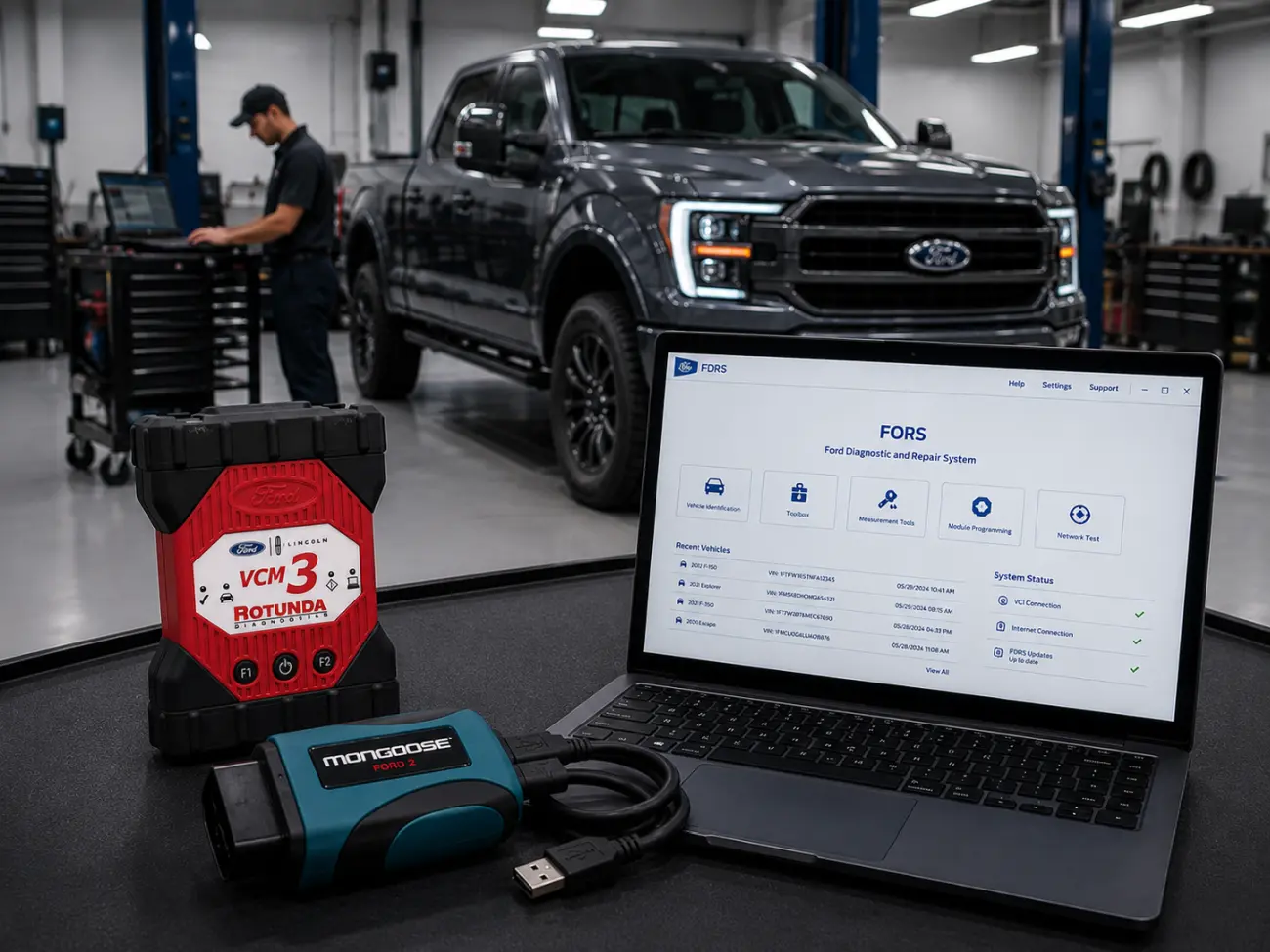
What Is Ford FDRS? Fault Diagnosis in Ford Vehicles
Modern Ford vehicles contain a complex network of electronic control units responsible for everything from engine management and transmission control to braking, airbags, body electronics, security, and driver-assistance systems.
As the number of electronic systems has increased, vehicle diagnostics have also become more sophisticated. A basic OBD-II scanner can be useful for reading standard diagnostic trouble codes, but it does not necessarily provide access to every electronic module or manufacturer-specific service function.
This is where Ford FDRS, short for Ford Diagnostic & Repair System, comes into play.
FDRS is a manufacturer-level diagnostic and repair system designed to communicate with supported Ford vehicle control modules. It can assist technicians with fault-code diagnosis, live-data analysis, system testing, module identification, programming, and various supported service procedures.
What Is Ford FDRS Used For?
FDRS is designed to provide deeper access to the electronic systems of supported Ford vehicles.
Depending on the vehicle and control module, technicians can use the system to investigate problems involving:
-
Engine management
-
Transmission control
-
ABS and electronic stability systems
-
SRS and airbag systems
-
Body electronics
-
Electric power steering
-
Climate control
-
Instrument and information systems
-
Security and immobilizer systems
-
Parking assistance
-
Cameras and driver-assistance systems
The exact functions available are not identical across every Ford model. Vehicle generation, model year, platform, installed modules, and software support can all affect what FDRS can access.
Reading Diagnostic Trouble Codes
One of the fundamental functions of FDRS is retrieving diagnostic trouble codes, or DTCs, from supported control modules.
When an electronic control unit detects an abnormal condition, it can store a fault code. The code provides an important clue about the system in which the problem has been detected.
However, a diagnostic trouble code should not automatically be interpreted as proof that a particular component has failed.
For example, a fault related to a sensor circuit could be caused by:
-
A defective sensor
-
Damaged wiring
-
A poor connector connection
-
Missing power supply
-
A poor ground
-
A communication problem
-
An ECU fault
-
A mechanical problem affecting the sensor reading
The code is therefore a starting point for diagnosis rather than an automatic parts-replacement instruction.
Using Live Data to Investigate Faults
Modern electronic diagnosis often requires more than reading stored codes. The technician may need to see what the system is actually doing while the vehicle is operating.
Where supported, FDRS can provide access to live data from various control modules.
Depending on the system, this may include information such as:
-
Engine speed
-
Engine temperature
-
Throttle position
-
Accelerator-pedal position
-
Airflow
-
Fuel-system parameters
-
Pressure values
-
Sensor signals
-
Other system-specific operating data
Live data is especially useful when a fault occurs only under certain conditions.
For example, a vehicle may operate normally at idle but develop a fault during acceleration or under high engine load. Monitoring the relevant parameters during the event can provide much more information than simply reading a stored fault code.
Active Tests and System Checks
Some problems cannot be diagnosed simply by monitoring sensor values. The technician may also need to determine whether an actuator responds correctly when commanded.
On supported systems, FDRS can provide active-test or system-control functions.
Depending on the vehicle, these tests may involve components such as:
-
Cooling fans
-
Relays
-
Solenoids
-
Valves
-
Electric motors
-
Body-control components
-
Other electronically controlled actuators
For example, if a cooling fan is suspected of malfunctioning, an active test can be used to command the fan and observe its response.
If the fan does not operate, further testing is still necessary. The technician may need to check the fuse, power supply, ground, wiring, relay, and fan motor.
The purpose of an active test is therefore to narrow down the possible causes rather than automatically identify a failed part.
Which Ford Vehicles Use FDRS?
FDRS is associated with newer generations of Ford electronic systems, but it should not be assumed that every Ford model and every model year uses exactly the same diagnostic platform.
Ford has used different diagnostic systems over time, including IDS for various earlier vehicle applications. The appropriate diagnostic software depends on the vehicle generation and the functions that need to be performed.
For this reason, identifying the correct diagnostic platform requires more than simply knowing the vehicle brand. The model, model year, vehicle platform, control modules, and required service procedure all matter.
Diagnosing Ford Control Modules
Modern Ford vehicles can contain numerous electronic control modules that communicate through the vehicle's network.
FDRS can help technicians identify supported modules and investigate their diagnostic information.
Depending on the system, information such as module identification, software information, communication status, and stored faults may be available.
This can be particularly useful when diagnosing communication problems.
If a control module cannot communicate with the diagnostic system, that does not automatically mean the module itself has failed.
The technician may also need to investigate:
-
Battery voltage
-
Fuses
-
Power supply
-
Ground connections
-
Wiring
-
CAN communication lines
-
Connectors
-
Other network modules
Electrical testing remains essential even when advanced diagnostic software is available.
ECU Programming and Software Updates
FDRS can also be involved in supported programming and software-related service procedures.
However, ECU programming should not be confused with fault diagnosis.
Fault diagnosis is the process of identifying why a system is not operating correctly.
ECU programming involves writing or updating software in a supported control module.
There are also important differences between programming, coding, configuration, adaptation, calibration, and ECU cloning.
These terms describe different procedures and should not be treated as interchangeable.
ECU Replacement and Configuration
Replacing an electronic control module in a Ford vehicle may require additional procedures after the physical installation.
Depending on the vehicle and module, the replacement may require:
-
Programming
-
Configuration
-
Coding
-
Initialization
-
Learning
-
Calibration
-
Security-related procedures
The exact process depends on the vehicle architecture and the specific module.
This is particularly important for control units that interact with immobilizer or vehicle security systems.
Installing a replacement ECU does not necessarily mean that the vehicle will immediately recognize and operate with the new module.
Ford Immobilizer and Security Systems
Vehicle security is another area where manufacturer-level diagnostics can be important.
Problems involving immobilizer communication, key recognition, or security-related control modules can involve more than the engine ECU.
Depending on the vehicle, several modules may participate in the authorization process.
A proper diagnostic procedure should therefore determine which module has recorded the fault and whether the problem is caused by the module itself, wiring, communication, configuration, or the security system.
Certain security-related procedures may also require specific authorization or manufacturer-supported service processes.
Diagnosing Automatic Transmission Problems
Modern Ford automatic transmissions use electronic control systems that monitor numerous operating parameters.
When a vehicle develops harsh shifting, delayed engagement, incorrect gear selection, or a transmission warning, electronic diagnosis can provide useful information before mechanical repairs are considered.
FDRS can help access supported transmission-control information, including fault codes and available operating parameters.
A transmission-related fault does not automatically mean that the transmission has a mechanical failure.
Possible causes can include:
-
Sensors
-
Solenoids
-
Wiring
-
Electrical connections
-
Control modules
-
Power supply
-
Software
-
Mechanical components
Electronic and mechanical diagnosis should therefore be considered together.
ABS and Electronic Stability Control
Ford vehicles use multiple sensors and electronic control systems to manage ABS and stability functions.
Wheel-speed sensors, steering-angle information, and other vehicle-motion signals can be monitored by the relevant control modules.
If a wheel-speed sensor fault is recorded, replacing the sensor immediately may not solve the problem.
The technician may also need to inspect the sensor wiring, connector, power supply, signal quality, and related components.
Live-data comparison can sometimes help identify a wheel-speed signal that differs from the other wheels.
SRS and Airbag Diagnosis
The SRS system contains its own electronic control and monitoring functions.
When a problem is detected in an airbag, seat-belt pretensioner, wiring circuit, or related component, the system can store a diagnostic fault and illuminate the appropriate warning indicator.
FDRS or the appropriate Ford diagnostic infrastructure can help identify supported SRS faults and provide additional diagnostic information.
However, airbag and pyrotechnic restraint components require special safety procedures. Repairs should be carried out using appropriate equipment and following the manufacturer's procedures.
Driver-Assistance and Camera Systems
Newer Ford vehicles increasingly use cameras, radar, and other sensors for driver-assistance functions.
Depending on the vehicle, these systems can support functions such as:
-
Lane-related assistance
-
Collision warnings
-
Adaptive cruise control
-
Parking assistance
-
Other driver-assistance features
A fault in one of these systems does not necessarily mean that the sensor itself is defective.
Physical alignment, wiring, communication, software, calibration, and environmental conditions can also affect system operation.
After certain repairs or component replacements, a calibration procedure may be required.
Electrical Diagnosis Still Matters
Advanced diagnostic software does not eliminate the need for basic electrical testing.
For example, FDRS may show that a control module is not communicating. Before replacing the module, a technician should determine whether the module has the correct power and ground connections and whether communication lines are functioning correctly.
This may require checking:
-
Battery voltage
-
Fuse condition
-
Power supply
-
Ground circuits
-
Connector condition
-
Wiring continuity
-
CAN communication
-
Voltage and signal levels
A diagnostic scanner and electrical test equipment therefore serve different purposes and are often used together.
Clearing Codes Does Not Repair the Problem
FDRS can be used to clear stored diagnostic trouble codes where supported, but deleting a code does not repair the underlying fault.
If a wire is broken, clearing the code does not repair the wire. If the problem remains, the control module may detect the same condition again during a subsequent drive cycle.
A proper repair process should therefore involve:
Reading the code → investigating the affected system → performing the necessary tests → repairing the cause → clearing the code → testing the vehicle again.
The vehicle should then be monitored to determine whether the fault returns.
FDRS vs. a Generic OBD-II Scanner
Generic OBD-II scanners provide access to standardized diagnostic information, particularly for engine and emissions-related systems.
However, a modern Ford vehicle can contain many more electronic systems than those covered by basic OBD-II functions.
ABS, SRS, transmission, body electronics, security systems, steering, parking systems, and driver-assistance features can all require additional manufacturer-specific diagnostic capabilities.
FDRS is designed to provide broader access to supported Ford systems and manufacturer-specific service functions.
A generic scanner can therefore be useful for basic diagnostics, while FDRS can provide a much more comprehensive view of supported Ford electronic systems.
Why Battery Voltage Matters During Programming
Stable electrical power is particularly important when programming or updating an ECU.
If vehicle voltage drops significantly during a programming operation, communication with the control module can be interrupted. In some situations, this can prevent the procedure from completing correctly.
For this reason, appropriate battery-support equipment may be required during sensitive programming procedures.
Battery condition is also worth considering during normal diagnosis because low system voltage can produce misleading or multiple electronic faults.
Does FDRS Automatically Find the Fault?
FDRS is an advanced diagnostic system, but it does not eliminate the need for technical diagnosis.
For example, if FDRS reports a throttle-control fault, the technician may still need to inspect the throttle body, wiring, connectors, power supply, ground circuits, sensor signals, ECU outputs, and possible mechanical causes.
The same diagnostic code can sometimes be produced by different underlying problems.
The diagnostic software provides valuable information and testing capabilities, but the technician must interpret the results and determine the actual cause.
Why FDRS Is Important for Ford Diagnostics
As Ford vehicles have become increasingly dependent on electronic control systems, vehicle diagnosis has become more complex as well.
FDRS provides a manufacturer-specific diagnostic environment for supported Ford vehicles, allowing technicians to access control modules, read diagnostic information, monitor live data, perform supported active tests, and carry out various service and programming procedures.
Its usefulness depends not simply on reading a fault code, but on correctly interpreting the information provided by the vehicle.
A diagnostic code should be treated as a clue rather than an automatic instruction to replace a component. Wiring, connectors, power supplies, communication networks, software, mechanical components, and other control modules may all need to be considered.
For this reason, accurate Ford diagnosis combines FDRS with electrical measurements, live-data analysis, physical inspection, and a systematic understanding of how the vehicle's systems work together.