TR
TR EN
EN

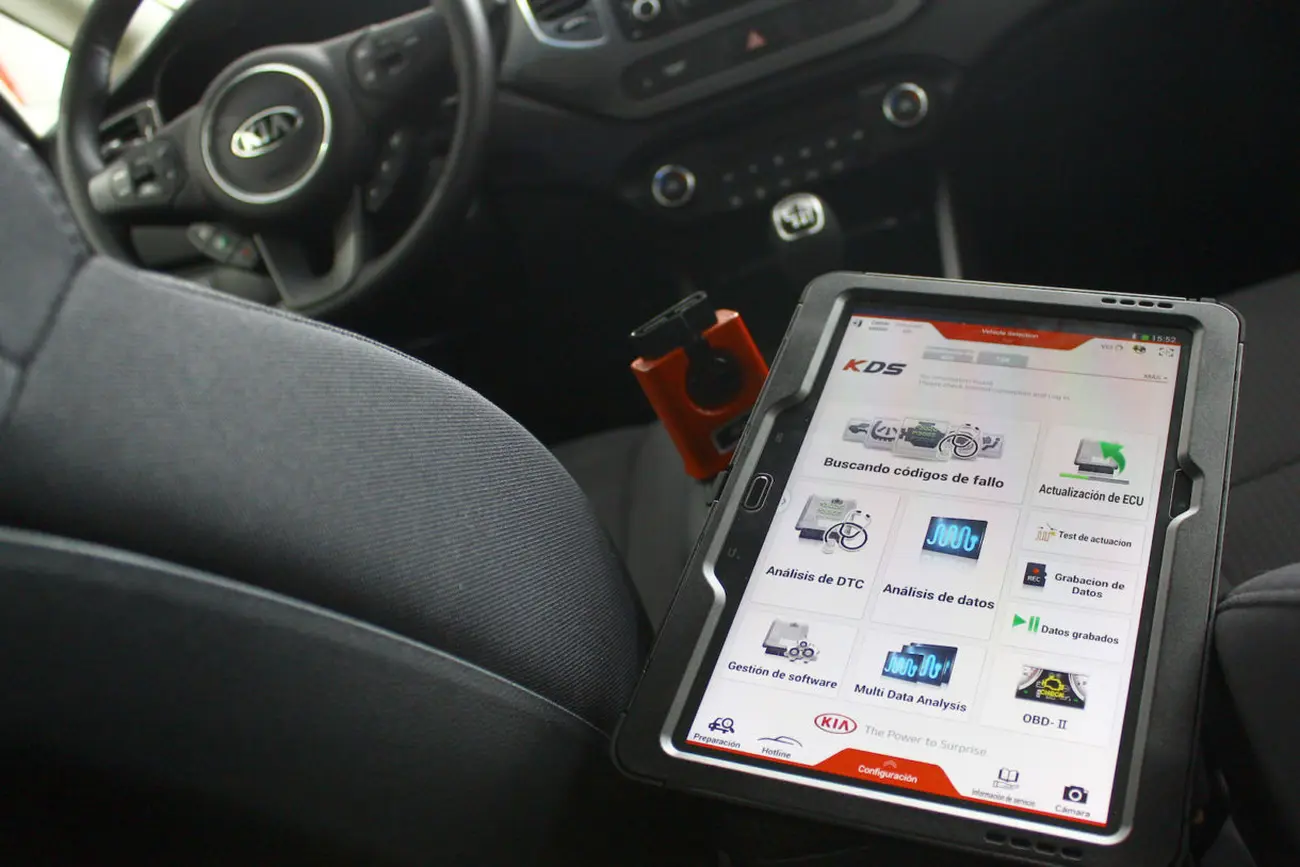
What Is Kia KDS? Fault Diagnosis in Kia Vehicles
Modern Kia vehicles contain a large number of electronic control units that communicate with each other continuously. Engine management, transmission control, ABS, airbag systems, body electronics, driver assistance systems, and many other functions depend on these control modules.
For basic engine fault codes, a standard OBD-II scanner may be sufficient. However, when a more detailed diagnosis is required, Kia-specific diagnostic equipment can provide access to information and functions that generic scanners may not support.
Kia KDS is a manufacturer-specific diagnostic platform designed to help technicians diagnose faults, monitor vehicle systems, perform supported tests, and carry out certain service and programming procedures on Kia vehicles.
What Is Kia KDS?
Kia KDS, generally associated with the Kia Diagnostic System, is a professional diagnostic platform developed for Kia vehicles.
Unlike a basic OBD-II scanner, KDS can communicate with a much wider range of electronic control modules. Depending on the vehicle and software version, it can provide access to engine, transmission, ABS/ESC, SRS, body control, climate control, steering, parking, and driver assistance systems.
Its purpose is not simply to read a fault code. KDS can also provide live data, perform supported actuator tests, identify control modules, and assist with certain service procedures.
The exact functions available depend on the Kia model, model year, control module, and KDS software version.
What Can Kia KDS Do?
One of the main advantages of KDS is that diagnosis does not have to stop after reading a fault code.
A technician can use information from different control modules to investigate how a system is operating and determine where further testing is necessary.
Reading and clearing fault codes
KDS can retrieve diagnostic trouble codes from supported control units.
Depending on the vehicle, this may include the engine ECU, transmission control module, ABS/ESC system, SRS system, body electronics, and other modules.
However, a fault code should not automatically be interpreted as proof that the component mentioned in the code has failed.
For example, a sensor-related code could be caused by the sensor itself, its wiring, connector, power supply, ground connection, or even a problem inside the control circuit.
Monitoring live data
KDS can display live information from vehicle control modules.
Depending on the system, technicians may be able to monitor parameters such as engine speed, throttle position, accelerator pedal position, coolant temperature, fuel-system data, sensor values, pressure readings, and other operating parameters.
Live data becomes particularly useful when a fault only appears under specific conditions.
A vehicle may operate normally at idle but develop a problem under heavy acceleration or at higher engine speeds. Monitoring live data while reproducing the fault can provide valuable information about what changes when the problem occurs.
Active Tests and Component Checks
Another important function of manufacturer-level diagnostic equipment is the ability to perform active tests on supported systems.
During an active test, the diagnostic system can command a particular actuator or component to operate. The technician can then observe whether the control unit is sending the expected command and whether the component responds correctly.
Depending on the Kia model and system, active tests may be available for components such as:
-
Cooling fans
-
Solenoids
-
Relays
-
Throttle-related components
-
Fuel-system components
-
Air-conditioning components
-
Electronic valves
-
Certain body-control functions
The available tests are not identical for every Kia vehicle.
Which Systems Can Kia KDS Diagnose?
Modern Kia vehicles can contain numerous electronic control units, which makes manufacturer-level diagnostics particularly useful.
Engine management
The engine ECU can be examined for faults involving sensors, actuators, fuel delivery, ignition, air management, emissions systems, and other engine-control functions.
A combination of fault codes and live data can help determine whether a problem is likely to be electrical, electronic, or potentially mechanical.
Automatic transmissions and DCT systems
Kia uses different types of electronically controlled transmissions, including conventional automatic transmissions and dual-clutch transmissions on various models.
KDS can provide access to transmission-related fault codes, operating parameters, and supported adaptation or service functions.
If a vehicle has harsh shifts, delayed engagement, clutch-related problems, or transmission communication faults, checking only the engine ECU may not provide enough information. The transmission control system should also be examined.
ABS and ESC
ABS and electronic stability control systems are critical safety systems.
KDS can be used to identify faults stored in the ABS/ESC control unit and, where supported, monitor sensor values and perform certain diagnostic tests.
Wheel-speed sensor information can be particularly useful when diagnosing ABS or stability-control problems.
SRS and airbag systems
Airbag and seat-belt systems have their own control units and sensors.
A generic OBD-II scanner may provide limited or no access to these systems. Manufacturer-level diagnostic equipment can provide more detailed information from the SRS control system, including stored fault codes and supported diagnostic data.
Because SRS components are safety-critical, diagnosis and repair should be performed according to the appropriate service procedures.
Body electronics
Body control systems can be responsible for functions such as lighting, central locking, power windows, wipers, keyless entry, and various electrical features.
When an electrical problem affects one of these systems, accessing the relevant control module can help narrow down the source of the problem.
ADAS, cameras, and radar systems
Newer Kia vehicles can be equipped with advanced driver assistance systems such as lane-keeping assistance, forward collision warning, adaptive cruise control, blind-spot monitoring, and parking assistance.
These systems may use cameras, radar sensors, ultrasonic sensors, and other components.
After replacing certain cameras or sensors, a calibration or initialization procedure may also be required. Whether such procedures are available through KDS depends on the vehicle and system.
Can Kia KDS Program an ECU?
Depending on the vehicle, control unit, and available service functions, KDS can support certain software updates, programming operations, or related service procedures.
However, ECU programming, coding, adaptation, calibration, and ECU cloning are not the same thing.
ECU programming generally involves writing or updating software or calibration data in a control module.
Coding or configuration involves setting specific vehicle-related parameters within a control unit.
Adaptation and learning procedures allow a control module to learn specific operating characteristics or component positions.
ECU cloning, on the other hand, involves transferring certain data from one control unit to another. This is different from carrying out a normal software update.
Therefore, having KDS does not automatically mean that every ECU can be programmed, coded, or cloned in every Kia vehicle.
Why Is KDS Important When Replacing an ECU?
Replacing an electronic control unit is not always as simple as removing the old module and installing another one.
Depending on the system, the replacement module may need to be configured, initialized, learned, or paired with the vehicle.
Security-related systems such as immobilizers can require additional procedures before the vehicle can operate normally.
Using an incorrect control unit or skipping a required configuration procedure can lead to communication problems or prevent certain vehicle functions from operating correctly.
This is one of the areas where manufacturer-level diagnostic equipment can be particularly useful.
Does KDS Identify the Failed Part Automatically?
No.
A diagnostic system can provide extremely valuable information, but it does not eliminate the need for proper diagnosis.
For example, if KDS reports a fault related to a sensor, the sensor itself may still be working correctly.
The actual problem could be:
-
A broken wire
-
A short circuit
-
A damaged connector
-
Corrosion inside a connector
-
Incorrect supply voltage
-
A poor ground connection
-
A missing reference voltage
-
Another component affecting the circuit
-
A problem in the control module
For this reason, replacing the component named in a fault code without performing additional checks can result in unnecessary repairs.
For example, if a Kia develops a throttle actuator circuit fault, the throttle body should not automatically be replaced. The throttle motor, wiring, connectors, power supply, ground, accelerator pedal signals, and ECU control circuit may all need to be checked.
Kia KDS vs. a Generic OBD-II Scanner
A standard OBD-II scanner is designed around a common diagnostic standard and can be very useful for basic engine and emissions-related diagnostics.
It can typically read generic diagnostic trouble codes and display a selection of standard live data.
KDS takes a different approach because it is designed specifically around Kia vehicles and their electronic systems.
It can provide access to manufacturer-specific control modules, diagnostic information, active tests, and supported service procedures that may not be available through a basic generic scanner.
In simple terms, OBD-II provides a standardized diagnostic interface, while KDS is designed to provide a deeper level of Kia-specific diagnostics.
Why Is Battery Voltage Important During KDS Procedures?
Stable electrical power is particularly important when performing software-related procedures.
If battery voltage drops significantly during programming or communication with a control unit, the operation may be interrupted. In some situations, this can create additional problems with the control module.
For this reason, professional workshops may use a suitable battery support unit or power supply during programming and other procedures that require stable voltage.
The condition of the vehicle's battery should also be considered before starting lengthy diagnostic or programming operations.
Does Kia KDS Work the Same Way on Every Kia?
No.
The available functions can vary according to the vehicle model, production year, engine, transmission, electronic architecture, control module, and KDS software version.
A newer Kia with advanced driver assistance, hybrid, or electric systems may have considerably different diagnostic requirements from an older conventional model.
Some procedures may also require online access, authorization, or communication with manufacturer systems.
Therefore, the presence of KDS does not mean that every function is available on every Kia vehicle.
Why Is Kia KDS Useful for Fault Diagnosis?
As vehicles become more dependent on electronic control systems, modern fault diagnosis requires more than simply reading a trouble code and replacing a component.
Kia KDS provides technicians with deeper access to Kia's electronic systems, allowing them to examine control modules, monitor live data, perform supported active tests, and carry out certain service procedures.
Nevertheless, even a manufacturer-level diagnostic system cannot replace proper technical diagnosis.
A fault code usually tells the technician that a particular system or circuit has detected an abnormal condition. Determining the actual cause may require voltage measurements, resistance checks, continuity testing, wiring inspections, connector checks, and mechanical tests.
For that reason, Kia KDS should be viewed not simply as a fault-code reader, but as a comprehensive manufacturer-specific diagnostic platform that helps technicians understand how the vehicle's electronic systems are operating and where further investigation is required.