TR
TR EN
EN

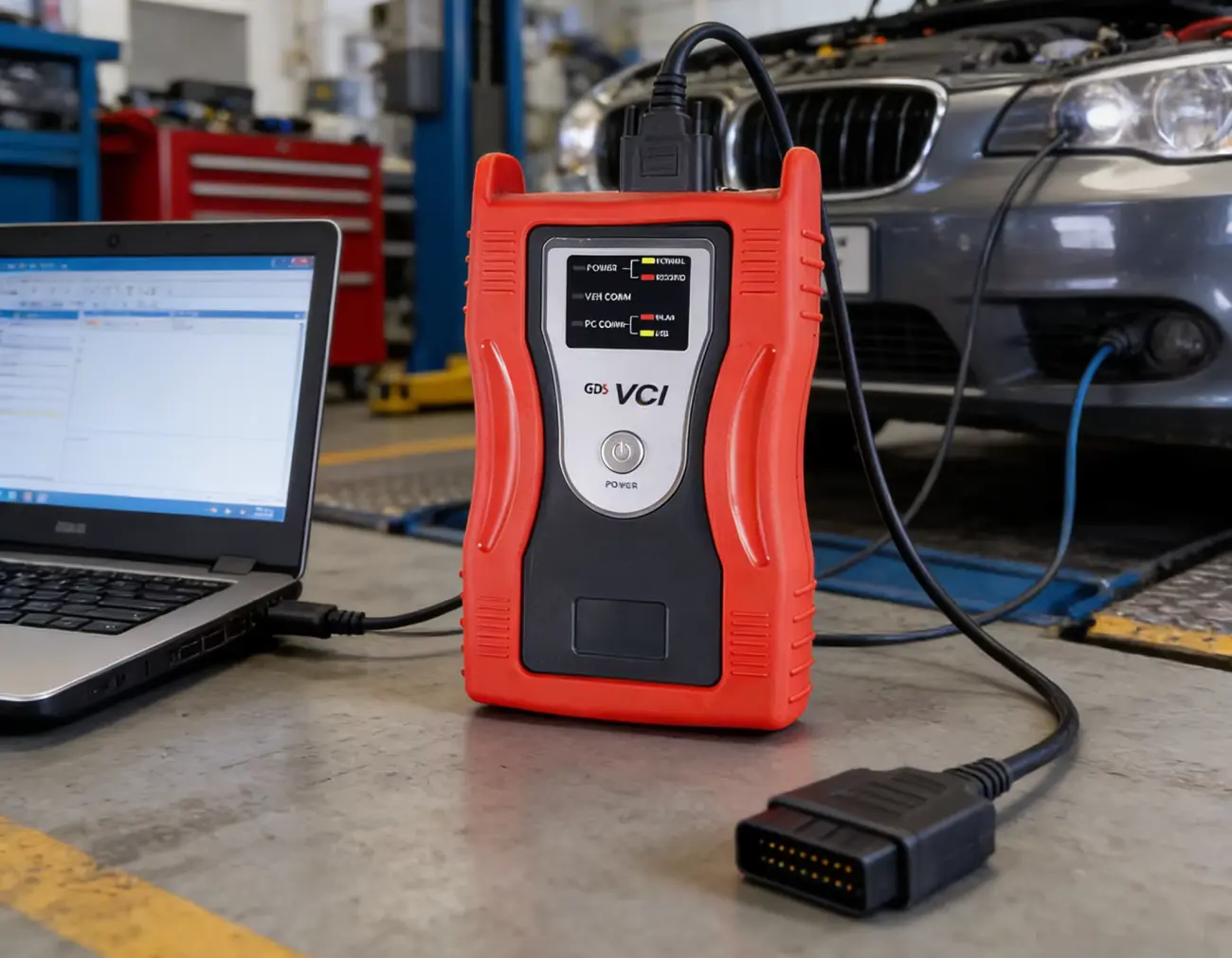
What Is Hyundai GDS? Fault Diagnosis in Hyundai Vehicles
Modern Hyundai vehicles rely on a large number of electronic control units to manage everything from engine operation and transmission control to braking, airbags, body electronics, and advanced driver assistance systems.
Because these systems constantly exchange information, diagnosing a fault often requires more than simply reading the engine's OBD-II trouble codes. A problem involving a sensor, for example, could actually be caused by wiring, a connector, power supply, grounding, or the control module itself.
This is where manufacturer-specific diagnostic equipment becomes important.
Hyundai GDS is a manufacturer-level diagnostic system associated with Hyundai vehicles. It provides technicians with access to a wider range of vehicle control modules and diagnostic functions than a basic generic OBD-II scanner.
What Is Hyundai GDS?
GDS stands for Global Diagnostic System and refers to Hyundai's manufacturer-level diagnostic platform and related diagnostic systems.
Unlike a basic OBD-II scanner, GDS is designed around Hyundai's vehicle electronics and can provide access to a broader range of control units and manufacturer-specific functions.
Depending on the vehicle, model year, control module, and software version, GDS may be used to read and clear diagnostic trouble codes, monitor live data, perform supported active tests, identify control units, and carry out certain service procedures.
The exact capabilities are not identical across all Hyundai vehicles. Older and newer models can use different diagnostic infrastructures and may support different functions.
What Does Hyundai GDS Do?
The primary purpose of GDS is to provide more detailed access to the electronic systems of Hyundai vehicles.
A generic OBD-II scanner can be useful for reading standard engine and emissions-related trouble codes. GDS goes further by communicating with various vehicle control modules and providing manufacturer-specific diagnostic information.
Depending on the vehicle, technicians may use it for:
-
Reading diagnostic trouble codes
-
Clearing stored fault codes
-
Monitoring live data
-
Viewing control-unit information
-
Performing active tests
-
Carrying out supported learning and adaptation procedures
-
Performing certain service functions
-
Assisting with supported software updates and programming procedures
Not every function is available on every Hyundai model.
Which Systems Can Hyundai GDS Diagnose?
Hyundai vehicles can contain many electronic control modules, making manufacturer-level diagnostics particularly useful.
Engine control
The engine ECU manages fuel injection, ignition, air management, emissions systems, and numerous sensors and actuators.
GDS can provide access to stored engine fault codes and, depending on the vehicle, live operating parameters.
Values such as engine speed, throttle position, accelerator pedal position, coolant temperature, sensor signals, and fuel-system parameters can be monitored.
This information can be particularly useful when a fault only appears under certain driving conditions.
Transmission control
Hyundai uses several types of electronically controlled transmissions, including conventional automatic transmissions, DCT systems, and IVT/CVT-type systems on different models.
A transmission problem may cause harsh shifting, delayed engagement, clutch-related symptoms, or a protective operating mode.
By accessing the transmission control system, GDS can help technicians examine stored fault codes, operating parameters, and supported service or adaptation functions.
Checking only the engine ECU is not always enough when diagnosing a transmission-related problem.
ABS and ESC
Anti-lock braking and electronic stability control systems are important safety systems.
The ABS/ESC system can use wheel-speed sensors, steering-angle information, pressure sensors, and other inputs to determine how the vehicle is behaving.
When an ABS or ESC warning appears, GDS can help identify stored faults and, on supported vehicles, provide access to relevant live data and diagnostic tests.
A wheel-speed sensor fault, for example, may require inspection of the sensor itself as well as the wiring, connector, power supply, and ABS control module.
SRS and airbag system
Airbag and seat-belt systems have dedicated electronic control units and sensors.
Generic OBD-II equipment may have limited access to these systems, while manufacturer-level diagnostic equipment can provide more detailed information.
GDS can be used on supported Hyundai vehicles to access the SRS control system, retrieve diagnostic information, and assist with the appropriate service procedures.
Because SRS components are safety-critical, diagnosis and repair should follow the correct service procedures.
Why Is Live Data Important?
Reading a fault code is often only the first step in the diagnostic process.
Live data allows a technician to see what the control module is actually receiving from sensors and what commands or operating values are being reported while the vehicle is running.
For example, if an electronic throttle problem is suspected, the technician may compare accelerator pedal position with throttle position.
If the accelerator pedal signal changes correctly but the throttle position does not respond as expected, additional testing can be performed on the throttle body, wiring, power supply, and control circuit.
Live data is especially useful for intermittent problems.
A vehicle may operate normally while stationary in a workshop but develop a fault during acceleration, at high engine speed, or under a particular load. Monitoring the relevant parameters while reproducing the problem can provide much more useful information than simply scanning the vehicle after the event.
What Are Active Tests?
An active test allows a technician to command a supported component or actuator through the diagnostic system.
Instead of waiting for the vehicle to activate a component automatically, the diagnostic system can request a specific operation and allow the technician to observe the response.
Depending on the Hyundai model and system, active tests may be available for components such as:
-
Cooling fans
-
Solenoids
-
Relays
-
Throttle-related components
-
Fuel-system components
-
Electronic valves
-
Air-conditioning components
-
Certain body-control functions
The purpose is to determine whether the control unit can command the component and whether the component responds as expected.
An active test result should still be interpreted together with electrical measurements and physical inspection.
Can Hyundai GDS Program an ECU?
Supported Hyundai vehicles and control units may allow certain software update or programming procedures through the applicable diagnostic infrastructure.
However, ECU programming should not be confused with coding, adaptation, calibration, or cloning.
ECU programming generally involves updating or writing software or calibration data to a control module.
Coding or configuration involves setting vehicle-specific parameters or equipment configurations.
Adaptation or learning allows a control unit to learn specific operating values or component characteristics.
Calibration may be required for certain sensors or driver assistance systems.
ECU cloning involves transferring certain data from one control unit to another and is fundamentally different from a normal software update.
Therefore, having Hyundai GDS does not mean that every ECU can automatically be programmed or cloned.
Why Is GDS Important When Replacing an ECU?
Replacing an electronic control unit can involve more than physically installing a new module.
Depending on the system, the replacement unit may need to be configured, initialized, learned, or paired with the vehicle.
Security-related systems such as immobilizers can require additional procedures before the vehicle operates correctly.
If an incompatible control unit is installed or a required configuration procedure is skipped, communication faults or other electronic problems may occur.
This makes manufacturer-level diagnostic equipment particularly useful after certain control-unit replacements.
Does Hyundai GDS Automatically Identify the Failed Part?
No.
Even a manufacturer-level diagnostic system does not necessarily identify the physically failed component by itself.
For example, if GDS reports a fault involving a particular sensor, the sensor itself may not be defective.
Other possible causes include:
-
Broken wiring
-
Short circuits
-
Loose connectors
-
Corrosion inside a connector
-
Incorrect supply voltage
-
Poor grounding
-
Missing reference voltage
-
Another component affecting the same circuit
-
A problem inside the control module
This is why replacing the component named in a trouble code without additional testing can lead to unnecessary repairs.
For example, if a Hyundai records an electronic throttle circuit fault, the throttle body should not automatically be replaced. The throttle motor, connector, wiring, power supply, ground, accelerator pedal signals, and ECU control circuit may all need to be checked.
Hyundai GDS vs. Generic OBD-II Scanners
OBD-II is a standardized diagnostic system designed to provide a common interface for vehicle diagnostics. It is particularly useful for checking generic engine and emissions-related trouble codes.
A basic OBD-II scanner can usually retrieve standard diagnostic codes and display selected live data.
Hyundai GDS is different because it is designed around Hyundai's own electronic systems.
Depending on the vehicle, GDS can provide access to additional control modules, manufacturer-specific trouble codes, live data, active tests, and supported service functions that may not be available through a generic scanner.
In simple terms, OBD-II provides a standardized diagnostic framework, while GDS provides a more vehicle-specific diagnostic environment for Hyundai.
Can Hyundai GDS Diagnose ADAS Systems?
Modern Hyundai vehicles can be equipped with numerous advanced driver assistance systems.
These may include:
-
Forward collision warning
-
Forward collision avoidance
-
Lane keeping assistance
-
Lane following assistance
-
Blind-spot monitoring
-
Adaptive cruise control
-
Parking assistance
-
Camera-based systems
-
Radar-based systems
These technologies can use cameras, radar sensors, ultrasonic sensors, and dedicated control modules.
When a camera or sensor is replaced, simply installing the new component may not be enough. Depending on the vehicle and system, initialization, learning, or calibration may be required.
The applicable Hyundai diagnostic and service system can assist with supported procedures.
ADAS work is particularly sensitive to equipment, vehicle alignment, sensor positioning, and the correct calibration procedure.
Hyundai GDS on Hybrid and Electric Vehicles
Hybrid and electric Hyundai vehicles introduce additional high-voltage electronic systems that are not found in conventional gasoline-powered vehicles.
These vehicles may contain systems such as:
-
High-voltage battery management
-
Inverters
-
Electric motors
-
On-board charging systems
-
Battery control modules
-
Power electronics
-
High-voltage safety systems
Manufacturer-level diagnostic equipment can provide access to relevant electronic systems on supported vehicles.
However, diagnosing an electronic fault and physically working on a high-voltage system are two different things.
High-voltage components require appropriate training, safety equipment, isolation procedures, and manufacturer-specific repair methods. A diagnostic scan alone does not make physical intervention on a high-voltage system safe.
Why Is Stable Battery Voltage Important?
Stable voltage is particularly important when performing software updates or programming procedures.
If battery voltage drops significantly during a programming operation, communication with the control unit can be interrupted. In some cases, an incomplete programming operation can create additional problems.
For this reason, professional workshops may use an appropriate battery support unit or power supply during programming and other procedures that require stable voltage.
The condition of the vehicle's battery should also be considered before beginning a lengthy diagnostic or programming procedure.
Is Hyundai GDS the Same for Every Hyundai Model?
No.
The available diagnostic functions can vary depending on the vehicle model, production year, engine, transmission, electronic architecture, and control module.
A conventional gasoline-powered Hyundai may have very different diagnostic requirements from a newer hybrid or electric model.
Advanced driver assistance systems can also introduce additional cameras, radar sensors, and control modules that require different diagnostic procedures.
Some software or service operations may also require online access or manufacturer authorization.
Therefore, when determining whether a particular operation can be performed, the exact vehicle and control module must be considered rather than assuming that every GDS function applies to every Hyundai.
Why Is Hyundai GDS Important for Professional Diagnosis?
Modern Hyundai vehicles contain increasingly complex electronic systems, so effective diagnosis requires more than reading a fault code and replacing the component mentioned by the scanner.
Hyundai GDS can give technicians deeper access to vehicle control modules, live operating data, supported active tests, and manufacturer-specific service functions.
Nevertheless, diagnostic software is only one part of the repair process.
A fault code usually indicates that a control system has detected an abnormal condition. Finding the actual cause may require voltage and resistance measurements, continuity testing, wiring inspection, connector checks, and mechanical testing.
For this reason, Hyundai GDS should not be considered simply a fault-code reader. It is better understood as a manufacturer-level diagnostic platform that helps technicians investigate Hyundai's electronic systems in greater detail and determine which areas require further testing.